

NEWS
Brett Mitchell's complete blog archive from Houston Symphony UK
Brett Mitchell was one of six official bloggers for the Houston Symphony's recent tour of the United Kingdom. Mr. Mitchell's three entries are archived below:
- Coming home ... sort of (October 6)
- Whirlwind days and musical nights (October 12)
- Preparing the choruses (October 15)
Preview: Brett Mitchell aims "to make the SBSO a truly 21st-century orchestra"
On the eve of his inaugural concert as Music Director of the Saginaw Bay Symphony Orchestra, , Brett Mitchell sits down with 360 Main Street's Jeanne Lesinski to discuss the orchestra's 2010-11 season, and his plans for the organization's future. To read this story, please click here.
Preview: A salute to Mexico's independence
"Inside the Houston Symphony" has published a blog entry previewing their upcoming performance saluting Mexico's independence, led by assistant conductor Brett Mitchell. To read this preview, please click here.
Cover Story: Brett Mitchell takes over at the Saginaw Bay Symphony
On the eve of his inaugural concert as Music Director of the Saginaw Bay Symphony Orchestra, , Brett Mitchell sits down with Bob Martin of "The Review" to discuss the orchestra's first season under his leadership and his plans for the organization's future. To read this story, please click here.
Preview: "Houston Symphony hosts its first 'Tweetcert'"
The Houston Chronicle has published a preview of the Houston Symphony's upcoming "Tweetcert." This concert will feature an interactive experience encouraging audience members to enjoy "live program notes" from conductor Brett Mitchell via Twitter throughout the evening. To read this article, please click here.
Preview: "Symphony Summer Series is like a day in the park"
Brett Mitchell is featured in a preview the Houston Chronicle has published about the Houston Symphony's upcoming summer concert series, including his concert with the orchestra this Thursday evening at Miller Outdoor Theatre. To read this article, please click here.
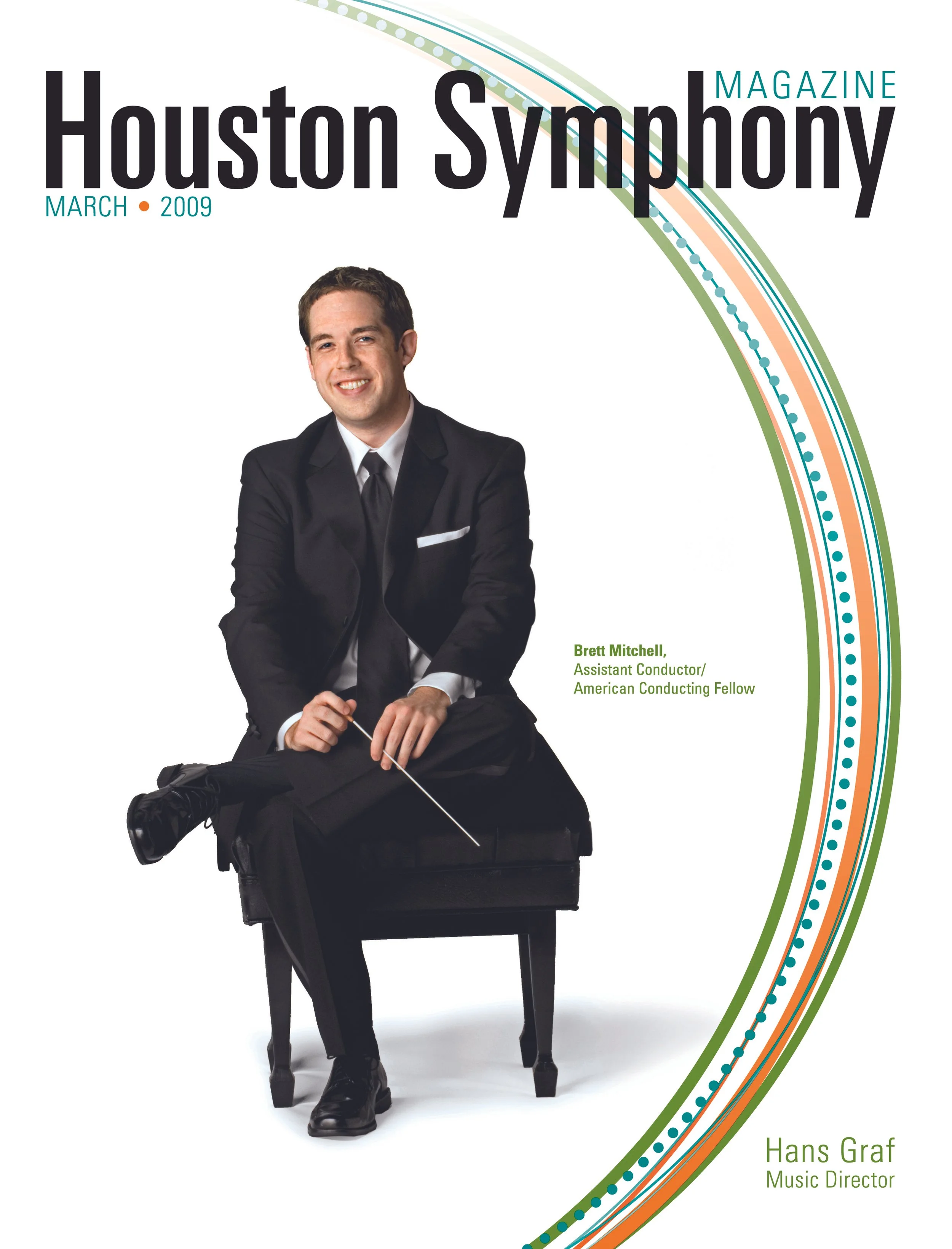
Contract extension with the Houston Symphony
HOUSTON — The Houston Symphony has announced a second extension of Brett Mitchell's contract as Assistant Conductor for a fourth season, ending in May 2011.
Mitchell will continue leading the orchestra in its classical, pops, education, and outreach programs throughout the 2010-11 season.
Front-Page Story: "Brett Mitchell to lead Saginaw Bay Symphony Orchestra"
The Saginaw News has published a front-page story with extensive coverage of Brett Mitchell's appointment as Music Director of the Saginaw Bay Symphony Orchestra. To read this article, please click here.
Brett Mitchell named Music Director of the Saginaw Bay Symphony Orchestra
SAGINAW — After a multi-season search process drawing on a pool of over 160 applicants, Brett Mitchell has been named the next music director of the Saginaw Bay Symphony Orchestra, effective July 2010.
Mitchell will lead the orchestra in its classical, pops, and education series throughout each season of his three-year contract, which runs through June 2013.
To read a story about this appointment that appeared on the front page of today's Saginaw News, please click here.
Lorin Maazel appoints Brett Mitchell assistant conductor of the 2010 Castelton Festival
After participating in last summer's inaugural Castleton Festival as an apprentice conductor, Brett Mitchell has been personally invited by Lorin Maazel to return to the 2010 Festival as assistant conductor and coach. Mr. Mitchell will prepare a new production of Puccini's Trittico (Il Tabarro, Gianni Schicchi, and Suor Angelica), and will share a concert program with Maestro Maazel during the Festival. For more information or to purchase tickets for these events, please click the "SCHEDULE" link above.
Review: "Symphony offering was raw, took risks"
The Peoria Journal Star has published a review of Brett Mitchell's recent guest appearance with the Peoria Symphony Orchestra on their subscription series finale. "The Beethoven, on the other hand, exploded. Symphony No. 7 is step-on-the-pedal, careen-around-the-corner music…and Mitchell and the musicians played it that way. The music hurried, even in the famous elegiac theme-and-variation second movement, now sounding urgent, desperate. Yes, this is majestic music; but Mitchell brought out its feverish, obsessive side as well. The third and fourth movements pulsated not with athleticism but with a crazy relentlessness. Even in the music’s most sublime moments, Mitchell emphasized how Beethoven likes to sneak up on his listeners." To read the complete review, please click here.
Preview: "Symphony candidate sees youth as a plus"

Brett Mitchell, a candidate for the position of music director at the Peoria Symphony Orchestra, leads the orchestra on April 24 at the Civic Center Theater.
The Journal Star (Peoria) has published a profile of Brett Mitchell in advance of his upcoming concert with the Peoria Symphony Orchestra:
Brett Mitchell, the next candidate in the Peoria Symphony Orchestra's music director search, said that a young face at the podium can be a plus.
"If you look at the list of candidates that the Peoria Symphony has brought this season, it's very clear that they are interested in reaching out to the next generation of concertgoers," said Mitchell of Houston, who leads the orchestra in a performance of Beethoven, Prokofiev and the music of contemporary composer Michael Torke on Saturday.
"We're all, relatively speaking, young. I think that's a great way to bring in young audiences. It seems like a superficial thing, but it's not and I'll tell you why. I go home on Monday night, if I can, and I watch 'House' just like everybody else. I'm excited about the last season of 'Lost' just like everybody else. I listen to top 40 radio just like everybody else. I think there is something really important - the relatability of the person on the podium."
Yet Mitchell, 30, is not just an "average Joe" who just happens to have a passion for classical music. Few rising conductors can impress the likes of conductor Kurt Masur, whom Mitchell can claim as a personal mentor and supporter. Connections to Masur led to three years of shuttling back and forth over the Atlantic while serving as assistant conductor for the French National Orchestra. And besides that world-class orchestra, Mitchell has led several other top-notch organizations: the London Philharmonic, the Philadelphia Orchestra and the Houston Symphony Orchestra, where he now serves as assistant conductor.
Nevertheless, Mitchell, who grew up in Seattle, hardly projects the image of a rarified know-it-all. His parents listened to not just classical but a variety of music, and he owes his fascination with orchestral sound to John Williams via movies like "Star Wars," "Superman," "E.T." and "Indiana Jones." In fact, for a time Mitchell wanted to be a film composer and studied composition at Western Washington University while taking lessons on his primary instrument, the piano, on which he is basically self-taught after having a few formal lessons when he was 6. (Mitchell broke out on his own because his piano teacher insisted that the young boy learn scales instead of songs.)
When he considered graduate school in music, however, Mitchell switched to conducting - partly because he decided he wasn't a young John Williams in the making. Also, he discovered he preferred collaborating with others.
"Playing the piano is a very solitary endeavor," Mitchell said. "You spend hours and hours alone in a practice room. The culmination of all that practice is that you go on stage alone again. Composition is a very solitary endeavor. You spend hours and hours alone writing your music. Once it's written, it's written. But with conducting - yes, I spend hours and hours alone studying these scores. But the end result is so different. The end result is that I get to work with 60, 80, 100 of my colleagues on these pieces. Then we get to perform them for one or two or three or five or 10,000 people. I'm such a people person. That just speaks to me and makes so much sense to me for who I am as an artist."
Not to mention the added benefit of spending a great deal of time with scores by Beethoven or Prokofiev - composers of genius. What job can be better than that?
After receiving a master's and doctoral degrees in orchestral conducting from the University of Texas at Austin, Mitchell went on to a varied career. Thanks to Kurt Masur, Mitchell received the inaugural Felix Mendelssohn Bartholdy Scholarship, which meant one-on-one study with Masur and helping the great conductor with concerts in Europe and America. He currently serves as assistant conductor/American conducting fellow of the Houston Symphony Orchestra.
Mitchell said that orchestras can broaden their audiences by being good representatives of their respective cities and regions. Programs, he said, should not be interchangeable: What is played in Chicago should be different from what is played in Dallas, because Chicago and Dallas are different places. For instance, the Peoria Symphony Orchestra might consider playing more music from local and regional composers as well as standards like Aaron Copland's homage to Abraham Lincoln.
"The Peoria Symphony Orchestra's programming should absolutely be reflective of Peoria and Illinois," Mitchell said. "Because otherwise we just become a symphony orchestra that just happens to be in Peoria. That is a huge mistake."
Beyond that, Mitchell would like to see collaborations with other dance, theater and other arts groups - projects he has tried to cultivate in his time with the Houston Symphony.
Mitchell, who also is in the running for the position of music director at Michigan State's Saginaw Bay Symphony Orchestra, said he's ready for a new stage in his career.
"I've had great music director experiences with my own orchestras - but they've been smaller orchestras," Mitchell said. "They've been largely academic orchestras, in a university setting, or a youth orchestra. I've had great professional orchestra experience, including with some of the greatest orchestras in the world. I've conducted the London Philharmonic. I've conducted the Philadelphia Orchestra. I work with the Houston Symphony. These are really sensational orchestras. I feel like the time is right for me to synthesize those two things - that great music director experience that I have and that great professional experience that I have. And become music director of one of the nation's really, truly great regional orchestras."
Preview: "Seattle native next to audition for SBSO post"
The Saginaw News has published a preview of Brett Mitchell's upcoming subscription concert with the Saginaw Bay Symphony Orchestra, as he auditions to become that orchestra's next music director. To read this article, please click here.
Cover Conductor for The Philadelphia Orchestra
After successfully auditioning with The Philadelphia Orchestra in December 2009, Brett Mitchell has been invited to cover several subscription weeks with the Orchestra in May 2010. These programs will be led by chief conductor Charles Dutoit, and will feature works of Stravinsky, Mozart, Rachmaninoff, and more. For more information, or to purchase tickets for these events, please click the "SCHEDULE" link above.
"Film music finding crossover appeal on concert stages"
Brett Mitchell is featured in an article about film music and its crossover appeal in the concert hall that first appeared in the Houston Chronicle, and now appears in papers nationwide. To read the original article, please click here.

Video: Brett Mitchell leads Musiqa in concert
Video of Brett Mitchell's recent performance with Musiqa of Pierre Jalbert's L'oeil écoute with film by Jean Detheux is now available. Please watch the video embedded in this post, or click here to watch the performance on Vimeo.
Preview: "Seven Conductors. One Baton."
Art & Society magazine (Peoria, Ill.) has published a preview of the Peoria Symphony Orchestra's 2009-10 season, during which Brett Mitchell will be the last of seven guest conductors vying to become that orchestra's next music director. To read this article, please click here.
Brett Mitchell: ‘New Music: It’s not just for your Classical Series’

Brett Mitchell has penned a column for online magazine NewMusicBox about the viability of incorporating more contemporary repertoire into orchestras' educational, family, and Pops programming.
As a staff conductor at a major American symphony orchestra, I’m called upon to conduct a wide variety of concerts, not only on our classical series, but also on our education, family, community outreach, and pops series. Programming for concerts outside an orchestra’s classical series typically consists of a mixture of the tried-and-true (i.e., the instantly recognizable) and easily digestible pops arrangements. I’ve been trying a somewhat different approach over the past several seasons with the Houston Symphony—and with great success, I’m happy to say: On every program I conduct, I try to incorporate at least one contemporary American orchestral work.
As a new-music lover, finding ways to introduce audiences to great new orchestral works has always been important to me. I became a conductor because I love to share music with people, and sharing contemporary music in particular has always been at the top of my list of artistic priorities. I have a degree in composition, and I conducted a new music ensemble for five seasons, so incorporating new music into any concert I lead—no matter the genre or venue—is not only important to me, but is an organic, integral part of who I am as an artist.
It may seem that incorporating new works into an orchestra’s concert season might be accomplished most logically through inclusion on its classical series. I propose, however, that the classical series is but one of many in which new music might find a viable, sustainable home. In some cases, it may actually be easier to include contemporary works outside the typical classical concert. Oftentimes, traditional classical audiences may view contemporary works as something to be “gotten through” on the way to the evening’s main course; uninitiated audiences tend to have fewer preconceived notions of what music their orchestra should (and should not) play, and are generally more open-minded and receptive to a broader swath of music.
In my experience, I’ve found that there are three keys to the successful incorporation of new music on pops programs: 1) accessibility of the work itself; 2) a solid rationale for the work’s inclusion on the program; and 3) an effective, concise verbal introduction of the work to the audience.
“Accessibility” has come to be a dirty word in some circles, so let me first define what I do not mean when using this word: mindless, one-dimensional works that are nothing more than ear candy. That said, denying the influence that 20th-century pop music has had on many of today’s composers is counterproductive, especially when an audience is coming to see one of those very acts on the second half of a pops program. The contemporary music I have found to be most successful on such concerts is by composers who take the best attributes of pop music (e.g., rhythmic regularity, simpler harmonic language, and sometimes even a melody or two) and skillfully, artfully incorporate them into their music. Whether one categorizes these composers as neoclassical, neo-romantic, post-minimalist, or something else is secondary to finding music that works well—both musically and programmatically—on a particular program.
A guest artist on the second half of a pops program presents an ideal opportunity to program a new work. With a little imagination, ingenuity, and background research on the artist, one can almost always find a programmatic link between that artist and a contemporary orchestral work. When the Houston Symphony presented Peter Cetera (former lead singer of the band Chicago) in January 2009, the orchestra and I presented an orchestral first half before Cetera and his band performed after intermission. Knowing that Cetera had been a founding member of a band named after one of America’s great big cities, I thought it would be interesting to present different aspects of big-city life on the first half. I wanted to find a contemporary work that captured the bustle, sounds, electric excitement, and fast-paced nature of a city like Chicago, and I found exactly that in a piece by Kevin Puts called Network. This work is around six minutes long and is of the post-minimalist school, which has several advantages: it lives in relatively simple harmonies and has just a handful of ideas that audiences can easily remember while listening through the piece. Before playing the piece, I explained to the audience a bit about the composer, the work, and our reasons for including it on the program; I pointed out what to listen for as we went through it, describing big-city scenes and how that related to the work they were about to hear. We found it to be a perfect complement to the rest of our first half, and, having the right context, the audience enjoyed it immensely.
Even on programs without a guest artist, opportunities may present themselves through an extra-musical theme you’re exploring. Our New Year’s Eve concerts in Houston typically consist of classical/”light classical” fare on the first half, followed by a more pops-oriented second half. On our New Year’s Eve concert in 2007 (my first with the orchestra), I decided to focus on the concept of time and how that relates to New Year’s celebrations. We performed the overture to Rossini’s La cenerentola (Cinderella), a movement from Haydn’s “Clock” Symphony, and selections from Tchaikovsky’s The Nutcracker. I needed a fourth piece to complete our first half, and found it in a work for string orchestra by Michael Torke called December. As with much of Torke’s music, the work is post-minimalist and quite tonal, and thus quite accessible. The great thing about including this work on the program, however, was that it fit in perfectly with my “time” theme for the first half. Torke provides program notes for his work, and I shared a portion of these with our audience from the stage before we played the piece. These notes are wonderfully descriptive, and explain the narrative of the work and what Torke was envisioning as he composed it. Every audience loves going behind the scenes, and getting a composer’s perspective on his work before hearing it lets an audience feel that they’ve got the inside scoop.
A conductor really can help enormously in regard to a work’s accessibility simply by priming the audience well; even a “tough” work can be rendered more accessible by a few well-chosen, articulate words of introduction. An example from my work that I often cite comes not from a pops program but a series of education concerts I led several seasons ago. This program was all about composers who came to America, one of whom was Arnold Schoenberg. Schoenberg is not an easy “sell” to any audience, but finding a way to relate your audience to a composer and his methods can work wonders for an audience’s reaction to a piece. After introducing Schoenberg the man, I briefly introduced the concept of his twelve-tone method by relating it to the similar “unrepeatability” of Sudoku. As most of the young people already knew, in Sudoku, you cannot repeat a number within a given box, row, or column; I then explained that, in Schoenberg’s music, you cannot repeat a note until you have used the other eleven. They then understood (to some degree, at least) why there was less regularity to Schoenberg’s melodies than to those of Dvorák, whose music we had played earlier on the program. Again, with the right context and good explanation, even children can listen to and enjoy something as complex as Schoenberg with new ears.
A quick word to those concerned that composers might be “insulted” by having their works included on something other than a strictly classical program. No composer I’ve ever personally known has ever expressed any feeling of being “relegated” to a pops or educational program. The composers I know create their works out of a genuine desire to communicate, and having one’s music heard by thousands of people over the course of a weekend—whatever the venue—is an opportunity I can’t imagine many composers turning down.
There are myriad reasons to program new works outside the traditional classical series. For one thing, orchestras love the chance to sink their teeth into “real” music on concerts that are typically less engaging and less artistically rewarding for them. I must say, though, that I never program contemporary works on pops programs with the aim of converting our audiences to new music devotees. Will audiences go out and buy a 10-CD retrospective of John Adams’s work after hearing Short Ride in a Fast Machine at a pops concert? Probably not, but that doesn’t mean that they haven’t heard something new, something that they might have genuinely enjoyed, something that might stick with them.
For me, sharing new music with any audience demands finding a piece in which you believe, which works organically with the rest of your program, and which you are willing and able to “sell” to your audience. A well-programmed, well-introduced, well-performed piece of contemporary music can have an impact on any audience like nothing else.
To read the complete column, please click here.
Brett Mitchell named finalist for Peoria Symphony music directorship
Brett Mitchell has been named one of seven finalists to become the next music director of the Peoria Symphony Orchestra. Mr. Mitchell will lead a subscription concert with the orchestra in April 2010 featuring music of Torke, Prokofiev, and Beethoven. For more information, please click here.
Preview: "Houston Symphony ready to dive into concert"
The Houston Chronicle has published a preview of the Houston Symphony's upcoming performance of George Fenton's score for The Blue Planet, led by Brett Mitchell, which will be synchronized with a screening of the film at Jones Hall. To read this article, please click here.