

NEWS
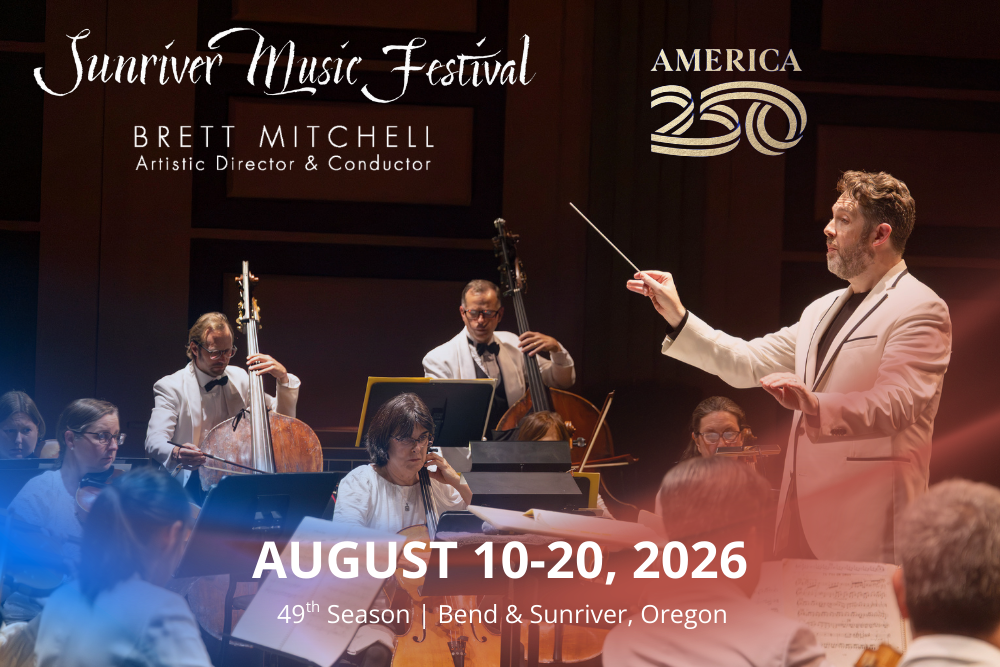
Videos: Brett Mitchell Previews the 2026 Sunriver Music Festival
SUNRIVER — Brett Mitchell has released six short videos previewing each concert of the 2026 Sunriver Music Festival, which runs from Monday, August 10 through Thursday, August 20 in Sunriver and Bend, Oregon.
Mon, Aug 10: Opening Night
Tower | Beethoven | Haydn
Wed, Aug 12: America Meets Scotland
Still | Barber | Mendelssohn
Fri, Aug 14: Harry Potter & the Instruments of the Orchestra
Williams | Mendelssohn
Sat, Aug 15: John Williams & the American Journey
Williams | Vieuxtemps | Gould | Copland
Tue, Aug 18: The Genius of Music
Puts | Bach | Mozart
Thu, Aug 20: Season Finale
Copland | Meyer | Schumann
Brett Mitchell Releases New Solo Piano Arrangement from John Williams’s ‘Disclosure Day’
Brett Mitchell has released a solo piano arrangement of ‘listen…’ from John Williams’s score for the new science fiction film Disclosure Day, his 30th feature collaboration with director Steven Spielberg.
Published on the same day as the release of both the film and its soundtrack album, the performance is an original transcription of the first cue unveiled from Williams’s highly anticipated score. The arrangement continues Mitchell’s longstanding exploration of Williams’s music through more than 150 original solo piano transcriptions, which have attracted a dedicated international audience of film music enthusiasts.
The complete performance may be viewed here.
Review: ‘Alec Baldwin Brings Lincoln’s Legacy to Pasadena Symphony’s Season Finale’
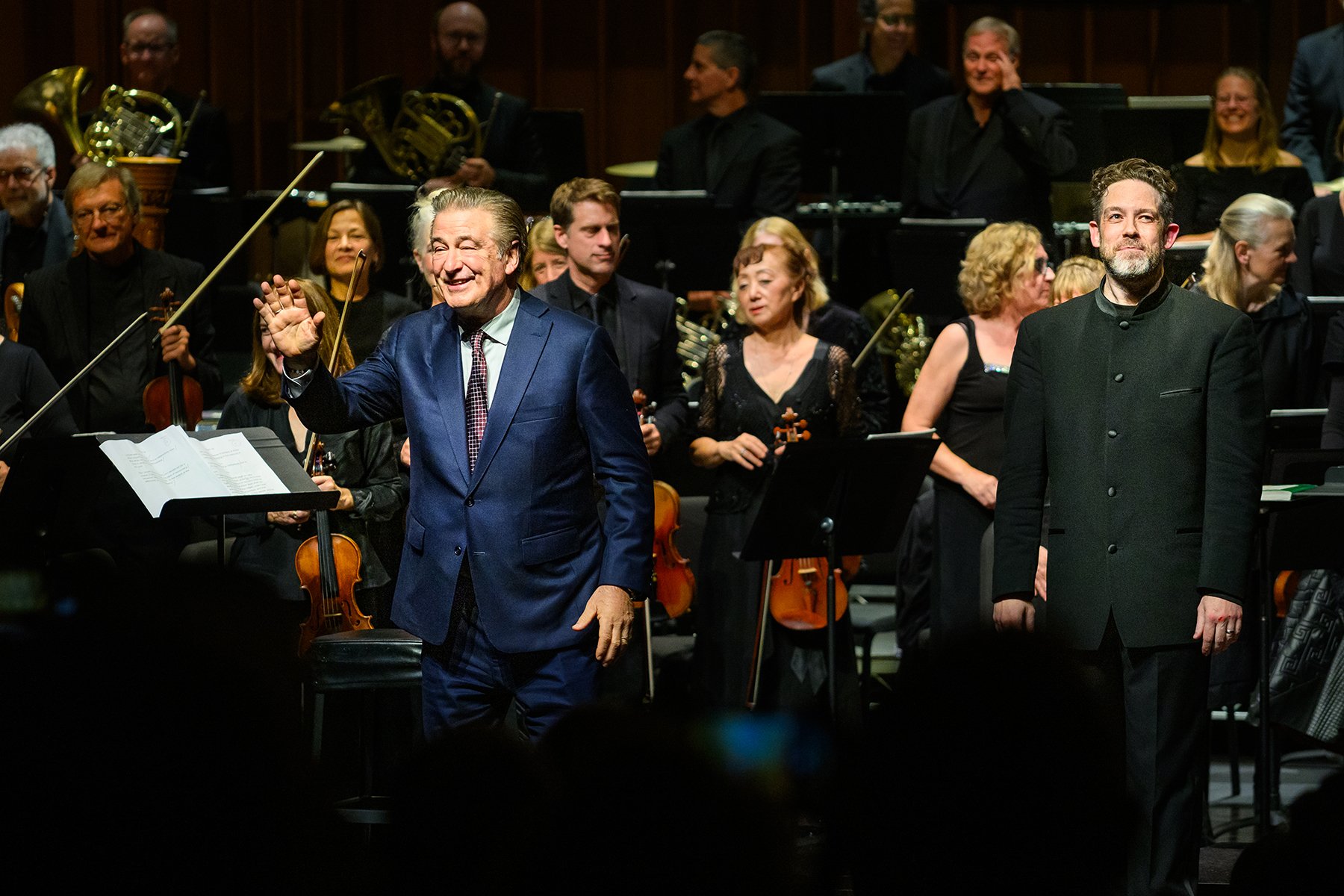
Narrator Alec Baldwin, Music Director Brett Mitchell, and the Pasadena Symphony at the Ambassador Auditorium. (Photo by Jamie Pham)
PASADENA — Local News Pasadena has published a review of the Pasadena Symphony’s 2025-26 season finale, Brett Mitchell’s second as Music Director:
The Pasadena Symphony closed its season at Ambassador Auditorium with a program titled America at 250, celebrating the nation’s upcoming 250th anniversary. The evening combined American compositions with reflections on democracy, immigration, and national identity, culminating in a moving performance of Aaron Copland’s Lincoln Portrait narrated by actor Alec Baldwin.
As is tradition, the symphony hosted its pre-concert “Insights” discussion an hour before the performance. Conductor Brett Mitchell, KUSC radio host Brian Lauritzen, and pianist Terrence Wilson provided historical background and musical context that enriched the audience’s experience throughout the evening.
The concert opened with John Williams’ Liberty Fanfare, composed in 1986 to commemorate the centennial of the Statue of Liberty. Mitchell noted that Williams had previously written the highly successful Olympic Fanfare and Theme for the 1984 Los Angeles Olympics, making him a natural choice for another national celebration.
“The dude knows how to write a fanfare,” Mitchell quipped. “It’s a humdinger.”
The piece immediately set a celebratory tone, filling the hall with the bold, unmistakably American sound that has made Williams one of the nation’s most recognizable composers.
Gershwin’s American Sound
A substantial portion of the pre-concert discussion focused on George Gershwin’s Concerto in F for Piano and Orchestra, the evening’s longest work and a centerpiece of the program. The concerto, composed in 1925, was performed by Grammy-winning, Juilliard-trained pianist Terrence Wilson alongside the Pasadena Symphony.
Lauritzen, Mitchell, and Wilson enthusiastically explored Gershwin’s innovative use of harmony. They described tonic chords as musical “home” and dominant chords as creating a sense of movement or being “away.” Gershwin’s playful manipulation of those relationships became one of the hallmarks of his style, shaped in part by the rich cultural influences surrounding him as the son of Russian-Jewish immigrants.
Mitchell demonstrated these harmonic tensions at the piano, bringing the discussion to life for audience members.
Because conductor Walter Damrosch of the New York Symphony Orchestra was so captivated by Gershwin’s Rhapsody in Blue, he commissioned the composer to create a larger, more ambitious work. The result was the three-movement Concerto in F.
The first movement, Allegro, opens with energetic orchestral rhythms before yielding to a blues-infused piano solo. Mitchell shared his own struggles as a young musician learning to authentically “swing,” underscoring the unique challenge of blending classical precision with jazz sensibility. Wilson, however, made the style sound effortless.
The second movement, Adagio, offered a more reflective atmosphere, highlighted by expressive solos from the woodwinds and brass, including a memorable muted trumpet passage.
The finale, Allegro agitato, was described by Gershwin himself as an “orgy of rhythms.” Wilson and the orchestra delivered a dazzling performance that brought the audience to its feet.
Gershwin’s enduring legacy rests largely on his pioneering fusion of classical music and jazz. As Mitchell observed, “Gershwin wanted to put jazz into classical music and classical music into jazz.” The uniquely American sound he created helped define the Roaring Twenties and continues to resonate today.
Aaron Copland and the American Landscape
The second half of the program featured two works by Aaron Copland, another son of Jewish immigrants whose music became synonymous with the American experience.
Mitchell explained that Copland initially gained recognition for more dissonant, rhythmically complex compositions influenced by modernism and jazz. In later works, however, he embraced a more open and accessible style that listeners came to associate with the American landscape.
One of the finest examples is Appalachian Spring, written for choreographer Martha Graham. Although Copland originally called the work Ballet for Martha, Graham later suggested the title that audiences know today, inspired by a line from a poem by Hart Crane.
When the piece premiered in 1945, audiences remarked that they could almost see the hills and smell the air of Appalachia. Through spacious harmonies and folk-inspired melodies, Copland created a musical portrait of optimism, community, and possibility.
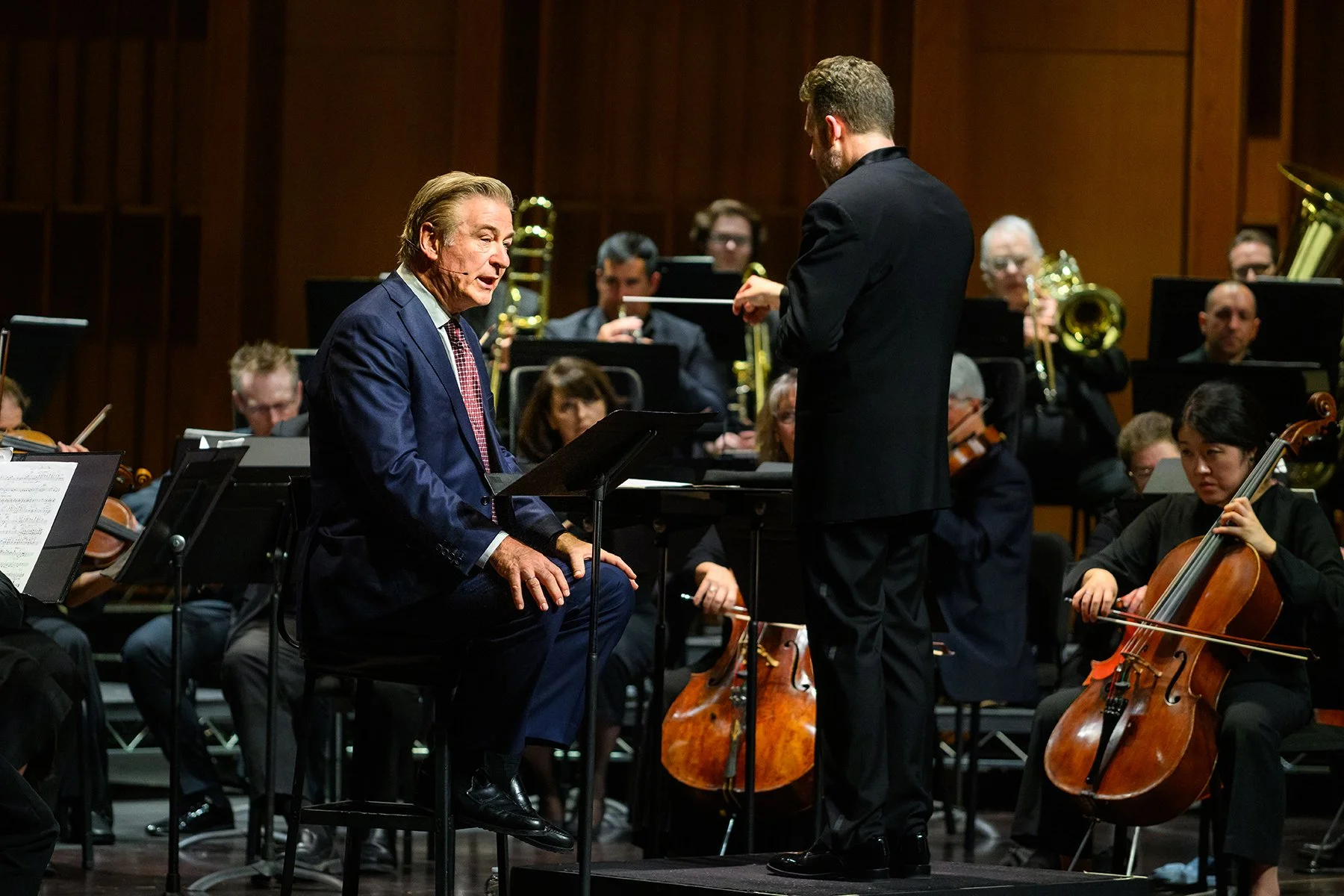
Alec Baldwin narrates Copland’s Lincoln Portrait with the Pasadena Symphony and Music Director Brett Mitchell. (Photo by Jamie Pham)
Lincoln’s Words for Then—and Now
The evening concluded with Copland’s Lincoln Portrait, commissioned in 1942 as America entered World War II. Conductor André Kostelanetz envisioned the work as a patriotic statement that would remind audiences of the nation’s democratic ideals during a time of global crisis.
For this performance, Mitchell invited actor Alec Baldwin to serve as narrator.
After a musical introduction incorporating the folk tunes “Camptown Races” and “Springfield Mountain,” Baldwin delivered Lincoln’s words.
“Fellow citizens, we cannot escape history,” he began in his characteristically booming, resonant baritone. “We of this Congress and this administration will be remembered despite ourselves.”
The audience sat transfixed as Baldwin delivered passages drawn from Lincoln’s speeches and writings, including excerpts addressing slavery, democracy, equality, and civic responsibility. Written during the darkest years of the Civil War, Lincoln’s words felt strikingly relevant today.
Perhaps most powerful was hearing these reflections from December 1862, when the war’s outcome remained uncertain, and the nation appeared irreparably divided. Lincoln offered neither easy optimism nor false reassurance. Instead, he called on Americans to meet their responsibilities with courage and conviction.
More than 160 years later, his message still resonates.
Throughout the hall, audience members wiped away tears as Baldwin’s narration merged seamlessly with Copland’s soaring score. The work became more than a historical tribute. It felt like a reminder that democracy has endured moments of profound division and that its survival has always depended on ordinary citizens’ willingness to uphold its ideals.
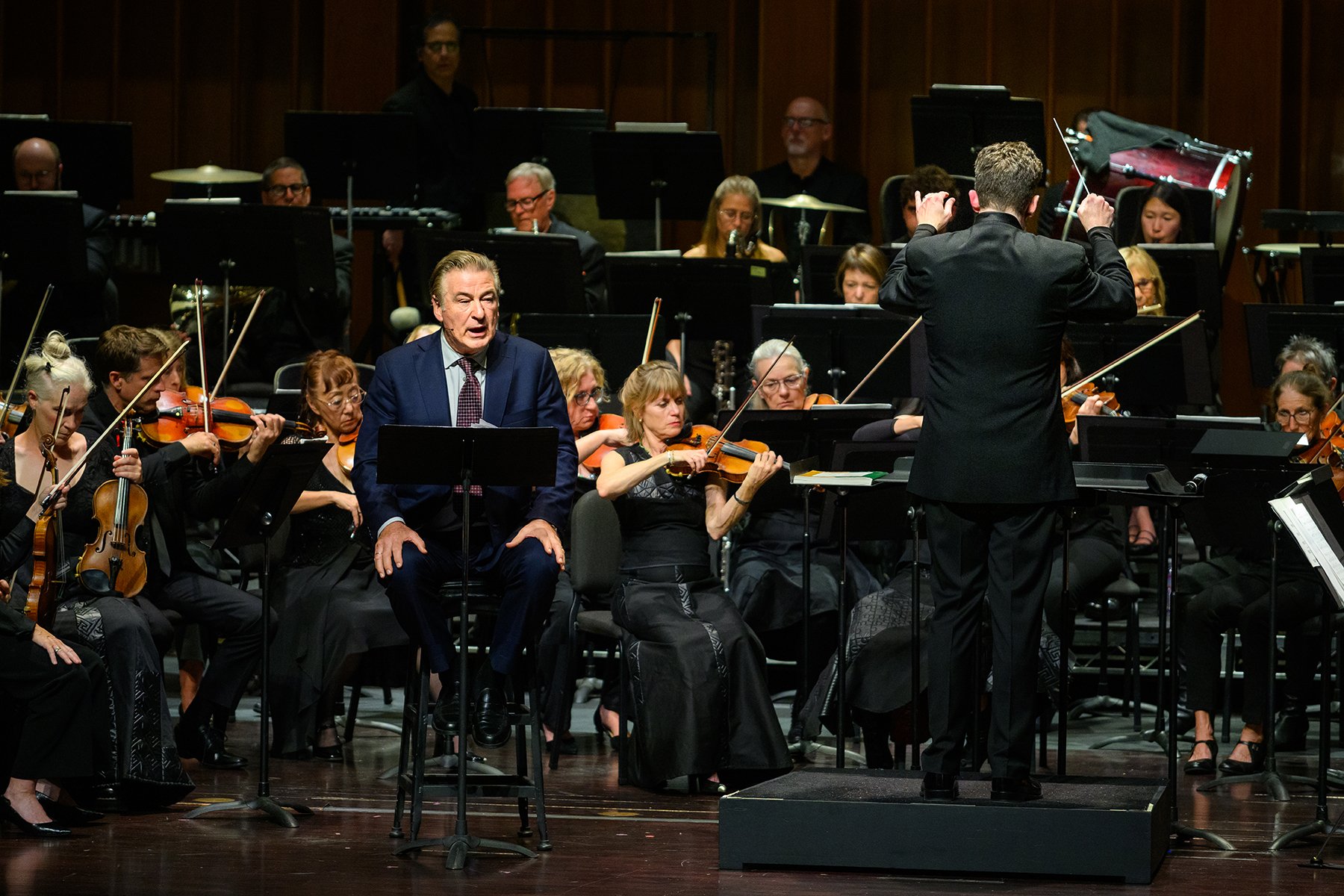
Alec Baldwin narrated the words of President Lincoln as set to music by Aaron Copland on the Pasadena Symphony’s 2025-26 season finale under Music Director Brett Mitchell. (Photo by Jamie Pham)
A Message of Hope
The evening showcased the work of some of America’s greatest artists: Lincoln, whose words continue to inspire; Copland and Gershwin, who helped define an American musical identity; and the performers who brought their visions to life.
Under Brett Mitchell’s leadership, with outstanding performances by Terrence Wilson, Alec Baldwin, and the Pasadena Symphony, America at 250 became a meditation on the nation’s history, its struggles, and its possibilities.
At a time when many Americans question the strength of the institutions that bind us together, hearing Lincoln’s voice once again, through Baldwin’s compelling narration and Copland’s majestic score, offered something increasingly rare: reassurance that the nation has faced great tests before and emerged stronger because citizens chose hope over despair.
For one evening in Pasadena, that message felt both timely and deeply moving.
To read the complete review, please click here.
Brett Mitchell leads the Nashville Symphony in music of Barber, Beethoven, and Edgar Meyer
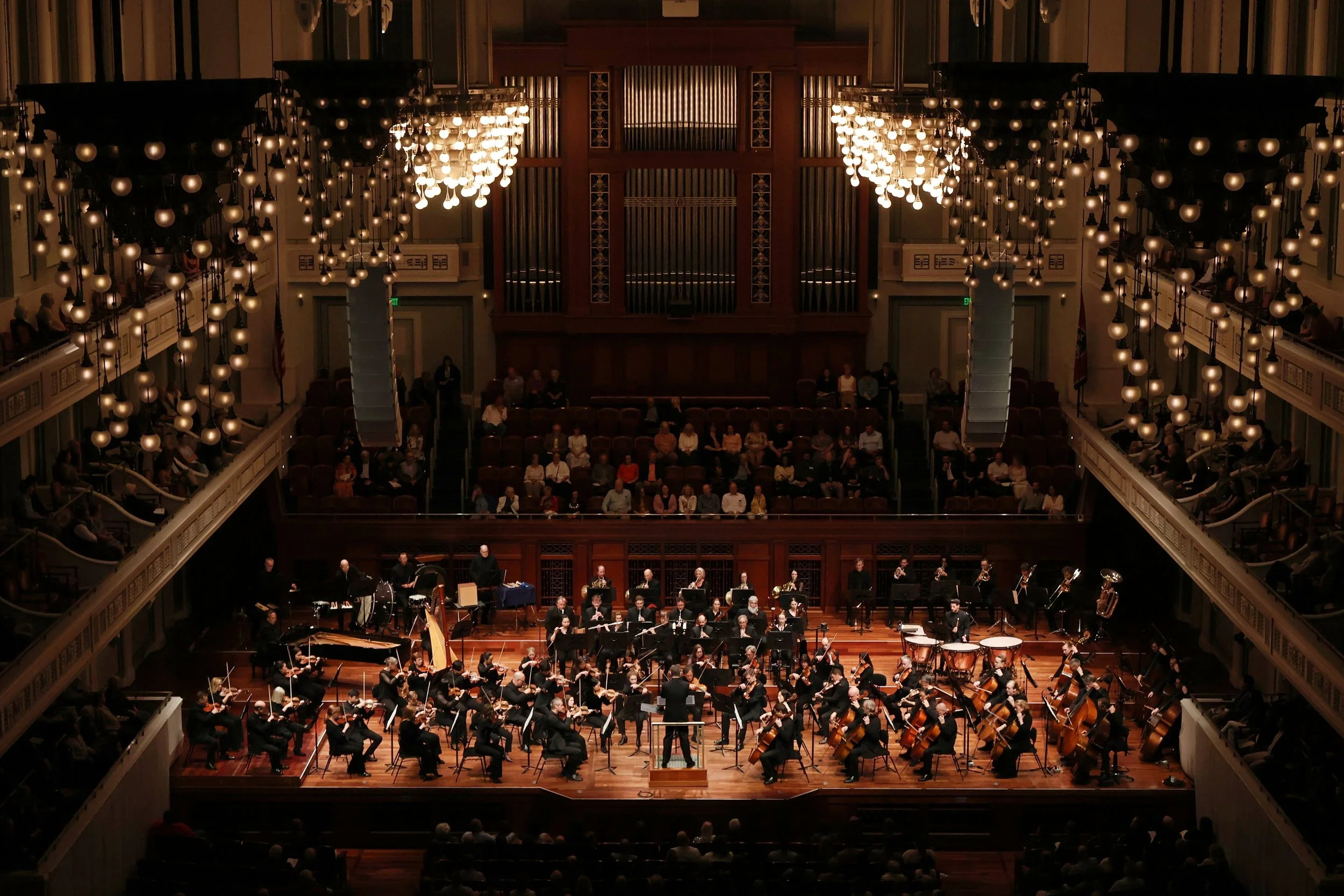
Brett Mitchell leads his debut with the Nashville Symphony at Schermerhorn Symphony Center on Friday, May 15. (Photo by Matthew Oh)
NASHVILLE — Brett Mitchell made his debut with the Nashville Symphony on Friday, May 15 and Saturday, May 16, leading two performances of the following program at Schermerhorn Symphony Center:
BARBER - Medea’s Meditation and Dance of Vengeance
EDGAR MEYER - Bass Concerto No. 2 (for Double Bass and Percussion)
Edgar Meyer, double bass | Sam Bacco, percussion
BEETHOVEN - Symphony No. 3, ‘Eroica’
View images and videos from the week below.
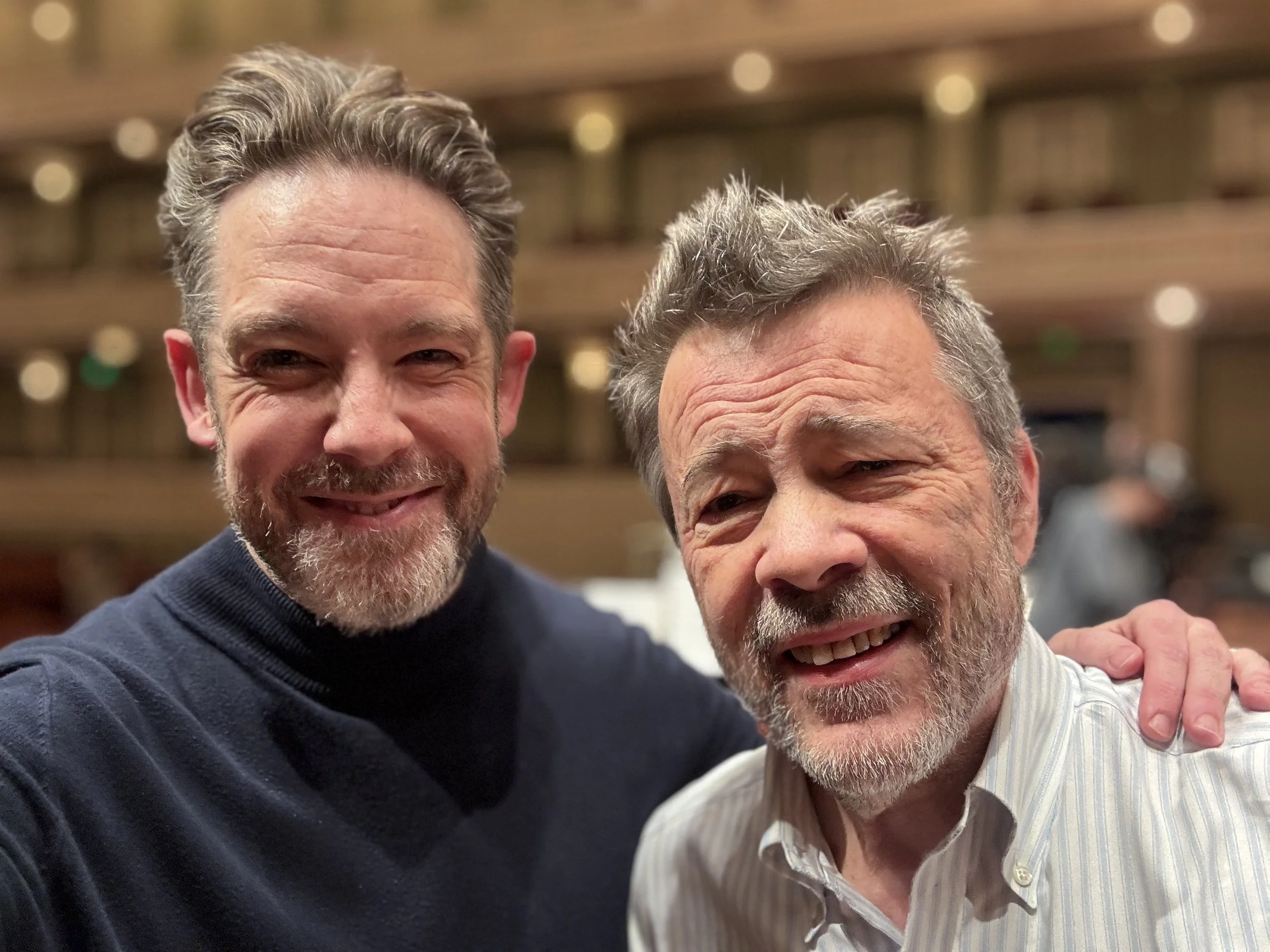
Conductor Brett Mitchell and bassist/composer Edgar Meyer
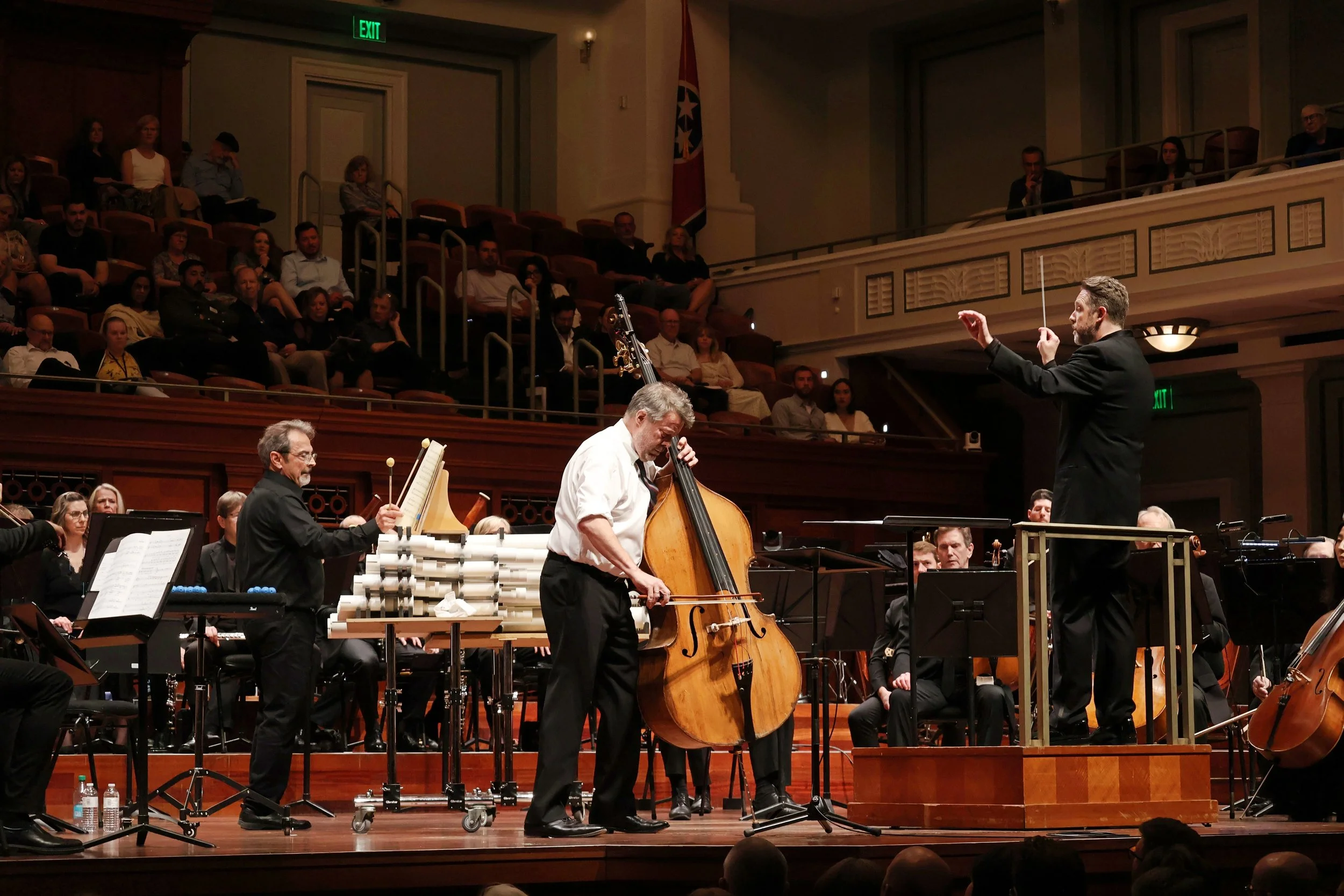
Percussionist Sam Bacco, bassist Edgar Meyer, and conductor Brett Mitchell perform Meyer’s Second Bass Concerto with the Nashville Symphony. (Photo by Matthew Oh)
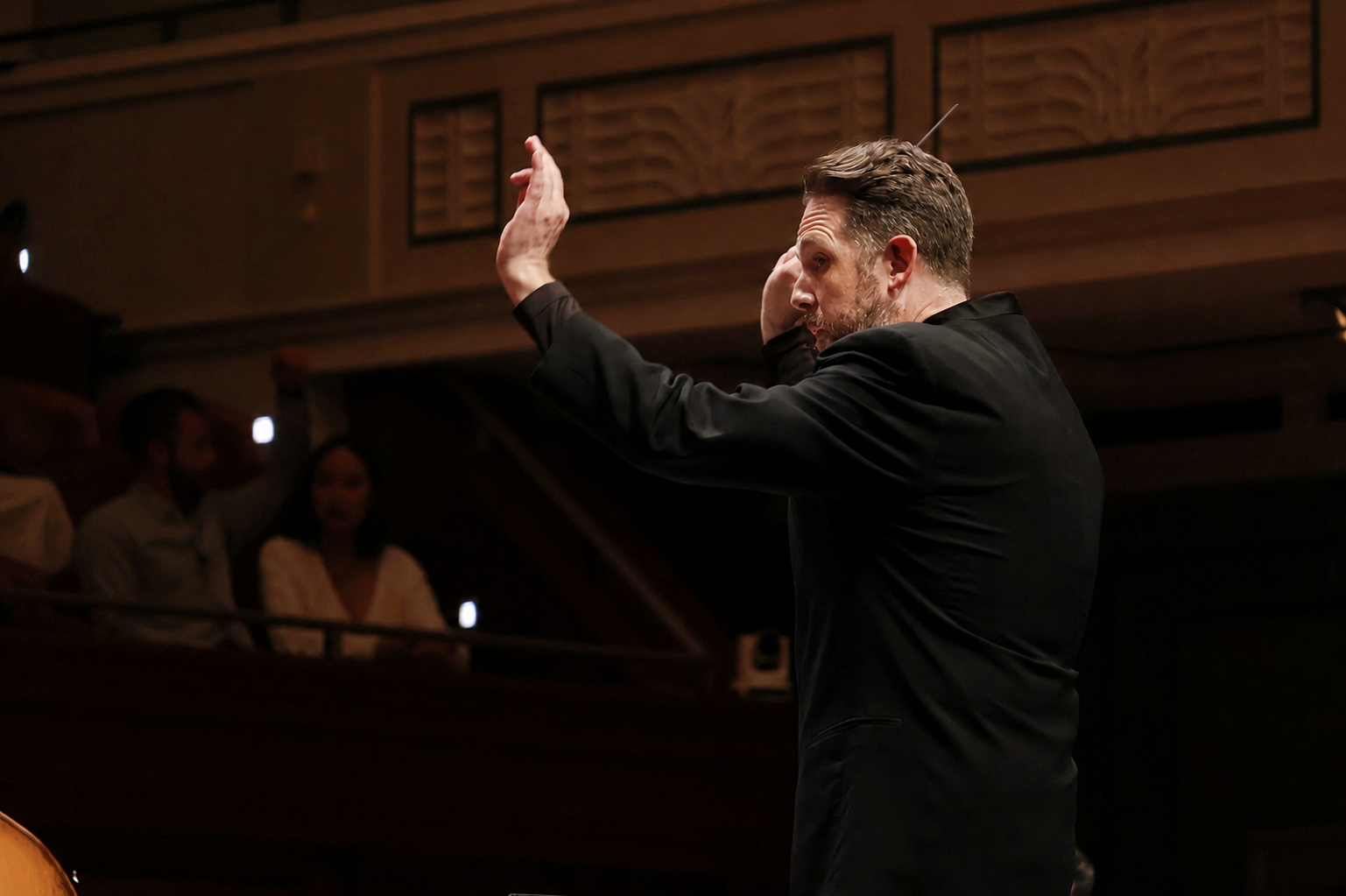
Brett Mitchell leads his debut performance with the Nashville Symphony at Schermerhorn Symphony Center on Friday, May 15. (Photo by Matthew Oh)
REHEARSAL CAM
CONCERT INVITATION
WEEKEND WRAP-UP

Feature: ‘Falling in love with music: A conversation with Sunriver Music Festival artistic director and conductor Brett Mitchell’
Photo by Roger Mastroianni
BEND, Ore. — Oregon ArtsWatch has published an extensive feature about the Sunriver Music Festival and its Artistic Director & Conductor, Brett Mitchell. The article features a substantial interview with Mr. Mitchell, who is about to begin his fourth season at the helm of the nearly-50-year-old festival in Central Oregon.
Falling in love with music:
A conversation with Sunriver Music Festival artistic director and conductor Brett Mitchell
Mitchell, now in his fourth season with the Central Oregon summer festival, discusses how his background as a composer informs his approach to conducting, why performing in Sunriver feels like coming home, and the immersive future of classical concerts.
Preparing to interview Brett Mitchell — conductor and artistic director of the Sunriver Music Festival, which starts August 2 and runs through the 13th — a few big questions came to mind. First: what is it that a conductor does, exactly? Beyond the time-keeping arm-waving and expressive emoting we all associate with the job, that is. Second: what goes into planning a seven-concert music festival in a resort town? It’s just the right length to be really difficult, in the sense that planning a single concert is hard but manageable, whereas planning a big long festival (like Chamber Music Northwest or the Oregon Bach Festival, say) is a lot more work by volume but also comes with a certain amount of wiggle room in terms of the longer arc.
Turns out, Mitchell had answers to all of these questions and a lot more…
Born in Seattle, studied with Leonard Slatkin, worked with Kurt Masur and Lorin Maazel, did The Lenny Thing and conducted the New York Philharmonic as a last-minute replacement (read those reviews right here). Basically your standard superstar conductor success story. He now lives in Colorado, where he ran the Colorado Symphony in Denver for five years, and currently leads the Pasadena Symphony. Since 2022 he’s been head honcho of the Sunriver Music Festival.
So much for the conducting credentials. During the pandemic he brushed up his piano chops, started having kids, and renewed his youthful interest in composing–an interest he’d mostly left behind when he had to choose career paths in grad school. Five years later and his YouTube channel has dozens of videos: Bartók, Chopin, Glass; massive amounts of film music (he was all dressed up to record Jaws when we spoke earlier this month); and a few samples of his own original work.
Mitchell’s original music was mostly written (or arranged) for his children, and a few pieces were sung by his wife Angela. Here’s “Love You Forever” (written for the first baby, Will):
And here’s Mitchell’s “Nocturne”:
And here he is playing Billy Joel’s “Nocturne”:
And here’s some Star Wars:
And here he is conducting Petrushka in 2016:
Got it? Good, then let’s go.
The following interview has been lightly edited and condensed for clarity and flow.
Oregon ArtWatch: Let’s start with your a-ha moment. What switched the light on for you as a musician?
Brett Mitchell: Thank you for leading with such a fun question. I do have an a-ha moment. I have a few of them as you would imagine, but there’s one that I always point to. I was born in 1979, and I was a little, little kid in the early ‘80s. It was just me and my mom at that point, and my mom was getting ready for work one morning and this song came on the radio, and for whatever reason it just grabbed me. I went into my mom’s bathroom where she was getting ready, and I said, “Mom, what is this song?”
And she told me what the song was. And I said, “do we have a record of this song?” And she said, “We do.” And I said, “Okay, here’s what I want to do. I want to take our record of this song and my little Fisher Price record player that you bought me for Christmas, and I want to take it to Janet’s house” (I used to stay with a caretaker named Janet) “and I want to play the song for Janet.” And my mom said, “well, you know, sweetheart, this was a number one song for a long time. I’m sure Janet knows the song.” I said, “yeah, mom, but I really want to play it for her.” And she said, “OK, well, how about this? Let’s take our record. Janet has a record player, we’ll play it on hers.” And I said, “No, mom, I want to take our record and my record player.” And rather than arguing with a three-year-old, which as a parent of a three-year-old right now I can tell you is not a winning proposition, we grabbed the record and the record player and we went to Janet’s house. And my mom said, “okay, sweetheart, I’ll see you tonight.” And I said, “where are you going?” And she said, “well, I have to go to work.” And I said, “no, mom, I want us all to sit here and listen to it.” And so we all sat there in this living room and listened to Barry Manilow’s “Mandy.”
Mitchell: Of all things, that is not where you thought this story was going! For whatever reason, that song really grabbed me. I mean, to the point where I have up on my wall the silver record signed by Mr. Manilow himself. It’s funny because I tell that anecdote a lot, and it’s cute, and it always gets a good laugh, but what it really illustrates is: It’s the exact same thing that I do today, which is find music that I love and then share it with as many people as I can. If that’s two people in a living room in Seattle, great. If it’s 20,000 people at some outdoor venue at a summer festival, great. It doesn’t matter to me.
Certainly it’s a long leap from “I heard a pop song from the ‘70s” to “I want to conduct the New York Philharmonic.” But at the same time, music is music. Falling in love with music is falling in love with music. There’s a lot of different ways that you can fall in love with music, and a lot of different avenues that that love can channel itself through. But for me, that was the moment that I was like, “okay, this is obviously something very special.”
I also remember from right around that same time, we had a piano at our house later but we didn’t have a piano when I was first growing up. But my mom’s aunt and uncle did in Roseburg, Oregon, and we would go visit them, and I remember being around that piano for the first time, and I remember playing the very highest notes on the piano. I was, again, about three or four years old. And because of the “tinkle, tinkle, tinkle,” I thought, “oh, Three Little Pigs, that’s fun.” And then I went down to the low end and I kind of rumbled down there and I thought, “oh, Big Bad Wolf.” So something about the storytelling potential of music got to me really early.
I grew up in Seattle and when I was at those really peak formative years of middle school that’s when grunge hit. Go back and look at my middle school yearbook from the early 1990s every one of us is in flannels. I really didn’t get to Beethoven until a few years later in high school, but the really nice thing about viewing music the way I’ve always viewed music is that I heard Nirvana and now I’m hearing Beethoven and they don’t sound super different to me. What it sounds like in both of these particular cases is a guy going through some really challenging times, really challenging things, and trying to work it out through his art, through his music. And by doing that, the rest of us that have had those experiences feel less alone, because somebody else is giving voice to the things that we’re experiencing. The crux of music, the whole purpose of music is communication. And composers in particular are only trying to communicate. They’re only trying to feel, to get us to feel what it is that they are feeling at that moment.
That’s the infinite power of music: it doesn’t really matter. Duke Ellington said there’s only two kinds of music, good music and bad music. That’s it. It doesn’t matter whether you call it symphonic or jazz or pop or emo or ska or whatever. Good music is good music. And that’s all we’re looking for.
OAW: Could you describe the nuts and bolts of what a conductor and artistic director does? We all know that it’s more than the arm waving, but what really goes into the work?
Mitchell: Well, the first thing I would say is that there’s the conducting part of the job, and then there’s the music directing part of the job, or the artistic directing part of the job. My title with Sunriver is “artistic director and conductor,” which implies two different things, and in fact it is two different things. As artistic director or music director, depending upon the organization, you’re in charge of the artistic direction of the organization. That means that I decide what the repertoire is that we’re going to play, what the music is that we’re going to play every season. I decide who the soloists are going to be, who are we going to bring in for some of the concertos that we do, the solo pieces with orchestra. I handle a decent amount of the administrative things that go along with any position.
As for the conducting part of things, what I’m essentially there to do is to help all of these highly trained professional musicians–who are looking in any given rehearsal or performance only at their part–to help them understand how their part fits in with everybody else’s part. You see the first flutist is looking at music that says “Flute 1,” and it has all of the music for the first flute. Same for the second flutist, same for the first oboist, the clarinetist, the bassoons, the horns, the violins, they’re all just looking at their own music. They don’t know what the horn player has in that bar because it’s not provided for them. I mean, if everybody had all of the music all of the time, the music would have to stop every 10 seconds so everyone could turn the page, right? It doesn’t really work like that.
So I have the great luxury of not having to learn how to physically, technically execute all of that music. I have to be able to look at the score, which is the document that I have that has everybody’s parts in it. It’s got the first flute and the second flute and the oboes and the clarinets and the bassoons. And so I’m able to see the context. I’m able to see what the musicians don’t see. Musicians are such good colleagues that we tend to always have our ears open, and when we find somebody else that we’re doing something with we try to mimic them. You’ve got a whole note in this bar, but the person sitting over there has a half note, and you think “if they’re exiting at this moment then I should probably be doing that as well.” And the answer is “no you don’t”–but where does that answer come from if you don’t have somebody at the center of it all that’s aware of the hierarchy at any given moment?
If you think about any pop song, there’s the melody that’s sung by the lead singer, but there’s also the drum track, the bass track, the keys track, the guitars track. All of that has to get blended together in a recording session. That’s the job of the engineer and the producer. I am the engineer and the producer when it comes to the orchestra.
I am what I would also call the arbiter of taste. If the score says “loud,” well, what what does “loud” mean? Does a “loud” in Mozart mean the same thing as a “loud” in Tchaikovsky? If it doesn’t, how are they different? Why are they different? So my job is to decide how loud is loud, how soft is soft, how fast is fast, how slow is slow, how long is long, how short is short, and to make sure that everybody is operating under the same rubric. If we’ve got 50 people on stage performing a Beethoven symphony, we might have 50 different opinions of how Beethoven should go. My job is to say, “for this performance, for the sake of intelligibility to the audience, everybody can’t just do what they want. We all have to be at the same place at the same time in the same way.” And I’m the guy that makes sure that all of those things happen. That’s a very high level look at what I do.
OAW: So then how would you characterize your own specific approach to conducting? What makes you different from any other conductor?
Mitchell: Part of what makes me different from any other conductor is that I’m me. We are all who we are as individuals, and you can’t separate who you are as a person from who you are as an artist. It’s a very physical thing that I do; I also contend with my body. We are all trapped in our own bodies. And even if I wanted to look like another conductor, even if I wanted to make a gesture like another conductor, I can mimic it but that’s his body or her body and it’s gonna look and feel more natural to them than it will to me.
So that’s part of the path of learning conducting: absorbing all of these other influences and then saying, “okay, but I’m my own person and I’m in my own body and this is what I have to work with.” So some of the individuality comes purely by you being an individual, and there’s nothing that we can do about that.
I would say that one of my defining characteristics as a conductor really stems from my background as a composer. My undergraduate degree is in composition from Western Washington University up in Bellingham. And when I started, I did not set out to become a conductor. That was not even on the radar. I started conducting by conducting my own music.
My high school band director commissioned me to write a piece the summer between my sophomore and junior years. And then we got to junior year, I had written the piece, and she said, “well, why don’t you just conduct it?” And I said, “because I don’t know how to conduct.” And she said, “yeah, but you know the most important thing about conducting this piece, which is you know this piece.”
And that’s what you really need. If you think about a word like “authority”–to have authority up on the podium, what does that really mean? Authority does not come from standing up on a box. I really think about the root of the word: If I want to have authority on the podium when I’m working on this piece, that means I have to know this piece so well that I could have authored it. That is what being an authority is. You know the thing so well that you may as well have written it yourself.
And listen, I’m a pianist and I am guilty of this when I am a pianist–as many musicians are–of ignoring markings that exist in the music, because I don’t want to do that at that exact moment. Well, okay, fine, but it’s not really about “want to.” The “want to” has to be serving the composer, because if the composer didn’t write this piece then we don’t have anything to do. The musicians don’t, I don’t, nobody does. So if we’re not there trying to serve the composer’s vision, then what are we there trying to do? What that means for me is that I take composers very seriously. And I take composers at their word. Now that doesn’t mean that I’m a slave to the score, that I don’t bring any imagination or thought. I understand that composers want us to use our imagination within what they have laid out for us. But I’m never casual about if. If a composer says that something should be done at, you know, half note equals 104, that’s the tempo the composer wants. Maybe I’ll be 96, maybe I’ll be 100, maybe I’ll be 108, maybe I’ll be 112. But I’m certainly not going to be 72. And I’m certainly not going to be 138.
And so I think part of what defines my approach is a real respect for and reverence for the composer and taking composers seriously and taking composers at their word.
Shakespeare had a great, very short line, which was “speak the speech.” You know what I mean? Just say it, just say the words. David Mamet, a great playwright and director, had a book about acting. He said, “you have to stop with the funny voices.” He said, “if the speech is good, nothing that you put on top of it will make it better. And if the speech is bad, nothing you put on top of it will make it better.” So, what that tells you is, the speech is the speech. The score is the score. You have to trust that the words in the play are going to connect with the people who hear them. And you have to trust that the notes at the concert are going to connect with the people who hear them. But the only way that you can make sure that the composer’s intention is being met is by doing what the composer asks you to do, even if it sometimes feels wrong, even if it sometimes feels awkward, even if you don’t quite understand why. I think presuming that we know better than the composer is a slippery slope and dangerous territory, and I don’t think I’ve ever gone against a composer’s wishes and felt like, “yeah, I showed him.”
That’s not the job. That’s really not the job. This is not a creative art, what I do. It is a re-creative art. I am taking music that is in printed form in these scores and with my colleagues trying to bring that music to life. But I’m not inventing the music. The players aren’t inventing the music. That’s already been done for us. So maybe that sets me apart from some of my colleagues.
OAW: What led you to then focus on conducting, rather than focusing on composing or playing piano?
Mitchell: My undergrad, as I mentioned, is in composition. I’ve always played the piano. And then I started conducting 30 years ago this fall, in October of ‘95. And it was just a practical thing. It was just my teacher saying, “hey, you should conduct this thing.” Not, “I’m gonna write this piece and finagle my way onto the podium.” That wasn’t the thought at all.
Mitchell: When I got to college, I started writing bigger and bigger pieces, and the bigger the piece you write, the more likely you are to need a conductor. So I started conducting more of my music in college. And then my colleagues in the composition program, my fellow composers, would say to me, “look at that, Brett conducts. Hey, you want to conduct my new piece?” And I’d be like, “yeah, sure, why not?” So I would conduct my friends’ music. And it became clear that I had a natural affinity for helping to shepherd what was going on.
And I knew as I was approaching the end of my undergrad that I was going to have to pick something. If you’re going to go to grad school, you’ve got to major in something. You have to get a master’s in something. You can’t get a master’s in everything.
I think my natural talents are part of what I have to offer: leadership ability. And you really need that as a conductor in a way that as a pianist you do not, and as a composer you do not. It’s also true that being a pianist, you spend hours and hours alone practicing, and you often go on stage alone. As a composer, you spend hours and hours alone writing, and then often you just give the music to other people and you’re not even part of the fun.
And as a conductor, certainly I spend hours and hours alone studying, but the penultimate result is that I get together with my colleagues in the orchestra, and we get to work for a few days on this music that I’ve been studying, and then we get to perform for an audience. I love working with other people, and I love performing for an audience, and given the musical spheres that I was in, it made sense to become a conductor.
And so that was really what I exclusively focused on from the time I was about 22 until I was–well, let’s see, I was 40 when the pandemic started. And when the pandemic started, I was stuck at home, as was everybody. And I was so kind of unmoored, because I couldn’t make music. Conductors, we need an orchestra. Orchestras just shut down because you, I mean, think about what an orchestra is. It’s a bunch of people blowing into their instruments. This is not what we wanted to do during COVID times.
I’ve always had a very clear mission statement, which is to share music I love with as many people as possible. And I was complaining to my wife a few months into the pandemic about how I wasn’t able to make music. And she said, “what does your mission statement say?” And I said, “to make music I love for as many people as possible.” And she said, “and where in there does it say anything about an orchestra? Where does it say anything about an audience? Where does it say anything about conducting?” And I was like, “you’re just constantly right.” She was, she was exactly right.
And so while I had played some piano over the intervening 20 years or so, I really got my chops back up once the pandemic started. I started arranging things. I started arranging film scores, scenes for piano, because that was a thing that I was able to do that nobody else was doing. I have conducted a lot of movies live to picture, so I had access to these scores. I have a composition degree, so I’m able to look at a big orchestral score and reduce that for piano. I am a pianist, so I can play those things on the piano. I understand how it works to try and line music up with picture.
Editing the audio, editing the video–that was a whole new thing. That was a challenging thing. But like many, many, many, many people, I figured out how to do that. As with, you know, virtually everything on the planet, COVID forced a readjustment of priorities. Now I find myself conducting all the time again, thank goodness. But I also do have a good following on YouTube, and I want to keep that going. Not because it makes me so much money, but because the people who are on there, who enjoy what I do on there, really enjoy what I do on there. I appreciate that a lot, and I enjoy doing it as well. I’m going to go record a video right after this interview, for Jaws‘ 50th anniversary.
Mitchell: I’m always suspicious of people who say, you know, “I knew from the time I was eight years old that I wanted to be a conductor.” When you’re eight years old, you don’t you don’t really understand what’s going on up there. You see somebody that’s the center of attention and standing on a box and waving their arms and apparently all-powerful. But that is about 1% the truth of what actually goes on up there. I think it’s much healthier if you sort of backdoor your way into it the way I did.
OAW: Could you talk about your composing life, what you’ve been working on and sharing on YouTube these last few years?
Mitchell: Almost everything that I’m composing now is actually not composing, it’s arranging. I would say that the composing that I’ve done over the past few years, with a couple of exceptions, has really been for our kids. We have an almost three-and-a-half-year old boy–a week from today he’d want me to tell you–who just started preschool last week, who’s very excited about that. And a little girl who just turned one back in April. When they were coming into the world, I thought “well dear God, I’m a musician. I’m a composer, I’m a pianist, I can’t not do something for them.”
So I repurposed a lullaby that I wrote back when I was either 15 or 16 and I called it “Will’s Lullaby.” I’ve actually never written it down anywhere; it exists on the YouTube channel, but I’ve never written it down anywhere.
And because my wife is a soprano, we also wanted to do a song for Will. And I had written a song maybe 20 years before for a colleague of mine who had a baby, and that was “Love You Forever.” And I said, “I want to make it a little bigger and a little more expansive.” And so I sort of rearranged that when Will was born.
Will was born Christmas Eve of 2021. Rose was born in April of ‘24, and her little lullaby was from another piece that I had written back in the year 2000 called “Four Miniatures for Solo Piano.” It was just the second movement of that. Again, I expanded it, changed it around a little bit. But I needed to find a new text, because I had run out of old music to repurpose.
We knew we were going to name her Rose. I’m Brett William, so our son is Will. My wife is Angela Rose, so we knew her name was gonna be Rose once we found out it was a girl. So I went looking around for rose poems and found a great poem by Robert Frost called “The Rose Family.”
Mitchell: I’ll tell you the really interesting thing about all four of those. My wife and I just did a recital together here in Denver last month, and we played all four of those things. I played “Will’s Lullaby,” we sang “Love You Forever,” then I did “Rose’s Lullaby,” and then we did “Rose Family.” And “Will’s Lullaby” was written, as I said, when I was 15 or 16, and “Rose’s Lullaby” was written when I was like 20 and towards the end of my composition degree. And one of our neighbors who came to the recital, a big music fan, she said, “I have to tell you, I really liked ‘Will’s Lullaby’ a lot. I think I liked that more than ‘Rose’s Lullaby.’” And I was like, “that’s very interesting because what you’re saying is that the music of the essentially relatively untrained 15-year-old was more palatable than the music of the trained 20-year-old.”
And I completely understand that. I really do. I totally understand where that’s coming from. When you’re in the middle of getting a composition degree, you want to be taken seriously, you want to explore all the different ways you can create music and sound worlds you can make. When I was writing “Will’s Lullaby” when I was 15, I was just writing a pretty tune, because that was all I was interested in doing then. And as it turns out, people are mostly interested in the pretty tune. I found that really interesting, and I didn’t take offense to it at all.
So most of the composing that I do is really in the guise of arranging for the YouTube channel. But then I’ll also write little things here and there, usually as gifts for people. Leonard Bernstein used to write little pieces for people that he called “anniversaries.” And it was either for an anniversary or a birthday, just little teeny tiny gifts. And then I think after Lenny died, they were all published together in three different sets or something like that. But it was never intended to be that. It was just intended to be, “hey, I love you.” Some people like to cook for other people. I like to write music for other people. It’s no different. It’s a love language coming from me.
OAW: Let’s talk about Sunriver Music Festival. How did you get the job in the first place, and what’s it like putting together a music festival?
Mitchell: I got a phone call, or maybe an email, at the beginning of a pandemic about this festival that was looking for an artistic director and would I be interested in applying. I think somebody may have recommended me for it. And I said, “sure, why not?” And ended up coming out during the summer of 2021. I was one of two candidates that they brought in to lead half of the festival. I led half the festival that year and they offered me the position and I took it. So this will be my fourth season.
The thing about a summer festival is we spend so much of our year working with the same people week in, week out. So there’s something really nice for musicians about going on the road for a couple of weeks, going to a really beautiful place like Sunriver–that’s certainly part of why we’re able to attract the caliber of musicians that we’re able to attract is, because we have a festival in a beautiful place–and to come together and to make a whole bunch of music in a relatively short period of time.
I’m always listening to the audience and what the audience is saying they want to hear, because that’s important. I’m listening to the board, I’m listening to the musicians. What do they want to hear? What do they want to play?
And then I’m really balancing that with the simple truth, the practical reality of how these festivals work. I’ll give you an example. If we have a show on Sunday night, the way that the rehearsal schedule usually works for it is we rehearse Saturday morning, Saturday night, Sunday morning, show on Sunday night. So we start at 10 a.m. on Saturday morning and 36 hours later, 10 p.m., we’re done with the program and we’ve done three rehearsals and the show. That is a tall order for anybody.
Part of what that means, and this aligns nicely with the summer festival, is that the programming has to be a little bit more conservative. You can’t just go totally crazy with these people who don’t play together for most of the year. So part of it is just getting our sea legs in terms of how we listen to each other. But then also being realistic about how much time we have to put this program together. And so I have to be very cognizant of all of those things.
So on our first program this year, there’s a couple of pieces that the orchestra could play, you know, blindfolded backwards in their sleep upside down. The selections from Carmen, I mean dear God, we have all played Carmen thousands of times in our career. No problem. The Ravel Piano Concerto, professional musicians play that all the time and we love it. And then there are a couple of pieces that are slightly more off the beaten path, but nothing that’s gonna cause the musicians any challenges. The Fauré, Pelléas et Mélisande, is one of the most beautiful pieces on the planet. And then the opening fanfare is a piece that doesn’t get played a lot. It’s also not terribly long, but it’s a great way to show off the brass section.
I’m trying to take all of the constituencies that we’re trying to serve. I’m trying to serve the audience. I’m trying to serve the musicians. I’m trying to serve the board for whom I work. I’m trying to serve myself because I have to believe in what we’re doing up there. Making sure that all of those different constituencies are being served and that we’ve got real variety over the course of the season. That’s the other thing that I think is really, really crucial.
That opening program is all French music. The next classical program is a classically oriented program: There’s Mozart, which is pure classical music; there is Tchaikovsky doing his Mozart impersonation; there is Stravinsky doing his Mozart impersonation; and there is Bill Bolcom doing his Mozart impersonation. So all of these pieces go together in a not haphazard way–they go together in a very intentional way to make sure that what you just heard is a little different from what you’re about to hear, but somehow related. That the concert you heard a few days ago is different from what you’re hearing tonight. I mean, how much more different can you get from an all-French program than the way we close with Haydn, Mozart, and Beethoven? The height of what we would call the Viennese school, Viennese classicism. And then in the middle of all of that, you’ve got this beautiful trip to Leipzig with Robert Schumann, and Mendelssohn with our concertmaster, and then a couple pieces by Bach.
And we haven’t even touched the family show, we haven’t talked about the pops show. So there’s all sorts of music that occurs over the course of the season with the intent of serving all of us so that we’ve got this great variety as we’re working our way through each of these seasons.
OAW: Having grown up in Seattle and now working all over the place and living in Colorado, does coming back to Bend feel like coming home?
Mitchell: Oh, 100 percent, totally. And it’s not just because I grew up in Seattle. I spent all my summers in Oregon. My mom is from Roseburg. By the time I was growing up, my grandparents had moved about an hour down I-5 to Grants Pass. So Grants Pass is where I used to spend my summers. I mean, if you were to look at my knees today, the vast majority of those scars I got in Grants Pass, falling off dirt bikes.
So I have been coming to Oregon my whole life. My mom’s entire side of the family is from Oregon. It was one of the things that I told the search committee, that it would be wonderful to feel like I’m back home for some time every summer. When I was a kid, my grandparents and I came over to Bend once, in the mid ‘80s. We came into Bend and I was like, “wow, this makes Grants Pass look like the big city.” And then I didn’t go back to Bend until 2021, when I auditioned. And I was like, “what happened?” Now it’s the big metropolis in Central Oregon. So it’s nice to have that lifelong perspective of what Bend was, which I remember so clearly from being a kid, and to see it now and to spend a good portion of my summer every year there.
Yes, it more than feels like coming home. It’s very special to me.
OAW: Our standard last question–what would you ask Brett Mitchell?
Mitchell: Oh my God. You know, very seldom do I get asked a question I’ve never been asked before. I guess I would ask myself, “where do you see the art form going?” The art form has changed a lot even in the course of my career. I’ve been doing this almost 30 years, and I got my doctoral degree 20 years ago, which means that was when I “finished” my training–we’re always training. When I was going to grad school, there was no such thing as, “what if we did the score for Empire Strikes Back live while we showed the movie?” It literally didn’t exist. The technology didn’t exist. They couldn’t have done that back then, even if they had wanted to. I was in academia, so it probably would have been looked down upon anyway. I’m glad to hear that that’s kind of going away, that looking down the nose kind of thing.
What does it look like 30 years from now? I mean, 30 years from now, I’ll be 75, almost 76, just wrapping it up-ish, hopefully. And what does it look like? I mean, I think that the more we can kind of hew to Duke Ellington’s “there are only two kinds of music,” the more successful we will be. I think if we say “dead white European males from the 19th century and everyone else need not apply,” that’s when the field gets in real trouble. Because I have conducted, I believe, over a thousand concerts now in my life. And at those thousands of concerts that I have performed for tens of thousands, if not hundreds of thousands of people, never once have I seen a dead white European male, ever. Never happened. I’m not saying that they don’t have things to say to us, because they do, and they’re universal messages. But they shouldn’t be heard at the expense of people who have things to say today.
And the more we can successfully look at music as a continuum. Classical music is not a thing that happened. It’s a thing that is happening. It is a genre all its own, and a genre that is doing its level best, I do believe, to break down barriers, to break down walls, both in terms of who’s on stage and who’s in the audience and whose music we’re performing. So I think that the future of music is very bright for organizations that embrace the reality of who we are and when we are and where we are. We are not a museum. We are not there to encase works and to put them on a pedestal and to look at them and say, “oh golly, isn’t that lovely?”
That’s not what composers are trying to do. Composers are trying to communicate with immediacy. This is part of the challenge of doing something like Beethoven 5. Imagine how paradigm-shattering and mind-blowing it would have been to hear that piece for the first time. And yet that piece is now over 200 years old, and we’ve all heard it many times. So how do you recapture that immediacy? Beethoven wants to grab you. So how do we grab the audience?
The thing about music that’s really well known is it loses its power. It loses its impact. And I’ll give you two perfect examples from the world of film. The first is the shower scene from Psycho. The second is anytime you hear the shark theme from Jaws. Back in 1960, when Psycho came out and Janet Leigh was getting hacked to death in the shower, and Bernard Herrmann has those screeching strings–that must have been truly terrifying in the theater. If you think about Jaws and those two notes, how terrifying. I mean, John Williams won the Oscar for that score. And I have done Psycho in performance, and I have done Jaws in performance. And you get to those scenes, and people laugh. Not because it’s funny, but because it’s like, “oh, right, there’s the wee, wee, wee,” or “there’s the doom, doom, doom, doom, doom.” So it loses its power.
Mitchell: Beethoven 5 loses its power with overexposure. This is why we try not to repeat ourselves too much, so that when the time does come for immediacy, it can really land.
I think the ability to take an audience on a journey that really is a clear conversation, so that the way you hear the first piece impacts the way you hear the second piece and the way you heard those first two pieces impacts the way you heard you hear the third piece. We have all sorts of visual possibilities now. I don’t see anything wrong with incorporating visual elements in concerts. We have eyes as well as ears, and there’s nothing wrong with trying to engage more than one sense at a time.
I think the organizations that are the nimblest, that are willing to zig and zag, rather than, “we are an ocean liner, we are classical music, this is the direction we are headed.” It’s like, “yes, but it’s an iceberg, don’t you see the iceberg?” You’ve got to be able to, you know, take the schooner this way.
So what do concerts look like in 30 years? Gosh, I don’t know. Immersive, I think. I think all of the senses will be engaged somehow.
I don’t believe for one second–maybe eight years ago, I would have believed this–but after COVID, I don’t believe for one second that people are only going to stay at home and listen to music. I have seen it myself. As we all got back into the concert hall, people wanted to be in the hall. People needed to be in the hall. People need the communal experience. And particularly today, where we’ve got so many blips and bings and pings and alerts and dings–for all of us to come together, shut up, shut off the devices, and let the composer or composers take us on the journey that they’re trying to take us on.
For anybody that’s ever been to a concert, it’s one thing to have a big loud end to a concert and then everybody leaps to their feet and screams. That’s wonderful, that’s lovely and it’s a nice thing to have happen. But I will tell you that I never ever feel more connected to an audience than I do when we end a piece quietly and we all hold the quiet. Now, I’m holding the quiet. I’m the one that’s not moving, and nobody’s going to clap until I move, and I know that. But I literally just got goosebumps, because you can feel 2,000 people wrapping you in that silence. And then when we release it and we can all exhale–that’s never going to go away.
So it’s like the Mark Twain quote, right? “Reports of my death have been greatly exaggerated.” Reports of classical music’s death have been greatly exaggerated. There’s a great Time Magazine article that goes around all the time about, “oh man, the audiences are getting older and look at all that white hair in the audiences and what are we ever gonna do?” And then you look at the date and it’s 1954. It’s like we have been saying classical music is dying since classical music was born. It’s not going anywhere. We just need to be constantly flexible and imaginative in terms of how we are presenting this music that we love to other people so that they might have an opportunity to love it too.

Feature: ‘Brett Mitchell Pays Tribute to Leonard Nimoy and Star Trek with Emotional Piano Performance’
‘Brett Mitchell Pays Tribute to Leonard Nimoy and Star Trek with Emotional Piano Performance’
Italian Star Trek news magazine ExtraTrek has published an extensive feature about Brett Mitchell’s film music covers on his YouTube channel. The following excerpts are translated from the original Italian:
* * * * *
BRETT MITCHELL PAYS TRIBUTE TO LEONARD NIMOY AND STAR TREK WITH EMOTIONAL PIANO PERFORMANCE
Brett Mitchell's YouTube channel features piano-based reinterpretations of famous film scores, celebrating iconic characters and creating an immersive musical experience
Brett Mitchell, a renowned conductor and pianist, has developed a special relationship with film and television music over the years, combining his interpretative sensitivity with his passion for soundtracks. On his YouTube channel, active since 2006, Mitchell offers original arrangements ranging from orchestral classics to the most iconic soundtracks in pop culture.
One of his most touching tributes is the video Horner: Spock (Brett Mitchell, piano), in which he performs on the piano an arrangement of James Horner ’s Spock theme, taken from the soundtrack of Star Trek II: The Wrath of Khan. This song, full of emotion and depth, is a perfect tribute to the figure of Leonard Nimoy and his iconic character, remembered for his wisdom, his stoicism and his famous motto: Live long and prosper. A few days ago Mitchell offered this piece on the day in which the actor, interpreter of the most famous Vulcan of the franchise, would have turned 94.
A tribute full of meaning
Mitchell's performance is notable for the delicacy with which he manages to render the emotional nuances of Horner's piece. The arrangement, entirely for piano, captures the melancholy and grandeur of Spock, evoking the most touching scenes of the film. Star Trek II: The Wrath of Khan is a fundamental chapter of the saga, made immortal by the dramatic scene of Spock 's death, accompanied by Horner's music.
This tribute goes beyond a simple musical performance: it is a gesture of love towards a character who has marked generations of fans and who continues to be one of the most beloved figures of the Star Trek franchise.
Music and Cinema: The Perfect Combination on Brett Mitchell's Channel
Mitchell's work doesn't stop with Spock . His channel is a veritable archive of great soundtracks reinterpreted with sensitivity and mastery. Staying on the subject of Star Trek, we can't help but mention another example of his talent: the piano arrangement of A Good Start, a piece composed by Jerry Goldsmith for Star Trek: The Motion Picture. This piece, which accompanies the iconic final sequence of the film, is a hymn to the wonder of space exploration and the sense of adventure that has always characterized the saga.
The artist doesn't just play music: in his videos he often synchronizes the music with the original scenes, offering an immersive experience that fuses the power of the soundtrack with the visual narrative.
In addition to the two videos mentioned, Mitchell's channel features other highly valuable performances, such as:
• Angelo Badalamenti: Twin Peaks Theme (Piano Cover) (Brett Mitchell, piano), a touching reinterpretation of the famous theme from the Twin Peaks series, characterized by dreamlike and melancholic atmospheres.
• John Williams: AI Artificial Intelligence (Brett Mitchell, piano), an intense and emotionally charged performance of Williams’s score for Steven Spielberg’s film, which perfectly captures the film’s sense of wonder and melancholy.
A journey through music and memory
Visit his YouTube channel and subscribe to not miss all his new reinterpretations and to enjoy many other songs already published. For those who love cinema, soundtracks and classical music, his YouTube channel is a must-see, where every note tells a timeless story.

Brett Mitchell conducts ‘Return of the Jedi’ with the Houston Symphony
Published January 30, 2022 Updated March 4, 2022
HOUSTON — The Houston Symphony has announced that Brett Mitchell will return to lead four performances of John Williams’s Oscar-nominated score for Star Wars: Episode VI - Return of the Jedi at Jones Hall in March 2022. The complete schedule is as follows:
Friday, March 4 at 8 p.m.
Saturday, March 5 at 2:30 p.m. & 8 p.m.
Sunday, March 6 at 2:30 p.m.
Mr. Mitchell has led over 100 performances with the Houston Symphony, principally in his former role as Assistant Conductor from 2007 to 2011.
For more information about these performances and to purchase tickets, please click here.
Read several preview articles by clicking on the following links:
The Katy News: “Houston Symphony Screens Star Wars: Return Of The Jedi With Orchestra Performing John Williams’ Iconic Score Live”
Culture Map: “Houston Symphony blasts off with special Return of the Jedi screening and performance”
Houston Chronicle: “Houston Symphony goes out of this world” (subscription required)
To watch Mr. Mitchell’s in-depth exploration of the music of Return of the Jedi, watch the video below, or click here to view it on YouTube.
Preview: Cleveland Orchestra holiday concerts are back
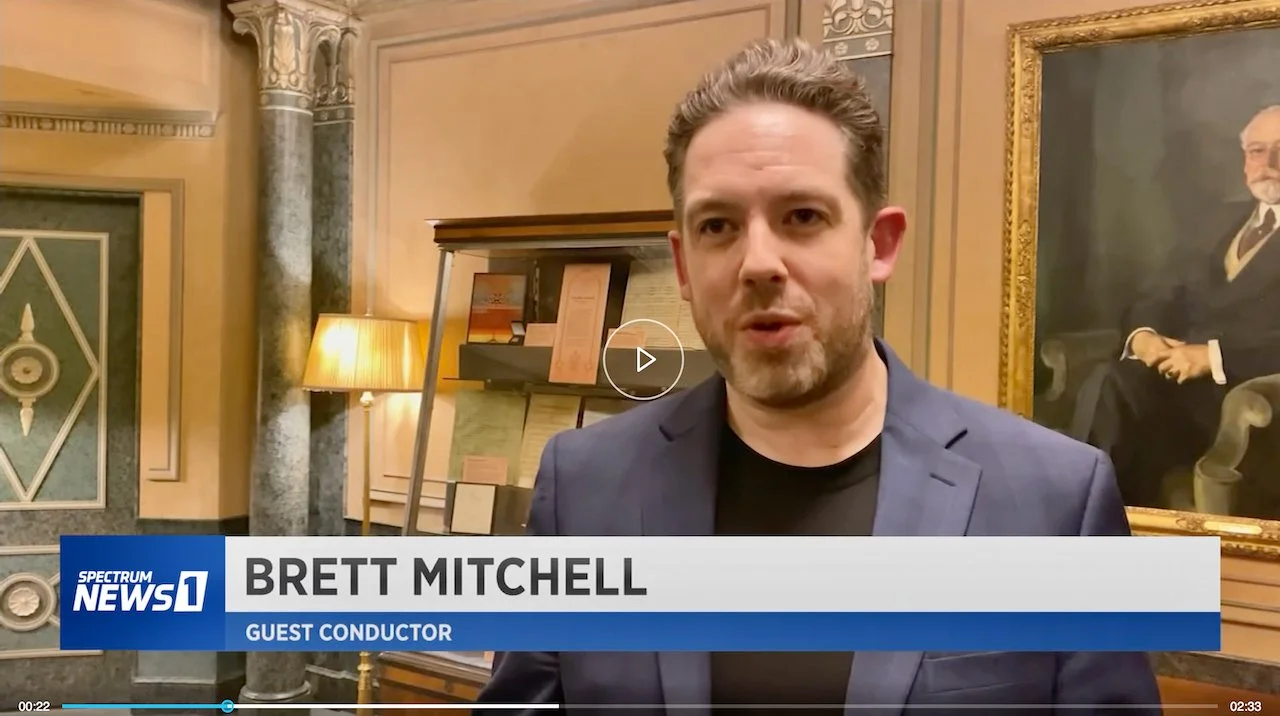
Brett Mitchell discusses The Cleveland Orchestra’s 2021 Holiday Concerts with Spectrum News 1.
CLEVELAND — Spectrum News 1 has published a story about The Cleveland Orchestra’s 2021 Holiday Concerts, including footage from the opening-night performance and an interview with guest conductor Brett Mitchell:
The world-renowned Cleveland Orchestra's Holiday Show is back this season.
'O come, all ye faithful' opens the show, as guest conductor Brett Mitchell leads the musicians and vocalists.
“To be able to have folks come in over the course of a dozen concerts like we’re doing over the next two weeks and to spend some of the holiday season with us, that’s really what this is about," said Mitchell
The Cleveland Orchestra Chorus, directed by Lisa Wong, is returning with the orchestra for its first in-person performance since 2020.
Mitchell told Spectrum News there is something different for everyone to enjoy.
There will also be guest vocalist, Capathia Jenkins, and guest choruses joining the stage on different days from such as Cleveland State University, the College of Wooster and Cleveland's Youth Chorus Chamber Ensemble.
Mitchel said the music is a reminder of how people from all different backgrounds can come together and celebrate being one.
“We all consequently grow up with this music. and so it takes everybody back to being a kid again and that for me is what the holidays are all about.”
To read the complete article and watch the video package, please click here.

Previews: Brett Mitchell leads The Cleveland Orchestra
CLEVELAND — Cleveland Classical has published a preview of The Cleveland Orchestra’s upcoming holiday performances, including an interview with guest conductor Brett Mitchell:
“What gets me excited about holiday concerts? Honestly, everything about them,” conductor Brett Mitchell said during a telephone conversation. “Every performance is for the audience, but these concerts really are for them. There’s so much opportunity for banter, and every crowd feels different.”
Mitchell pointed out a favorite quote of his from the late Stephen Sondheim, who said, the audience is the final collaborator. “And that is what we have been missing for the last two years in general, but particularly for this kind of program.”
Beginning on Thursday, December 9 at 7:30 pm, Brett Mitchell returns to Mandel Hall at Severance to lead The Cleveland Orchestra and Cleveland Orchestra Chorus in a holiday program devoted to music of the season. The concert also features director of choruses Lisa Wong as well as vocalist and Northeast Ohio favorite Capathia Jenkins. Performances continue through December 19. See our Concert Listings page for dates, times, and guest choirs. Tickets are available online.
Mitchell noted that the concerts are also a family affair where everyone in the audience gets dressed in their holiday finest. “It’s a special occasion for them, and to look out and see the kids and the magic in their eyes when ‘you know who’ makes his special entrance is so heartwarming.”
The conductor said that this year’s program is full of musical selections that will appeal to everyone. “The longest piece is only seven minutes — the ‘Waltz of the Flowers’ from Nutcracker. So if you’re not into one piece, just wait, because the next one is coming.”
He said that the selections are also intended to evoke the feeling of a homecoming, beginning with the first piece — Oh Come all ye faithful — which by tradition, serves as the opener for the Orchestra’s holiday concerts.
“It starts with just the voices and builds and builds,” Mitchell said. “Then there’s a big key change, and that’s when all the wreaths and bows and all of the other holiday finery lights up. Even though we’ve done it hundreds of times, it always has an emotional effect.”
Asked if he has a favorite piece on the program, Mitchell said that since one of his last projects as associate conductor of The Cleveland Orchestra was leading fully staged performances of The Nutcracker at Playhouse Square, “Waltz of the Flowers” is his sentimental favorite.
“But as a guy who was eleven years old in 1990 when Home Alone came out, getting to do ‘Somewhere in My Memory’ is very special, and it’s one the great holiday songs of all time. And right before that is another piece from Home Alone, ‘Holiday Flight.’ Getting to conduct both of these John Williams songs couldn’t be more exciting. It just takes me back to being an eleven-year-old again every time I hear that music. And if you can’t embrace that during the holidays, I don’t know when you can.”
Read additional brief previews from the Plain Dealer, cleveland.com, WKYC, and ideastream, and watch Mr. Mitchell preview these performances in the video below or on YouTube, Facebook, Twitter, or Instagram.
Previews: Brett Mitchell leads The Cleveland Orchestra's return to Blossom
CLEVELAND — As Brett Mitchell prepares to lead the opening weekend of The Cleveland Orchestra’s 2021 Blossom Music Festival, several news outlets have published previews of this program, excerpted below.
• CLEVELAND.COM •
2021 Cleveland Orchestra Blossom Music Festival calendar: A return to live music
The Cleveland Orchestra’s 2021 Blossom Music Festival kicks off this July 3-4 with a pair of holiday weekend concerts, both capped with fireworks. It’s the first time the orchestra will perform in front of a live audience since March of 2020.
The ensemble will be under the baton of conductor Brett Mitchell, with Michelle Cann as guest on piano. The concerts will be festive, holiday affairs, featuring works by Bernstein, Copland, Tchaikovsky, Sousa and more.
• CLEVELAND.COM •
Grand reunion ahead as Cleveland Orchestra opens 2021 Blossom Festival season
Music lovers aren’t the only ones headed for a major reunion at Blossom Music Center this weekend. No, the Cleveland Orchestra itself is also about to enjoy an important homecoming. When it convenes at its summer home with former associate conductor Brett Mitchell this Independence Day weekend, it’ll be the first time the full ensemble has appeared together since March 2020. “This is quite serious,” said chief brand officer Ross Binnie. “I think it will be extremely emotional. To see so many friends and fans I think will be powerful indeed. I think this will be one concert to say you were at.” …
Even as it celebrates the nation’s 245th birthday with fireworks and traditional favorites like Sousa’s “Stars and Stripes Forever” and Tchaikovsky’s “1812” Overture, the orchestra also will take some of its first steps on a new mission to better represent the country as a whole. Much of the 2021 Blossom Music Festival season consists of favorites, pieces Gidalevich called “chestnuts.” … This weekend, though, the orchestra is thinking along much different lines. It’s starting off featuring relatively unsung masterworks: music by three African-Americans, two of them women. In the mix with beloved works by Bernstein and Copland will be “An American Fanfare,” by Adolphus Hailstork; Concerto in One Movement, by Florence Price; and “Soul of Remembrance,” by Mary Watkins. “It’s a hard sweet spot to hit, but we made a concerted effort to make sure this looks more like an American program than in previous years,” [artistic administrator Ilya] Gidalevich said.
• CLEVELANDCLASSICAL.COM •
The Cleveland Orchestra Returns to Blossom Music Center
“The program is titled ‘An American Celebration,’ and while I’m certain there have been countless Fourth of July concerts over the decades with the same name, for me, this program feels truly American,” Mitchell said during a telephone conversation. “We’re certainly not going to ignore the holiday, so there will be the pieces that are associated with it — the 1812 Overture and Stars and Stripes Forever — but there was a desire to have the program be reflective of times that we are living in and that we have lived through since the Orchestra and audiences were last together.” …
Mitchell, who served on the Orchestra’s conducting staff from 2013 to 2017, noted that the evenings will open with Bernstein’s celebratory Overture. “We didn’t want a concert full of sis-boom-bah American repertoire, we wanted to acknowledge where we are and where we have been. And part of where we have been — as if anybody needs to be reminded why the Orchestra has not been able to perform for live audiences for sixteen months — is that we’ve all lived through a very difficult time. But that’s not entirely true because half a million of us did not survive the pandemic. So after the Candide we’ll play this gorgeous, heartbreaking piece, Mary D. Watkins’ Soul of Remembrance.”
The conductor said that he was introduced to the Watkins piece by a member of the Colorado Symphony. “Miss Watkins is a Denver-based African American composer, and when my friend played it for me I thought ‘my, this is beautiful.’” Mitchell described the piece as quiet and in places meditative. “She has a wonderful voice and a wonderful gift for immediate expression. I was only introduced to her music a couple of months ago and I can’t wait to dive into more of it. She seems to have a real knack for being able to communicate directly with the listener. There’s nothing opaque about it.” …
Florence Price’s Concerto in One Movement will feature pianist Michelle Cann, a graduate of both the Cleveland and Curtis Institutes of Music, and who now teaches at Curtis. “The piece is only eighteen minutes long but there’s so much wonderful material it feels like a Brahms concerto,” Mitchell said. “The music is just glorious and my great hope is that it will find its way into the permanent piano concerto repertoire. And it should because it is a sensational piece of music. I can guarantee that people are going to love it.” Click here to read Jarrett Hoffman’s interview with Michelle Cann.
Having had the opportunity to speak to Brett Mitchell on numerous occasions during his time in Cleveland, one thing that always struck me was his unabashed enthusiasm for newly-composed and long-neglected works. “I was a composer before I was a conductor, so I know what it’s like to write a piece and then hope that someone will play it,” he said. “I became a conductor to be the composer’s advocate and Mary D. Watkins and Florence Price deserve to be heard. If I can do anything to help introduce this great music to new ears, that’s the most fulfilling thing I can do.”
• NEW VIDEO RELEASE •
Aaron Copland: Introduction from Appalachian Spring
Mr. Mitchell has also recorded a solo piano arrangement of the Introduction from Aaron Copland’s Appalachian Spring, one of the works featured on the second half of this program. View the complete performance below, or watch on YouTube, Facebook, Twitter, or Instagram.
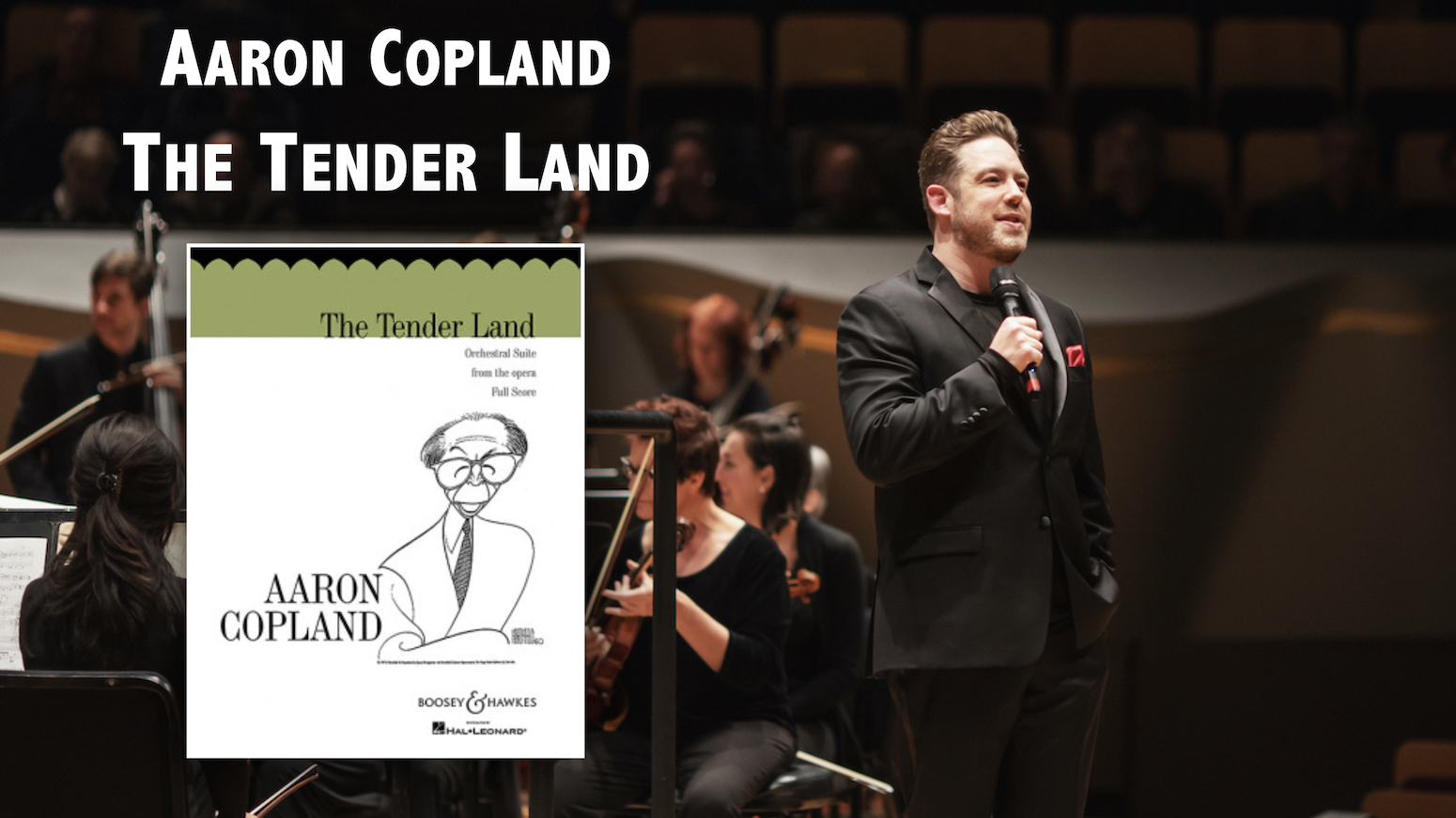
Video: Brett Mitchell explores Copland’s ‘The Tender Land’
DENVER — Brett Mitchell has released a new video exploring Aaron Copland’s Suite from The Tender Land.
Presented live at Boettcher Concert Hall in April 2018 as part of a program entitled The American Voice, Mr. Mitchell leads the Colorado Symphony in demonstrations exploring what makes the 1954 opera sound so distinctly American.
All three movements of the Suite are explored:
I. Introduction and Love Music
II. Party Scene
III. Finale: The Promise of Living
Watch the complete demonstration above, or learn more on YouTube, Facebook, and Twitter.

Video: The Mitchells commemorate Black History Month
Brett and Angela Mitchell record music of African American composers at home in February 2021.
Published Feb 5, 2021 Updated Feb 26, 2021
DENVER — Every Friday throughout Black History Month, Brett Mitchell and his wife, soprano Angela Mitchell, released a new recording of an art song by an African American composer.
H. Leslie Adams
“For you there is no song”
On February 5, the Mitchells released “For You There Is No Song” (1960) by Cleveland native H. Leslie Adams (b. 1932).
JOHN W. WORK III
“SOLILOQUY”
On February 26, the Mitchells released “Soliloquy” (1946) by Tennessee native John W. Work III (1901-67).
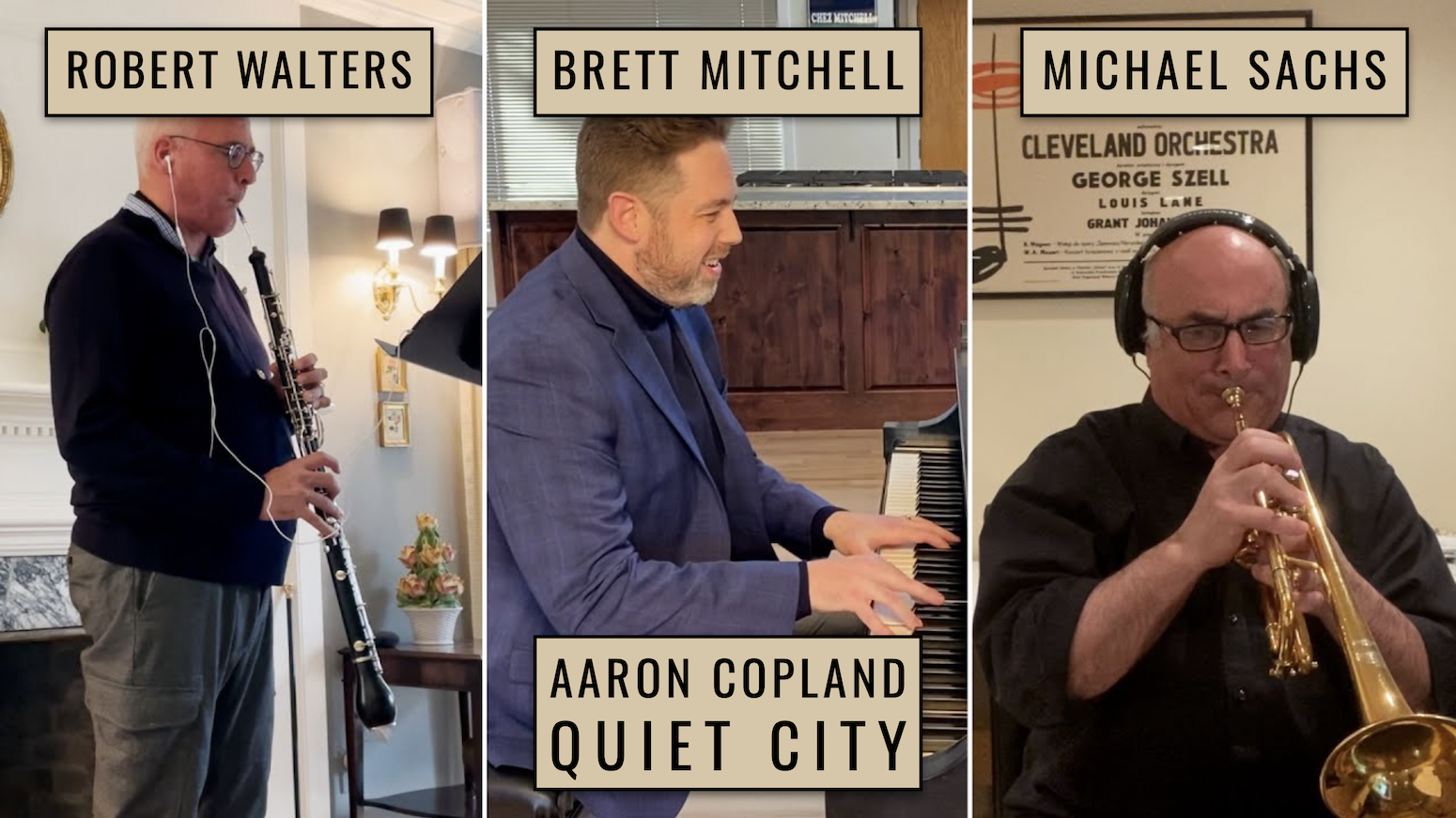
Video: Cleveland Orchestra musicians join Brett Mitchell for 80th-anniversary recording of Copland's 'Quiet City'
Robert Walters (English horn), Brett Mitchell (piano), and Michael Sachs (trumpet) perform Aaron Copland’s ‘Quiet City.’
DENVER — Cleveland Orchestra principal trumpet Michael Sachs and solo English horn Robert Walters join Brett Mitchell for a long-distance performance of Aaron Copland's Quiet City, recorded to commemorate the 80th anniversary of the piece's premiere on January 28, 1941.
Mr. Mitchell worked with Mr. Sachs and Mr. Walters from 2013 to 2017 while serving on the conducting staff of The Cleveland Orchestra, where Mr. Sachs has been principal trumpet since 1988 and Mr. Walters has been solo English horn since 2004.
Mr. Mitchell recorded his portion of this video in Denver, Colorado, on January 8. Mr. Walters and Mr. Sachs recorded their portions in Cleveland, Ohio, on January 15 and 19, respectively.
Enjoy the complete performance below, or watch on YouTube, Facebook, Twitter, and Instagram.

Video: Brett Mitchell explores Mahler 9 with the Colorado Symphony
Brett Mitchell and a virtual ensemble of Colorado Symphony musicians explore Mahler's Ninth Symphony.
DENVER — The Colorado Symphony and Music Director Brett Mitchell have released a new video exploring Gustav Mahler’s Ninth Symphony.
Mr. Mitchell and the orchestra were to have performed the work in May 2020, but those performances were canceled due to the COVID-19 outbreak.
Instead, Mr. Mitchell explores the work from the piano at home, and is joined virtually by members of the Colorado Symphony for demonstrations of three orchestral excerpts from Mahler’s final masterpiece.
Mr. Mitchell is also joined by his wife, soprano Angela Mitchell, for demonstrations from Mahler’s Kindertotenlieder and the hymn Abide With Me.
The video originally premiered on Wednesday, September 9 on both YouTube and Facebook, and may now be viewed on both platforms on demand.

Gustav Mahler (1909)
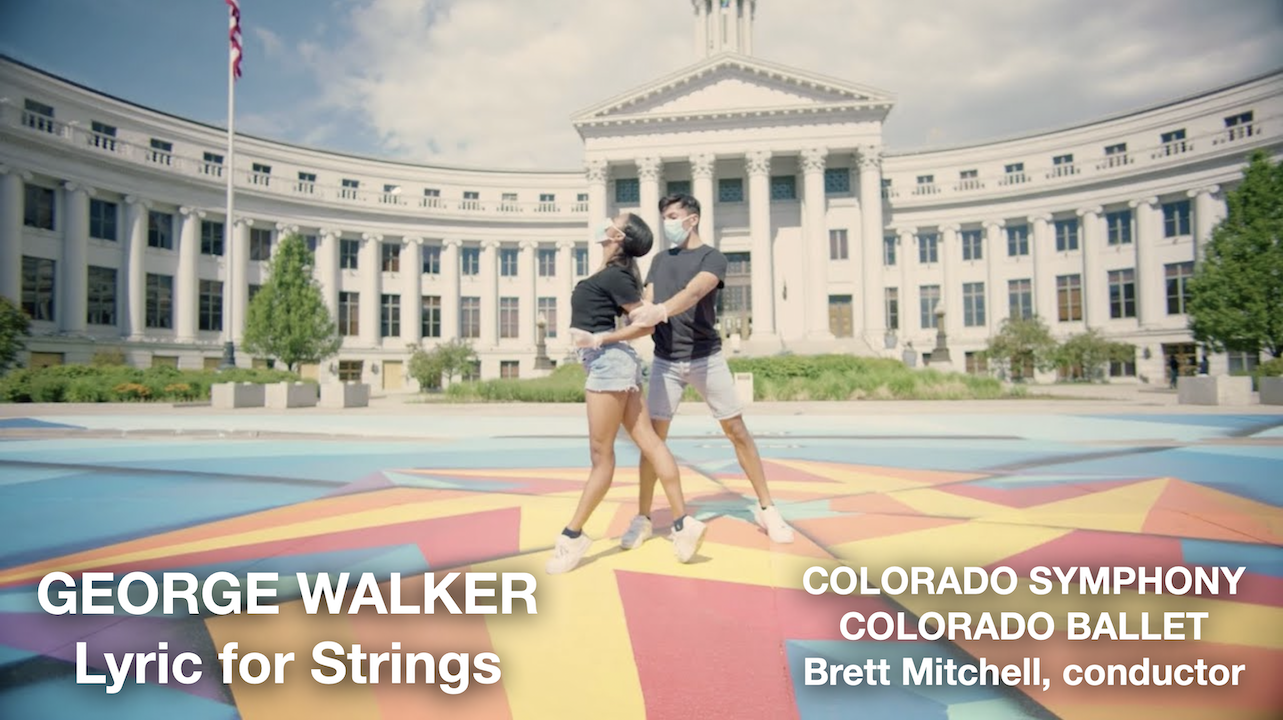
Video: Brett Mitchell leads Colorado Symphony in world-premiere collaboration with Colorado Ballet
Colorado Ballet dancers Sheridan Guerin and Alejandro Perez-Torres perform original choreography for George Walker’s ‘Lyric for Strings,’ as recorded by the Colorado Symphony and Music Director Brett Mitchell.
DENVER — The Colorado Symphony and Music Director Brett Mitchell have released a video of their new, world-premiere collaboration with Colorado Ballet.
On Thursday, June 11, Mr. Mitchell and nine members of the Colorado Symphony’s string section convened in Boettcher Concert Hall for the first time since mid-March to record George Walker’s Lyric for Strings.
Mr. Walker—the first African American to win the Pulitzer Prize for Music—composed the work in 1946, but it spoke directly to choreographer Sandra Brown about the current American moment:
"I could feel and hear parts of the music that were just crying out to me about the pain and the sorrow that people are dealing with right now. It's our job as artists to take what we're feeling and present it to the community and empathize with the community."
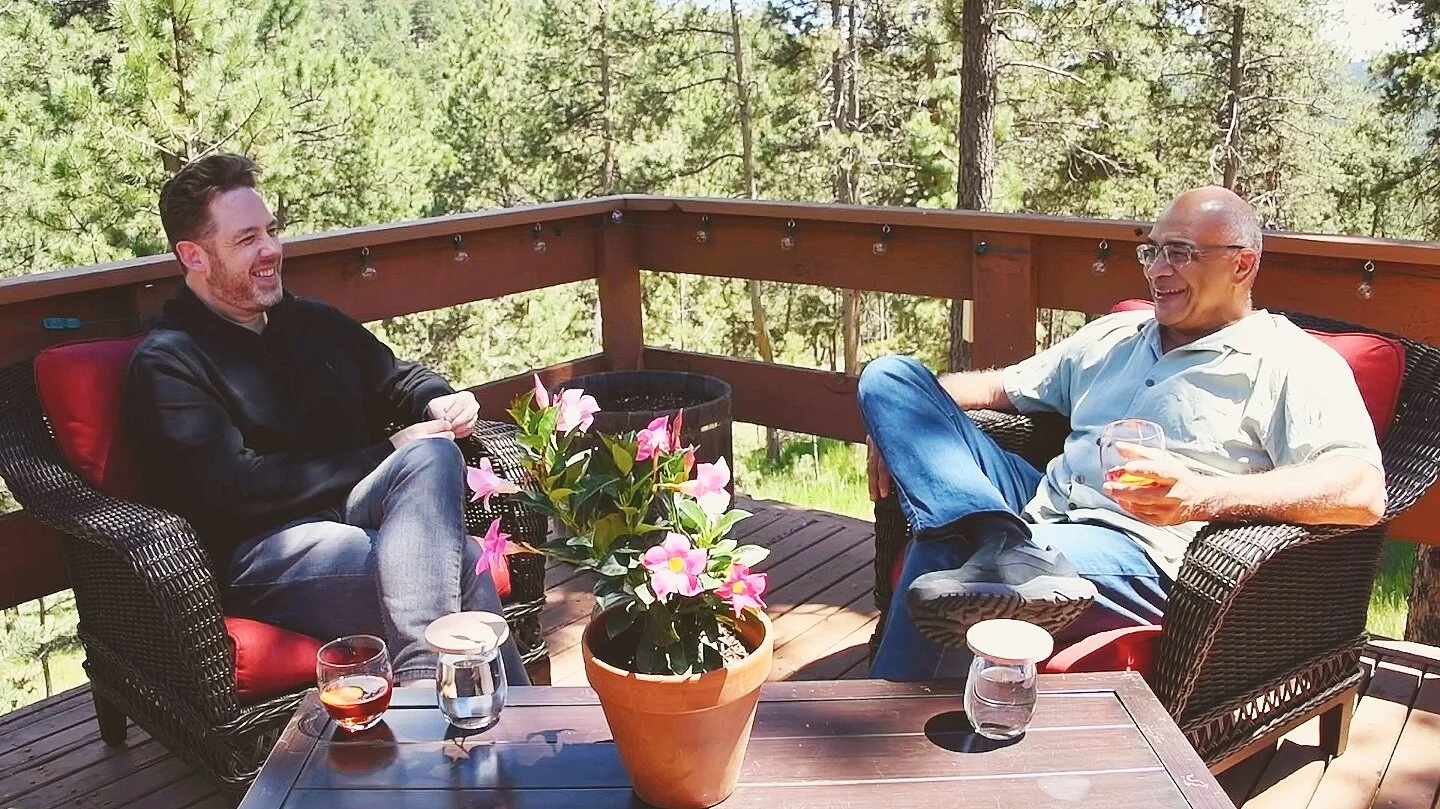
Video: Brett Mitchell and Basil Vendryes discuss race in classical music
Brett Mitchell and Basil Vendryes recorded their conversation on Wednesday in Golden, CO.
DENVER — Brett Mitchell sits down with Basil Vendryes, Principal Violist of the Colorado Symphony, for a candid, extended conversation about race in classical music. Watch the complete conversation below.

World premiere video: Brett Mitchell and the Colorado Symphony explore Wagner’s ‘Ring’
Brett Mitchell introduces the Colorado Symphony’s latest Virtual Music Hour: ‘The Ring without Words.’
DENVER — From May 22 to 24, as part of its ongoing Virtual Music Hour series, the Colorado Symphony will present never-before-seen video of its April 2018 performances of The Ring without Words, a selection of orchestral highlights from Richard Wagner’s Ring cycle as arranged by Lorin Maazel. Music Director Brett Mitchell explains how the project came to Denver:
“In my late twenties, I was very fortunate to be mentored by the great conductor Lorin Maazel. One of the many pieces we delved into during our time together was his arrangement of orchestral highlights from Richard Wagner’s Ring cycle, which Maazel affectionately titled The Ring without Words. When I accepted my position at the Colorado Symphony, I knew right away that I wanted to bring this incredible masterpiece to our audience, not just because of the greatness of Wagner’s music, but also because of my personal relationship with Maazel. When I reached out to Maestro’s widow to let her know we’d be doing this piece, I was stunned and incredibly moved when, a few weeks later, I received from her one of Maestro’s last batons with which to conduct the weekend’s performances. For so many reasons, it remains one of the most meaningful programs I’ve ever led, and one I’ll certainly carry with me for the rest of my life.”
Before presenting a complete performance of the piece, Mr. Mitchell and the orchestra shared with the audience various leitmotifs, compositional techniques, and plot points from Wagner's score:

COVID-19 update: Colorado Symphony plays on
The Colorado Symphony has launched several initiatives to continue bringing music to its audience throughout the COVID-19 outbreak, including the newly announced Virtual Music Hour.
DENVER — Following the postponement of the Colorado Symphony’s concert activity through May 11, Brett Mitchell has filmed several messages to introduce its audience to new initiatives aimed at continuing to bring music to their audience throughout the COVID-19 outbreak.
The first video previews a series of solo and ensemble performances taped in Colorado Symphony musicians’ homes, shared via online video. “Just because we’re not together in Boettcher Concert Hall doesn’t mean the music has stopped.”
Watch the full message below:
On Thursday, April 2, Mr. Mitchell announced a second series, Virtual Music Hour, in which select large-scale works from previous seasons will be streamed each weekend on the Colorado Symphony’s website. He also announced the work to be streamed during the series’s first weekend (Apr. 3-5): Beethoven’s Symphony No. 7.
We begin this new series with one of the most uplifting, joyous pieces ever composed: Beethoven’s Seventh Symphony, the so-called “Apotheosis of the Dance.”
If anyone understood the struggle of self-distancing and isolation — something we’ve all learned a little more about over the past few weeks — it was Beethoven. When he was barely 30 years old, he wrote a heartbreaking letter to his brothers, saying that because of his ever-worsening hearing loss, "I was compelled early to isolate myself, to live in loneliness."
And yet, a decade later, even as his hearing continued to decline, and solitude became the rule rather than the exception, Beethoven showed us with this Seventh Symphony that no matter how dark things may seem, there is always hope, always the possibility of joy. And if there was hope for Beethoven, there is hope for all of us.
How grateful we can be to Beethoven for a reminder like that in times like these.
Watch the complete announcement below:

Video: Brett Mitchell discusses John Williams’s score for ‘Return of the Jedi’
Brett Mitchell and host Karla Walker in the Colorado Public Radio studios. (Photo by Hart Van Denburg/CPR)
DENVER — Before leading the Colorado Symphony in Star Wars: Return of the Jedi later this week (Feb. 27-29, more info here), Brett Mitchell sat down with host Karla Walker in the Colorado Public Radio Performance Studio to explore some of the highlights of John Williams's iconic soundtrack.
After reviewing themes from A New Hope (original breakdown here) and The Empire Strikes Back (original breakdown here), Mr. Mitchell explores the new themes Mr. Williams created for characters in Return of the Jedi, including Luke and Leia, the Emperor, Jabba the Hutt, and the Ewoks.
Watch the full video and listen to the audio version below, or read the complete story on CPR.org: WATCH: The Iconic Musical Themes Of ‘Return Of The Jedi,’ Explained.
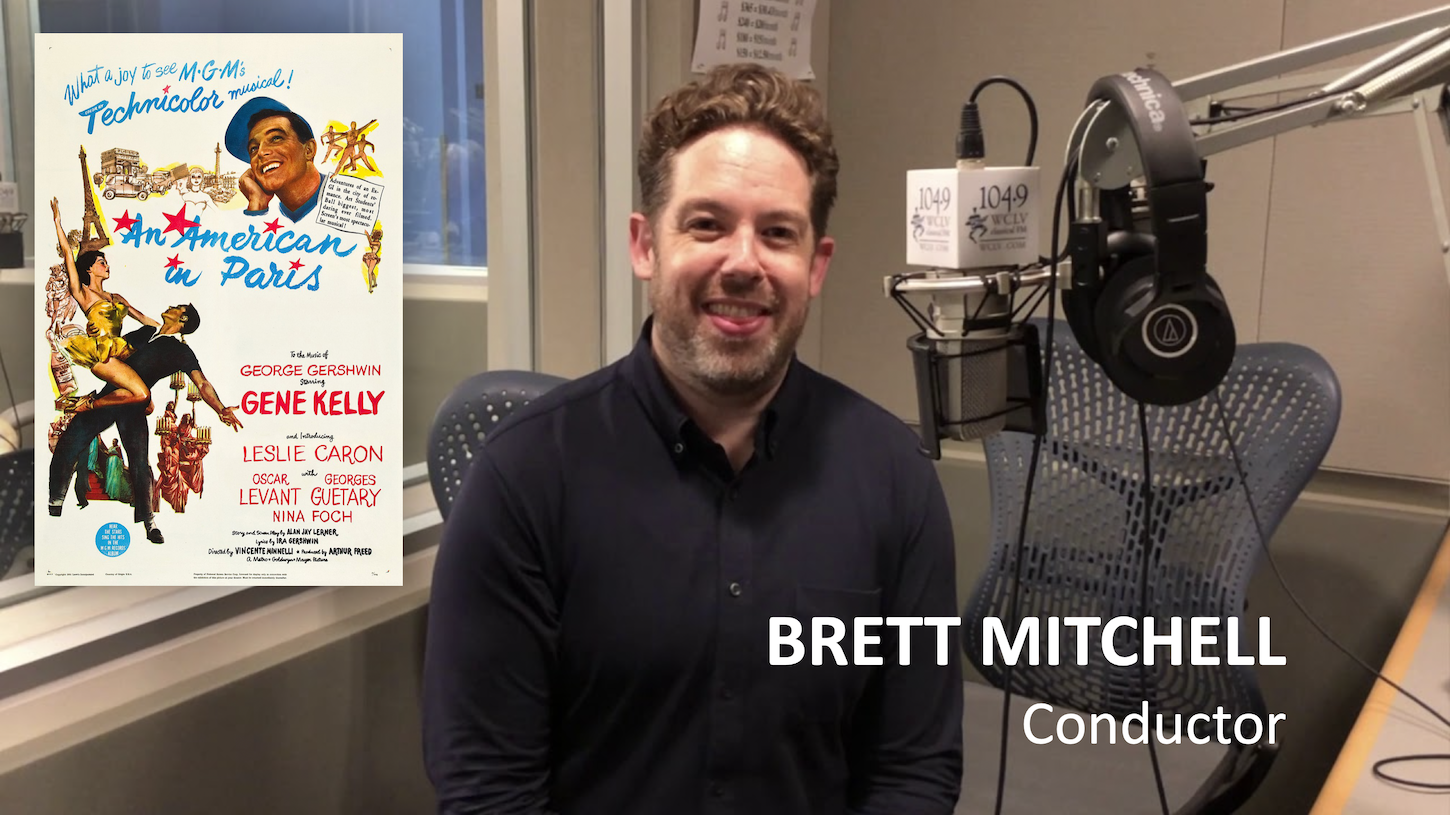
Preview: 'An American in Paris' with The Cleveland Orchestra
CLEVELAND — The Cleveland Orchestra has published several behind-the-scenes videos previewing their upcoming performances of the classic 1951 film ‘An American in Paris’ led by guest conductor Brett Mitchell.
In the first video, Mr. Mitchell explores the methods and challenges of syncing a live orchestra in 2019 with singing and dancing in a film made almost 70 years ago: