NEWS
Review: ‘Alec Baldwin Brings Lincoln’s Legacy to Pasadena Symphony’s Season Finale’
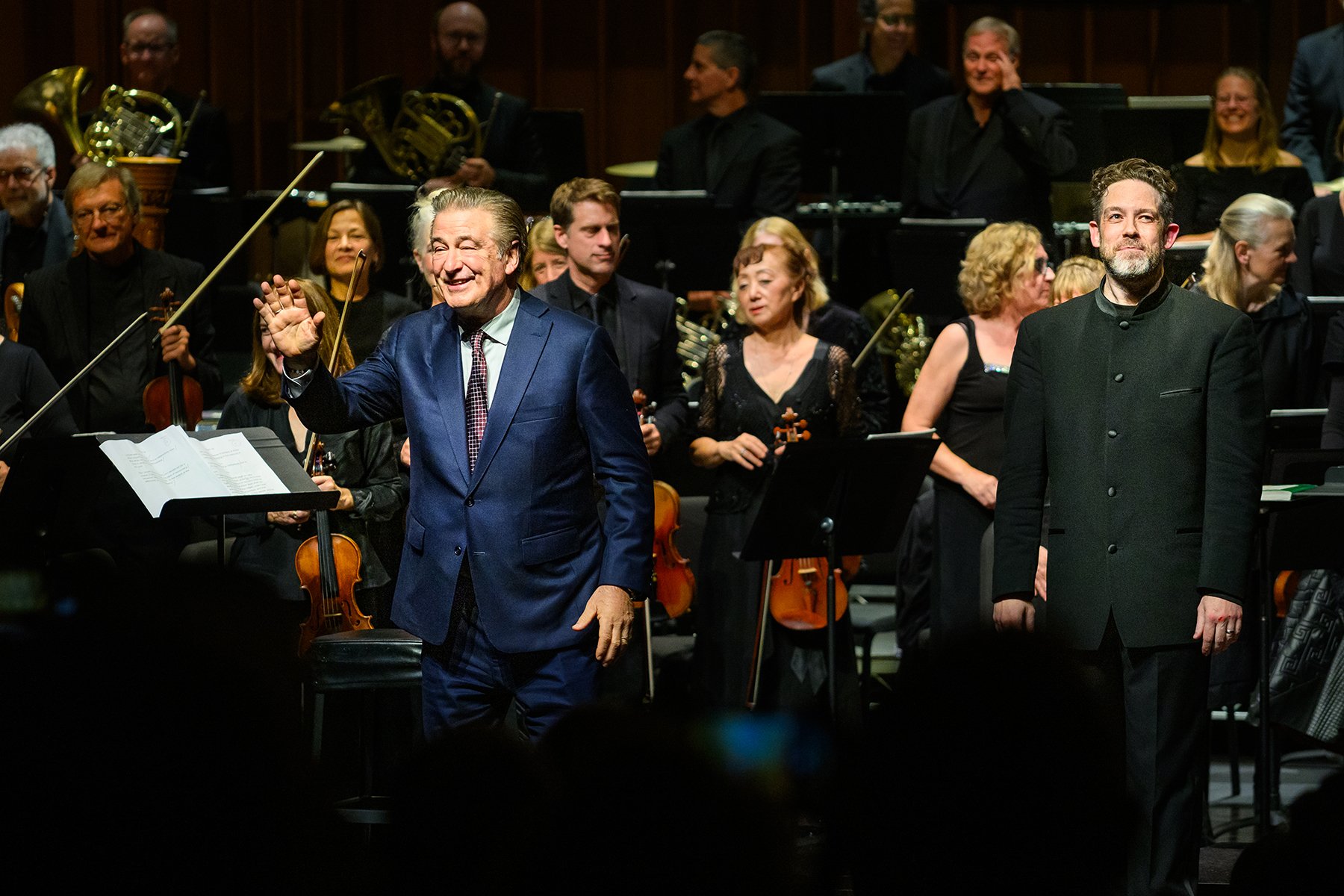
Narrator Alec Baldwin, Music Director Brett Mitchell, and the Pasadena Symphony at the Ambassador Auditorium. (Photo by Jamie Pham)
PASADENA — Local News Pasadena has published a review of the Pasadena Symphony’s 2025-26 season finale, Brett Mitchell’s second as Music Director:
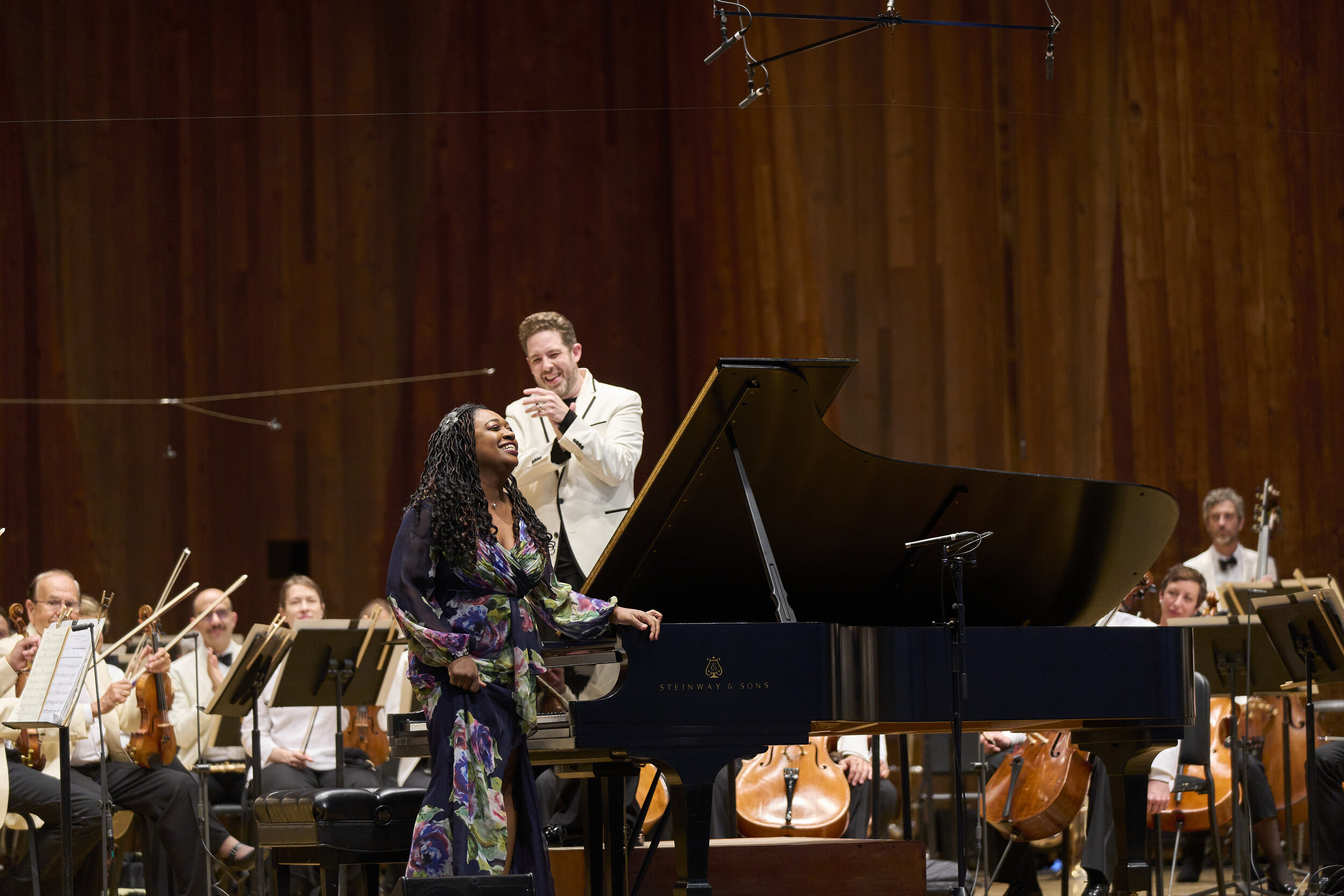
The Pasadena Symphony closed its season at Ambassador Auditorium with a program titled America at 250, celebrating the nation’s upcoming 250th anniversary. The evening combined American compositions with reflections on democracy, immigration, and national identity, culminating in a moving performance of Aaron Copland’s Lincoln Portrait narrated by actor Alec Baldwin.
As is tradition, the symphony hosted its pre-concert “Insights” discussion an hour before the performance. Conductor Brett Mitchell, KUSC radio host Brian Lauritzen, and pianist Terrence Wilson provided historical background and musical context that enriched the audience’s experience throughout the evening.
The concert opened with John Williams’ Liberty Fanfare, composed in 1986 to commemorate the centennial of the Statue of Liberty. Mitchell noted that Williams had previously written the highly successful Olympic Fanfare and Theme for the 1984 Los Angeles Olympics, making him a natural choice for another national celebration.
“The dude knows how to write a fanfare,” Mitchell quipped. “It’s a humdinger.”
The piece immediately set a celebratory tone, filling the hall with the bold, unmistakably American sound that has made Williams one of the nation’s most recognizable composers.
Gershwin’s American Sound
A substantial portion of the pre-concert discussion focused on George Gershwin’s Concerto in F for Piano and Orchestra, the evening’s longest work and a centerpiece of the program. The concerto, composed in 1925, was performed by Grammy-winning, Juilliard-trained pianist Terrence Wilson alongside the Pasadena Symphony.
Lauritzen, Mitchell, and Wilson enthusiastically explored Gershwin’s innovative use of harmony. They described tonic chords as musical “home” and dominant chords as creating a sense of movement or being “away.” Gershwin’s playful manipulation of those relationships became one of the hallmarks of his style, shaped in part by the rich cultural influences surrounding him as the son of Russian-Jewish immigrants.
Mitchell demonstrated these harmonic tensions at the piano, bringing the discussion to life for audience members.
Because conductor Walter Damrosch of the New York Symphony Orchestra was so captivated by Gershwin’s Rhapsody in Blue, he commissioned the composer to create a larger, more ambitious work. The result was the three-movement Concerto in F.
The first movement, Allegro, opens with energetic orchestral rhythms before yielding to a blues-infused piano solo. Mitchell shared his own struggles as a young musician learning to authentically “swing,” underscoring the unique challenge of blending classical precision with jazz sensibility. Wilson, however, made the style sound effortless.
The second movement, Adagio, offered a more reflective atmosphere, highlighted by expressive solos from the woodwinds and brass, including a memorable muted trumpet passage.
The finale, Allegro agitato, was described by Gershwin himself as an “orgy of rhythms.” Wilson and the orchestra delivered a dazzling performance that brought the audience to its feet.
Gershwin’s enduring legacy rests largely on his pioneering fusion of classical music and jazz. As Mitchell observed, “Gershwin wanted to put jazz into classical music and classical music into jazz.” The uniquely American sound he created helped define the Roaring Twenties and continues to resonate today.
Aaron Copland and the American Landscape
The second half of the program featured two works by Aaron Copland, another son of Jewish immigrants whose music became synonymous with the American experience.
Mitchell explained that Copland initially gained recognition for more dissonant, rhythmically complex compositions influenced by modernism and jazz. In later works, however, he embraced a more open and accessible style that listeners came to associate with the American landscape.
One of the finest examples is Appalachian Spring, written for choreographer Martha Graham. Although Copland originally called the work Ballet for Martha, Graham later suggested the title that audiences know today, inspired by a line from a poem by Hart Crane.
When the piece premiered in 1945, audiences remarked that they could almost see the hills and smell the air of Appalachia. Through spacious harmonies and folk-inspired melodies, Copland created a musical portrait of optimism, community, and possibility.
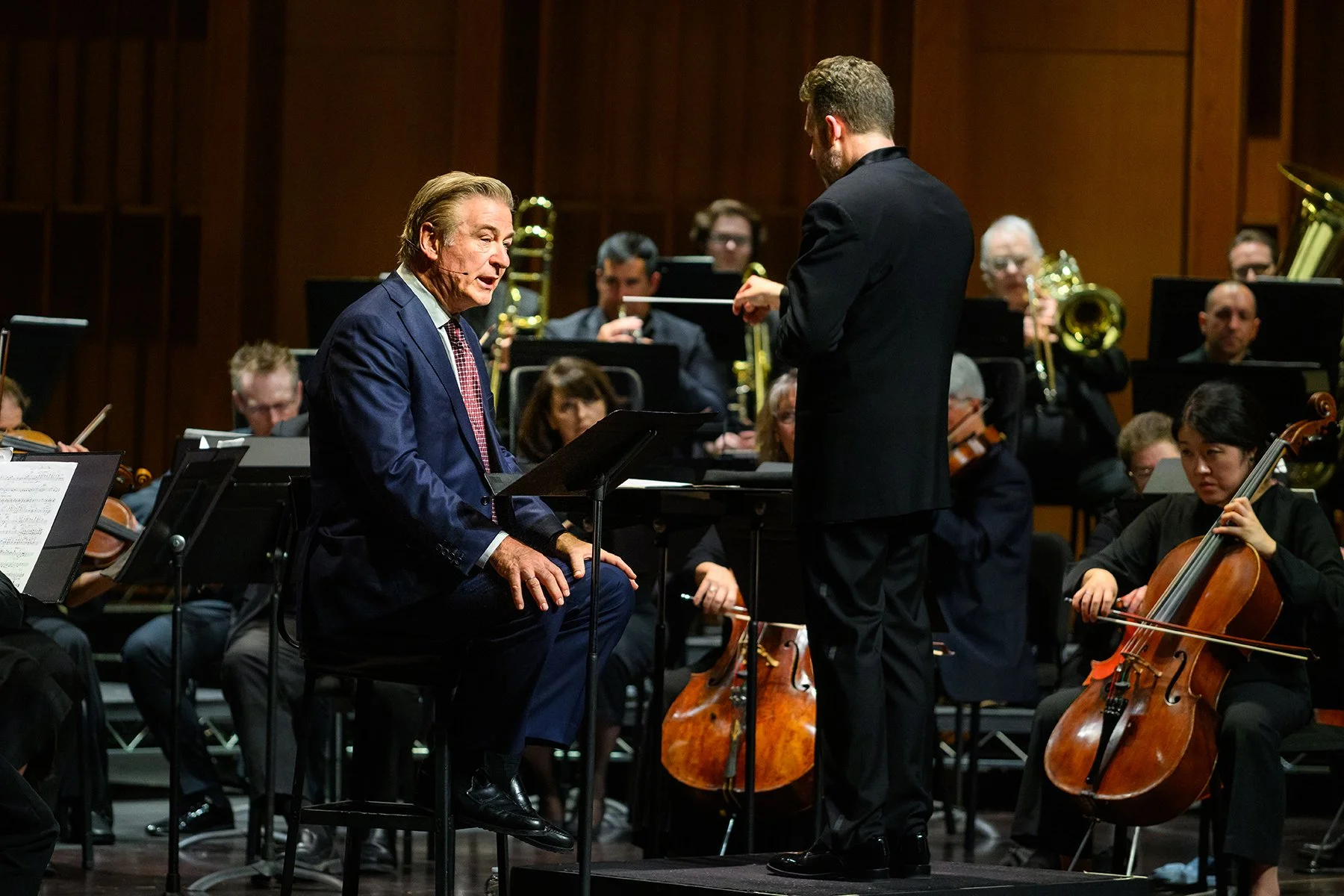
Alec Baldwin narrates Copland’s Lincoln Portrait with the Pasadena Symphony and Music Director Brett Mitchell. (Photo by Jamie Pham)
Lincoln’s Words for Then—and Now
The evening concluded with Copland’s Lincoln Portrait, commissioned in 1942 as America entered World War II. Conductor André Kostelanetz envisioned the work as a patriotic statement that would remind audiences of the nation’s democratic ideals during a time of global crisis.
For this performance, Mitchell invited actor Alec Baldwin to serve as narrator.
After a musical introduction incorporating the folk tunes “Camptown Races” and “Springfield Mountain,” Baldwin delivered Lincoln’s words.
“Fellow citizens, we cannot escape history,” he began in his characteristically booming, resonant baritone. “We of this Congress and this administration will be remembered despite ourselves.”
The audience sat transfixed as Baldwin delivered passages drawn from Lincoln’s speeches and writings, including excerpts addressing slavery, democracy, equality, and civic responsibility. Written during the darkest years of the Civil War, Lincoln’s words felt strikingly relevant today.
Perhaps most powerful was hearing these reflections from December 1862, when the war’s outcome remained uncertain, and the nation appeared irreparably divided. Lincoln offered neither easy optimism nor false reassurance. Instead, he called on Americans to meet their responsibilities with courage and conviction.
More than 160 years later, his message still resonates.
Throughout the hall, audience members wiped away tears as Baldwin’s narration merged seamlessly with Copland’s soaring score. The work became more than a historical tribute. It felt like a reminder that democracy has endured moments of profound division and that its survival has always depended on ordinary citizens’ willingness to uphold its ideals.
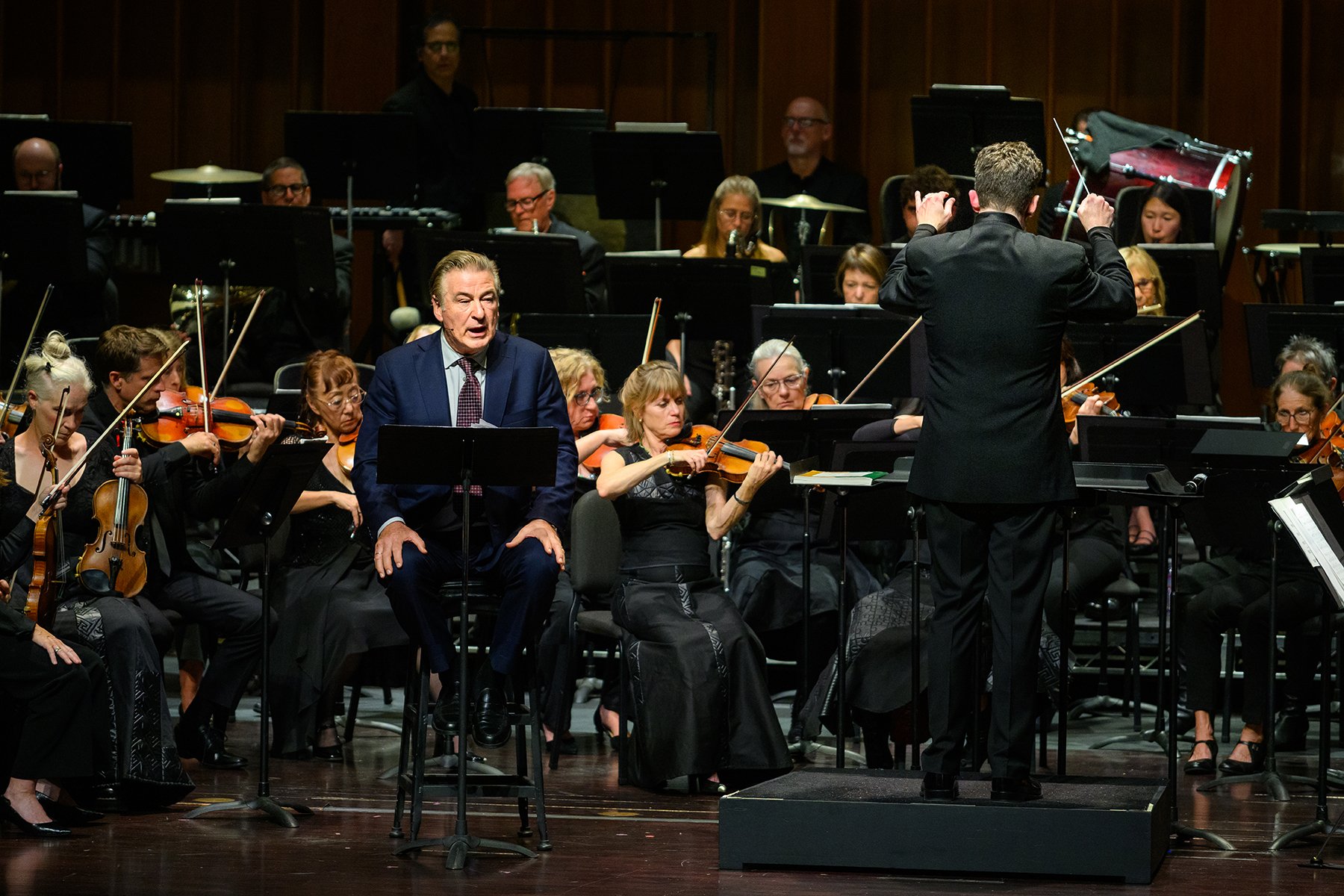
Alec Baldwin narrated the words of President Lincoln as set to music by Aaron Copland on the Pasadena Symphony’s 2025-26 season finale under Music Director Brett Mitchell. (Photo by Jamie Pham)
A Message of Hope
The evening showcased the work of some of America’s greatest artists: Lincoln, whose words continue to inspire; Copland and Gershwin, who helped define an American musical identity; and the performers who brought their visions to life.
Under Brett Mitchell’s leadership, with outstanding performances by Terrence Wilson, Alec Baldwin, and the Pasadena Symphony, America at 250 became a meditation on the nation’s history, its struggles, and its possibilities.
At a time when many Americans question the strength of the institutions that bind us together, hearing Lincoln’s voice once again, through Baldwin’s compelling narration and Copland’s majestic score, offered something increasingly rare: reassurance that the nation has faced great tests before and emerged stronger because citizens chose hope over despair.
For one evening in Pasadena, that message felt both timely and deeply moving.
To read the complete review, please click here.
Review: ‘Jazzy Fun and a Riotous Finale at the Pasadena Symphony’
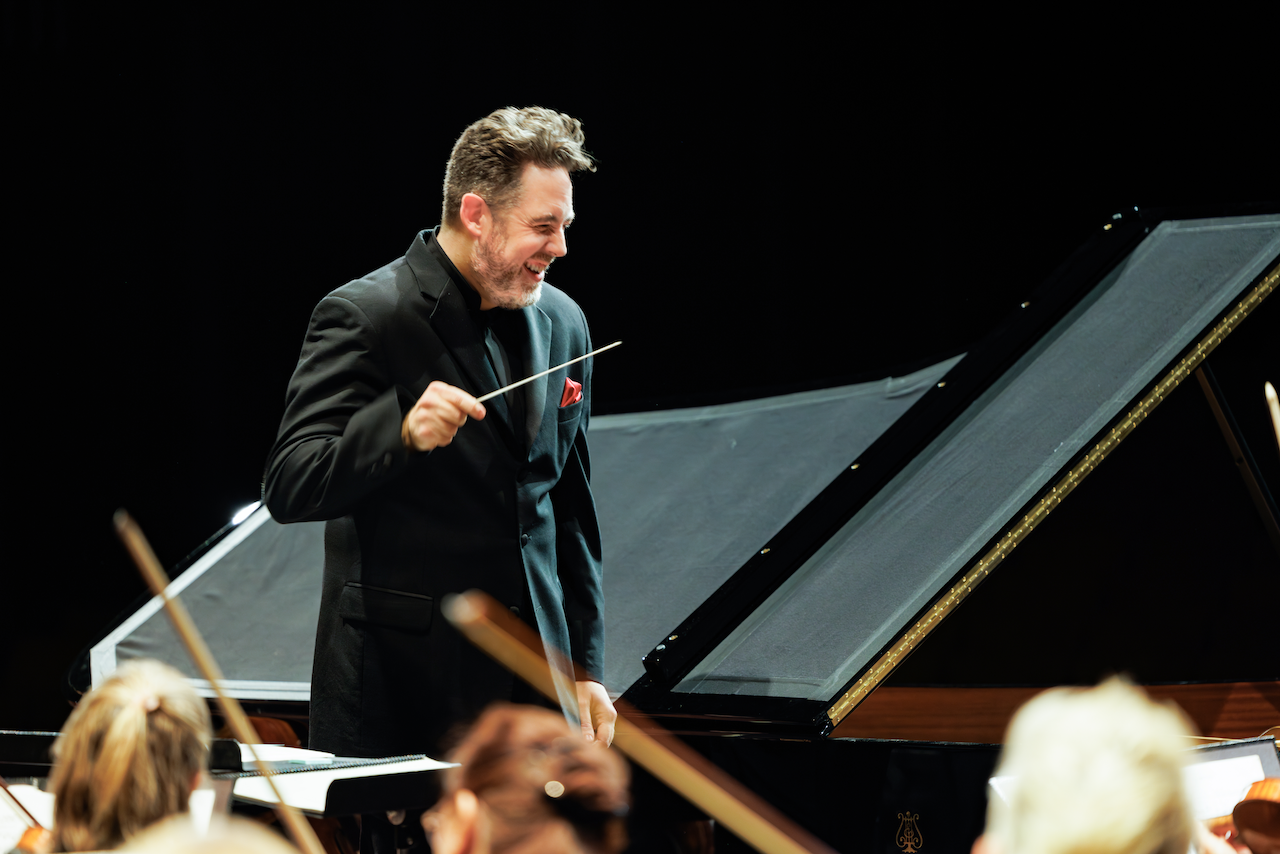
Music Director Brett Mitchell leads the Pasadena Symphony at the Ambassador Auditorium. (Photo by Courtney Lindberg)
PASADENA — San Francisco Classical Voice has published a review of the opening program of the Pasadena Symphony’s 2025-26 season, Brett Mitchell’s second as Music Director:
Just a week after Halloween, Hector Berlioz’s spooky Symphonie fantastique took center stage at the Pasadena Symphony’s season-opening concert. Outside on Nov. 8, it was an appropriately foggy evening for devilish music. Inside the Ambassador Auditorium, Music Director Brett Mitchell warmed up the hall with a weighty program that also featured sunny jazz-inspired compositions by Maurice Ravel and Jim Self.
Beginning his second season with the Pasadena Symphony, Mitchell enjoys communicating with his audience and provided extensive descriptions and background for each piece, which made for a lengthy but educational evening.
The program’s opener, held special personal significance for Mitchell and the orchestra. Besides his prolific life as a composer, Jim Self was Pasadena’s principal tuba for 50 years (1975–2025) and played in many other ensembles in the L.A. area. He also performed as a veteran studio musician on 1,500 soundtracks for film and television, becoming the “go-to” tubist for film composers. His most memorable gig was providing the “Voice of the Mothership” in John Williams’s score for Steven Spielberg’s Close Encounters of the Third Kind.
Tour de Force: Episodes for Wind Ensemble was programmed as a 50th anniversary tribute to Self, assuming the composer would be there to take a bow. Sadly, however, Self died just days before the performance, at the age of 82. Mitchell called for a moment of silence in his memory.
The most popular of Self’s 90 published works, Tour de Force was inspired by the European tour he took with the Pacific Symphony in 2006. Scored for a large…ensemble with augmented percussion, it unfolds in nine loosely connected (and not programmatic) episodes. In a note, Self admitted that the piece was “certainly not classical, profound, or groundbreaking,” but “fun, mildly provocative, rhythmically interesting, jazzy, bluesy, and Latin at times.”
The Pasadena Symphony…made a strong case for this rousing and noisy curtain-raiser, which, not surprisingly, draws upon Self's long career in movie scoring for its energy, splashy sound effects, accessibility, and short attention-getting outbursts. The music may not be “great,” but the jazzy atmosphere and dynamic contrasts between larger and smaller groups of instruments made for an entertaining and ear-opening experience.
Tour de Force and the Ravel Piano Concerto in G Major that followed had something in common: the influence of George Gershwin. Episode Five of Tour de Force ends with a “Gershwin-like clarinet solo,” and the piece throughout uses the jazzy “stacked fourth” chords Gershwin was fond of.
Pianist Orion Weiss brought Ravel’s jazzy inflections to the surface of this performance in his delicate, perceptive, and refined interpretation. His account of the sublime second-movement Adagio followed a clear and lyrical line, with shimmering trills and hushed dynamics. Mitchell coaxed fine solo work from the woodwinds, prominent in the spare scoring. The racing downward scales of the final Presto had verve and propulsion, reminiscent of passages from Petrushka by Igor Stravinsky, Ravel’s contemporary in Paris.
Berlioz’s Symphonie fantastique requires sustained energy and physical stamina from the conductor, orchestra — and perhaps the audience. Mitchell led with commitment and precision, showing that his connection with the orchestra has deepened since his inaugural season last year…
The work tells a personal story of the composer’s own romantic obsession with the actress Harriet Smithson. Beginning in dreamy infatuation, it progresses, finally to diabolical ruin in a riotous sonic orgy, one of the great climaxes in the symphonic literature… Mitchell and the Pasadena Symphony…managed to capture the drama of Berlioz’s star-crossed journey.
To read the complete review, please click here.

Review: ‘Participating in the ritual: Central Oregon’s Sunriver Music Festival’
Artistic Director & Conductor Brett Mitchell leads the Sunriver Music Festival Orchestra in Aug. 2025 at the Tower Theatre in Bend, Ore. (Photo by David Young-Wolff)
SUNRIVER, Ore. — Oregon ArtsWatch has published an extensive review of the final three concerts of the 2025 Sunriver Music Festival, Brett Mitchell’s fourth as Artistic Director & Conductor.
Participating in the ritual: Central Oregon’s Sunriver Music Festival
The joys and miracles of live music in the rustic Great Hall, with SRMF director Brett Mitchell, concertmaster Yi Zhao, pianist and Cliburn medalist Vitaly Starikov, and an orchestra full of stars.
The heat wave that baked much of the Pacific Northwest for a few days last week was in full force as the final concerts of the 48th annual Sunriver Music Festival began. Taking place in the rustic charm of the Sunriver Great Hall, which was once the officer’s HQ at Camp Abbott during the Second World War, the festival took us from Leipzig to Vienna with some strange stops in between…
Monday the 11th was “The Leipzig Connection,” and opened with Schumann’s Manfred Overture; an interesting factoid was that Robert and Clara’s great-great granddaughter was in the audience that night. There was plenty of sturm und drang during the Manfred, and I did my best to hear over the oft-featured horns and woodwinds. The strings were rich and woody, somehow appropriate to this venue as if in a strange “like to like” principle…
Yi Zhao, concertmaster, was the soloist [in Mendelssohn’s Violin Concerto], and her cantabile portions were fantastic… She leaned into the sentimentality of the opening movement, and her scalar passages were well-constructed as she was ably supported by the orchestra. The attacca bassoon into the second movement was a delight, and being delighted by the first bassoonist Anthony Georgeson was to become a regular feature of my time here. Zhao wrung the pathos out of the lower registers, sounding very viola-like. The tutti serenade was beautiful… The finale was appropriately spritely and dancing, and Zhao really shone here, as her rapid-fire sautillé toward the end positively sparkled. I’m not sure what the classical music scene as a whole is like in Central Oregon these days, but since the demise of the Cascade Festival of Music, I imagine there are not many other chances to hear tremendously important works of this caliber in the region.

Sunriver Music Festival Orchestra Concertmaster Yi Zhao and Artistic Director & Conductor Brett Mitchell. (Photo by David Young-Wolff)
Earlier in the first half, conductor and Artistic Director Brett Mitchell (read his interview with Matthew Neil Andrews, and get more detail on the festival and venue here) mentioned that anyone who achieved a certain level of piano aptitude likely learned some of Mendelssohn’s Songs Without Words at some point in their playing career. Those ones escaped me, but us little Baroque boys instead sometimes learned a piano transcription of the work that opened the second half, the now-(though not always)-famous Toccata and Fugue in D Minor BWV 565 by good old Uncle Bach, the great Johann Sebastian. Originally composed for the organ (though there is apparently some argument as to whether Bach himself actually composed it), the work languished in relative obscurity until Leopold Stokowski’s famous orchestral transcription appeared in Walt Disney’s Fantasia about the time the Sunriver Great Hall was being built. Mitchell pointed out that the number of musicians required to play that particular transcription might be almost equal to that night’s orchestra plus all the members of the audience, so the rendition played here was Australian composer Luke Styles’ brilliantly scaled-down version for percussion, strings, and a small wind section.
A startling simultaneous trill on tambourine and triangle underpinned an abrupt and almost comical exposition of the famous toccata theme by the winds at the opening. The huge, menacing chords built from the ground up by the winds were fantastic, and the woodblock chattered behind arpeggiating strings. Gently the strings carried the majority of the fugal opening, and the descending scales were parted out to various instruments in clever salvos. The percussion accents were various and vital, and all in all this work with its light touch and deft instrumentation was a breath of fresh air for those (like me) who consider Stokowski’s version weighted and a bit stodgy.
The finale of the evening was Bach’s Orchestral Suite No. 3 in D Major BWV 1068, the perfect piece for a summer music festival, right up there with Handel’s Music for the Royal Fireworks or his Water Music suite. Mitchell led the orchestra deftly in a marvelous rendition of the “Overture,” this gem of stylized Baroque grandeur at its finest with its succinct trumpet fanfares set one after another in a filigree of majestic fortissimo timpani rolls. In the second movement, whose main theme is sometimes known as the Air on the G String, the strings played this timeless melody in a broad, handsome largo. In the Gavottes the interpolations from the principal trumpet Jeffrey Work ended with breathtakingly gentle terminal trills, in opposition to the wide, bold cadential trills he delivered later in the Gigue. The evening left me excited for more of the festival, and ready for whatever peregrinations would lead us to Vienna for the final evening…

Brett Mitchell leads the Sunriver Music Festival Orchestra at the Great Hall in Sunriver, Ore. (Photo by David Young-Wolff)
Miracles
The final night of the festival took us as promised to Vienna, after the ethereal and mystical stops of the previous evening. The evening opened, appropriately enough, with a work by Haydn, Symphony No. 96 in D Major, Hob. I:96, also nicknamed the “Miracle.” The opening was appropriate because the other great Viennese masters Mozart and Beethoven were also programmed this evening, and Haydn was at one point Beethoven’s teacher, and was a friend and mentor to Mozart for most of the latter’s life, with Mozart even dedicating six of his string quartets to “Papa Haydn”…
The SRMF’s performance featured some magical moments. Principal oboe Lindabeth Brinkley was absolutely top-notch: her delicacy of phrasing, her ability to combine the sweet with the powerful during the opening “Adagio” made me wish that movement would never end. The winds generally were fantastic while I was there; the little trios and quartets that manifested themselves here and there were constantly among the highlights of any performance. The fine tutti sections in the finale were strong, punctuated without being overblown, and the finesse required from the brass and winds to deliver a first-rate performance was everywhere in evidence.
Much as it had been at The Cliburn earlier in the summer, it was a true pleasure to hear Vitaly [Starikov] play multiple concerts in one week, and his back-to-back performances at SRMF were a highlight of my year. He chose the Piano Concerto No. 17 in G Major, K. 453 to play at the SRMF…
In the “Andante” the woodwinds again showed their caliber: the very highest. They displayed unity and precision in an almost uncannily unified timbre to come from such disparate instruments; if I have ever heard a more dulcet bassoon than Georgeson playing the Mozart that evening, I can’t remember when it was. The soloist played misterioso, giving this movement everything we love about a Mozart andante; it was soulful and hauntingly melodic. He has a sensitivity to his attack, a way of leaning into the instrument and bringing his hands down in such a way that it feels like he is going to disgorge some frightfully loud chord – and then he puts all that tremendous energy into the softest cantabile imaginable…
My friend Jon was with me for both the Leipzig and Vienna concerts. He is a musician himself, and we shared our insights with one another throughout the week. He commented that he thought a really great soloist can raise the level of the orchestra, and I agreed with him, and in this case, I thought that two things were going on; that is to say there was a feedback loop between soloist and orchestra, as though each kept upping their game, as if each were daring the other to do better. The orchestra was spectacular in this work, and I was as impressed with Starikov’s Mozart as I was with his solo work, which is about the highest praise I can think of.
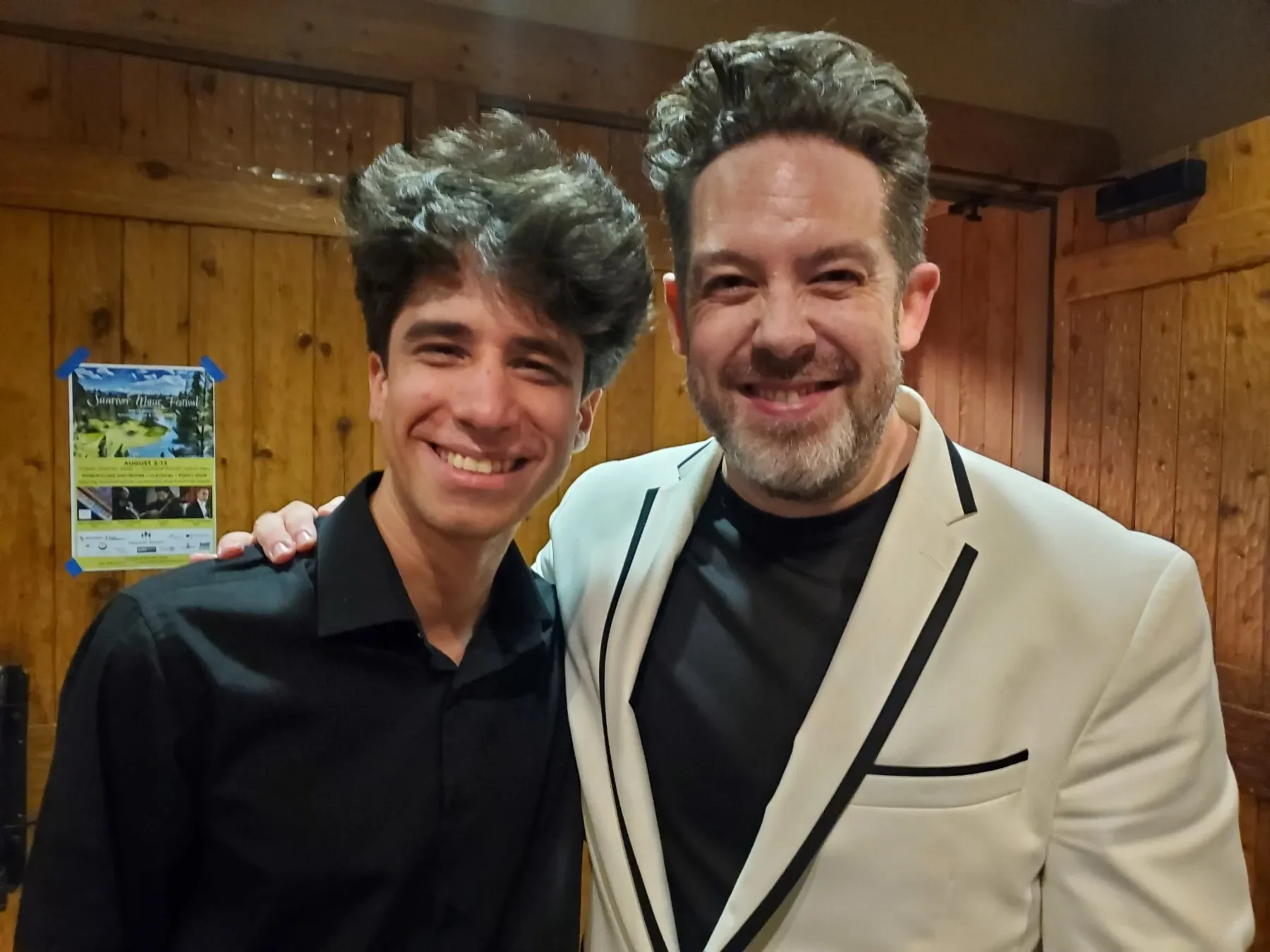
Pianist Vitaly Starikov and conductor Brett Mitchell after performing Mozart’s Piano Concerto No. 17 with the Sunriver Music Festival Orchestra. (Photo by Jimena Shepherd)
Talk about your all-time festival favorites, what better way than to round off the festival than by playing Beethoven’s Symphony No. 5 in C Minor, Op 67…
The opening four notes are maybe the most famous four notes in music history, and their execution is something of a matter of personal choice by the conductor. Mitchell chose here to launch straight into it with no fanfare, no ritardando or undue accenting: he simply played them as they were written: the opening bit of an “Allegro con brio,” and this worked really well. Let’s not milk it, I thought, there is so much other great stuff here, and we will get to hear this motive many more times tonight. The brisk tempo was also a great choice, and the strings were obviously having great fun – this was their chance to shine, and the phrasing was nuanced and intelligent, with sensitive piannisimi, giving the music plenty of room to grow dynamically.
I began to note various things live that I maybe don’t pay as much attention to when I listen to a recording. Things like the bitter battles between strings and winds, the importance of the bassoon as an anchor to the harmonies, the small but vital horn entrances on which the ensuing parts hang. In the “Andante con moto” I noticed just how difficult the contrabass parts were, and how much fun the double bassists Jason Schooler and Clinton O’Brien had on their fortissimo cadential endings, the one-note whomps! they got to play at the end of a phrase… I heard how the cellos and violas sounded at times delightfully like a collection of woodwinds; their ability to change color, chameleon-like in this fashion is something I don’t note unless I’m sitting there, reveling in the glory. The sudden and surprising crescendi, the tootling piccolo hits in the “Scherzo” – the list goes on and on.
As the Beethoven ended, I pondered the incredible possibilities and synergies that develop when performers and audience gather at the same time, to participate in the ritual, the very real magic known as live music. Though this was my first time attending, the Sunriver Music Festival, in its 48th year, feels like the gift that just keeps on giving. Here’s to 48 more.

Brett Mitchell and the Sunriver Music Festival Orchestra after performing Beethoven’s Symphony No. 5. (Photo by David Young-Wolff)

‘An Impressive Philharmonic Debut’: Brett Mitchell Steps In at the New York Philharmonic
Brett Mitchell leads the New York Philharmonic at David Geffen Hall. © Brandon Patoc
NEW YORK — On May 16, 17, and 18, Brett Mitchell stepped in for his subscription debut with the New York Philharmonic, leading three performances of Kevin Puts's The Brightness of Light featuring soprano Renée Fleming and baritone Rod Gilfry, followed by the complete score of Ravel's Daphnis et Chloé featuring the New York Philharmonic Chorus.

Review: With Last-Minute Conductor Swap, Philharmonic Soldiers On
Brett Mitchell led the New York Philharmonic in the local premiere of a song cycle by Kevin Puts, featuring the soprano Renée Fleming.

"The Philharmonic announced on Thursday afternoon — just a day before the concerts — that [Juanjo] Mena would not be conducting… Instead, the conductor Brett Mitchell, the music director of California's Pasadena Symphony and a newcomer to the Philharmonic, stepped in. Mitchell possesses the right credentials, having led The Brightness of Light at the Colorado Symphony with Fleming and Gilfry in 2019. Still, this was no easy task given his truncated rehearsal time and lack of familiarity with the players... School may be almost out, but the Philharmonic passed this particular test with grit."

New York Philharmonic with Renée Fleming & Rod Gilfry — Brett Mitchell conducts Puts and Ravel
Stepping in for Juanjo Mena, Brett Mitchell made an impressive Philharmonic debut.
"Under Mitchell, the Philharmonic was rhythmically secure and well-attuned to the nuances of Puts's captivating score, and electrifying in the rapturous rendition of 'The High Priestess of the Desert'."
"Mitchell expertly managed [Daphnis et Chloé's] frequent tempo changes, alternating between languid wooing, ceremonial processions, exhilarating dances, sudden scenes of conflict, and tumultuous revelry... The vocalizing of the 60-member NY Philharmonic Chorus, meticulously prepared by Malcolm J. Merriweather, provided additional color and strength to this ravishing rendition."

"The Philharmonic was not left out of Puts's efforts—not only in the marvelously, intricately orchestrated songs, but in a pair of Orchestral Interludes, 'Georgia and Alfred' and 'The High Priestess of the Desert'—through which conductor Mitchell drew sweep and passion. He was a last-minute substitution on the podium, though he had conducted the work once before. Still, he did a stellar job, as did the ensemble."


"Complete scores of ballets can flag in concert without dancers to sustain interest, but the hour-long performance of Daphnis et Chloé had no such problem Friday night. Conductor Mitchell smoothly managed Ravel's constant tempo changes, ushering in stately processions, infectious dances, languid wooing, sudden battles, and ecstatic revelry by rapid turns. (The list of tempo markings alone occupied an entire page of the Philharmonic program.)"

"There is a pleasing lyricism to Puts' writing here, and the Philharmonic produced an appropriately warm coloring under conductor Brett Mitchell, a last-minute replacement…"
"Mitchell rounded out the program with a complete performance of Daphnis et Chloé, the latest in the Philharmonic's ongoing celebration of Ravel's 150th anniversary... Mitchell kept the action moving seamlessly in a work that can easily turn a conductor into a traffic cop, and...the Philharmonic's reading offered a performance delightfully varied in color and style."


"In his Philharmonic debut, Brett Mitchell was a last-minute replacement... Even on short notice, Mitchell was well prepared for the Puts cycle, having conducted the work in 2019 as music director of the Colorado Symphony, one of the work's co-commissioners... The conductor paced both works nicely, with a good sense of where the Puts needed to breathe."

Brett Mitchell leads the New York Philharmonic at David Geffen Hall. © Brandon Patoc
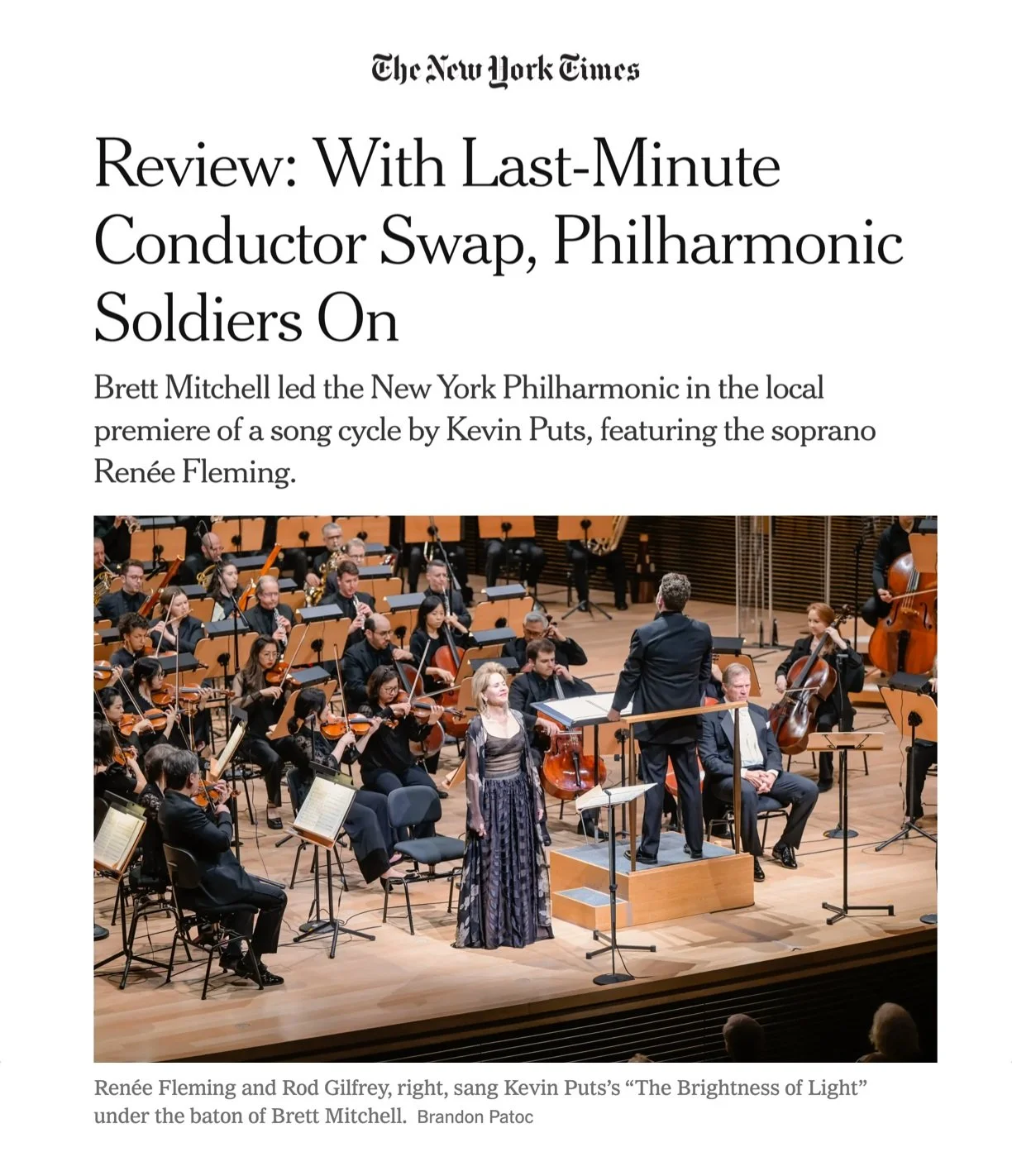
New York Times Review: ‘With Last-Minute Conductor Swap, Philharmonic Soldiers On’
NEW YORK — The New York Times has published a review of Brett Mitchell’s eleventh-hour subscription debut with the New York Philharmonic:
The final weeks of an orchestra’s season can feel like the end of school: Everyone’s worn down and summer is beckoning. Last week’s program at the New York Philharmonic had that mood even before a late-breaking curveball that tested the orchestra further.
The Spanish conductor Juanjo Mena was to be on the podium for the New York debut of Kevin Puts’s “The Brightness of Light,” an orchestral song cycle featuring the soprano Renée Fleming and the baritone Rod Gilfry, along with Ravel’s rapturous “Daphnis et Chloé.”
But the Philharmonic announced on Thursday afternoon — just a day before the concerts — that Mena would not be conducting…
Instead, the conductor Brett Mitchell, the music director of California’s Pasadena Symphony and a newcomer to the Philharmonic, stepped in. Mitchell possesses the right credentials, having led “The Brightness of Light” at the Colorado Symphony with Fleming and Gilfry in 2019. Still, this was no easy task given his truncated rehearsal time and lack of familiarity with the players.
“The Brightness of Light” is a portrait of the artist Georgia O’Keeffe and her husband, the photographer Alfred Stieglitz. For the libretto, Puts uses selections from their correspondence — from the heady rush of their early relationship through its souring and O’Keeffe’s deepening romance with the landscape of New Mexico. (This work expands on an earlier piece with Fleming, “Letters,” that relies solely on O’Keeffe’s perspective.)
Puts, who also wrote the opera “The Hours” with Fleming in mind, adores her voice’s glowing luminosity; his orchestral writing often bathes her in shining halos of sound, and on Friday she returned the favor. Gilfry, who was also making his New York Philharmonic debut, handled Stieglitz with polish, though the role functions as little more than a foil for O’Keeffe’s personal and artistic evolution.
The music was accompanied by Wendall K. Harrington’s visuals, which included projections of work by O’Keeffe and Stieglitz, images of the couple’s letters, and libretto supertitles. Puts leans on the projections to do the storytelling; the music often feels more like accompaniment than main attraction. Still, he illustrates the couple’s complicated relationship with verve and humor, deploying rapid percussion to express the nervous, bright energy of new love, and a hacking, squawking violin solo (played by the concertmaster Frank Huang) to go with the lines “I’ve labored on the violin till all my fingers are sore — You never in your wildest dreams imagined anything worse than the notes I get out of it.” (A little on the nose, but enjoyable nonetheless.)
Then came the Ravel, played with a steely determination to get through the not-ideal circumstances… School may be almost out, but the Philharmonic passed this particular test with grit.
To read the complete review, please click here.
(A version of this article appeared in print on May 21, 2025, Section C, Page 2 of the New York edition with the headline: “Last-Minute Switch Steps Up to Podium. A newcomer conducts a song cycle featuring Renée Fleming.”)

Review: New York Philharmonic with Renée Fleming and Rod Gilfry - Brett Mitchell conducts Puts and Ravel
Conductor Brett Mitchell and New York Philharmonic Chorus director Malcolm J. Merriweather onstage with the New York Philharmonic. © Brandon Patoc
Stepping in for Juanjo Mena, Brett Mitchell made an impressive Philharmonic debut.
NEW YORK — Classical Source has published a review of Brett Mitchell’s recent subscription debut with the New York Philharmonic:
Based on the 30-year-long, almost-daily correspondence between American painter Georgia O’Keeffe and the German-born photographer Alfred Stieglitz, Kevin Puts’s Brightness of Light is an expansion of his 2015 song-cycle, Letters from Georgia. Composed for Renée Fleming and Rod Gilfry in 2019, the highly programmatic piece is difficult to categorize. Enhanced by Wendall K. Harrington’s engaging and evocative projection design – which utilizes videos of O’Keeffe and images by both artists and copies of some of their letters – the opus touches on every aspect of the couple’s tumultuous relationship, from their first, business-like meeting, through their initial ardor and post-marriage cooling off, to their final separation, which left them physically distant though still emotional entwined…
Under [Brett] Mitchell, the Philharmonic was rhythmically secure and well-attuned to the nuances of Puts’s captivating score, and electrifying in the rapturous rendition of ‘The High Priestess of the Desert’. There were many memorable moments, most notably concertmaster Frank Huang’s humorous, scordatura-tuned accompaniment to O’Keeffe’s narration of her own attempts to play the violin, and the tuned gongs in the concluding ‘Sunset’.
Somewhat long-winded, with an outlandish scenario based on a 2nd century quasi-mythic love story involving a goatherd, a shepherdess, a herdsman, pirates and the god Pan, Daphnis et Chloé is perhaps best appreciated by simply sitting back and marveling at Ravel’s miraculous music. Mitchell expertly managed the score’s frequent tempo changes, alternating between languid wooing, ceremonial processions, exhilarating dances, sudden scenes of conflict, and tumultuous revelry. Flute, clarinet, horn, and trumpet soloists were uniformly eloquent, and Nancy Allen (recognized at intermission for her 25 years as the Philharmonic’s principal harp) delivered particularly graceful glissandos. The vocalizing of the 60-member NY Philharmonic Chorus, meticulously prepared by Malcolm J. Merriweather, provided additional color and strength to this ravishing rendition.
To read the complete review, please click here.

Review: ‘Kevin Puts Has Georgia (and Alfred) on His Mind in BRIGHTNESS at NY Philharmonic’
Soprano Renée Fleming, conductor Brett Mitchell, and baritone Rod Gilfry perform Kevin Puts’s ‘The Brightness of Light’ with the New York Philharmonic. © Brandon Patoc
Renee Fleming and Rod Gilfry Thrill in Helping Bring Correspondence to Musical Life with Conductor Brett Mitchell
NEW YORK — Broadway World has published a review of Brett Mitchell’s recent subscription debut with the New York Philharmonic:
This past weekend, composer Kevin Puts’s BRIGHTNESS OF LIGHT, based on the long, abundant correspondence of artist Georgia O’Keeffe and photographer/gallerist Alfred Stieglitz, had its long overdue New York premiere, with the New York Philharmonic under debuting conductor Brett Mitchell, and soprano Renee Fleming as O’Keeffe and baritone Rod Gilfry as Stieglitz, friends and lovers (marital and otherwise)…
The Philharmonic was not left out of Puts’s efforts—not only in the marvelously, intricately orchestrated songs, but in a pair of Orchestral Interludes, “Georgia and Alfred” and “The High Priestess of the Desert”—through which conductor Mitchell drew sweep and passion. He was a last-minute substitution on the podium, though he had conducted the work once before. Still, he did a stellar job, as did the ensemble…
Filling out the program was Ravel’s “Daphnis et Chloe (Choreographic Symphony in Three Parts),” which had been written by the composer for the Ballets Russes in 1912. It ran from the rhapsodic to the anarchic and back again, and was exciting to hear even if it's not among Ravel's most frequently played works.
Again, Mitchell didn’t have much time with the orchestra when he was parachuted in to replace Juanjo Mena, who was a last-minute cancellation, but the performance nonetheless ran smoothly… The New York Philharmonic Chorus, under Malcolm Merriweather, added greatly to the overall effect of the piece, becoming one more element of the orchestra.
To read the complete review, please click here.
Review: ‘Noisy and pastoral love vie in mixed Philharmonic program’

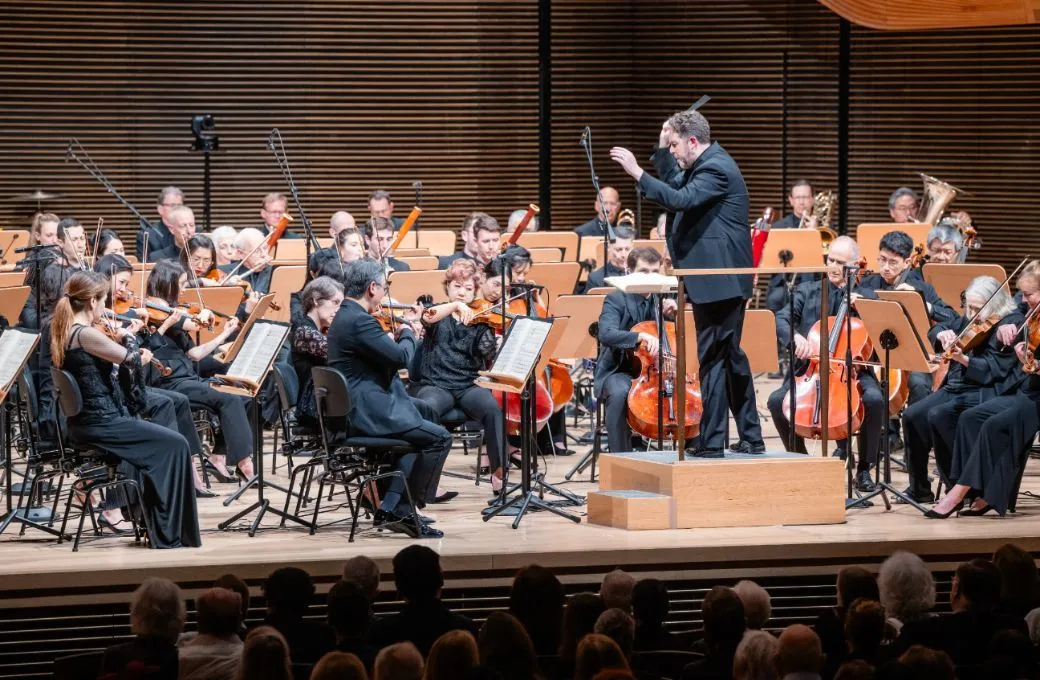
Brett Mitchell conducts the New York Philharmonic. © Brandon Patoc
NEW YORK — New York Classical Review has published a review of Brett Mitchell’s recent subscription debut with the New York Philharmonic:
Complete scores of ballets can flag in concert without dancers to sustain interest, but the hour-long performance of Daphnis et Chloé had no such problem Friday night. One could try to picture in one’s mind the ballet’s wacky scenario involving religious rites, shepherdesses and pirates, or one could just sit back and appreciate Ravel’s mastery of orchestral color and atmosphere. Ravel extracted two suites from this score, the second of which has become a familiar concert item, but it turns out the material in between the excerpts is almost as interesting.
Conductor [Brett] Mitchell smoothly managed Ravel’s constant tempo changes, ushering in stately processions, infectious dances, languid wooing, sudden battles, and ecstatic revelry by rapid turns. (The list of tempo markings alone occupied an entire page of the Philharmonic program.)
The wordless singing of the New York Philharmonic Chorus, directed by Malcolm J. Merriweather, put a human presence in the scene, whether cooing over the lovers or shouting for joy in the work’s closing revels.
Wind soloists and concertmaster Frank Huang had their eloquent say in the score’s quieter moments. Ripping arpeggios and tinkling nature sounds were contributed by harpist Nancy Allen, who was recognized before the performance for her 25 years as the Philharmonic’s principal harp.
To read the complete review, please click here.
Review: ‘Scenes from a marriage: The Brightness of Light at the NY Philharmonic’
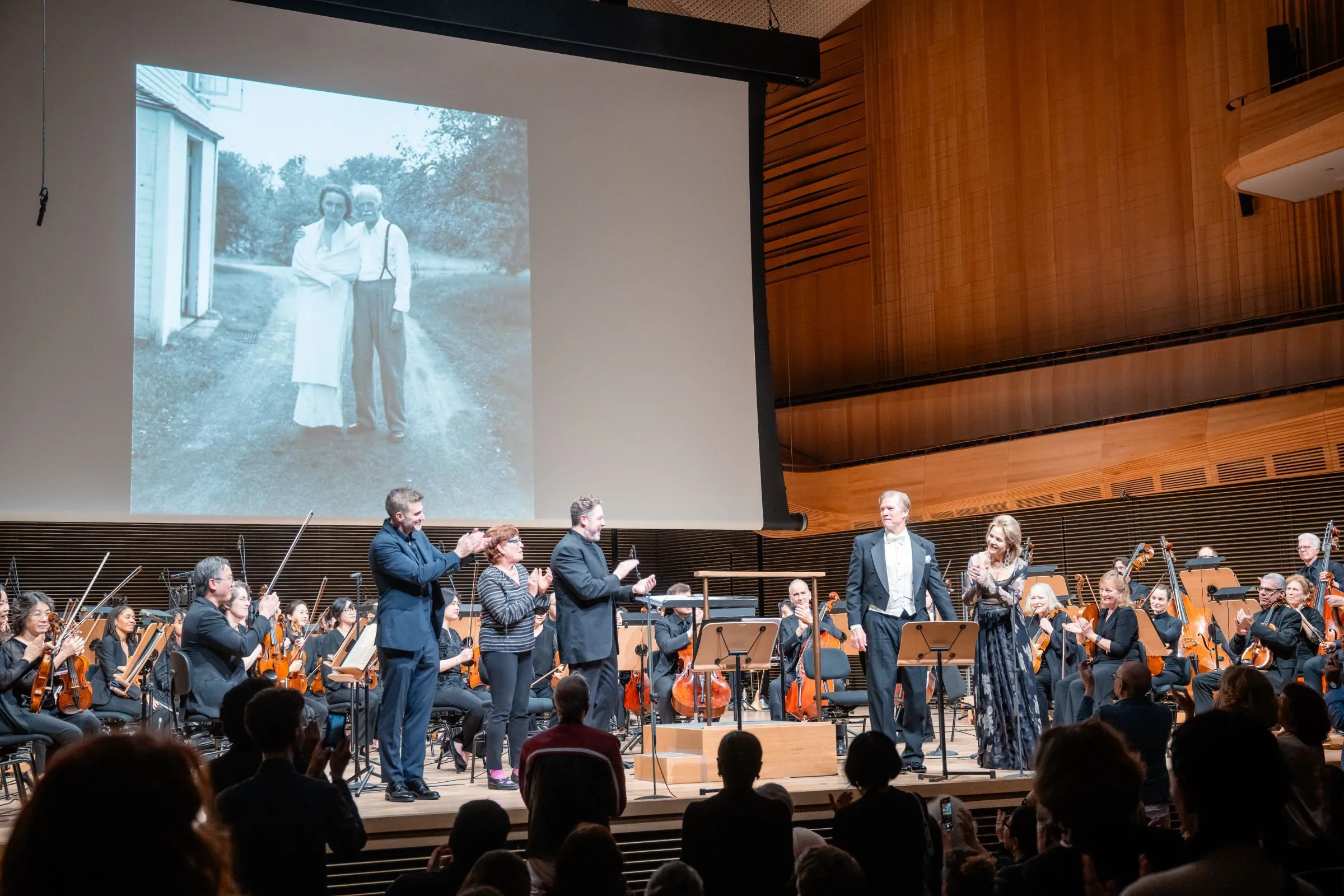
‘The Brightness of Light’ creative team: from L to R, the New York Philharmonic, composer Kevin Puts, projection designer Wendall K. Harrington, conductor Brett Mitchell, baritone Rod Gilfry, and soprano Renée Fleming. © Brandon Patoc
NEW YORK — Bachtrack has published a review of Brett Mitchell’s recent subscription debut with the New York Philharmonic:
Georgia O’Keeffe and Alfred Stieglitz wrote thousands of letters to each other, beginning in 1916 and continuing until his death 30 years later. Along the way, her talent and his influence turned them into one of the most influential artistic couples the United States has ever produced. Kevin Puts memorializes their complex relationship, and their way with words, in The Brightness of Light, a song cycle drawn from their voluminous correspondence. Previously heard in Boston, Chicago, Los Angeles and Kansas City since its 2019 premiere, the work made its long-awaited Manhattan debut at the New York Philharmonic, featuring its original stars, Renée Fleming and Rod Gilfry.
Puts approaches the musical language in his typical style, an unapologetic embrace of neo-romanticism that recalls Barber and other mid-20th century American composers. The orchestra swells in two overwhelmingly lush interludes, Georgia and Alfred and The High Priestess of the Desert, with deeply chromatic tutti passages that envelope the listener in an intense sound world. There is a pleasing lyricism to Puts’ writing here, and the Philharmonic produced an appropriately warm coloring under conductor Brett Mitchell, a last-minute replacement…
Mitchell rounded out the program with a complete performance of Daphnis et Chloé, the latest in the Philharmonic’s ongoing celebration of Ravel’s 150th anniversary. The unusually bright acoustic of David Geffen Hall since its renovation in 2022 served the piece well, isolating solo voices in the woodwind and brass that sometimes get lost within the overall tapestry of the hour-long work. Mitchell kept the action moving seamlessly in a work that can easily turn a conductor into a traffic cop, and while the listener’s attention sometimes cannot help but wane, the Philharmonic’s reading offered a performance delightfully varied in color and style. Much credit goes to the New York Philharmonic Chorus, prepared by Malcolm J Merriweather, whose wordless cries of ecstasy set the right bacchic mood.
To read the full review, please click here.

Review: ‘Love, Light, Letters: Song Cycle Embraces Painter, Photographer’
Brett Mitchell leads the New York Philharmonic in Kevin Puts’s ‘The Brightness of Light’ with soprano Renée Fleming and baritone Rod Gilfry. © Brandon Patoc
NEW YORK — Classical Voice North America has published a review of Brett Mitchell’s recent subscription debut with the New York Philharmonic:
On May 16, the New York Philharmonic offered a program of two romances born in the early 20th century: a contemporary song cycle based on the correspondence between two iconic American artists and a 1912 ballet score highlighting nymphs and shepherds from classical mythology. The repertoire provided the opportunity to luxuriate in work by two of America’s finest opera veterans, supported and surrounded by New York’s flagship orchestra in full fettle.
Kevin Puts’ The Brightness of Light was born from an Eastman School of Music 2015 commission for soprano Renée Fleming for a performance by the conservatory’s orchestra at Lincoln Center. Eastman alumnus Puts came across a quote from Georgia O’Keeffe — “My first memory is of the brightness of light, of light all around” — and decided to set letters from the painter’s voluminous correspondence with Alfred Stieglitz, photographer, gallery owner, and O’Keeffe’s life partner. After the premiere of the cycle of eight songs for soprano, Fleming suggested expanding the work into a musical dialogue with Stieglitz with a part for a male singer. The expanded cycle premiered in 2019 at Tanglewood, co-commissioned by seven performing institutions, with Fleming and baritone Rod Gilfry in the roles they sang with the Philharmonic…
The complete score of Ravel’s Daphnis et Chloé (2012) filled the second half and provided a showcase for the orchestra, particularly appropriate on an evening honoring Philharmonic retirees and long-serving current members. Rich in solo opportunities throughout the sections, the work was Ravel’s only score for the legendary Ballets Russes, which from 1909 to 1929 was Europe’s preeminent ballet company. The hour-long ballet, to Ravel’s longest score, is set on the island of Lesbos where the goatherd Daphnis pursues the shepherdess Chloé among nymphs and shepherds. After Daphné is abducted by pirates and rescued, thanks to the intervention of Pan, all dance a frenzied bacchanale.
Ravel’s lush impressionistic language was a treat for the ear… There were many sensual delights to relish, notably the sinuous flute solos played by Robert Langevin.
In his Philharmonic debut, Brett Mitchell was a last-minute replacement for scheduled conductor Juanjo Mena. Mitchell currently serves as music director of the Pasadena Symphony and has appeared with major orchestras across the U.S. and globally. Even on short notice, Mitchell was well prepared for the [Kevin] Puts cycle [The Brightness of Light], having conducted the work in 2019 as music director of the Colorado Symphony, one of the work’s co-commissioners. The occasional earsplitting fortissimo (and a runaway wind machine) revealed Mitchell’s lack of familiarity with the acoustics of David Geffen Hall, but the conductor paced both works nicely, with a good sense of where the Puts needed to breathe.
To read the complete review, please click here.

In his Philharmonic debut, Brett Mitchell was a last-minute replacement for scheduled conductor Juanjo Mena. © Brandon Patoc
Review: ‘Pasadena Symphony Warms to New Music Director’
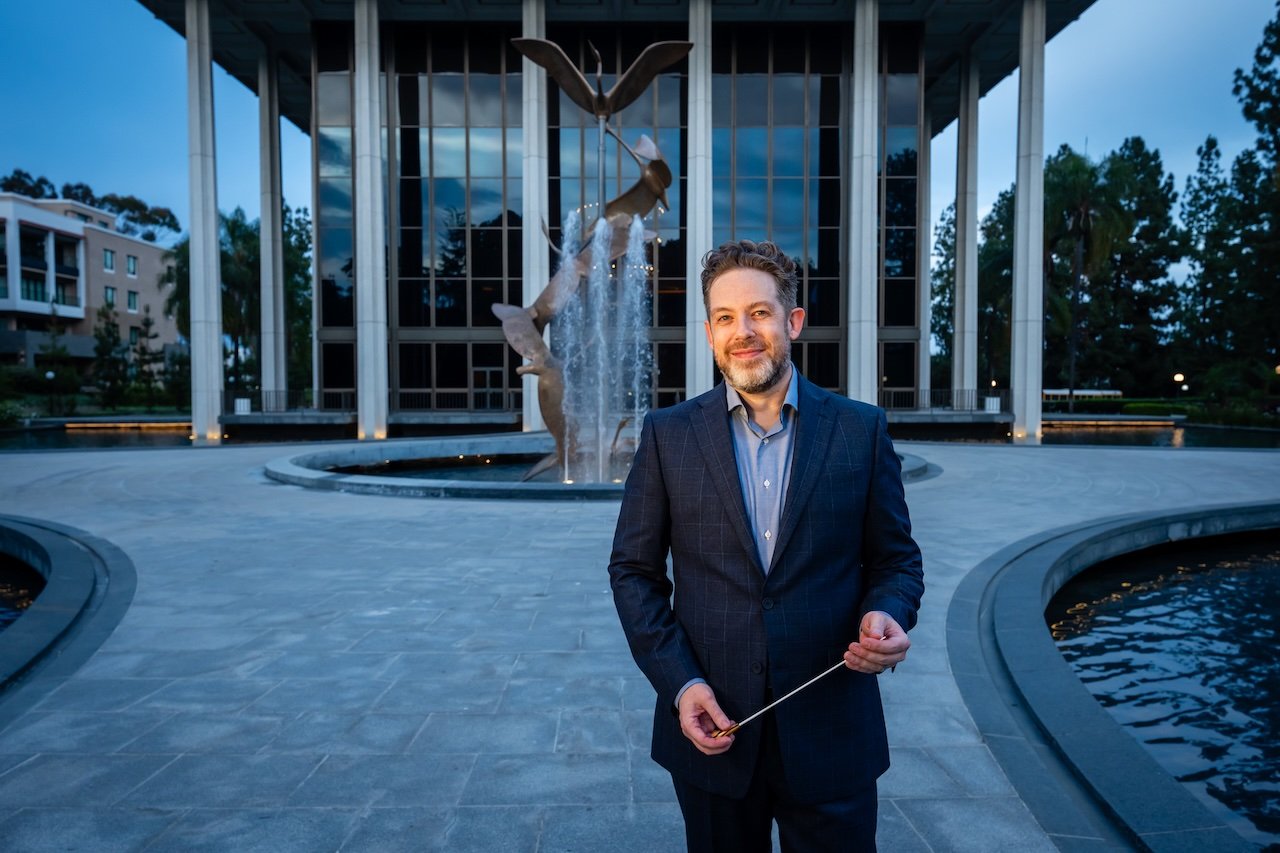
Brett Mitchell stands in front of the Pasadena Symphony’s home, the Ambassador Auditorium. (Photo by Tim Sullens)
PASADENA — San Francisco Classical Voice has published a review of Brett Mitchell’s recent subscription program with the Pasadena Symphony:
A new era began at the Pasadena Symphony this season with the arrival of Brett Mitchell as music director… Mitchell is only the sixth music director in the band’s 97-year history, an impressive record of longevity and continuity in a business that typically sees much more turnover at the top…
Judging by the orchestra’s solid performance on Saturday, Jan. 25, at Ambassador Auditorium — the third subscription concert of Mitchell’s inaugural season — the organization is in competent professional and musical hands. An engaging communicator who has already forged a congenial rapport with both the musicians and the audience, Mitchell, who formerly led the Colorado Symphony, created an informal and welcoming atmosphere for this eclectic program of works by Jessie Montgomery, Florence Price, and Mozart. It will take time, of course, to judge Mitchell’s musical vision for the orchestra, which has in the last few years been staging a strong recovery from financial strain and the COVID shutdown.
In brief remarks, he acknowledged the devastating impact of the terrible fires that recently ravaged nearby Altadena and parts of Pasadena and paid tribute to first responders and fire department personnel who had been invited to attend. A heartfelt, if glacially slow, performance of Samuel Barber’s funereal Adagio for Strings followed, an appropriate addition to the scheduled program. “America’s semi-official music for mourning,” as NPR writer Anastasia Tsioulcas has called it, this arrangement for string orchestra of the second movement of the composer’s 1936 String Quartet, Op. 11, has been heard after many tragic occasions.
Another work for string orchestra, Montgomery’s exuberant and cheerful Starburst, cleared the air. Montgomery has said that this energetic curtain-raiser lasting just a little over three minutes is meant to “create a multidimensional soundscape” inspired by the dazzling birth of new stars, represented by jabbing unison string lines and a pulsing rhythmic undercurrent. The Pasadena Symphony strings rose to the occasion…
To read the complete review, please click here.
Review: ‘Brett Mitchell makes his mark: a fresh take on Mahler at Pasadena’s Ambassador Auditorium’
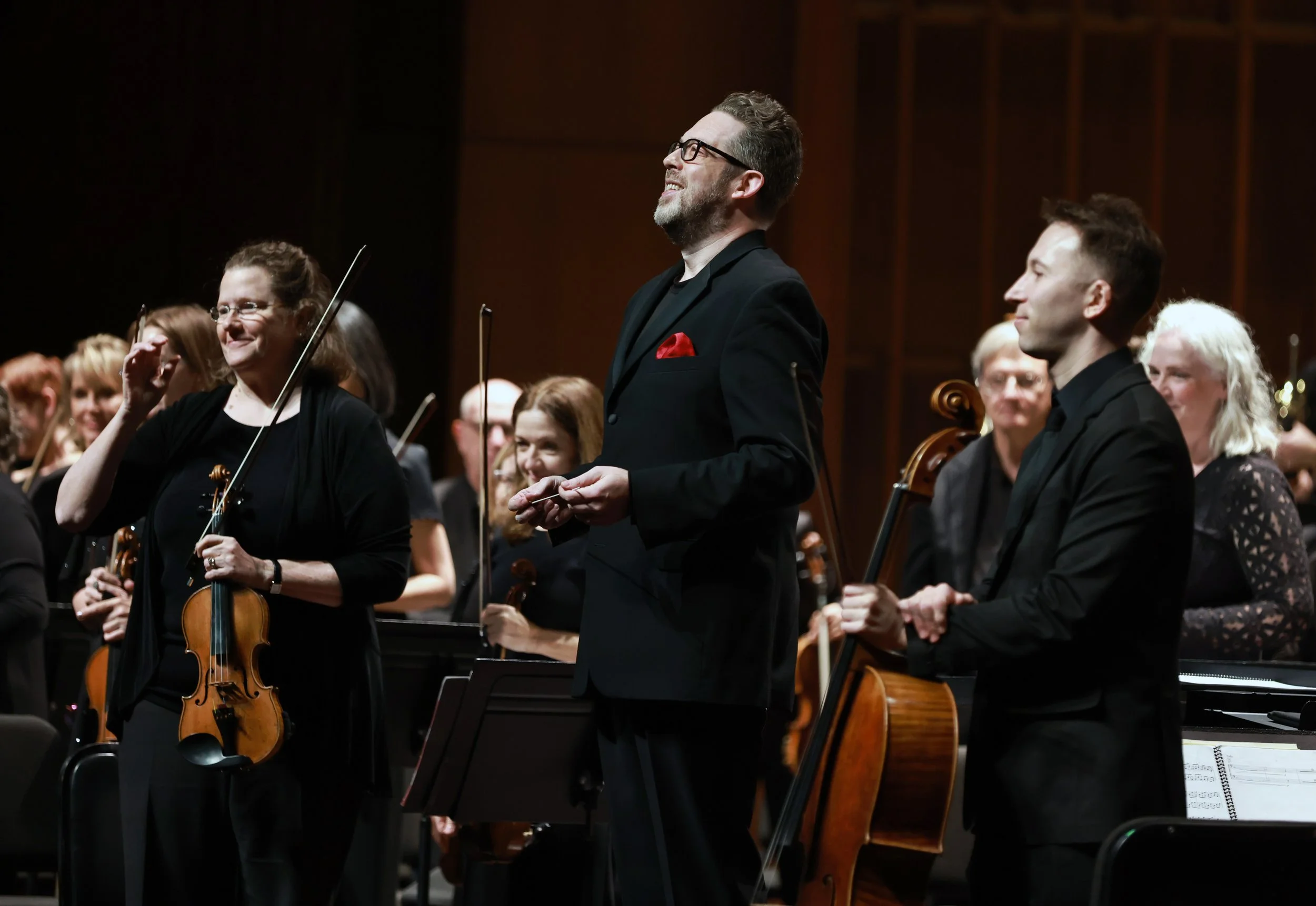
Brett Mitchell leads the Pasadena Symphony in his inaugural performances as Music Director at the Ambassador Auditorium on October 26, 2024. (Photo by Karen Tapia)
PASADENA — Seen and Heard International has published a review of Brett Mitchell’s inaugural program as Music Director of the Pasadena Symphony:
The Pasadena Symphony’s new music director, Brett Mitchell, used an edition of Mahler’s Symphony No. 1 that, while controversial, brought with it a breath of fresh air. Ambassador Auditorium, with its splendid acoustics and embraceable seating, affirmed its standing as perhaps the best orchestral hall in town.
The program began with Peter Boyer’s New Beginnings, featuring brass fanfares and driving rhythms with a lyrical middle section that suggested Copland’s American-style melodies. It is richly orchestrated and makes the instruments shine. No wonder it has been performed more than 25 times. In fact, this was Mitchell’s third performance of the piece, following earlier appearances with the Houston Symphony and Colorado Symphony, and the playing had the audience on the edge of their seats.
The soloist was violinist Akiko Suwanai, who won the Moscow Tchaikovsky Competition in 1990. She swept through Korngold’s Concerto as so many do – it is meant to be swept through – balancing Hollywood glamour with refined elegance. Her silvery tone in the rhapsodic slow movement and graceful handling of the finale’s pyrotechnics brought out the work’s lyrical soul rather than just its surface, Tinseltown brilliance.
The tone for Mahler’s First Symphony was set by the precision of the gurgling clarinets, the charming and natural ebb and flow of the dialogue between the offstage horns and the trumpets, and the lovely understated cello portamenti. It was light-hearted, like a Haydn symphony. The Ländler swing in the second movement was just right and resisted the temptation to make parts of the Trio into a clog dance. The oboe and flute solos in the Trio and throughout were exquisite, lovely in tone and alive with nuance and color.
The controversy is whether the famous funeral march opening of the third movement should be played as a striking, surreal solo by a single double bass (as is traditional), or more smoothly by the entire bass section in unison. While historical evidence from Mahler’s time definitively favors the solo bass interpretation, the 1992 Critical Edition argued for the full section based on score analysis. And that is the interpretation Mitchell played.
The result was more like Schubert than Kurt Weill, perfectly aligned with Mitchell’s more human-scaled, less titanic overall concept. The interpretation revealed layers of chamber music-like intimacy, with wonderful woodwind solos floating above crystalline textures, and trumpet work that managed to be both brilliant and beautifully integrated. The strings, rather than overwhelming with sheer power, created a mesmerizing transparency; the first violins, in particular, brought an otherworldly radiance to the great themes. The final movement built with inexorable momentum to a conclusion that was both musically thrilling and emotionally cathartic. For Mitchell, it was a remarkably assured debut that suggests exciting times ahead for the Pasadena Symphony.
To read the complete review, please click here.
Review: ‘Mitchell Had the Pasadena Symphony Playing at Their Finest’
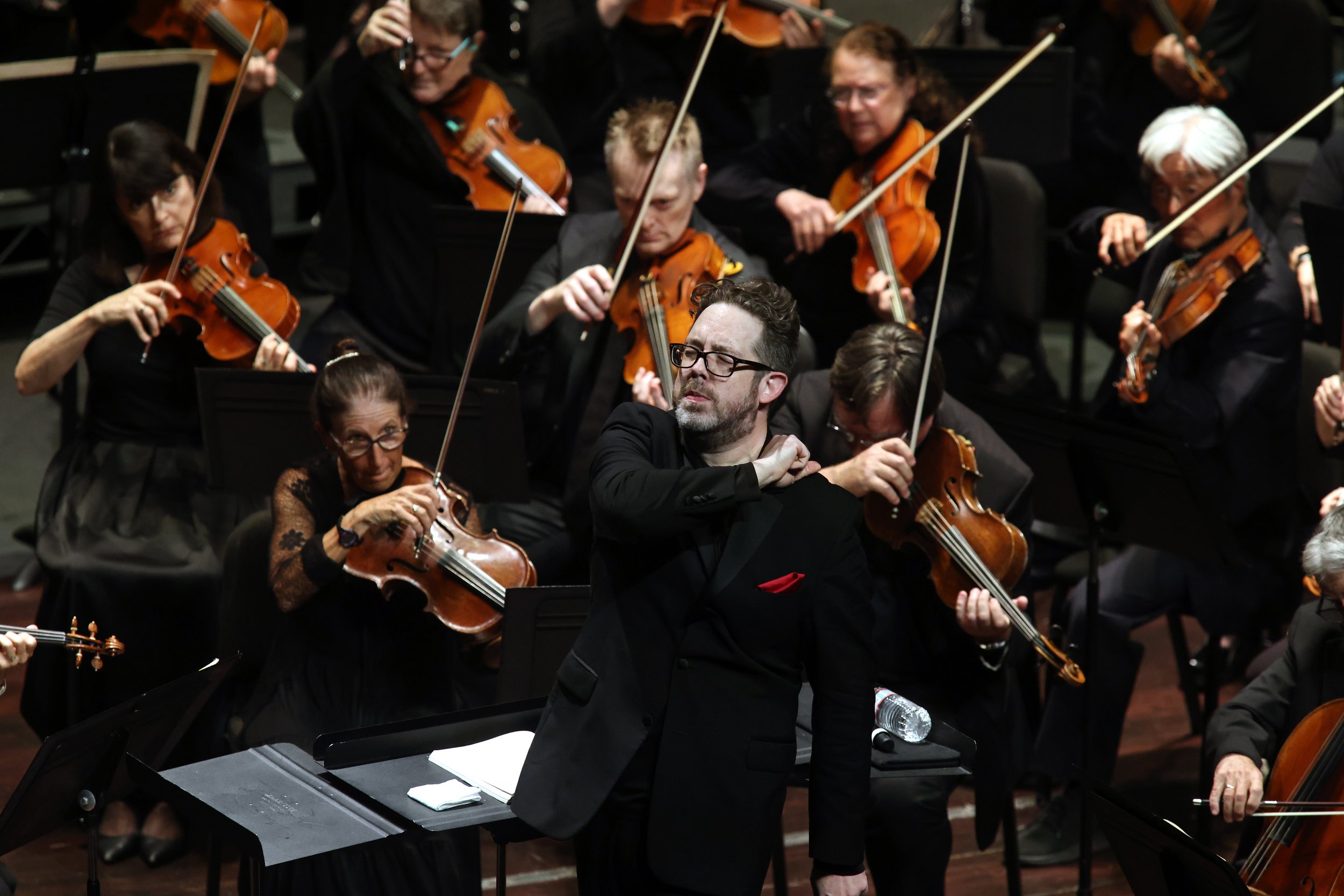
Brett Mitchell leads the Pasadena Symphony in his inaugural performances as Music Director at the Ambassador Auditorium on October 26, 2024. (Photo by Karen Tapia)
PASADENA — Culture Spot LA has published a review of Brett Mitchell’s inaugural program as Music Director of the Pasadena Symphony:
At 2 and 8 p.m. at the Ambassador Auditorium in Pasadena, the Pasadena Symphony gave its inaugural concert of the 2024/25 season under the direction of its new music director, Brett Mitchell. The program featured New Beginnings by Altadena composer Peter Boyer, the Violin Concerto in D Major, Op. 35 by Eric Wolfgang Korngold with violinist Akiko Suwanai, and the Symphony No. 1 in D Major (“Titan”) by Gustav Mahler. The Pasadena Symphony…showed why they are one of the top regional orchestras in the Southland.
The first piece on the program, New Beginnings, by local composer Peter Boyer was, as Music Director Mitchell stated in his comments, extremely apropos. Not only was this the inaugural concert by the PSO in their 2024/25 season, but it was the first being led by newly appointed Music Director Mitchell. So, it was new beginnings all around. New Beginnings is an uplifting single-movement work with hints of John Williams that utilizes a large orchestra and makes the most of the brass sections. It contains rhythmic sequences that are hard not to tap your foot to, and it was the perfect work to introduce the new season and the new conductor.
And, speaking of film scores, the first half of the concert concluded with the equally uplifting and melodic violin concerto by Korngold. Korngold, who was a child prodigy in his native Vienna, Austria, eventually came to Los Angeles where he composed film scores in addition to classical music. The Violin Concerto contains melodies from four of his film scores woven together in a beautiful and thrilling late romantic work for violin and orchestra. Suwanai more than handled the difficult solo part. Her playing was understated but both technically and tonally top-notch. Mitchell did a fine job of accompanying her while never letting the orchestra overwhelm.
The concert concluded with Mahler’s First Symphony, which is subtitled “The Titan.” However, many of Mahler’s subsequent symphonies were actually more titan if by that we mean large-scale and lengthy. This symphony really shows off all the sections of the orchestra, but especially the horn section. The PSO horns were more than up to the task and really knocked the ball out of the park. Mitchell showed why he was selected as the PSO’s new music director. He very capably served up an exciting rendition of the Mahler First and had the orchestra playing at their finest.
To read the complete review, please click here.

Review: A Mahler of ‘Unfailing Mastery’ in Pasadena
Brett Mitchell leads the Pasadena Symphony in his inaugural performances as Music Director at the Ambassador Auditorium on October 26, 2024. (Photo by Karen Tapia)
PASADENA — Classical Voice has published a review of Brett Mitchell’s inaugural program as Music Director of the Pasadena Symphony:
At 2pm Saturday, October 26, the Pasadena Symphony opened its 97th season at the Ambassador Auditorium… The opening concert, conducted by Brett Mitchell, the orchestra’s new music director, was a strong one: Mahler’s ‘titanic’ Symphony No. 1 and two works paying tribute to Hollywood’s Golden Age.
The first work, New Beginnings, by Pasadena-area composer/Hollywood orchestrator Peter Boyer, features a brass fanfare and folksy tunefulness (but no direct quoting of folksong) not unlike many works of Aaron Copland (his second symphony, for example). The musicians, many of whom also work in Hollywood recording studios, played with brilliance and great enthusiasm.
[Erich] Wolfgang Korngold’s Violin Concerto followed. The music contains echoes of many of Korngold’s Golden Age Hollywood film scores (Sea Hawk, Captain Blood, Robin Hood) but without directly quoting them. Under maestro Mitchell’s baton, the seafaring first-movement, the chivalric romance in the second, and the swashbuckling finale all came across brilliantly in lush, orchestral Technicolor…
With unfailing mastery, Mitchell conducted Mahler’s Symphony No. 1 (‘Titan’) and took us into a bright, lyrical Wunderhorn world. The music flowed through him with all its emotion, excitement, precision and attention to passing details and the larger form. The orchestral playing was superb, notably in the expressive string portamento that is an essential part of Mahler’s music.
To read the complete review, please click here.

Review: ‘Béla Fleck and Cleveland Orchestra wow Blossom Music Center with Rhapsody in Blue’

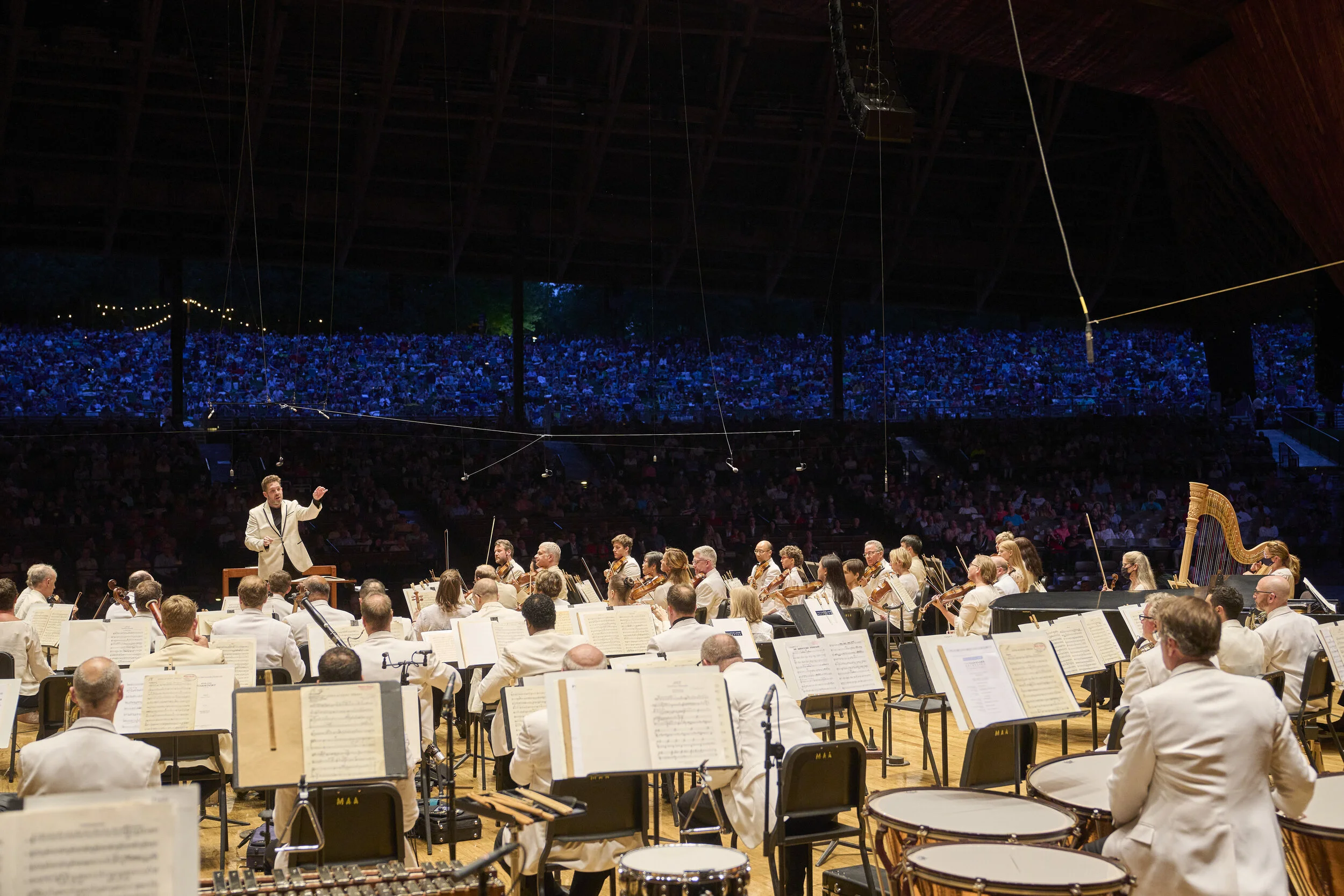
Brett Mitchell leads The Cleveland Orchestra at Blossom Music Center. (Photo by Roger Mastroianni)
CLEVELAND — Cleveland.com has published a review of Brett Mitchell’s recent performance with The Cleveland Orchestra, opening the classical series of the 2024 Blossom Music Festival:

Brett Mitchell and Béla Fleck backstage at Severance Music Center
Appearing with the Cleveland Orchestra on Saturday evening July 6, Béla Fleck surprised the Blossom Music Center crowd not so much by the level of his playing — virtuosic as always — but by how well he adapted the solo piano part for the banjo in his transcription of George Gershwin’s Rhapsody in Blue.
His reworkings succeeded so well that the piece seemed not just suitable for the banjo but actually conceived for it.
With a reputation that preceded him — his 18 Grammys acknowledge his mastery of every genre from bluegrass to classical —the audience warmed to Fleck immediately and continued to lavish their attention on his playing, eager to hear what magic might happen next.
Under the direction of Brett Mitchell, the Orchestra too seemed eager, playing at lower volumes than usual to balance the soloist. Wind soloists were excellent, especially Daniel McKelway, whose clarinet released a glorious opening skyward glissando, and Michael Sachs, who offered 1920s-style jazz from his muted trumpet. Strings generated an arrestingly warm sound, particularly in the famous orchestral tutti after the first cadenza — the passage used in commercials by a certain airline….
Mitchell opened the program with Leonard Bernstein’s Three Dance Episodes from On The Town, a 1944 musical about a trio of sailors getting to spend a day of shore leave in New York City. Although pit and jazz bands have the edge over classical orchestras when it comes to Broadway jazz, The Clevelanders managed to loosen up in spite of their habits of exactitude.
All three selections were sexy and fun, but the final Episode, Times Square: 1944, fairly teetered on debauchery. Special mention again goes to McKelway, who caroused on both the E-flat and B-flat clarinet. Trombonist [Shachar Israel] and the alto sax [Gabriel Piqué] suggested alarming degrees of impropriety.
Samuel Barber’s Overture to The School for Scandal, an eight-minute theater piece teeming with statements both mercurial and tender, unlocked the second half. It spotlighted lovely and meticulous solo playing from the woodwinds.
In William Grant Still’s 1931 Symphony No. 1 “Afro-American,” blues both opens and permeates the work, calling to mind George Gershwin but without the heat (the two composers knew each other’s work).
Although jazz had been unleashed in America by 1931, Still’s symphony seems European: rhythms are right-angled, syncopations are aligned with downbeats, and blues sections are more calculated than carefree. But Mitchell summoned a great deal of beauty and nobility from the symphony’s events.
To read the complete review, please click here.
Review: 'Cleveland Orchestra kicks off 2023 holiday series with festive Severance concert'
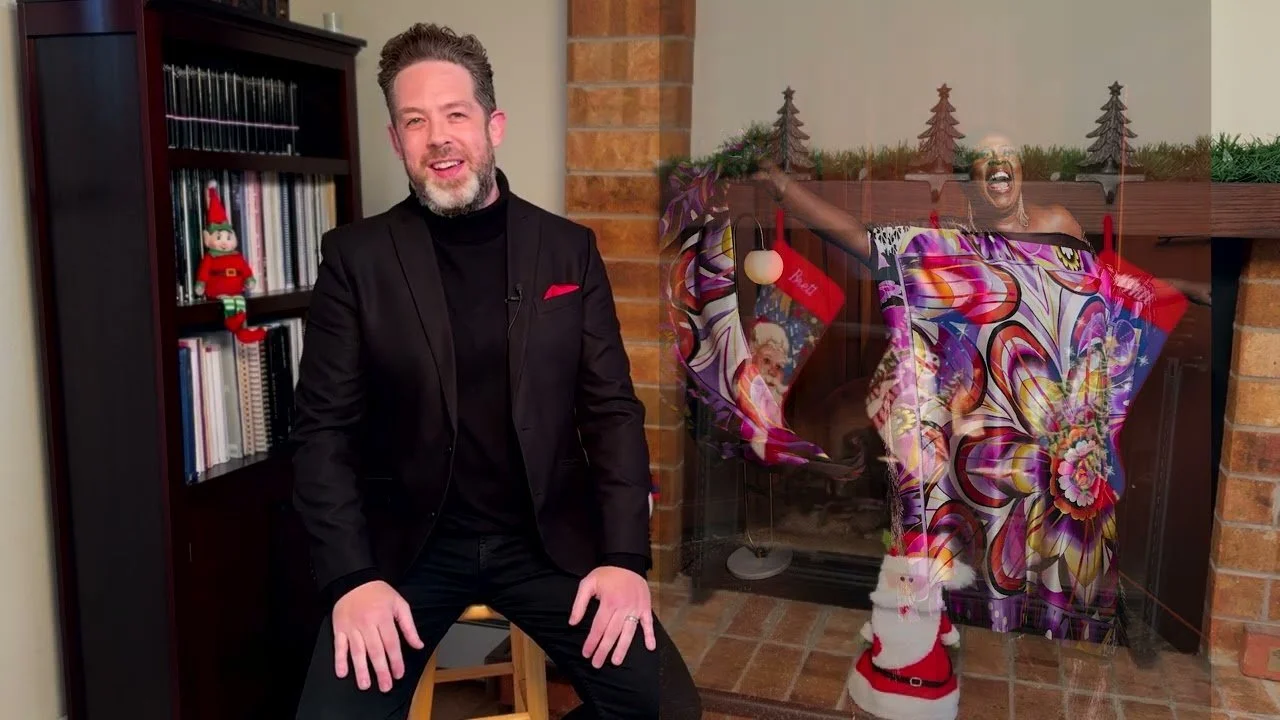
Brett Mitchell introduces The Cleveland Orchestra’s 2023 Holiday Concerts from his living room in Denver, CO.
CLEVELAND — Cleveland.com has published a review of The Cleveland Orchestra’s 2023 Holiday Concerts, led by guest conductor Brett Mitchell:
It’s a safe bet to hold off on the Noëls and Fa-la-la-la-las until The Cleveland Orchestra and Chorus launch their Holiday Concerts. This year there are 14 of them, and these events are regarded as the true beginning of the holiday season. Let the celebrations begin!
And so they did on Wednesday evening, December 13, at Severance Music Center, when Brett Mitchell led The Cleveland Orchestra and Cleveland Orchestra Chorus (joined by the Cleveland State University Chorale and the College of Wooster Chorus) in a classy program of Christmas, Chanukah, and winter-themed music starring the formidable Capathia Jenkins, who brought her personal vocal rizz to the party (thank you, Oxford English Dictionary, for the gift of that new word).
The engaging playlist began with a hearty welcome by conductor/emcee Brett Mitchell, a former Cleveland Orchestra assistant conductor, and an elaborate version of “O Come, All Ye Faithful” by Mack Wilberg, director of the Mormon Tabernacle Choir, who contributed four arrangements to the program.
Mitchell went on to introduce two orchestral selections “from the classical canon,” an arrangement of the chorale that appears twice in Johann Sebastian Bach’s Cantata BWV 147 by Leopold Stokowski, long-time conductor of the Philadelphia Orchestra and himself an organist, and the breath-taking Dance of the Tumblers from Rimsky-Korsakoff’s “The Snow Maiden,” tossed off at a daring tempo with astonishing clarity…
Mitchell gave a nod to another December celebration, the Jewish Festival of Lights, summed up in Jeff Tyzik’s ebullient “Chanukah Suite,” which featured the Orchestra’s gleaming brass section.
Brett Mitchell introduces The Cleveland Orchestra’s 2023 Holiday Concerts from the stage at Severance Music Center.
Then it was time to bring the audience into the celebration. Mitchell announced that “Away in a Manger” (arranged by Steven Amundson) would be its audition piece, and if things went well, the assembled multitudes would be invited to join in “Joy To the World.” Things did, and Admundson’s arrangement of Handel’s tune set the mood for the composer’s “Hallelujah Chorus” in Mozart’s orchestration, which brought the audience to its feet…
How do you follow such a class act? With an appearance by Saint Nicholas himself, who ho-ho-ho’d his way down the aisle looking untraditionally svelte, to hold a witty Q&A with Mitchell. His departure led to Leroy Anderson’s obligatory and delightful “Sleigh Ride,” and to the final piece on the printed program, Wilberg’s arrangement of “Hark! The Herald Angels Sing,” prefaced by Mitchell’s concise (and accurate!) comments about the origin of Mendelssohn’s tune.
Not quite finished yet, Mitchell led the performers and audience in Carmen Dragon’s lovely and theatrical arrangement of “Silent Night” and the musical greeting card, “We Wish You a Merry Christmas.”
To read the full review, please click here.
Brett Mitchell leads The Cleveland Orchestra, Cleveland Orchestra Chorus, and Wooster Chorus in Arthur Harris’s arrangement of ‘We Wish You a Merry Christmas’ live at Severance Music Center on Dec 14, 2023.
Review: 'Cleveland Orchestra exudes joy on resplendent 2021 Holiday Concerts program'
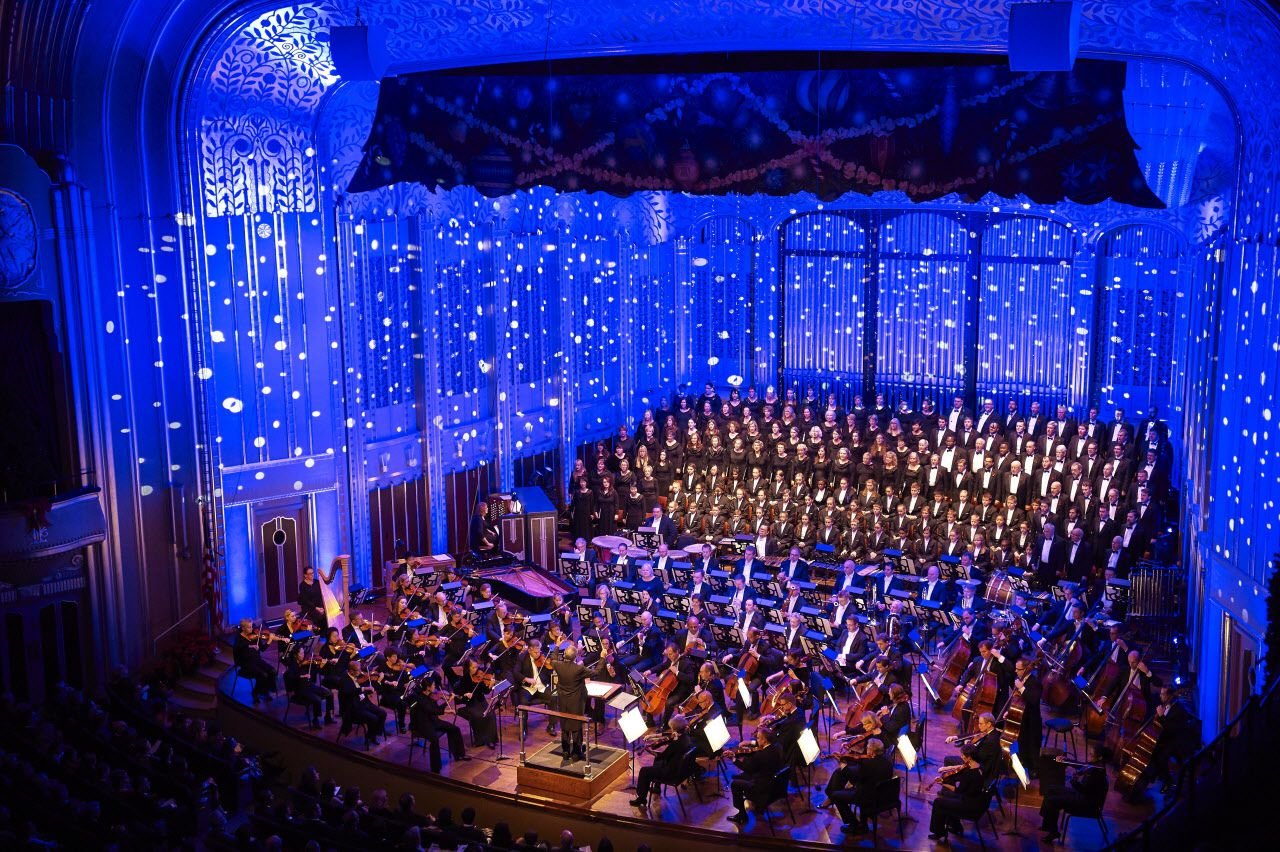
Brett Mitchell leads The Cleveland Orchestra in a dozen performances of their 2021 Holiday Concerts at Severance Music Center. (Photo by The Plain Dealer)
CLEVELAND — cleveland.com has published a review of the opening night performance of The Cleveland Orchestra’s 2021 Holiday Concerts, led by guest conductor Brett Mitchell:
Look no further than this year’s Holiday Concerts for proof the Cleveland Orchestra is glad to be back playing for live audiences.
Packed like a full stocking with a wide variety of music, the orchestra’s holiday program in 2021 is nothing if not a display of sincere goodwill all the way around.
Brett Mitchell, a former associate conductor here, is back in a role for which he is uncommonly well suited. He’s adept at the classics, to be sure, but he’s also got a special knack for pops and an easy sense of humor that makes him a natural host.
Patrons Thursday night at Severance Music Center also got to hear the first live notes by the Cleveland Orchestra Chorus with the orchestra in 21 months. On its own, “O Come, All Ye Faithful” would have been beautiful, but context made it an even greater treasure.
All patrons, happily, get to hear vocalist Capathia Jenkins. Into an evening otherwise devoted to classical, traditional, and contemporary music, she injects a healthy dose of holiday jazz, expertly conjuring Ella Fitzgerald in “Santa Claus is Coming to Town” and holding the house perfectly transfixed with “Let it Snow!” and “Have Yourself a Merry Little Christmas.”
The Chorus remains in fine form under director Lisa Wong. To this listener, Eric Whitacre’s solemn “Lux Aurumque” (“Light and Gold”) is alone worth the price of admission, with its gentle, haunting dissonance, but a lavish, resonant “Wexford Carol” and stirring first movement from Rutter’s “Gloria” compete as close seconds.
The singers also hold up admirably on a brisk account of Handel’s tricky but always rewarding “Hallelujah” Chorus and in a luminous performance of “Somewhere in my Memory” from John Williams’ brilliant soundtrack to the film “Home Alone.”
The big man himself pays an unannounced visit, stopping by to exchange witty remarks with Mitchell, improvise sly responses to audience questions, and narrate “The Night Before Christmas,” in an obviously rehearsed performance with the orchestra.
That the musicians also have done their due diligence is evident in several purely orchestral numbers. Leroy Anderson’s “Sleigh Ride” makes its mandatory appearance but a lilting performance of Tchaikovsky’s “Waltz of the Flowers,” a dashing “Christmas Overture” by Samuel Coleridge-Taylor, and the little-known “Sleigh Ride” German Dance by Mozart are even more welcome.
Rounding out the night are two (okay, three, with an encore) sing-along moments. All those without hearts of stone are certain to enjoy taking part in the all-too-rare experience of communal singing, in this case of “Away in a Manger,” “Joy to the World,” and “Silent Night.” If the concert as a whole is a well-decorated tree, they’re the last, essential piece, the star at the top.
To read the complete review, please click here.
Reviews: Brett Mitchell leads The Cleveland Orchestra's return to Blossom

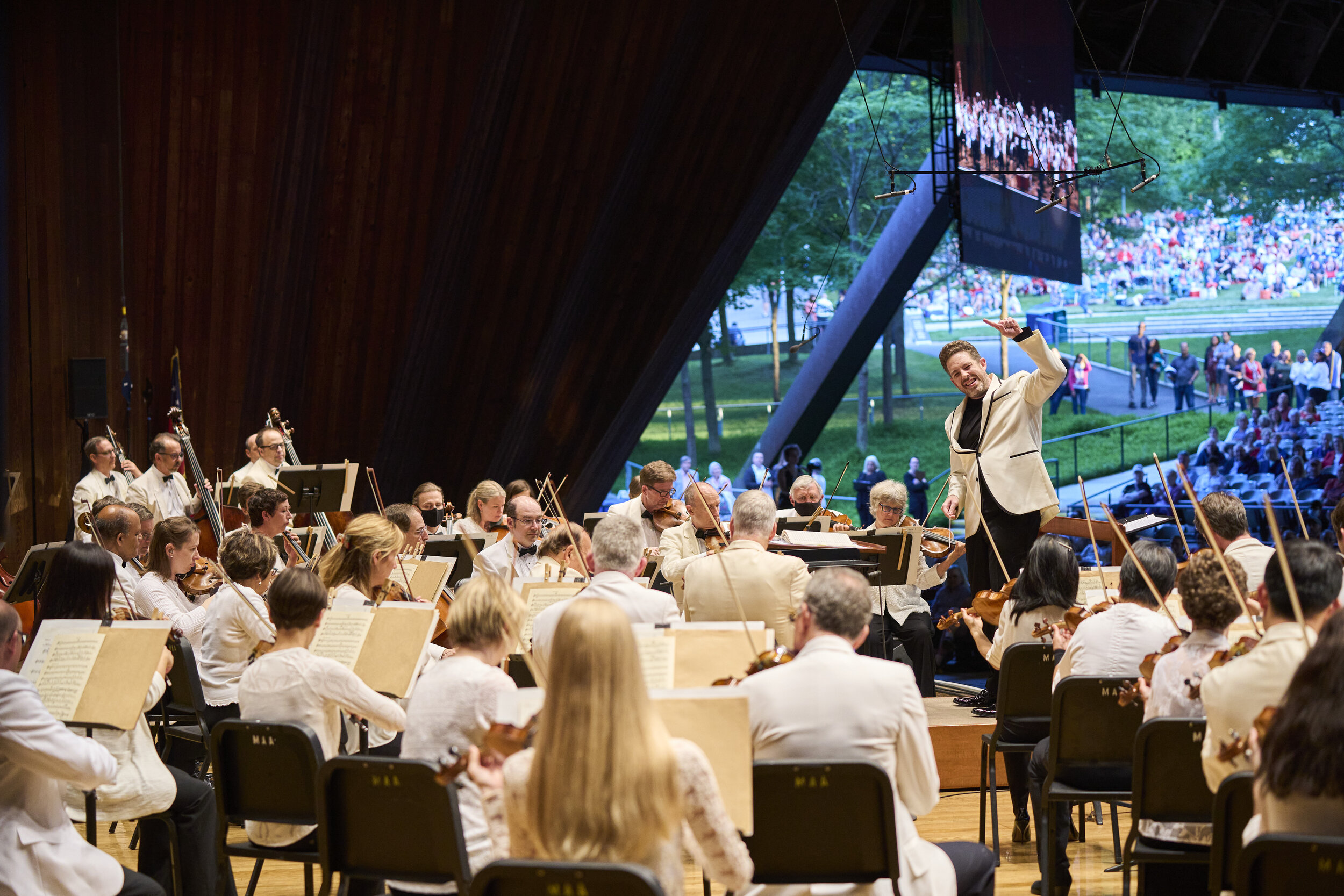
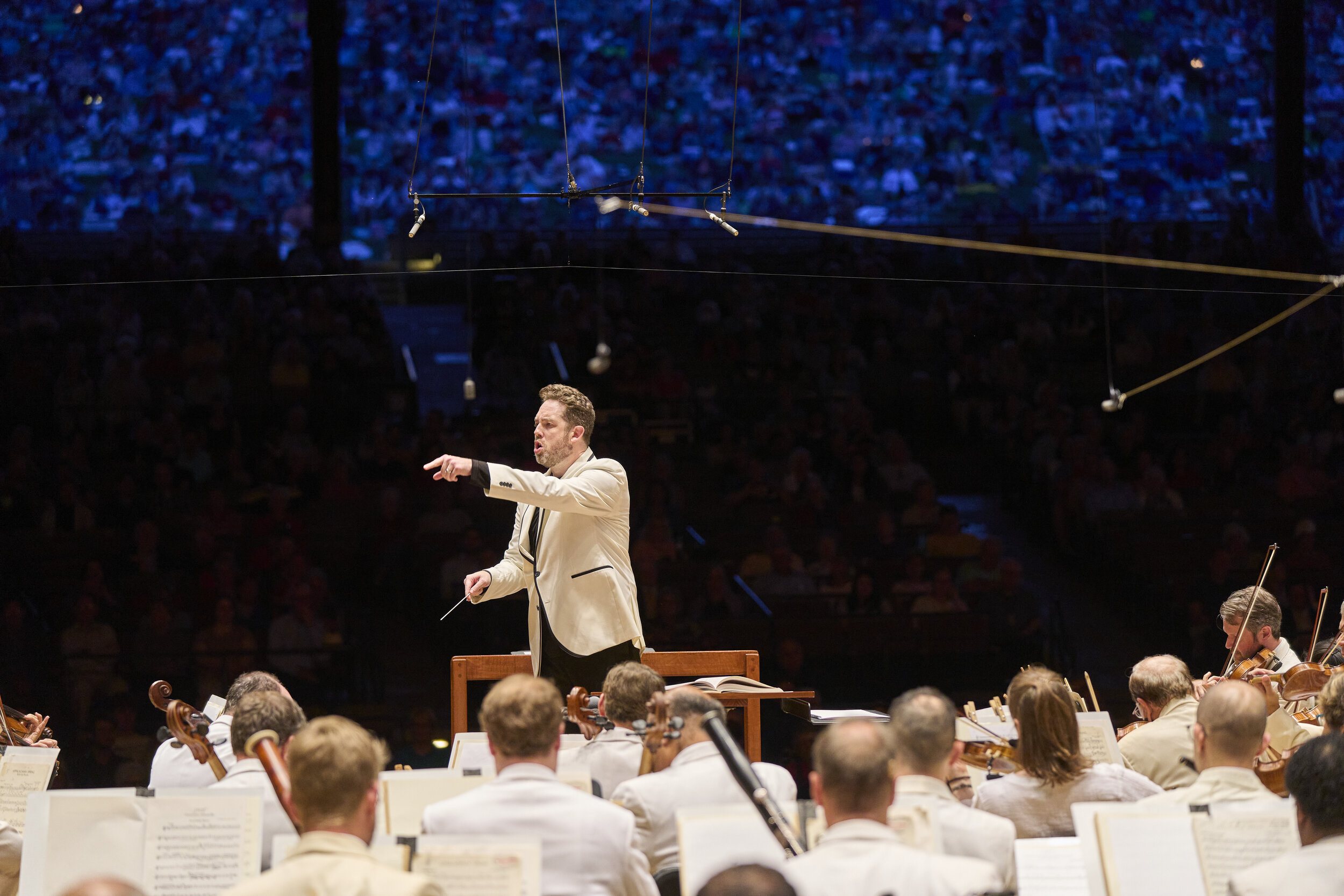
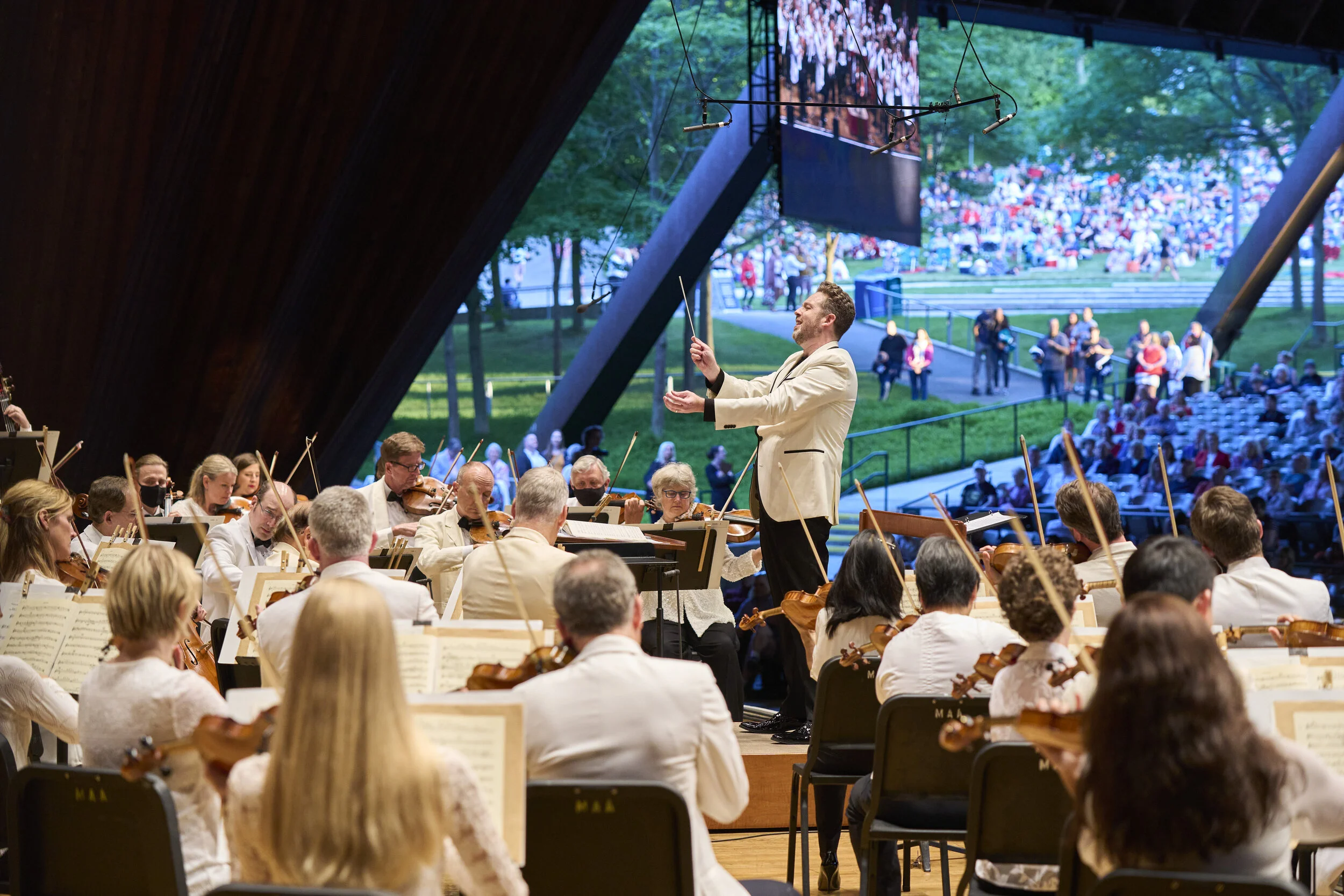
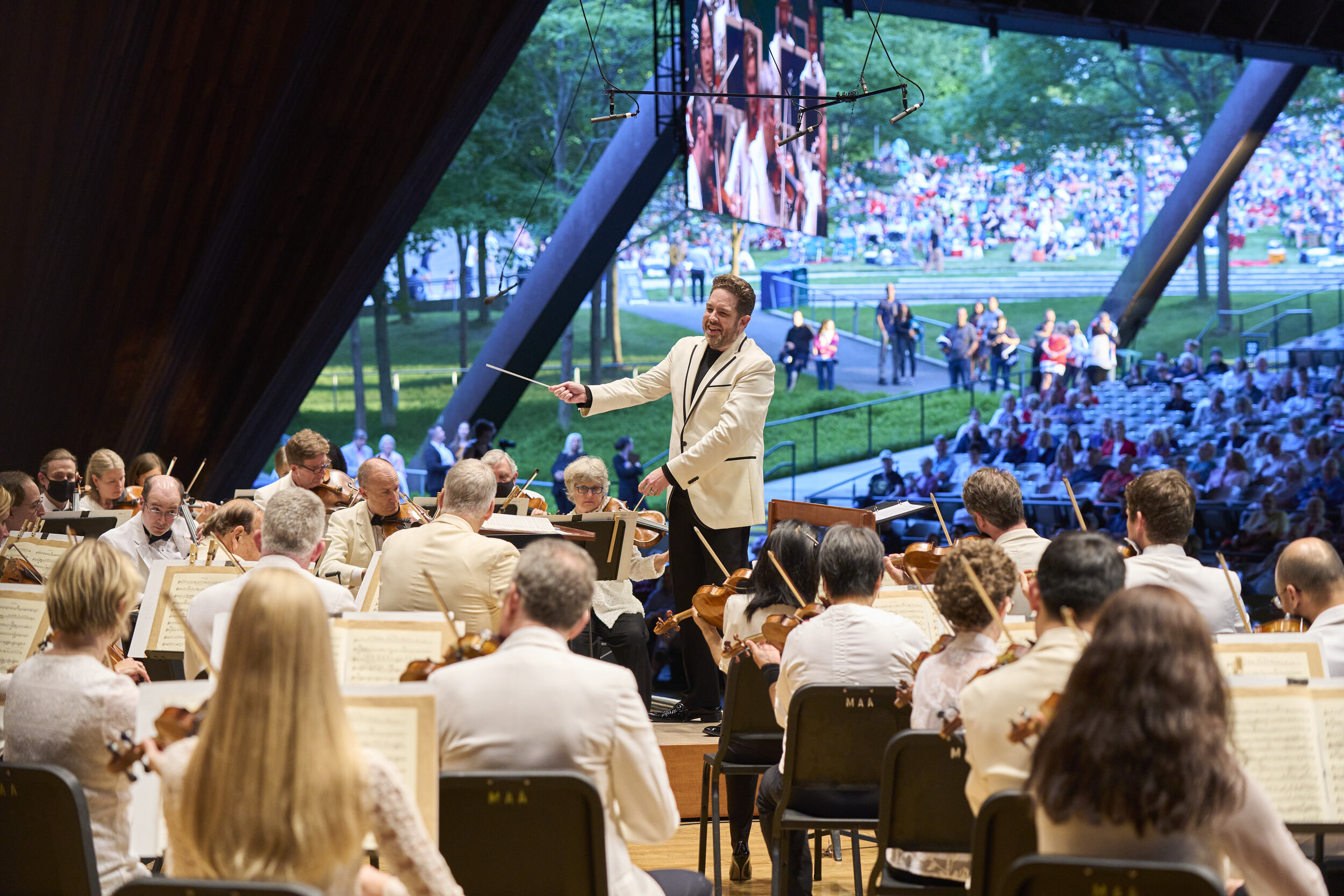
Brett Mitchell leads The Cleveland Orchestra at Blossom Music Center on July 3, 2021, marking the orchestra’s first public performance since March 2020. (Photo by Roger Mastroianni)
CUYAHOGA FALLS, Ohio — Several additional media outlets have published reviews of Brett Mitchell’s opening weekend performances of the 2021 Blossom Music Festival with The Cleveland Orchestra, marking the orchestra’s first public performances since March 2020. (See below or click here to read the reviews from Cleveland.com and ClevelandClassical.com.)
Conductor Brett Mitchell, who has a long history with the Cleveland Orchestra as assistant, associate and guest conductor, had started the concert with a rather laid-back version of Leonard Bernstein’s overture to Candide, perhaps spaciously paced to allow the work’s sparkling lines to register in the reverberant acoustic of the Blossom Music Center’s pavilion, made even more resonant by the socially-distanced seating of audience members (though the lawn was packed with what must have been a record crowd for an orchestra concert).
Mary J. Watkins’s ‘Soul of Remembrance’ was another of the three works on the program by African-American composers. It is a solemn balance of spiritual-inspired lyricism over a steadily tolling slow march, and is one of the sections of Watkins’s Five Movements of Color. Mitchell introduced the piece with a moment of silence and dedicated it to the memory of those lost in the pandemic.
The second half of the concert opened with Adolphus Hailstork’s ‘An American Fanfare’, his response to Aaron Copland’s ‘Fanfare for the Common Man’. Though not as interesting as some of Hailstork’s larger orchestral works, it was a great showpiece for the Cleveland Orchestra brass, which as a section is the strongest it has ever been.
Copland’s Appalachian Spring suite was given a sure-handed performance under Mitchell’s baton, and even the 1812 Overture and ‘The Stars and Stripes Forever’ were played passionately in a concert where the musicians were clearly delighted to be on stage, and the listeners were overjoyed to have them there once again.
The official program, conducted by Brett Mitchell, was an eclectic mix drawn from various traditions. It began with a spirited rendition of the overture to Leonard Bernstein’s Candide. One might argue that the musical — based on Voltaire’s cynical take on human nature — had nothing to do with July 4th, but that one would not be me because it’s a favorite piece so who cares?
This was followed by works by under-celebrated African American composers. The first was Mary D. Watkins’ meditative “Soul of Remembrance” from Five Movements in Color. Next came Concerto in One Movement by the better-known Florence Price, with a fine and dramatic presentation by pianist Michelle Cann. The last work was Adolphus Hailstork’s “An American Fanfare.” One hopes works by these composers will continue to be heard in coming seasons.
PHOTOGRAPHS BY ROGER MASTROIANNI



Review: The Cleveland Orchestra Returns to Blossom
Brett Mitchell leads The Cleveland Orchestra at Blossom Music Center on July 3, 2021, marking the orchestra’s first public performance since March 2020. (Photo by Roger Mastroianni)
CUYAHOGA FALLS, Ohio — Brett Mitchell led The Cleveland Orchestra in the opening weekend of the 2021 Blossom Music Festival on July 3 and 4, marking the orchestra’s first public performances since March 2020. The following are excerpts from ClevelandClassical.com’s review of Sunday evening’s concert:
It was March 20, 2020, when The Cleveland Orchestra and Franz Welser-Möst gave their last concert as a complete ensemble before the COVID-19 pandemic shut down live performances for more than a year. The Orchestra, with guest conductor Brett Mitchell, returned triumphantly to Blossom Music Center on July 3 and 4 to celebrate Independence Day.
Three works by African American composers were the highlights of the concert. All of them should be adopted into the Orchestra’s standard repertoire. Mary D. Watkins’ “Soul of Remembrance” from Five Movements in Color (1993) was especially moving. The mood is both nostalgic and bittersweet, with beautiful melodies and lush, American Romantic harmonies and orchestrations. There is a slow, steady pulse throughout as the musical material develops, with wind descants soaring above the melody, finally reaching a full-orchestra climax before fading back to a single violin note at the conclusion. If the other movements of Watkins’ suite are of this quality, the whole set should be performed. This composer, born in 1939 and still living, deserves attention from a broad audience.
The real “find” on this program was Adolphus Hailstork’s 1985 An American Fanfare for brass and percussion — Hailstork’s response to Aaron Copland’s Fanfare for the Common Man, but with more musical substance and variety, and treacherous, jagged leaps across octaves.
Copland’s Appalachian Spring made its almost obligatory appearance, in a pristine, carefully developed performance.
To read the complete review, please click here.
PHOTOGRAPHS BY ROGER MASTROIANNI

Review: Cleveland Orchestra gathers again at Blossom for specially meaningful ‘American Celebration’

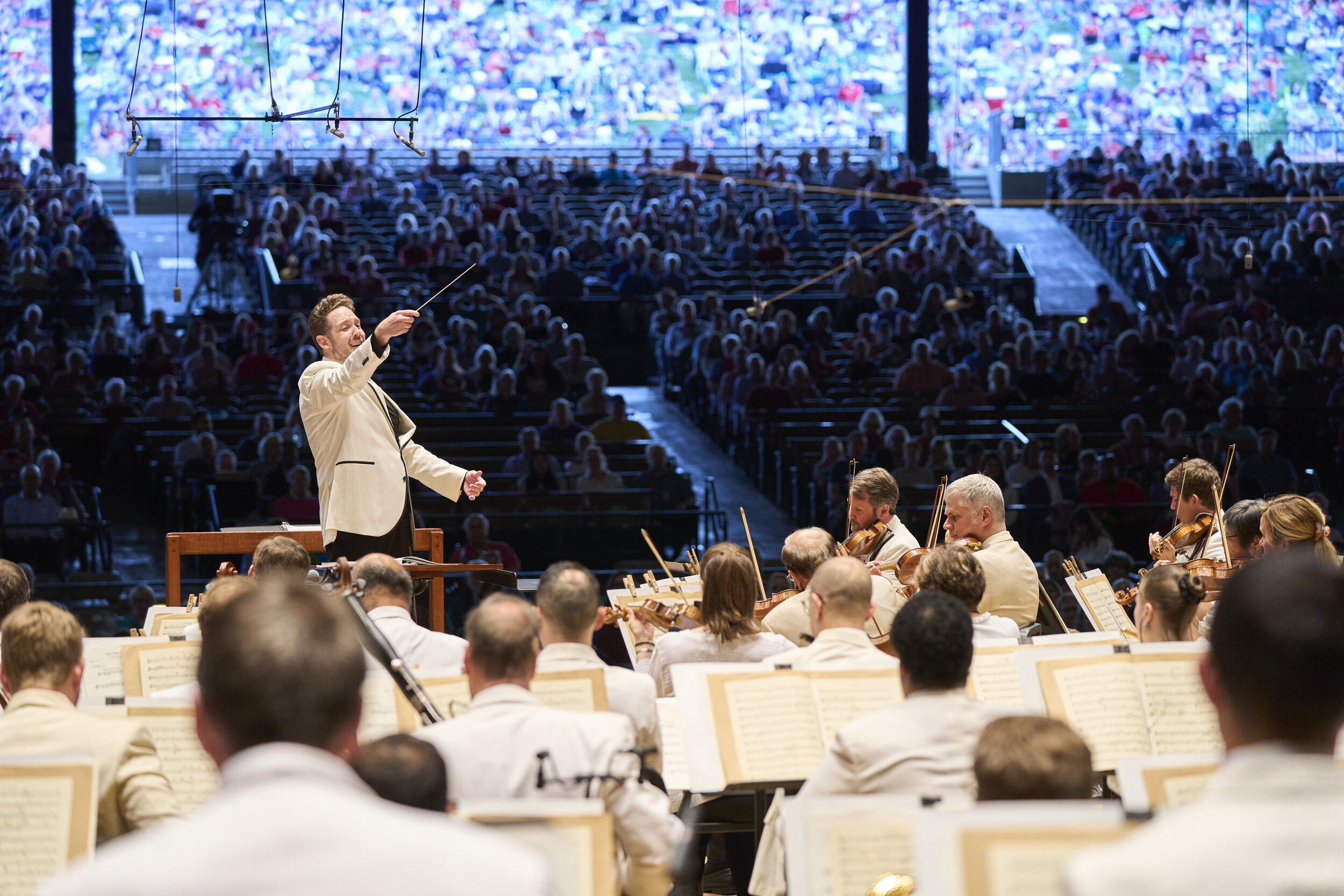
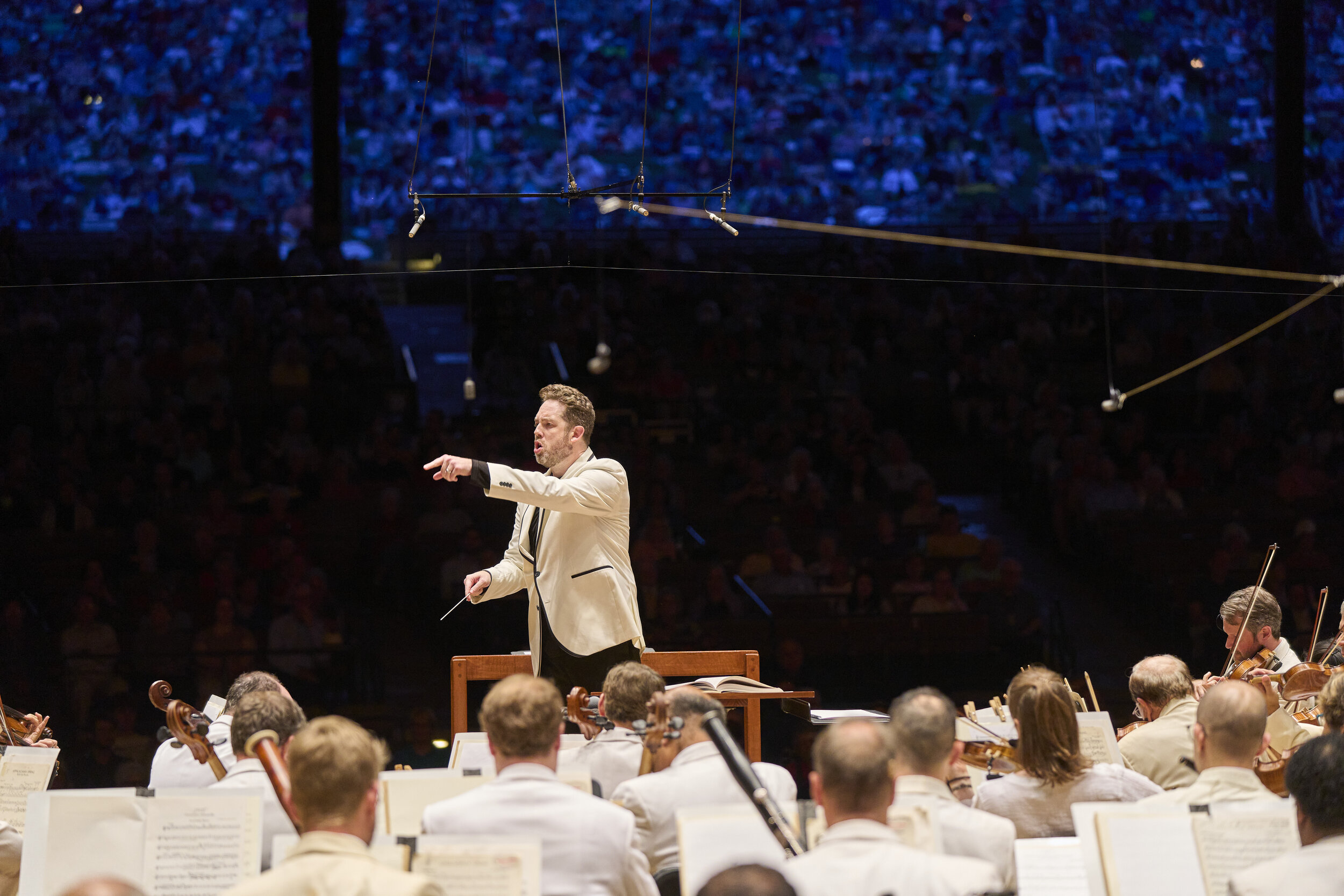
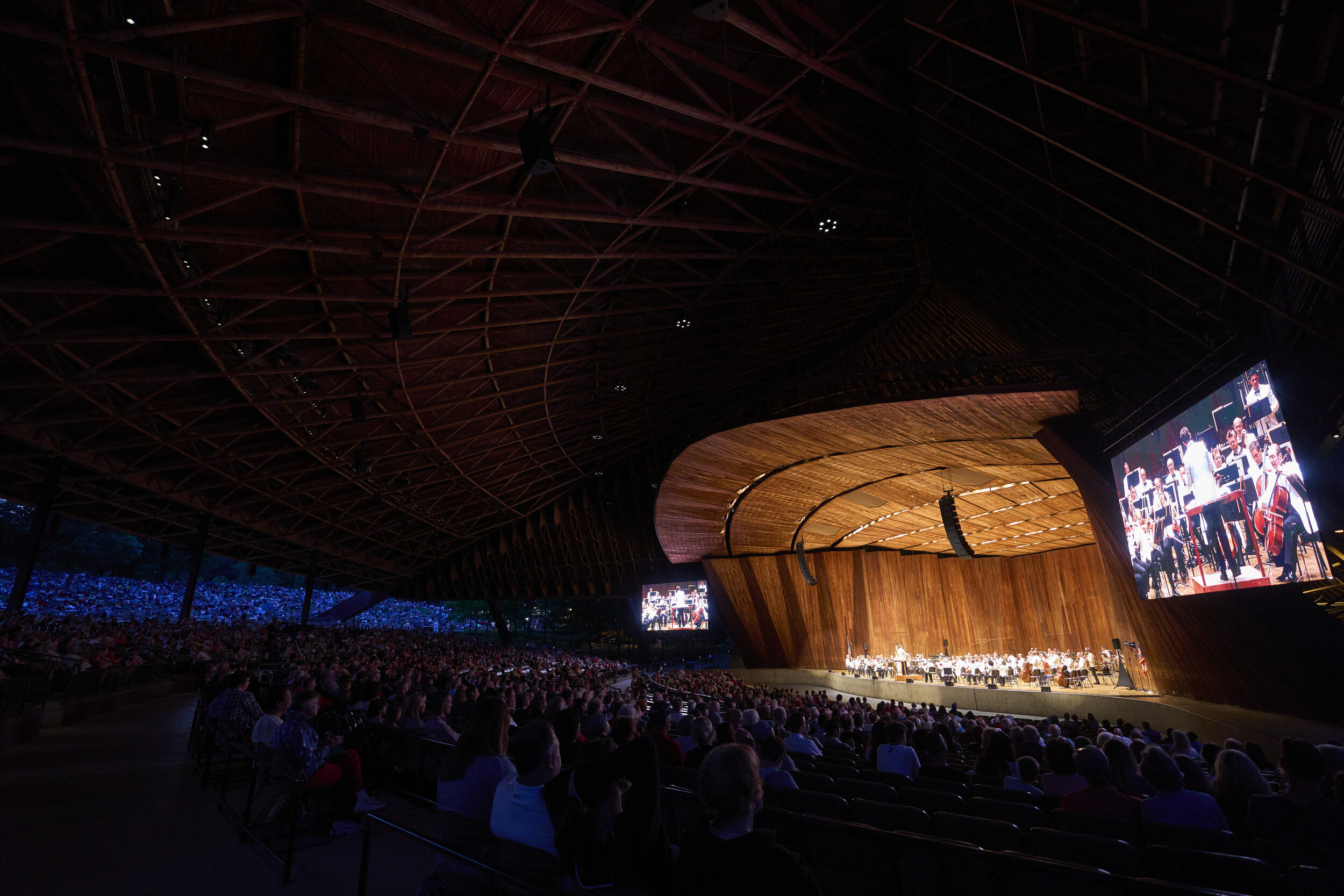
Brett Mitchell leads The Cleveland Orchestra at Blossom Music Center on July 3, 2021, marking the orchestra’s first public performance since March 2020. (Photo by Roger Mastroianni)
CUYAHOGA FALLS, Ohio — Brett Mitchell led The Cleveland Orchestra in the opening weekend of the 2021 Blossom Music Festival on July 3 and 4, marking the orchestra’s first public performances since March 2020. The following are excerpts from Cleveland.com’s review of Saturday evening’s concert:
Never before has the phrase “Blossom Music Festival” rung so true. On this occasion, there was indeed something to celebrate. The sense of post-pandemic release was palpable, and the first sounds of the full orchestra surely brought a lump to many a throat. By night’s end, before a fireworks display, the official attendance was an estimated 11,600.
The music reflected the festive mood, in a novel way. Even as it marked the nation’s 245th birthday, the program, which kicked off with a snappy account of Bernstein’s “Candide” Overture and included works by three African-Americans, also reflected society more broadly and inclusively than most Cleveland Orchestra concerts. This was a celebration of America and its music as they are, not as one group of people once imagined them to be.
The earth-shaking cannons that augmented Tchaikovsky’s “1812” Overture certainly got their point across, and there’s no beating Sousa’s “The Stars and Stripes Forever,” but to this listener, the most effective work of the night was “Soul of Remembrance,” a 1993 work by Mary Watkins steeped in the historically resilient African-American spirit.
Brett Mitchell, the orchestra’s former associate conductor, preceded the lyrical, slow-burning work with a moment of silence for the victims of COVID-19 before leading a tender but powerfully emotional reading in which the harp was a vital presence.
Another welcome piece of non-standard fare was the 1934 Concerto in One Movement by another African-American, Florence Price. Cleveland-trained pianist Michelle Cann, a champion of Price’s music, handled the recently rediscovered score with panache, treating its three sections to animated, compelling performances.
A third African-American composer, Adolphus Hailstork, kicked off the second half with “An American Fanfare,” a solemn, brass-intensive work strongly reminiscent of Copland, whose Suite from “Appalachian Spring” followed on its heels. No doubt parts of the often-delicate Suite were lost on the lawn, but in the pavilion, every measure of this well-known score, up to and including “Simple Gifts,” sparkled as if the orchestra and the audience were encountering it for the first time.
Truly, it was an Independence Day concert like no other by the Cleveland Orchestra. There were fireworks, funnel cakes, and patriotic classics, but there was also real emotion, musical depth, and the introduction of new possibilities. The Cleveland Orchestra is back and in some respects may be better than ever.
To read the complete review, please click here.
Cleveland 19 News (CBS) has also published a brief story about the event: Cleveland Orchestra performs in person for first time in more than a year at Blossom.
Photographs by Roger Mastroianni