

NEWS
Preview: ‘Sunriver Music Festival brings classical music to Central Oregon’
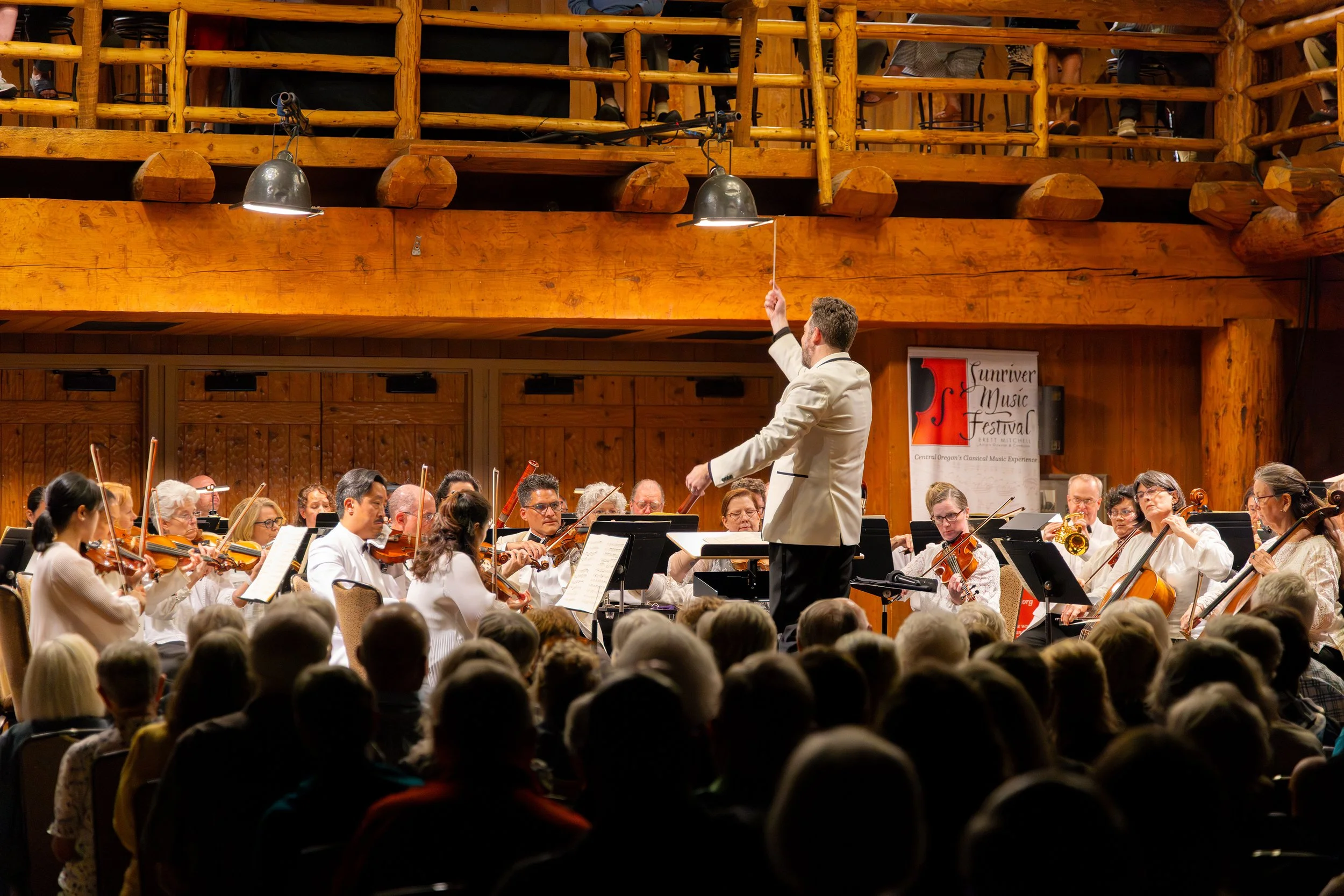
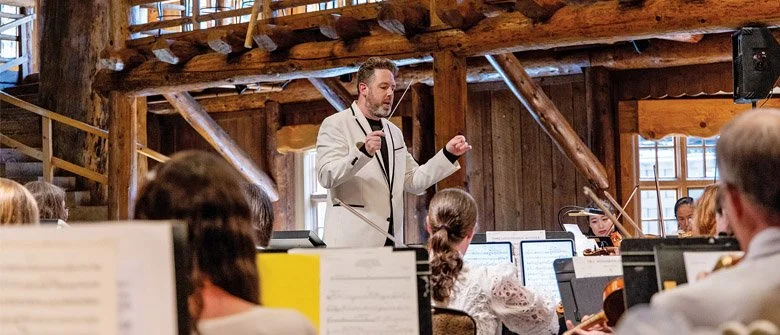
Brett Mitchell leads the Sunriver Music Festival Orchestra at the Sunriver Resort Great Hall. (Photo by David Young-Wolff)
BEND, Ore. — The Bulletin has published a preview of the Sunriver Music Festival’s 2026 season, the fifth under Artistic Director & Conductor Brett Mitchell:
In their earliest conversations about programming a series around America’s 250th birthday, conductor Brett Mitchell and the rest of the Sunriver Music Festival team faced a problem: Should they do it in August 2025, 11 months ahead of July 2026, or this August, a month after what could be the peak of patriotic feelings?
The SRMF team opted for the latter, which means the 49th season of the annual classical musical festival, set to begin Monday, will feature American composers, as well, of course, as a bevy of legends including Beethoven and Bach, Mozart and Mendelssohn, through Aug. 20.
“What I really wanted to do with, and what I’m always trying to do, is to have these programs be a real conversation between the greatest masterworks of yesterday and the most promising voices of today and tomorrow. And in this particular case, because it’s America’s 250th birthday, I really wanted to make sure that we were having a representation of the totality of America,” Mitchell said.
That die will be cast from the first piece he leads the professional Sunriver Festival Orchestra through: “Made in America,” by Grammy-winning composer Joan Tower, during Classical Concert I at 7:30 p.m. Monday in the Sunriver Resort Great Hall. From there, each of the concerts in the annual classical music festival will open with a work by an American composer.
“We will open our 2nd concert with a piece by a gentleman who was known as the dean of African-American composers,” Mitchell said, referring to William Grant Still and his “Darker America,” at 7:30 p.m. Wednesday, Aug. 12.
“We are really trying to hear from a multiplicity of voices because, look, programs, symphonic programs, are little tiny Americas. They’re little tiny melting pots, right?” said Mitchell. “And it’s like, these are the three ingredients that go into this little melting pot for this concert. So the melting pot of the first concert is Joan Tower’s ‘Made in America,’ Beethoven’s 4th Piano Concerto, and Haydn’s 101st Piano Concerto. The melting pot of the next one is a little bit different. But the idea that all of these programs, hopefully, when taken together, will demonstrate to our audience this idea that one, classical music is not a thing that happened. It is a thing that is happening.”
Family Concert
It is happening in Sunriver and Bend, where the series moves for its final concerts — but not until after the annual Family Concert returns Friday, Aug. 14, a matinee event at SHARC with a pre-concert opportunity to “meet the instruments” followed by what is quite possibly the best concert title ever, “Harry Potter & the Instruments of the Orchestra,” featuring music by John Williams.
“It’s such an unusual, interesting thing that he chose to do,” Mitchell said of Williams’ note at the beginning of his score, which reads in part: “When I wrote the full orchestral score for Harry Potter and the Sorcerer’s Stone, I hadn’t planned to write the eight miniatures presented here. The film score did not require them, and our production schedule, usually very difficult in the film world, made no provision for their arrival. However, if I can be permitted to put it a bit colorfully, each piece seemed to insist on being hatched out of the larger body of the full score.”
“So what John does is he takes eight little miniatures, eight different themes, and gives them to the whole orchestra, but to specific sections,” Mitchell said. “So like the second movement is the ‘Theme for Hogwarts,’ right? … And the theme is played by four French horns so that the kids in the audience can hear the sound of French horns. … What about the bad guy? What about Voldemort? He’s played by a trio of bassoons.”
And what about Harry’s magical broomstick, the Nimbus 2000? Played by the woodwinds, of course.
“It’s a great way to play music that the kids will know from a story they will know (and) to show them the colors of the orchestra while we’re doing it,” Mitchell continued. “So they’re getting all of this information without even knowing that they’re getting it. So I’m really, really tickled that we’re going to be able to do this piece for the kids because I know they’re absolutely going to just fall in love with it.”
Pops Concert
The following evening, it’s on to Bend for the remaining concerts, starting with the ever-popular Pops Concert, Saturday, Aug. 15, at the Tower Theatre. Titled, “John Williams and the American Journey,” highlights include music from “Saving Private Ryan,” “Born on the Fourth of July,” some patriotic tunes and Copland’s “Fanfare for the Common Man.”
Mitchell said, “We start with John’s arrangement of ‘The Star-Spangled Banner.’ And then we really begin the program with The Revolutionary War. So some of John’s music for ‘The Patriot,’ and then this wonderful piece for a violin and orchestra called ‘Souvenir from America, Yankee Doodle Variations’ by a French composer. And so that’s The Revolutionary War. Then we go to the Civil War. We’ll do some of John Williams’s music from ‘Lincoln.'”
Said Meagan Iverson, SRMF’s executive director, “Brett is such an aficionado of film music and John Williams, and the way he has been able to create this program that blends a lot of film music, and also beloved patriotic pieces, is going to make for such an incredible concert.”
Iverson also warned that tickets to the Pops Concert, along with Monday’s opening night concert in Sunriver, are selling fast.
“All of the concerts are selling pretty well,” she said. “Those are the two that if people don’t hop on it, we might have to say, ‘Oh, we’ll put you on the wait list.”
The final two classical music concerts are Aug. 18 and 20, also at the Tower Theatre.
While you’ll need a ticket to attend all of the abovementioned concerts, Iverson notes that there are a number of rehearsals that are free and open to the public. The open rehearsal schedule, as well as ticketing, more events and other information, is at sunrivermusic.org.
Some concerts have only one rehearsal, which would not happen if the Festival Orchestra was not made up of professionals who come ready to play, Iverson added.
“We have been realizing that (open rehearsal) is a very extra special offering, as it’s becoming less and less common to have so many opportunities for people, to just get a taste of what’s happening behind the scenes,” Iverson said, “and hopefully be inspired then to come to the full concert.”
To read the complete preview, please click here.
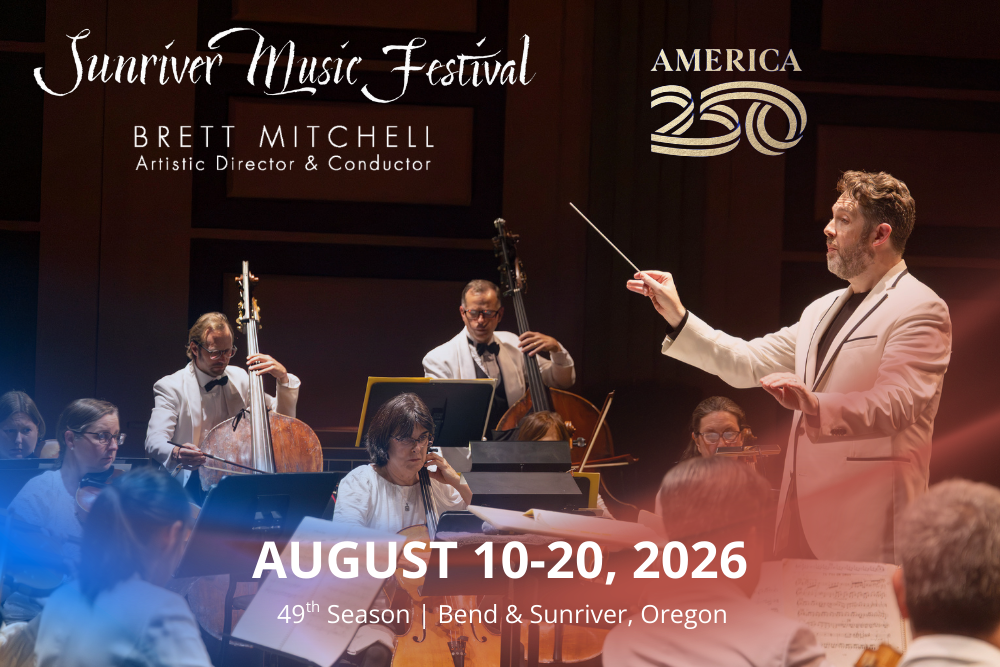
Videos: Brett Mitchell Previews the 2026 Sunriver Music Festival
SUNRIVER — Brett Mitchell has released six short videos previewing each concert of the 2026 Sunriver Music Festival, which runs from Monday, August 10 through Thursday, August 20 in Sunriver and Bend, Oregon.
Mon, Aug 10: Opening Night
Tower | Beethoven | Haydn
Wed, Aug 12: America Meets Scotland
Still | Barber | Mendelssohn
Fri, Aug 14: Harry Potter & the Instruments of the Orchestra
Williams | Mendelssohn
Sat, Aug 15: John Williams & the American Journey
Williams | Vieuxtemps | Gould | Copland
Tue, Aug 18: The Genius of Music
Puts | Bach | Mozart
Thu, Aug 20: Season Finale
Copland | Meyer | Schumann
Audio: Brett Mitchell on ‘Ray’s Random Questions’
Getting to know some of Central Oregon’s most interesting and influential people by using ice-breaker questions
BEND, Ore. — Brett Mitchell has appeared on the latest episode of Ray’s Random Questions, an interview series hosted by Ray Solley “using three levels of ice-breaker questions randomly drawn by each guest. By listening and posing follow-up questions, Solley prompts informal conversations, making each participant comfortable to share personal stories, meaningful memories, life values… and which ice cream flavor best sums up their mood today.”
Listen to this 24-minute episode on MyCentralOregon.com or via the player below.

Preview: Sunriver conductor Brett Mitchell to play in ‘Maestro at the Piano’ Saturday
Brett Mitchell will present a solo piano recital in Sunriver, Ore. on Saturday, April 11, featuring his original arrangements of iconic works from film score history. (Photo by Roger Mastroianni)
BEND, Ore. — The Bulletin (Bend) has published a preview of Brett Mitchell’s upcoming solo piano recital in Sunriver on Saturday, April 11.
Sunriver conductor Brett Mitchell to play in ‘Maestro at the Piano’ Saturday
Mitchell flexes his other chops, arranging tunes from Star Wars, Jurassic Park and other popular films for piano
On Saturday, Central Oregonians will have another chance to see and hear Sunriver Music Festival Artistic Director and Conductor Brett Mitchell — this time around, however, he won’t be on a podium, but rather seated at a piano in his exclusive “The Maestro at the Piano: Music in Film” recital.
For Mitchell, it’s a familiar space in which to ply two major, if lesser known, aspects of his musicality.
“I’ve always been a pianist. I’ve always played the piano,” he said last week by phone from his home in Denver, where he is former conductor of the Colorado Symphony. Today, Mitchell conducts the Pasadena Symphony, as well as Central Oregon’s summertime concert series each August.
But before his career helming orchestras, Mitchell’s piano abilities and ambitions almost took him down a different career path: composition.
“By the time I got into college, I thought I wanted to be a film composer,” Mitchell said. “And the bigger the pieces I started writing, the more likely they were to need a conductor. So I ended up just kind of conducting my own pieces, and then that led to conducting other people’s pieces. But that piano part of things for me has always been really at the forefront for me, even though it hasn’t been at the forefront of how I perform most of the time publicly. I mean, certainly the world knows me as a conductor.”
Musical chairs
Six years ago, courtesy of a pandemic, that work came to an abrupt halt — or a caesura, if you want to put it in classical conducting terms.
“The whole reason that I became a conductor is because I love working with other people. I love working with other musicians,” he said. “And obviously when the pandemic happened, that went away, in large part for a year, year and a half, two years, depending on how you look at it. And I was sitting there here in our house, probably two months into this thing when it became clear that it wasn’t going to be like a two-month deal, but that we were going to all be here for a while.”
This allowed Mitchell to both play the piano and get creative by “flexing (his) arranging chops, arranging chops, taking iconic scores from film music history and arranging them for solo piano,” as he put it in a press release from Sunriver Music Festival.
As is surely true of many a great feat, this one came about after complaining to his spouse.
“I was basically just complaining to my wife saying, ‘I have I have no way to perform right now, because the performing that I do requires other large groups of musicians to all be in the same place together and that’s not able to happen,'” he recalled. “And she said, ‘We’ve got the Steinway. Why don’t you why don’t you go go make music on the Steinway?’ And while that’s a very different experience, what I really found was so fulfilling to me. I had basically left the piano alone in terms of public performance for the better part of 20 years.”
That’s not altogether true; he had performed a recital or two in that time, as well as occasional chamber performances with orchestra members. Otherwise, he’d spent little time playing piano in public for those two decades.
On his home Steinway, “What I was able to do was kind of take all of the parts of me that make me who I am musically, which is primarily an orchestral conductor. I have also conducted an awful lot of films live to picture. That’s something that has gone on now for the better part of 10 or 15 years and I have been a part of that kind of new endeavor. And I have a composition degree, which means I am fully capable of taking an enormous orchestral score and trying to look at it through the lens of the composer and rearrange that music for solo piano.”
Popular YouTube channel
Mitchell performs his arrangements of movie tunes his YouTube channel, which has over 4,500 subscribers. There, you can watch Mitchell perform highly recognizable music from “Gone with the Wind” to “Close Encounters of the Third Kind” and “Harry Potter and the Sorcerer’s Stone.”
By his own assessment, these are “no frills,” three-angle videos — a wide shot, Mitchell’s face and his hands on the keys — the popularity of which “is a surprise to no one more than me,” he said.
“I was really making these projects, these videos because it was something I was interested in doing. It was something that I felt passionately about. It was music that I loved and cared deeply about,” he said. “And as it turns out, a lot of people felt the same way. And I’m, I’m really grateful for that.”
Saturday in Sunriver, the live audience will have an opportunity his YouTube fans do not: To hear Mitchell performing them live. Mitchell’s sorted the nearly 400 videos he’s created over the last several years according to which have the most views in creating Saturday’s program.
“So basically, the top 10 or whatever on my channel are showing up on this recital program,” he said. He’ll also perform his arrangements of Bernard Herrmann’s score for Alfred Hitchcock’s “Vertigo” as well as “Adoration of the Magi ” and “Start of Bethlehem” from “Ben-Hur.”
And much like Mitchell’s YouTube channel followers, fans of composer John Williams — the famed and prolific scorer of some of the biggest films of the past 50 years, from “Star Wars” and “E.T. the Extra-Terrestrial” to “Schindler’s List” — will not be disappointed.
“There are things (that) would divide my channel in terms of the film score part of it into two sections,” Mitchell said. “The first is John Williams. The second is everybody else.” Of the 398 videos on his channel now, 157 of them are John Williams tunes.
“John Williams is certainly my great hero,” Mitchell said. “I would not be here if it were not for John Williams.”
2026 Sunriver Music Festival
Though the recital certainly works as a standalone event, Mitchell said, it also serves as a lead-in to August’s Sunriver Music Festival, which will pay tribute to country’s 250th birthday.
“All of that’s to really lead into the summer festival,” Mitchell said. “We’ve got classical concerts as always during the summer festival. Each one of those will have a piece by a contemporary American composer on it.” The recital is a particularly strong antecedent to the annual Pops Concert, which will be “John Williams and the American Journey” and the annual Family Concert, “Harry Potter and the Instruments of the Orchestra, which will be an all-John Williams program.
Said Mitchell, “I’m really excited to kick off that America 250 celebration with these film score excerpts, because the art of film scoring was born during the American century,” aka the 20th century. “I’m going to talk a lot throughout the program and share behind the scenes stories with the audience, some anecdotes that perhaps they know, but more likely they don’t that will help them listen with new ears.”
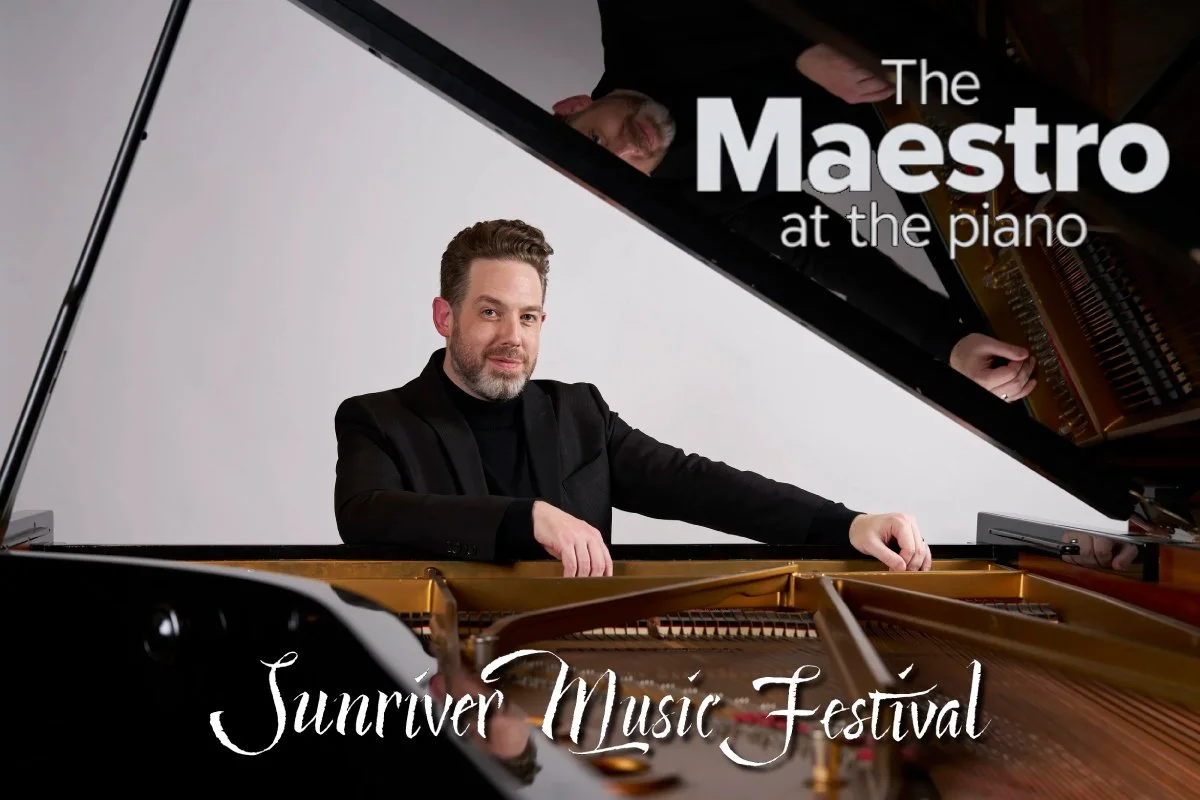
Preview: Sunriver Music Festival — The Maestro at the Piano
BEND, Ore. — The Source has published a preview of Brett Mitchell’s upcoming solo piano recital, presented by the Sunriver Music Festival:
Hailed for the breadth of his work on the podium and at the piano, Maestro Brett Mitchell has carved a unique path in the world of contemporary American classical music. Sunriver Music Festival’s Artistic Director & Conductor will present an exclusive solo piano recital featuring his own arrangements for film in Sunriver on April 11. Visit sunrivermusic.org for tickets to The Maestro at the Piano.
As a conductor, Mitchell currently serves as Music Director of the Pasadena Symphony and Artistic Director & Conductor of Oregon’s Sunriver Music Festival. He previously served as Music Director of the Colorado Symphony, Associate Conductor of The Cleveland Orchestra, and Assistant Conductor of both the Houston Symphony and Orchestre National de France. Working widely as a guest conductor, Mitchell has led the New York Philharmonic at David Geffen Hall, the Los Angeles Philharmonic at the Hollywood Bowl, and principal orchestras spanning the United States and beyond.
As a pianist, Steinway Artist Brett Mitchell has a devoted fanbase of his work at the keyboard. The high standard he has set with artistic and professional achievements makes it most appropriate that Mitchell is formally included on the Steinway Artist roster—a list of the most accomplished and discriminating artists in the world. His exceptionally active YouTube channel @brettmitchellconductor features his original solo piano videos of iconic cues from film history and landmark works from classical, jazz, and pop canons.
“Film music has always been one of my great musical loves. When the pandemic hit in 2020 and we couldn’t present orchestral music, I flexed my arranging chops, taking iconic scores from film music history and arranging them for solo piano. What began as a pandemic diversion has morphed into a continuing passion project that I’m now thrilled to share with more than 15,000 subscribers across my social platforms, and I couldn’t be more pleased as we gear up for Sunriver Music Festival’s “America @ 250” celebrations in August 2026 to share many of these iconic selections with our audience in Central Oregon. The art of film scoring was born during the American century, and I can’t imagine a better way to kick off our celebrations than with an intimate evening featuring some of my favorite music of all time. Please join me on April 11 in Sunriver.” - Artistic Director & Conductor Brett Mitchell
Mark your calendars for April 11 and visit sunrivermusic.org for tickets to Sunriver Music Festival’s exclusive concert The Maestro at the Piano. VIP ticketed guests are welcomed to an intimate post-concert reception offering wine, light fare and unhurried conversation with the maestro in an informal setting.
Click here to read the complete preview, and here to read the official press release from the Sunriver Music Festival.
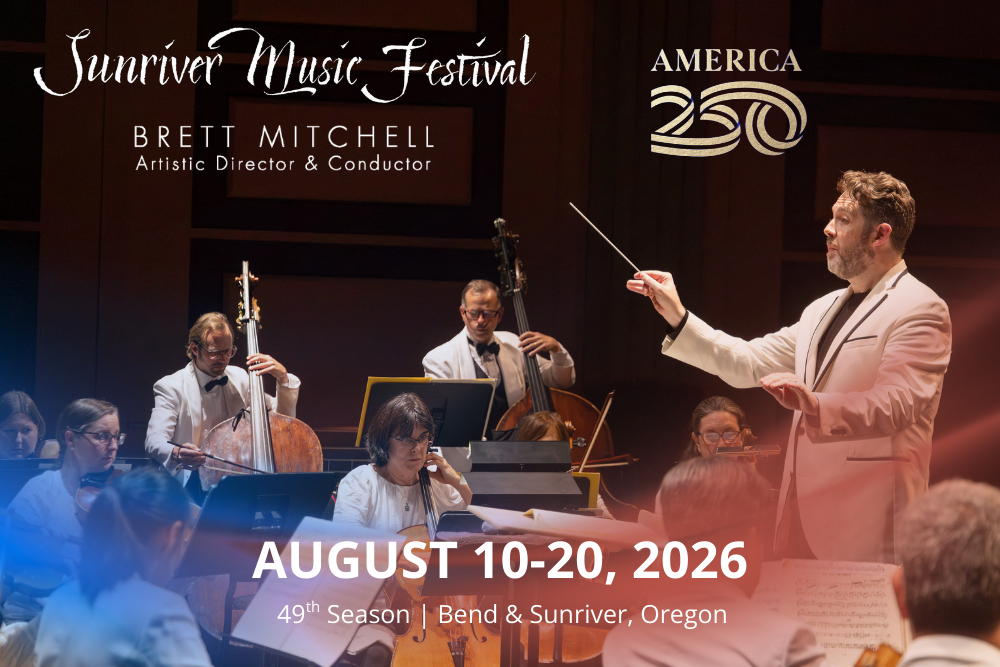
Sunriver Music Festival announces 2026 season, Brett Mitchell’s fifth as Artistic Director & Conductor
SUNRIVER, Ore. — The Sunriver Music Festival has announced details of its 2026 summer season, Brett Mitchell’s fifth as Artistic Director & Conductor:
As America celebrates 250 years in 2026, we honor one of its greatest gifts to the world: music. The 49th season programming, curated by Artistic Director & Conductor Brett Mitchell, will feature world-class orchestra musicians and acclaimed soloists performing eclectic works by American composers — Aaron Copland, Samuel Barber, William Grant Still, Joan Tower, Kevin Puts, Edgar Meyer and John Williams — alongside favorites by Beethoven, Bach, Mozart, Haydn, Schumann, and Mendelssohn and more.
The Summer Festival opens August 10 at Sunriver Resort’s historic Great Hall and closes August 20 at the iconic Tower Theatre in downtown Bend. Four classical concerts, a pops concert and a family concert will be presented. Featured artists include pianist Michelle Cann, violinists William Hagen and Tessa Lark, bass-baritone Timothy Jones, and the Central Oregon Mastersingers.
The classical season will consist of the following four programs:
Wed, Aug 12 | Sunriver Resort Great Hall - Sunriver, OR
AMERICA MEETS SCOTLAND
STILL - Darker America
BARBER - Violin Concerto
William Hagen, violin
MENDELSSOHN - Symphony No. 3, ‘Scottish’
Mon, Aug 10 | Sunriver Resort Great Hall - Sunriver, OR
BEETHOVEN, HAYDN, AND MADE IN AMERICA
JOAN TOWER - Made in America
BEETHOVEN - Piano Concerto No. 4
Michelle Cann, piano
HAYDN - Symphony No. 101, ‘Clock’
Thu, Aug 20 | Tower Theatre - Bend, OR
APPALACHIA AND SPRING
COPLAND - Suite from Appalachian Spring
EDGAR MEYER - Violin Concerto
Tessa Lark, violin
R. SCHUMANN - Symphony No. 1, ‘Spring’
Tue, Aug 18 | Tower Theatre - Bend, OR
THE GENIUS OF MUSIC
KEVIN PUTS - Einstein on Mercer Street
Timothy Jones, bass-baritone
J.S. BACH - Brandenburg Concerto No. 3
MOZART - Symphony No. 39
See our Upcoming Events page for complete repertoire, and visit sunrivermusic.org to learn more. Click here to read a preview in The Source.
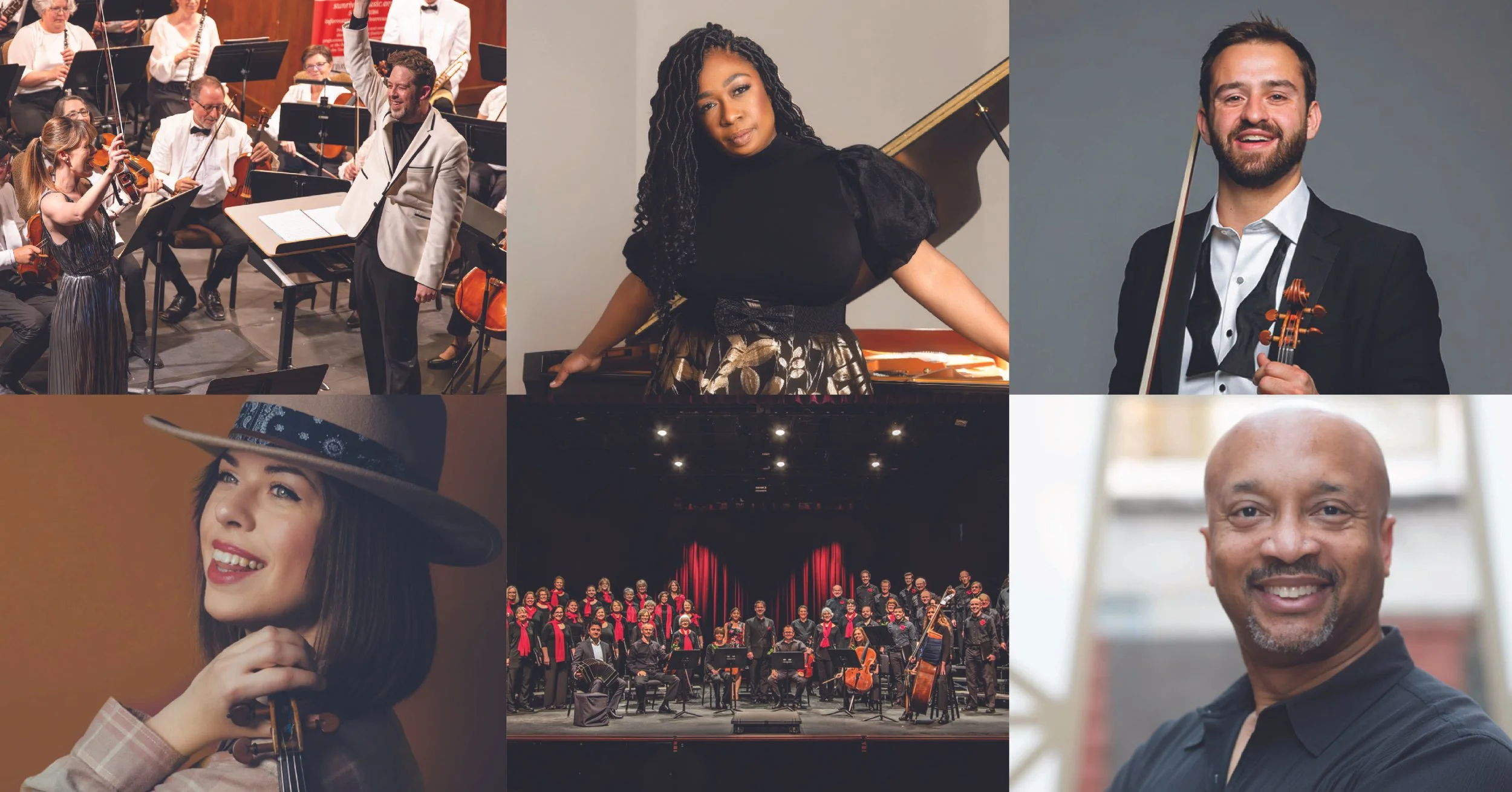
Artistic Director & Conductor Brett Mitchell will welcome pianist Michelle Cann, violinists William Hagen and Tessa Lark, bass-baritone Timothy Jones, and the Central Oregon Mastersingers as featured artists during the 2026 Sunriver Music Festival.

Review: ‘Participating in the ritual: Central Oregon’s Sunriver Music Festival’
Artistic Director & Conductor Brett Mitchell leads the Sunriver Music Festival Orchestra in Aug. 2025 at the Tower Theatre in Bend, Ore. (Photo by David Young-Wolff)
SUNRIVER, Ore. — Oregon ArtsWatch has published an extensive review of the final three concerts of the 2025 Sunriver Music Festival, Brett Mitchell’s fourth as Artistic Director & Conductor.
Participating in the ritual: Central Oregon’s Sunriver Music Festival
The joys and miracles of live music in the rustic Great Hall, with SRMF director Brett Mitchell, concertmaster Yi Zhao, pianist and Cliburn medalist Vitaly Starikov, and an orchestra full of stars.
The heat wave that baked much of the Pacific Northwest for a few days last week was in full force as the final concerts of the 48th annual Sunriver Music Festival began. Taking place in the rustic charm of the Sunriver Great Hall, which was once the officer’s HQ at Camp Abbott during the Second World War, the festival took us from Leipzig to Vienna with some strange stops in between…
Monday the 11th was “The Leipzig Connection,” and opened with Schumann’s Manfred Overture; an interesting factoid was that Robert and Clara’s great-great granddaughter was in the audience that night. There was plenty of sturm und drang during the Manfred, and I did my best to hear over the oft-featured horns and woodwinds. The strings were rich and woody, somehow appropriate to this venue as if in a strange “like to like” principle…
Yi Zhao, concertmaster, was the soloist [in Mendelssohn’s Violin Concerto], and her cantabile portions were fantastic… She leaned into the sentimentality of the opening movement, and her scalar passages were well-constructed as she was ably supported by the orchestra. The attacca bassoon into the second movement was a delight, and being delighted by the first bassoonist Anthony Georgeson was to become a regular feature of my time here. Zhao wrung the pathos out of the lower registers, sounding very viola-like. The tutti serenade was beautiful… The finale was appropriately spritely and dancing, and Zhao really shone here, as her rapid-fire sautillé toward the end positively sparkled. I’m not sure what the classical music scene as a whole is like in Central Oregon these days, but since the demise of the Cascade Festival of Music, I imagine there are not many other chances to hear tremendously important works of this caliber in the region.

Sunriver Music Festival Orchestra Concertmaster Yi Zhao and Artistic Director & Conductor Brett Mitchell. (Photo by David Young-Wolff)
Earlier in the first half, conductor and Artistic Director Brett Mitchell (read his interview with Matthew Neil Andrews, and get more detail on the festival and venue here) mentioned that anyone who achieved a certain level of piano aptitude likely learned some of Mendelssohn’s Songs Without Words at some point in their playing career. Those ones escaped me, but us little Baroque boys instead sometimes learned a piano transcription of the work that opened the second half, the now-(though not always)-famous Toccata and Fugue in D Minor BWV 565 by good old Uncle Bach, the great Johann Sebastian. Originally composed for the organ (though there is apparently some argument as to whether Bach himself actually composed it), the work languished in relative obscurity until Leopold Stokowski’s famous orchestral transcription appeared in Walt Disney’s Fantasia about the time the Sunriver Great Hall was being built. Mitchell pointed out that the number of musicians required to play that particular transcription might be almost equal to that night’s orchestra plus all the members of the audience, so the rendition played here was Australian composer Luke Styles’ brilliantly scaled-down version for percussion, strings, and a small wind section.
A startling simultaneous trill on tambourine and triangle underpinned an abrupt and almost comical exposition of the famous toccata theme by the winds at the opening. The huge, menacing chords built from the ground up by the winds were fantastic, and the woodblock chattered behind arpeggiating strings. Gently the strings carried the majority of the fugal opening, and the descending scales were parted out to various instruments in clever salvos. The percussion accents were various and vital, and all in all this work with its light touch and deft instrumentation was a breath of fresh air for those (like me) who consider Stokowski’s version weighted and a bit stodgy.
The finale of the evening was Bach’s Orchestral Suite No. 3 in D Major BWV 1068, the perfect piece for a summer music festival, right up there with Handel’s Music for the Royal Fireworks or his Water Music suite. Mitchell led the orchestra deftly in a marvelous rendition of the “Overture,” this gem of stylized Baroque grandeur at its finest with its succinct trumpet fanfares set one after another in a filigree of majestic fortissimo timpani rolls. In the second movement, whose main theme is sometimes known as the Air on the G String, the strings played this timeless melody in a broad, handsome largo. In the Gavottes the interpolations from the principal trumpet Jeffrey Work ended with breathtakingly gentle terminal trills, in opposition to the wide, bold cadential trills he delivered later in the Gigue. The evening left me excited for more of the festival, and ready for whatever peregrinations would lead us to Vienna for the final evening…

Brett Mitchell leads the Sunriver Music Festival Orchestra at the Great Hall in Sunriver, Ore. (Photo by David Young-Wolff)
Miracles
The final night of the festival took us as promised to Vienna, after the ethereal and mystical stops of the previous evening. The evening opened, appropriately enough, with a work by Haydn, Symphony No. 96 in D Major, Hob. I:96, also nicknamed the “Miracle.” The opening was appropriate because the other great Viennese masters Mozart and Beethoven were also programmed this evening, and Haydn was at one point Beethoven’s teacher, and was a friend and mentor to Mozart for most of the latter’s life, with Mozart even dedicating six of his string quartets to “Papa Haydn”…
The SRMF’s performance featured some magical moments. Principal oboe Lindabeth Brinkley was absolutely top-notch: her delicacy of phrasing, her ability to combine the sweet with the powerful during the opening “Adagio” made me wish that movement would never end. The winds generally were fantastic while I was there; the little trios and quartets that manifested themselves here and there were constantly among the highlights of any performance. The fine tutti sections in the finale were strong, punctuated without being overblown, and the finesse required from the brass and winds to deliver a first-rate performance was everywhere in evidence.
Much as it had been at The Cliburn earlier in the summer, it was a true pleasure to hear Vitaly [Starikov] play multiple concerts in one week, and his back-to-back performances at SRMF were a highlight of my year. He chose the Piano Concerto No. 17 in G Major, K. 453 to play at the SRMF…
In the “Andante” the woodwinds again showed their caliber: the very highest. They displayed unity and precision in an almost uncannily unified timbre to come from such disparate instruments; if I have ever heard a more dulcet bassoon than Georgeson playing the Mozart that evening, I can’t remember when it was. The soloist played misterioso, giving this movement everything we love about a Mozart andante; it was soulful and hauntingly melodic. He has a sensitivity to his attack, a way of leaning into the instrument and bringing his hands down in such a way that it feels like he is going to disgorge some frightfully loud chord – and then he puts all that tremendous energy into the softest cantabile imaginable…
My friend Jon was with me for both the Leipzig and Vienna concerts. He is a musician himself, and we shared our insights with one another throughout the week. He commented that he thought a really great soloist can raise the level of the orchestra, and I agreed with him, and in this case, I thought that two things were going on; that is to say there was a feedback loop between soloist and orchestra, as though each kept upping their game, as if each were daring the other to do better. The orchestra was spectacular in this work, and I was as impressed with Starikov’s Mozart as I was with his solo work, which is about the highest praise I can think of.
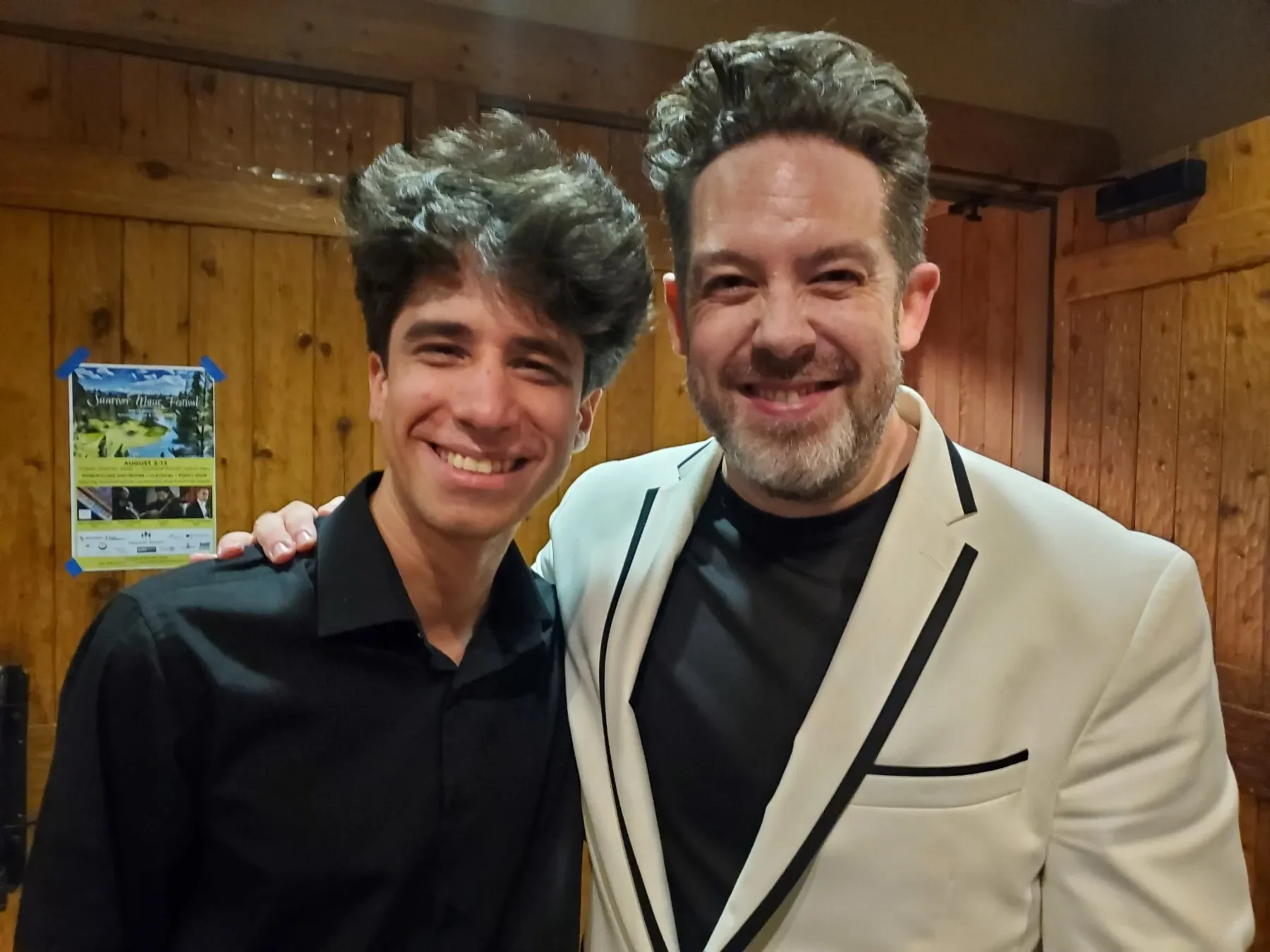
Pianist Vitaly Starikov and conductor Brett Mitchell after performing Mozart’s Piano Concerto No. 17 with the Sunriver Music Festival Orchestra. (Photo by Jimena Shepherd)
Talk about your all-time festival favorites, what better way than to round off the festival than by playing Beethoven’s Symphony No. 5 in C Minor, Op 67…
The opening four notes are maybe the most famous four notes in music history, and their execution is something of a matter of personal choice by the conductor. Mitchell chose here to launch straight into it with no fanfare, no ritardando or undue accenting: he simply played them as they were written: the opening bit of an “Allegro con brio,” and this worked really well. Let’s not milk it, I thought, there is so much other great stuff here, and we will get to hear this motive many more times tonight. The brisk tempo was also a great choice, and the strings were obviously having great fun – this was their chance to shine, and the phrasing was nuanced and intelligent, with sensitive piannisimi, giving the music plenty of room to grow dynamically.
I began to note various things live that I maybe don’t pay as much attention to when I listen to a recording. Things like the bitter battles between strings and winds, the importance of the bassoon as an anchor to the harmonies, the small but vital horn entrances on which the ensuing parts hang. In the “Andante con moto” I noticed just how difficult the contrabass parts were, and how much fun the double bassists Jason Schooler and Clinton O’Brien had on their fortissimo cadential endings, the one-note whomps! they got to play at the end of a phrase… I heard how the cellos and violas sounded at times delightfully like a collection of woodwinds; their ability to change color, chameleon-like in this fashion is something I don’t note unless I’m sitting there, reveling in the glory. The sudden and surprising crescendi, the tootling piccolo hits in the “Scherzo” – the list goes on and on.
As the Beethoven ended, I pondered the incredible possibilities and synergies that develop when performers and audience gather at the same time, to participate in the ritual, the very real magic known as live music. Though this was my first time attending, the Sunriver Music Festival, in its 48th year, feels like the gift that just keeps on giving. Here’s to 48 more.

Brett Mitchell and the Sunriver Music Festival Orchestra after performing Beethoven’s Symphony No. 5. (Photo by David Young-Wolff)

Feature: ‘From Manilow to Mozart, Sunriver maestro Brett Mitchell is an all-around music fan’
Brett Mitchell leads the Sunriver Music Festival Orchestra (Photo by David Young-Wolff)
BEND, Ore. — The Bulletin has published a feature about the Sunriver Music Festival and its Artistic Director & Conductor, Brett Mitchell, who is about to begin his fourth season at the helm of the nearly-50-year-old festival in Central Oregon.
Sunriver Music Festival kicks off Saturday, with four classical concerts, a family concert and the ever-popular, and often sold-out, pops concert over the next week and a half in Bend and Sunriver.
The festival opens at the Tower Theatre with an evening program titled “A French Soiree,” followed by the Pops Concert Sunday night, also in the downtown Bend theater.
Concerts continue apace, through Aug. 11’s Season Finale Classical Concert, “Vienna Waits for You,” with music by Haydn, Mozart and Beethoven, among the many composers who called the Austrian city home.
But if, like Brett Mitchell, conductor and music director of the seasonal classical festival, you’re a Billy Joel fan, you know that the concert’s title is a pulled directly from the lyrics of “Vienna,” the B-Side to Joel’s 1977 single “Just the Way You Are.”
“I really am a subscriber to Duke Ellington’s great aphorism, which is, ‘There’s only two kinds of music. There’s good music, and there’s bad music,'” Mitchell said.
First came rock
Mitchell’s classical bona fides include his service as current music director of the Pasadena Symphony, and previous stints as music director of the Colorado Symphony, associate conductor of The Cleveland Orchestra and assistant conductor of both the Houston Symphony and Orchestre National de France. In May, Mitchell stepped in for conductor Juanjo Mena and made his subscription debut with the New York Philharmonic with less the 24 hours’ notice, receiving wide praise in reviews of his work.
But Mitchell is also a rock and pop aficionado. The array of autographs on the wall of his home studio attests to his wide and varied musical influences and tastes:
“I’m in my studio right now, and I’ve got to my left what I call my autograph wall, and I’ll tell you who’s autographs are on this wall,” Mitchell said. “The autographs are Stephen Sondheim, Leonard Bernstein, John Williams, Billy Joel, Barry Manilow, Paul Simon and Art Garfunkel and Tony Bennett.”
If there are any aesthetes turning a nose up at the very notion of this diverse group sharing space on Mitchell’s wall or playlists, know this: He grew up in a non-musical family, and from a young age, rock and pop were his entry points into what he does professionally now.
We mean very young.
In the early ’80s, when he was 3 years old, he heard a song on the radio and asked his mom, who was getting ready for work, if they had it on vinyl.
“She said, ‘We do have a record of it.'”
Mitchell told his mom he wanted to take said record and his Fisher-Price record player to his caretaker, Janet’s house. His mom said Janet probably already knew the song. But he was determined to do it his was. His mom gave in on the record, but told him Janet has her own record player.
“I said, ‘No mom, I really want to take our record and my record player.’ And rather than argue with a 3-year-old, which is never a winning proposition — which I can attest to because we have a 3-year-old right now — she said, ‘OK.'”
Oh Mandy
When they arrived at Janet’s, the future conductor stopped his mom from leaving to head to work, he insisted the three of them sit together and listen to it.
The record: “Mandy,” Manilow’s 1975 no. 1 song, in which Mandy came and gave without taking. “The thing I have up on my wall — there was a silver record released for ‘Mandy’s’ 40th anniversary like 10 years ago, that Barry signed however many of.
“It’s funny, because people hear, you know, Leonard Bernstein, Stephen Sondheim, John Williams up on my wall with the silver record of ‘Mandy’ by Barry Manilow, and it’s like, ‘Guys, this is what I’m talking about,'” Mitchell said. “I tell that story all the time because it’s a cute story … but here’s what it really is. I found music that I loved, and I wanted to share it with as many people as I could.
“Now, when I was 3, that was for my mom and my caretaker on a living room floor in Seattle,” he added. “Now I get to do it — I opened the Cleveland Orchestra’s Blossom season (that’s the name of its summer performance venue) for 20,000 people a couple of weekends ago. So when you ask do I listen to pop, I do listen to pop. I listen to jazz. I listen to almost everything but classical to be honest with you, because I’m always working on classical music. That’s what I do all the time.
“The last thing I want to do when I’ve finished a day of studying Mozart is go listen to more Mozart. I’d much rather listen to Dave Brubeck and Bill Evans.”
The early ’90s
Knowing he was 3 in the early ’80s and living in the Pacific Northwest, you can probably guess what genre he got into after the smooth rock of Manilow.
“I was born in 1979 in Seattle,” he said. “By the time I got to middle school in 1991, it was Nirvana, it was Pearl Jam, it was Soundgarden.”
Crack open his middle school yearbook to “whatever page you want, every one of us is in flannels and ripped jeans,” he said, laughing.
He’s chiefly a Nirvana guy: “I thought Nirvana was as good as it got.” He even preferred the raucous, Steve Albini-engineered “In Utero” over the polished, Butch Vig-produced breakthrough “Nevermind.”
For him, there’s a common thread among all the songwriters and composers he’s come to love in his work and his free time that ties it all together.
Because of the way Mitchell had always viewed music, when he began exploring classical at age 15, “It didn’t strike me as any different from Nirvana,” he said. “Here’s a guy dealing with some serious things in his life, and has chosen, as part of the way that he’s going to work through these things, he has chosen to share that with the rest of us, to make the rest of us feel less alone. That’s exactly what Kurt Cobain was doing. That’s exactly what Beethoven was doing.”
“To me, it’s all the same,” he said.

Feature: ‘Falling in love with music: A conversation with Sunriver Music Festival artistic director and conductor Brett Mitchell’
Photo by Roger Mastroianni
BEND, Ore. — Oregon ArtsWatch has published an extensive feature about the Sunriver Music Festival and its Artistic Director & Conductor, Brett Mitchell. The article features a substantial interview with Mr. Mitchell, who is about to begin his fourth season at the helm of the nearly-50-year-old festival in Central Oregon.
Falling in love with music:
A conversation with Sunriver Music Festival artistic director and conductor Brett Mitchell
Mitchell, now in his fourth season with the Central Oregon summer festival, discusses how his background as a composer informs his approach to conducting, why performing in Sunriver feels like coming home, and the immersive future of classical concerts.
Preparing to interview Brett Mitchell — conductor and artistic director of the Sunriver Music Festival, which starts August 2 and runs through the 13th — a few big questions came to mind. First: what is it that a conductor does, exactly? Beyond the time-keeping arm-waving and expressive emoting we all associate with the job, that is. Second: what goes into planning a seven-concert music festival in a resort town? It’s just the right length to be really difficult, in the sense that planning a single concert is hard but manageable, whereas planning a big long festival (like Chamber Music Northwest or the Oregon Bach Festival, say) is a lot more work by volume but also comes with a certain amount of wiggle room in terms of the longer arc.
Turns out, Mitchell had answers to all of these questions and a lot more…
Born in Seattle, studied with Leonard Slatkin, worked with Kurt Masur and Lorin Maazel, did The Lenny Thing and conducted the New York Philharmonic as a last-minute replacement (read those reviews right here). Basically your standard superstar conductor success story. He now lives in Colorado, where he ran the Colorado Symphony in Denver for five years, and currently leads the Pasadena Symphony. Since 2022 he’s been head honcho of the Sunriver Music Festival.
So much for the conducting credentials. During the pandemic he brushed up his piano chops, started having kids, and renewed his youthful interest in composing–an interest he’d mostly left behind when he had to choose career paths in grad school. Five years later and his YouTube channel has dozens of videos: Bartók, Chopin, Glass; massive amounts of film music (he was all dressed up to record Jaws when we spoke earlier this month); and a few samples of his own original work.
Mitchell’s original music was mostly written (or arranged) for his children, and a few pieces were sung by his wife Angela. Here’s “Love You Forever” (written for the first baby, Will):
And here’s Mitchell’s “Nocturne”:
And here he is playing Billy Joel’s “Nocturne”:
And here’s some Star Wars:
And here he is conducting Petrushka in 2016:
Got it? Good, then let’s go.
The following interview has been lightly edited and condensed for clarity and flow.
Oregon ArtWatch: Let’s start with your a-ha moment. What switched the light on for you as a musician?
Brett Mitchell: Thank you for leading with such a fun question. I do have an a-ha moment. I have a few of them as you would imagine, but there’s one that I always point to. I was born in 1979, and I was a little, little kid in the early ‘80s. It was just me and my mom at that point, and my mom was getting ready for work one morning and this song came on the radio, and for whatever reason it just grabbed me. I went into my mom’s bathroom where she was getting ready, and I said, “Mom, what is this song?”
And she told me what the song was. And I said, “do we have a record of this song?” And she said, “We do.” And I said, “Okay, here’s what I want to do. I want to take our record of this song and my little Fisher Price record player that you bought me for Christmas, and I want to take it to Janet’s house” (I used to stay with a caretaker named Janet) “and I want to play the song for Janet.” And my mom said, “well, you know, sweetheart, this was a number one song for a long time. I’m sure Janet knows the song.” I said, “yeah, mom, but I really want to play it for her.” And she said, “OK, well, how about this? Let’s take our record. Janet has a record player, we’ll play it on hers.” And I said, “No, mom, I want to take our record and my record player.” And rather than arguing with a three-year-old, which as a parent of a three-year-old right now I can tell you is not a winning proposition, we grabbed the record and the record player and we went to Janet’s house. And my mom said, “okay, sweetheart, I’ll see you tonight.” And I said, “where are you going?” And she said, “well, I have to go to work.” And I said, “no, mom, I want us all to sit here and listen to it.” And so we all sat there in this living room and listened to Barry Manilow’s “Mandy.”
Mitchell: Of all things, that is not where you thought this story was going! For whatever reason, that song really grabbed me. I mean, to the point where I have up on my wall the silver record signed by Mr. Manilow himself. It’s funny because I tell that anecdote a lot, and it’s cute, and it always gets a good laugh, but what it really illustrates is: It’s the exact same thing that I do today, which is find music that I love and then share it with as many people as I can. If that’s two people in a living room in Seattle, great. If it’s 20,000 people at some outdoor venue at a summer festival, great. It doesn’t matter to me.
Certainly it’s a long leap from “I heard a pop song from the ‘70s” to “I want to conduct the New York Philharmonic.” But at the same time, music is music. Falling in love with music is falling in love with music. There’s a lot of different ways that you can fall in love with music, and a lot of different avenues that that love can channel itself through. But for me, that was the moment that I was like, “okay, this is obviously something very special.”
I also remember from right around that same time, we had a piano at our house later but we didn’t have a piano when I was first growing up. But my mom’s aunt and uncle did in Roseburg, Oregon, and we would go visit them, and I remember being around that piano for the first time, and I remember playing the very highest notes on the piano. I was, again, about three or four years old. And because of the “tinkle, tinkle, tinkle,” I thought, “oh, Three Little Pigs, that’s fun.” And then I went down to the low end and I kind of rumbled down there and I thought, “oh, Big Bad Wolf.” So something about the storytelling potential of music got to me really early.
I grew up in Seattle and when I was at those really peak formative years of middle school that’s when grunge hit. Go back and look at my middle school yearbook from the early 1990s every one of us is in flannels. I really didn’t get to Beethoven until a few years later in high school, but the really nice thing about viewing music the way I’ve always viewed music is that I heard Nirvana and now I’m hearing Beethoven and they don’t sound super different to me. What it sounds like in both of these particular cases is a guy going through some really challenging times, really challenging things, and trying to work it out through his art, through his music. And by doing that, the rest of us that have had those experiences feel less alone, because somebody else is giving voice to the things that we’re experiencing. The crux of music, the whole purpose of music is communication. And composers in particular are only trying to communicate. They’re only trying to feel, to get us to feel what it is that they are feeling at that moment.
That’s the infinite power of music: it doesn’t really matter. Duke Ellington said there’s only two kinds of music, good music and bad music. That’s it. It doesn’t matter whether you call it symphonic or jazz or pop or emo or ska or whatever. Good music is good music. And that’s all we’re looking for.
OAW: Could you describe the nuts and bolts of what a conductor and artistic director does? We all know that it’s more than the arm waving, but what really goes into the work?
Mitchell: Well, the first thing I would say is that there’s the conducting part of the job, and then there’s the music directing part of the job, or the artistic directing part of the job. My title with Sunriver is “artistic director and conductor,” which implies two different things, and in fact it is two different things. As artistic director or music director, depending upon the organization, you’re in charge of the artistic direction of the organization. That means that I decide what the repertoire is that we’re going to play, what the music is that we’re going to play every season. I decide who the soloists are going to be, who are we going to bring in for some of the concertos that we do, the solo pieces with orchestra. I handle a decent amount of the administrative things that go along with any position.
As for the conducting part of things, what I’m essentially there to do is to help all of these highly trained professional musicians–who are looking in any given rehearsal or performance only at their part–to help them understand how their part fits in with everybody else’s part. You see the first flutist is looking at music that says “Flute 1,” and it has all of the music for the first flute. Same for the second flutist, same for the first oboist, the clarinetist, the bassoons, the horns, the violins, they’re all just looking at their own music. They don’t know what the horn player has in that bar because it’s not provided for them. I mean, if everybody had all of the music all of the time, the music would have to stop every 10 seconds so everyone could turn the page, right? It doesn’t really work like that.
So I have the great luxury of not having to learn how to physically, technically execute all of that music. I have to be able to look at the score, which is the document that I have that has everybody’s parts in it. It’s got the first flute and the second flute and the oboes and the clarinets and the bassoons. And so I’m able to see the context. I’m able to see what the musicians don’t see. Musicians are such good colleagues that we tend to always have our ears open, and when we find somebody else that we’re doing something with we try to mimic them. You’ve got a whole note in this bar, but the person sitting over there has a half note, and you think “if they’re exiting at this moment then I should probably be doing that as well.” And the answer is “no you don’t”–but where does that answer come from if you don’t have somebody at the center of it all that’s aware of the hierarchy at any given moment?
If you think about any pop song, there’s the melody that’s sung by the lead singer, but there’s also the drum track, the bass track, the keys track, the guitars track. All of that has to get blended together in a recording session. That’s the job of the engineer and the producer. I am the engineer and the producer when it comes to the orchestra.
I am what I would also call the arbiter of taste. If the score says “loud,” well, what what does “loud” mean? Does a “loud” in Mozart mean the same thing as a “loud” in Tchaikovsky? If it doesn’t, how are they different? Why are they different? So my job is to decide how loud is loud, how soft is soft, how fast is fast, how slow is slow, how long is long, how short is short, and to make sure that everybody is operating under the same rubric. If we’ve got 50 people on stage performing a Beethoven symphony, we might have 50 different opinions of how Beethoven should go. My job is to say, “for this performance, for the sake of intelligibility to the audience, everybody can’t just do what they want. We all have to be at the same place at the same time in the same way.” And I’m the guy that makes sure that all of those things happen. That’s a very high level look at what I do.
OAW: So then how would you characterize your own specific approach to conducting? What makes you different from any other conductor?
Mitchell: Part of what makes me different from any other conductor is that I’m me. We are all who we are as individuals, and you can’t separate who you are as a person from who you are as an artist. It’s a very physical thing that I do; I also contend with my body. We are all trapped in our own bodies. And even if I wanted to look like another conductor, even if I wanted to make a gesture like another conductor, I can mimic it but that’s his body or her body and it’s gonna look and feel more natural to them than it will to me.
So that’s part of the path of learning conducting: absorbing all of these other influences and then saying, “okay, but I’m my own person and I’m in my own body and this is what I have to work with.” So some of the individuality comes purely by you being an individual, and there’s nothing that we can do about that.
I would say that one of my defining characteristics as a conductor really stems from my background as a composer. My undergraduate degree is in composition from Western Washington University up in Bellingham. And when I started, I did not set out to become a conductor. That was not even on the radar. I started conducting by conducting my own music.
My high school band director commissioned me to write a piece the summer between my sophomore and junior years. And then we got to junior year, I had written the piece, and she said, “well, why don’t you just conduct it?” And I said, “because I don’t know how to conduct.” And she said, “yeah, but you know the most important thing about conducting this piece, which is you know this piece.”
And that’s what you really need. If you think about a word like “authority”–to have authority up on the podium, what does that really mean? Authority does not come from standing up on a box. I really think about the root of the word: If I want to have authority on the podium when I’m working on this piece, that means I have to know this piece so well that I could have authored it. That is what being an authority is. You know the thing so well that you may as well have written it yourself.
And listen, I’m a pianist and I am guilty of this when I am a pianist–as many musicians are–of ignoring markings that exist in the music, because I don’t want to do that at that exact moment. Well, okay, fine, but it’s not really about “want to.” The “want to” has to be serving the composer, because if the composer didn’t write this piece then we don’t have anything to do. The musicians don’t, I don’t, nobody does. So if we’re not there trying to serve the composer’s vision, then what are we there trying to do? What that means for me is that I take composers very seriously. And I take composers at their word. Now that doesn’t mean that I’m a slave to the score, that I don’t bring any imagination or thought. I understand that composers want us to use our imagination within what they have laid out for us. But I’m never casual about if. If a composer says that something should be done at, you know, half note equals 104, that’s the tempo the composer wants. Maybe I’ll be 96, maybe I’ll be 100, maybe I’ll be 108, maybe I’ll be 112. But I’m certainly not going to be 72. And I’m certainly not going to be 138.
And so I think part of what defines my approach is a real respect for and reverence for the composer and taking composers seriously and taking composers at their word.
Shakespeare had a great, very short line, which was “speak the speech.” You know what I mean? Just say it, just say the words. David Mamet, a great playwright and director, had a book about acting. He said, “you have to stop with the funny voices.” He said, “if the speech is good, nothing that you put on top of it will make it better. And if the speech is bad, nothing you put on top of it will make it better.” So, what that tells you is, the speech is the speech. The score is the score. You have to trust that the words in the play are going to connect with the people who hear them. And you have to trust that the notes at the concert are going to connect with the people who hear them. But the only way that you can make sure that the composer’s intention is being met is by doing what the composer asks you to do, even if it sometimes feels wrong, even if it sometimes feels awkward, even if you don’t quite understand why. I think presuming that we know better than the composer is a slippery slope and dangerous territory, and I don’t think I’ve ever gone against a composer’s wishes and felt like, “yeah, I showed him.”
That’s not the job. That’s really not the job. This is not a creative art, what I do. It is a re-creative art. I am taking music that is in printed form in these scores and with my colleagues trying to bring that music to life. But I’m not inventing the music. The players aren’t inventing the music. That’s already been done for us. So maybe that sets me apart from some of my colleagues.
OAW: What led you to then focus on conducting, rather than focusing on composing or playing piano?
Mitchell: My undergrad, as I mentioned, is in composition. I’ve always played the piano. And then I started conducting 30 years ago this fall, in October of ‘95. And it was just a practical thing. It was just my teacher saying, “hey, you should conduct this thing.” Not, “I’m gonna write this piece and finagle my way onto the podium.” That wasn’t the thought at all.
Mitchell: When I got to college, I started writing bigger and bigger pieces, and the bigger the piece you write, the more likely you are to need a conductor. So I started conducting more of my music in college. And then my colleagues in the composition program, my fellow composers, would say to me, “look at that, Brett conducts. Hey, you want to conduct my new piece?” And I’d be like, “yeah, sure, why not?” So I would conduct my friends’ music. And it became clear that I had a natural affinity for helping to shepherd what was going on.
And I knew as I was approaching the end of my undergrad that I was going to have to pick something. If you’re going to go to grad school, you’ve got to major in something. You have to get a master’s in something. You can’t get a master’s in everything.
I think my natural talents are part of what I have to offer: leadership ability. And you really need that as a conductor in a way that as a pianist you do not, and as a composer you do not. It’s also true that being a pianist, you spend hours and hours alone practicing, and you often go on stage alone. As a composer, you spend hours and hours alone writing, and then often you just give the music to other people and you’re not even part of the fun.
And as a conductor, certainly I spend hours and hours alone studying, but the penultimate result is that I get together with my colleagues in the orchestra, and we get to work for a few days on this music that I’ve been studying, and then we get to perform for an audience. I love working with other people, and I love performing for an audience, and given the musical spheres that I was in, it made sense to become a conductor.
And so that was really what I exclusively focused on from the time I was about 22 until I was–well, let’s see, I was 40 when the pandemic started. And when the pandemic started, I was stuck at home, as was everybody. And I was so kind of unmoored, because I couldn’t make music. Conductors, we need an orchestra. Orchestras just shut down because you, I mean, think about what an orchestra is. It’s a bunch of people blowing into their instruments. This is not what we wanted to do during COVID times.
I’ve always had a very clear mission statement, which is to share music I love with as many people as possible. And I was complaining to my wife a few months into the pandemic about how I wasn’t able to make music. And she said, “what does your mission statement say?” And I said, “to make music I love for as many people as possible.” And she said, “and where in there does it say anything about an orchestra? Where does it say anything about an audience? Where does it say anything about conducting?” And I was like, “you’re just constantly right.” She was, she was exactly right.
And so while I had played some piano over the intervening 20 years or so, I really got my chops back up once the pandemic started. I started arranging things. I started arranging film scores, scenes for piano, because that was a thing that I was able to do that nobody else was doing. I have conducted a lot of movies live to picture, so I had access to these scores. I have a composition degree, so I’m able to look at a big orchestral score and reduce that for piano. I am a pianist, so I can play those things on the piano. I understand how it works to try and line music up with picture.
Editing the audio, editing the video–that was a whole new thing. That was a challenging thing. But like many, many, many, many people, I figured out how to do that. As with, you know, virtually everything on the planet, COVID forced a readjustment of priorities. Now I find myself conducting all the time again, thank goodness. But I also do have a good following on YouTube, and I want to keep that going. Not because it makes me so much money, but because the people who are on there, who enjoy what I do on there, really enjoy what I do on there. I appreciate that a lot, and I enjoy doing it as well. I’m going to go record a video right after this interview, for Jaws‘ 50th anniversary.
Mitchell: I’m always suspicious of people who say, you know, “I knew from the time I was eight years old that I wanted to be a conductor.” When you’re eight years old, you don’t you don’t really understand what’s going on up there. You see somebody that’s the center of attention and standing on a box and waving their arms and apparently all-powerful. But that is about 1% the truth of what actually goes on up there. I think it’s much healthier if you sort of backdoor your way into it the way I did.
OAW: Could you talk about your composing life, what you’ve been working on and sharing on YouTube these last few years?
Mitchell: Almost everything that I’m composing now is actually not composing, it’s arranging. I would say that the composing that I’ve done over the past few years, with a couple of exceptions, has really been for our kids. We have an almost three-and-a-half-year old boy–a week from today he’d want me to tell you–who just started preschool last week, who’s very excited about that. And a little girl who just turned one back in April. When they were coming into the world, I thought “well dear God, I’m a musician. I’m a composer, I’m a pianist, I can’t not do something for them.”
So I repurposed a lullaby that I wrote back when I was either 15 or 16 and I called it “Will’s Lullaby.” I’ve actually never written it down anywhere; it exists on the YouTube channel, but I’ve never written it down anywhere.
And because my wife is a soprano, we also wanted to do a song for Will. And I had written a song maybe 20 years before for a colleague of mine who had a baby, and that was “Love You Forever.” And I said, “I want to make it a little bigger and a little more expansive.” And so I sort of rearranged that when Will was born.
Will was born Christmas Eve of 2021. Rose was born in April of ‘24, and her little lullaby was from another piece that I had written back in the year 2000 called “Four Miniatures for Solo Piano.” It was just the second movement of that. Again, I expanded it, changed it around a little bit. But I needed to find a new text, because I had run out of old music to repurpose.
We knew we were going to name her Rose. I’m Brett William, so our son is Will. My wife is Angela Rose, so we knew her name was gonna be Rose once we found out it was a girl. So I went looking around for rose poems and found a great poem by Robert Frost called “The Rose Family.”
Mitchell: I’ll tell you the really interesting thing about all four of those. My wife and I just did a recital together here in Denver last month, and we played all four of those things. I played “Will’s Lullaby,” we sang “Love You Forever,” then I did “Rose’s Lullaby,” and then we did “Rose Family.” And “Will’s Lullaby” was written, as I said, when I was 15 or 16, and “Rose’s Lullaby” was written when I was like 20 and towards the end of my composition degree. And one of our neighbors who came to the recital, a big music fan, she said, “I have to tell you, I really liked ‘Will’s Lullaby’ a lot. I think I liked that more than ‘Rose’s Lullaby.’” And I was like, “that’s very interesting because what you’re saying is that the music of the essentially relatively untrained 15-year-old was more palatable than the music of the trained 20-year-old.”
And I completely understand that. I really do. I totally understand where that’s coming from. When you’re in the middle of getting a composition degree, you want to be taken seriously, you want to explore all the different ways you can create music and sound worlds you can make. When I was writing “Will’s Lullaby” when I was 15, I was just writing a pretty tune, because that was all I was interested in doing then. And as it turns out, people are mostly interested in the pretty tune. I found that really interesting, and I didn’t take offense to it at all.
So most of the composing that I do is really in the guise of arranging for the YouTube channel. But then I’ll also write little things here and there, usually as gifts for people. Leonard Bernstein used to write little pieces for people that he called “anniversaries.” And it was either for an anniversary or a birthday, just little teeny tiny gifts. And then I think after Lenny died, they were all published together in three different sets or something like that. But it was never intended to be that. It was just intended to be, “hey, I love you.” Some people like to cook for other people. I like to write music for other people. It’s no different. It’s a love language coming from me.
OAW: Let’s talk about Sunriver Music Festival. How did you get the job in the first place, and what’s it like putting together a music festival?
Mitchell: I got a phone call, or maybe an email, at the beginning of a pandemic about this festival that was looking for an artistic director and would I be interested in applying. I think somebody may have recommended me for it. And I said, “sure, why not?” And ended up coming out during the summer of 2021. I was one of two candidates that they brought in to lead half of the festival. I led half the festival that year and they offered me the position and I took it. So this will be my fourth season.
The thing about a summer festival is we spend so much of our year working with the same people week in, week out. So there’s something really nice for musicians about going on the road for a couple of weeks, going to a really beautiful place like Sunriver–that’s certainly part of why we’re able to attract the caliber of musicians that we’re able to attract is, because we have a festival in a beautiful place–and to come together and to make a whole bunch of music in a relatively short period of time.
I’m always listening to the audience and what the audience is saying they want to hear, because that’s important. I’m listening to the board, I’m listening to the musicians. What do they want to hear? What do they want to play?
And then I’m really balancing that with the simple truth, the practical reality of how these festivals work. I’ll give you an example. If we have a show on Sunday night, the way that the rehearsal schedule usually works for it is we rehearse Saturday morning, Saturday night, Sunday morning, show on Sunday night. So we start at 10 a.m. on Saturday morning and 36 hours later, 10 p.m., we’re done with the program and we’ve done three rehearsals and the show. That is a tall order for anybody.
Part of what that means, and this aligns nicely with the summer festival, is that the programming has to be a little bit more conservative. You can’t just go totally crazy with these people who don’t play together for most of the year. So part of it is just getting our sea legs in terms of how we listen to each other. But then also being realistic about how much time we have to put this program together. And so I have to be very cognizant of all of those things.
So on our first program this year, there’s a couple of pieces that the orchestra could play, you know, blindfolded backwards in their sleep upside down. The selections from Carmen, I mean dear God, we have all played Carmen thousands of times in our career. No problem. The Ravel Piano Concerto, professional musicians play that all the time and we love it. And then there are a couple of pieces that are slightly more off the beaten path, but nothing that’s gonna cause the musicians any challenges. The Fauré, Pelléas et Mélisande, is one of the most beautiful pieces on the planet. And then the opening fanfare is a piece that doesn’t get played a lot. It’s also not terribly long, but it’s a great way to show off the brass section.
I’m trying to take all of the constituencies that we’re trying to serve. I’m trying to serve the audience. I’m trying to serve the musicians. I’m trying to serve the board for whom I work. I’m trying to serve myself because I have to believe in what we’re doing up there. Making sure that all of those different constituencies are being served and that we’ve got real variety over the course of the season. That’s the other thing that I think is really, really crucial.
That opening program is all French music. The next classical program is a classically oriented program: There’s Mozart, which is pure classical music; there is Tchaikovsky doing his Mozart impersonation; there is Stravinsky doing his Mozart impersonation; and there is Bill Bolcom doing his Mozart impersonation. So all of these pieces go together in a not haphazard way–they go together in a very intentional way to make sure that what you just heard is a little different from what you’re about to hear, but somehow related. That the concert you heard a few days ago is different from what you’re hearing tonight. I mean, how much more different can you get from an all-French program than the way we close with Haydn, Mozart, and Beethoven? The height of what we would call the Viennese school, Viennese classicism. And then in the middle of all of that, you’ve got this beautiful trip to Leipzig with Robert Schumann, and Mendelssohn with our concertmaster, and then a couple pieces by Bach.
And we haven’t even touched the family show, we haven’t talked about the pops show. So there’s all sorts of music that occurs over the course of the season with the intent of serving all of us so that we’ve got this great variety as we’re working our way through each of these seasons.
OAW: Having grown up in Seattle and now working all over the place and living in Colorado, does coming back to Bend feel like coming home?
Mitchell: Oh, 100 percent, totally. And it’s not just because I grew up in Seattle. I spent all my summers in Oregon. My mom is from Roseburg. By the time I was growing up, my grandparents had moved about an hour down I-5 to Grants Pass. So Grants Pass is where I used to spend my summers. I mean, if you were to look at my knees today, the vast majority of those scars I got in Grants Pass, falling off dirt bikes.
So I have been coming to Oregon my whole life. My mom’s entire side of the family is from Oregon. It was one of the things that I told the search committee, that it would be wonderful to feel like I’m back home for some time every summer. When I was a kid, my grandparents and I came over to Bend once, in the mid ‘80s. We came into Bend and I was like, “wow, this makes Grants Pass look like the big city.” And then I didn’t go back to Bend until 2021, when I auditioned. And I was like, “what happened?” Now it’s the big metropolis in Central Oregon. So it’s nice to have that lifelong perspective of what Bend was, which I remember so clearly from being a kid, and to see it now and to spend a good portion of my summer every year there.
Yes, it more than feels like coming home. It’s very special to me.
OAW: Our standard last question–what would you ask Brett Mitchell?
Mitchell: Oh my God. You know, very seldom do I get asked a question I’ve never been asked before. I guess I would ask myself, “where do you see the art form going?” The art form has changed a lot even in the course of my career. I’ve been doing this almost 30 years, and I got my doctoral degree 20 years ago, which means that was when I “finished” my training–we’re always training. When I was going to grad school, there was no such thing as, “what if we did the score for Empire Strikes Back live while we showed the movie?” It literally didn’t exist. The technology didn’t exist. They couldn’t have done that back then, even if they had wanted to. I was in academia, so it probably would have been looked down upon anyway. I’m glad to hear that that’s kind of going away, that looking down the nose kind of thing.
What does it look like 30 years from now? I mean, 30 years from now, I’ll be 75, almost 76, just wrapping it up-ish, hopefully. And what does it look like? I mean, I think that the more we can kind of hew to Duke Ellington’s “there are only two kinds of music,” the more successful we will be. I think if we say “dead white European males from the 19th century and everyone else need not apply,” that’s when the field gets in real trouble. Because I have conducted, I believe, over a thousand concerts now in my life. And at those thousands of concerts that I have performed for tens of thousands, if not hundreds of thousands of people, never once have I seen a dead white European male, ever. Never happened. I’m not saying that they don’t have things to say to us, because they do, and they’re universal messages. But they shouldn’t be heard at the expense of people who have things to say today.
And the more we can successfully look at music as a continuum. Classical music is not a thing that happened. It’s a thing that is happening. It is a genre all its own, and a genre that is doing its level best, I do believe, to break down barriers, to break down walls, both in terms of who’s on stage and who’s in the audience and whose music we’re performing. So I think that the future of music is very bright for organizations that embrace the reality of who we are and when we are and where we are. We are not a museum. We are not there to encase works and to put them on a pedestal and to look at them and say, “oh golly, isn’t that lovely?”
That’s not what composers are trying to do. Composers are trying to communicate with immediacy. This is part of the challenge of doing something like Beethoven 5. Imagine how paradigm-shattering and mind-blowing it would have been to hear that piece for the first time. And yet that piece is now over 200 years old, and we’ve all heard it many times. So how do you recapture that immediacy? Beethoven wants to grab you. So how do we grab the audience?
The thing about music that’s really well known is it loses its power. It loses its impact. And I’ll give you two perfect examples from the world of film. The first is the shower scene from Psycho. The second is anytime you hear the shark theme from Jaws. Back in 1960, when Psycho came out and Janet Leigh was getting hacked to death in the shower, and Bernard Herrmann has those screeching strings–that must have been truly terrifying in the theater. If you think about Jaws and those two notes, how terrifying. I mean, John Williams won the Oscar for that score. And I have done Psycho in performance, and I have done Jaws in performance. And you get to those scenes, and people laugh. Not because it’s funny, but because it’s like, “oh, right, there’s the wee, wee, wee,” or “there’s the doom, doom, doom, doom, doom.” So it loses its power.
Mitchell: Beethoven 5 loses its power with overexposure. This is why we try not to repeat ourselves too much, so that when the time does come for immediacy, it can really land.
I think the ability to take an audience on a journey that really is a clear conversation, so that the way you hear the first piece impacts the way you hear the second piece and the way you heard those first two pieces impacts the way you heard you hear the third piece. We have all sorts of visual possibilities now. I don’t see anything wrong with incorporating visual elements in concerts. We have eyes as well as ears, and there’s nothing wrong with trying to engage more than one sense at a time.
I think the organizations that are the nimblest, that are willing to zig and zag, rather than, “we are an ocean liner, we are classical music, this is the direction we are headed.” It’s like, “yes, but it’s an iceberg, don’t you see the iceberg?” You’ve got to be able to, you know, take the schooner this way.
So what do concerts look like in 30 years? Gosh, I don’t know. Immersive, I think. I think all of the senses will be engaged somehow.
I don’t believe for one second–maybe eight years ago, I would have believed this–but after COVID, I don’t believe for one second that people are only going to stay at home and listen to music. I have seen it myself. As we all got back into the concert hall, people wanted to be in the hall. People needed to be in the hall. People need the communal experience. And particularly today, where we’ve got so many blips and bings and pings and alerts and dings–for all of us to come together, shut up, shut off the devices, and let the composer or composers take us on the journey that they’re trying to take us on.
For anybody that’s ever been to a concert, it’s one thing to have a big loud end to a concert and then everybody leaps to their feet and screams. That’s wonderful, that’s lovely and it’s a nice thing to have happen. But I will tell you that I never ever feel more connected to an audience than I do when we end a piece quietly and we all hold the quiet. Now, I’m holding the quiet. I’m the one that’s not moving, and nobody’s going to clap until I move, and I know that. But I literally just got goosebumps, because you can feel 2,000 people wrapping you in that silence. And then when we release it and we can all exhale–that’s never going to go away.
So it’s like the Mark Twain quote, right? “Reports of my death have been greatly exaggerated.” Reports of classical music’s death have been greatly exaggerated. There’s a great Time Magazine article that goes around all the time about, “oh man, the audiences are getting older and look at all that white hair in the audiences and what are we ever gonna do?” And then you look at the date and it’s 1954. It’s like we have been saying classical music is dying since classical music was born. It’s not going anywhere. We just need to be constantly flexible and imaginative in terms of how we are presenting this music that we love to other people so that they might have an opportunity to love it too.
Preview: ‘Brett Mitchell & the Sunriver Music Festival’
Sunriver, ORE. — Cascade A&E has published a preview of the 2025 Sunriver Music Festival, Brett Mitchell’s fourth season as Artistic Director & Conductor:
The Sunriver Music Festival will be celebrating its 48th season this year in 2025. Leading the show for his fourth consecutive year is Artistic Director and Conductor Brett Mitchell. Mitchell’s career has carried him to stages across the country, from being the music director for the Pasadena Symphony, to his role as conductor in the Nashville Symphony, among many other exploits.
This year, Mitchell plans on taking guests of the Sunriver Music Festival on a journey through time, touring different nations and showcasing their classical music taste to audiences young and old. “First and foremost, I’ve always come at music as a fan. Who couldn’t?” said Mitchell. “Especially when it comes to showcasing music to an audience. If I’m not totally wrapped up in and invested in the experience, how can I expect the audience to be invested?”
Looking at the early inspirations that influenced his taste in music, Mitchell said his first love was Jazz, which his grandparents helped expose him to. Then from his parents, classic artists like Billy Joel, Elton John and Simon and Garfunkel. “The 70s acts were a bit before my time, but it’s what my parents were listening to when I was growing up,” he said.
Then, Mitchell recalls some early classical records and how they stood out from other records in his house because of the names and cover art. Aside from records at home, he recalls cassette tapes in his dad’s car that showed him the beauty of The Nutcracker.
Mitchell has always approached Classical music, like all music, as a fan, following a philosophy that good music is good music, regardless of genre. He explained his choices for the Sunriver Music Festival by comparing his role to a DJ putting together a setlist. “They really are just setlists that I plan out six to nine months in advance because of all the logistics and moving pieces,” Mitchell said. “It really is that similar, in that we’re both trying to put together a list of musical tracks that create a certain emotion or vibe during the concert. It’s about taking that emotion you feel while listening and being able to project that feeling to an audience to take them on a journey.”
The 2025 Summer Festival will feature four classical concerts, one pops concert, a brilliant solo piano recital and a family concert. Featured artists include pianist Stewart Goodyear, cellist Mark Kosower and Festival concertmaster/violinist Yi Zhao. The Festival will also welcome a 2025 Van Cliburn International Piano Competition medalist. Mitchell’s philosophy behind the four classical concerts (A French Soirée, The Classical Tradition, The Leipzig Connection and Vienna Waits for You) are all designed to take guests on a cultural journey, experiencing some quintessential pieces from various cultural hotspots of Classical music.
Mitchell spoke about the difficulty (and the honor) that comes with selecting only a handful of tracks to represent potentially hundreds of years of Classical tradition, but he’s done so with grace. The concerts he has planned provide a taste of different styles and eras from within each region, providing guests with some classical they’ll hum along to, along with newer or lesser-known selections that help showcase the diverse sounds and styles that have influenced each region.
When asked about how to balance music for fans old and new, Mitchell compared his show to a Billy Joel concert. “It’s no different,” he said. “You’re gonna get some classics that the fans love like We Didn’t Start the Fire and Uptown Girl, but you’re also going to get some newer pieces, something that showcases what they’ve been working on recently, or how their sound has evolved.”
Continuing, he said, “Truth be told, old fans and new fans will be able to enjoy all of it. Whether it’s your first time or 100th time, a classic is a classic and music is one of those art forms that everyone can enjoy with almost no experience in the study of it.”
Lastly, Mitchell spoke about the Central Oregon venues that will hold this year’s summer festival; The Tower Theater and Sunriver’s Great Hall. He said that the venue for any show is incredibly important, as, just like with any concert, every part is part of the experience. Aside from the music itself, the venue, the lights, the setting and every other aspect all add to the overall experience. “The Tower Theater is one of these venues that feels intimate but still boasts a decently large audience,” he said, “and after travelling for years and playing in countless concert halls, there really is nothing quite like The Great Hall. I’m very honored to be able to add to the history of these venues and I’m looking forward to seeing them once again.”
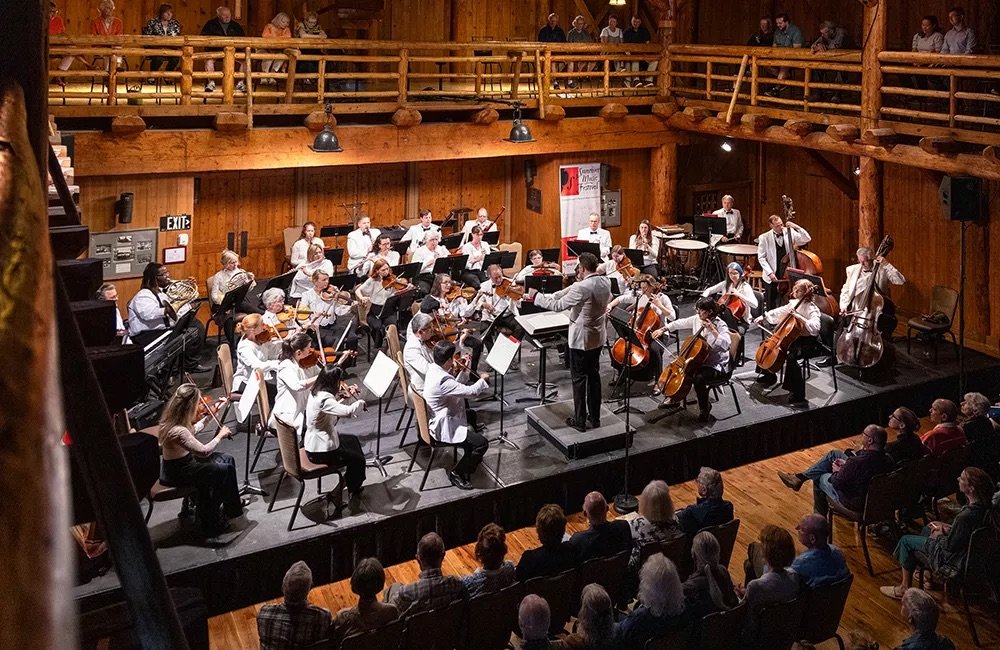
Preview: ‘Van Cliburn Winning Pianist Coming to Sunriver’
Brett Mitchell leads the Sunriver Music Festival Orchestra in Sunriver, Ore. (Photo by David Young-Wolff)
BEND, Ore. — Source Weekly has published a preview of the Sunriver Music Festival’s 2025 season, Brett Mitchell’s fourth as Artistic Director & Conductor:
During this year's Sunriver Music Festival, listeners will be treated to amazing performers, diverse compositions and a dynamic, creative driving force behind it all. One of the most thrilling aspects of this year's festival is that a newly awarded medalist from the prestigious Van Cliburn International Piano Competition will be announced on June 7, and this performer will subsequently come to Sunriver to play two concerts. Artistic Director and Conductor Brett Mitchell shared his excitement over the 48th season of the festival…
Source Weekly: How did the partnership between the Van Cliburn Piano Competition and the Sunriver Music Festival come about?
Brett Mitchell: The Cliburn connection is something that has been a part of Sunriver Music Festival for longer than I have been. It is always, of course, an enormous event in the classical music world. These pianists come from all over the world, and to have a complete unknown who, seemingly overnight, becomes a household name is amazing. This opportunity that we have in Sunriver to feature one of the medalists, honestly is one of the things that attracted me to this position. The opportunity to work with some of the greatest up-and-coming musicians on the scene is incredible. I'm a musician, period, because I had a great high school band director. I thought that's what I wanted to do, to teach young musicians. And that has been a very big part of my career. When I was the assistant director of the Cleveland Orchestra, I was also the director of the Cleveland Youth Orchestra. So, the opportunity to find these young musicians that the Cliburn has and shine a light on them... and that we in Sunriver are able to bring them to our community, literally two months after they have been awarded a medal, is just amazing. I think it's one of the most exciting things we do.
SW: I imagine it's a bit like choosing a favorite child, but which concert are you personally most excited about this summer?
BM: I love all of these programs. The French program that we open with is going to be a really nice experience. All of the pieces are French, but they couldn't be more different from each other. The Dukas Fanfare is a brass fanfare, which is not something you associate with France. The Ravel Piano Concerto is hugely inspired by George Gershwin and the world of jazz. The Fauré is probably what most folks would consider French music: delicate, beautiful, exquisite. And then, of course, there's Carmen [by Bizet] which is designed to celebrate the 150th anniversary of Carmen, which premiered in 1875, and it also marks the 150th anniversary of Bizet's death. And then also the Classical Tradition program, with the Bolcom Commedia, which is such a funny, witty piece. To have Mark Kosower, who is the principal cellist of the Cleveland Orchestra, come out and do the Rococo Variations of Tchaikovsky... and we know that Tchaikovsky was history's greatest admirer of Mozart, along with about five million of the rest of us! Then to have [Mozart's] Marriage of Figaro on there, it's such a greatest hit of classical music. And then to follow that up with the Stravinsky Dance Concertantes, which is from Stravinsky's neoclassical period... that program I'm really excited about as well. I know you asked for one, but there's two.
SW: Can you talk about your personal journey with music?
BM: When I was growing up in Seattle in the '80s and early '90s when grunge hit, I got to Nirvana before I got to Beethoven. But when I got to Beethoven in high school a few years later, it did not sound so different to me from Nirvana. It was like, here's this guy, or group of guys, and they are clearly going through some stuff... and they are trying to say it artistically to see if it might resonate with the rest of us. And that, I don't care if you are from the 1700s, 1800s, 1900s or today, if you have a universal message, it's worth hearing. Which is why we do what we do.
To read the complete preview, please click here.

Sunriver Music Festival announces 2025 season, Brett Mitchell’s fourth as Artistic Director & Conductor
SUNRIVER, Ore. — The Sunriver Music Festival has announced details of its 2025 summer season, Brett Mitchell’s fourth as Artistic Director & Conductor and the organization’s 48th:
The Summer Festival opens August 2 at the iconic Tower Theatre in downtown Bend and closes August 13 at Sunriver Resort’s historic Great Hall. Four classical concerts, one pops concert, a brilliant solo piano recital and a Family Concert will be presented. Featured artists include pianist Stewart Goodyear, cellist Mark Kosower, and Festival concertmaster Yi Zhao.
The classical season will consist of the following four programs:
THE CLASSICAL TRADITION
WILLIAM BOLCOM - Commedia for (Almost) 18th-Century Orchestra
TCHAIKOVSKY - Variations on a Rococo Theme
Mark Kosower, cello
MOZART - Overture to The Marriage of Figaro
STRAVINSKY - Danses Concertantes
A FRENCH SOIRÉE
DUKAS - Fanfare from La Péri
RAVEL - Piano Concerto in G Major
Stewart Goodyear, piano
FAURÉ - Suite from Pelléas et Mélisande
BIZET - Selections from Carmen
VIENNA WAITS FOR YOU
HAYDN - Symphony No. 96, ‘Miracle’
MOZART - Piano Concerto TBD
2025 Van Cliburn International Piano Competition medalist
BEETHOVEN - Symphony No. 5
THE LEIPZIG CONNECTION
SCHUMANN - Manfred Overture
MENDELSSOHN - Violin Concerto
Yi Zhao, violin
BACH (arr. Styles) - Toccata and Fugue in D minor
BACH - Orchestral Suite No. 3 in D Major
For complete repertoire, see our Upcoming Events page, and visit sunrivermusic.org to learn more.


Preview: ‘Sunriver Music Festival to have doubly classical year in Central Oregon’
Brett Mitchell will lead the Sunriver Music Festival’s 2024 season in Central Oregon from August 10 to 23. (Photo by Roger Mastroianni)
BEND, Ore. — The Bulletin (Bend) has published a preview of the Sunriver Music Festival’s 2024 season, Brett Mitchell’s third as Artistic Director & Conductor:
Earth. Fire. Water. Air. These are the four classical elements the ancient Greeks used to explain the nature of matter.
Sunriver Music Festival, Central Oregon’s soon-to-return summer classical music series, returns this week with four classical concerts. Maestro Brett Mitchell and the Sunriver Music Festival team struck thematic gold this year, tying each of the year’s four concerts to one of those classical elements. It starts with Sunday’s opening night concert at the Tower Theatre in Bend, works inspired by or pertaining to Earth on the opening night concert Sunday at the Tower Theatre in Bend, the first of a total of four festival concerts that will be held at the downtown Bend theater.
On Aug. 18, the Festival Orchestra will present the second of the elementally themed concerts, “Water,” also the fourth and final of the Tower concerts, before moving back to its longtime home, the Sunriver Resort Great Hall, for “Fire” (Aug. 21), featuring pianist Joyce Yang, followed by the annual solo concert on Aug. 22, on which renowned violinist and bluegrass fiddler Tessa Lark will perform. Lark returns the following evening for the final of this year’s concerts, “Air.”
Four score
Before they tackle the second elemental concert, however, Mitchell and the Festival Orchestra will present the ever-popular Pops Concert, “A Tribute to Broadway & Film Music,” on Tuesday at the Tower.
This year’s Pops Concert features a celebration of big anniversaries, which includes music from films such as 60-year-old “My Fair Lady” and “Breakfast at Tiffany’s” and younger fare such as 30-year-old “Forrest Gump,” Mitchell said.
“You kind of see where I’m going with it. All of these pieces are on this Pops program not just because they’re fun pieces that I think work together, but it’s a really nice way to commemorate the passage of time,” Mitchell said. “All of the pieces premiered or were released in ‘4’ years — 1944, 1964, 2004, that kind of thing.”
A fire idea
The idea for the season to have the “Classical Elements” theme came from the festival’s board and Meagan Iverson, SRMF executive director, Mitchell said.
“There’s no reason that the public would know this, but we have our final concert of every season on whatever night that is, and then literally the very next morning, the board and I sit down for like an hour and a half and we just do a debrief,” Mitchell said. They discuss what worked, what they’d bring back and what could be improved upon. One of those things was to have a theme that runs like connective tissue throughout the festival.
From the brainstorm session, “I took it and ran with it. I thought, ‘We have four classical concerts, and there are four classical elements,’” Mitchell said, adding with a laugh, “Apparently, now there’s five, but we don’t talk about that, ‘cause that screws up my season.” (To save you a Google trip: It’s “aether,” aka “quintessence.”)
Evocative tunes
Finding compositions that fit each evening’s theme was not exactly a problem.
“The trouble was not finding pieces; the trouble was ‘Of all of these pieces, what are we going to do?’” Mitchell said.
“Because composers have been so drawn to creating what we would call programmatic pieces — pieces inspired by things outside the music itself. Beethoven’s Symphony No. 5 is not a programmatic piece; it’s just a piece of music. But Beethoven’s Symphony No. 6, which we’re doing on opening night this year, is program music,” he said. “It’s music that was specifically designed to evoke Beethoven’s love of nature, which seemed a great way to open the whole festival.”
That evening’s concert also features Charles Ives’ Variations on “America” and a celebration of George Gershwin’s “Rhapsody in Blue” featuring the talents of Orion Weiss, described as a “brilliant pianist” by The New York Times.
Mitchell points to how the second classical concert’s music evokes the evening’s “Water” theme. It starts with Johann Strauss’ “The Blue Danube,” followed by Debussy’s “The Sunken Cathedral,” “which every elementary pianist tries to play,” he said. They’re followed by George Frideric Handel’s “Water Music Suite” and Robert Schumann’s “Rhenish” Symphony.
“We really leaned into all of those various composers, really trying to be evocative,” he said.
Other program notes
Mitchell and Iverson are enthused about having violinist Lark on hand this season. In addition to her solo program on Aug. 22, Lark will perform Michael Torke’s “Sky” concerto with the orchestra on Aug. 23’s “Air” concert.
“That was literally written for her and to feature her unique skill set, which is bluegrass and classical,” Iverson said. “She’s renowned in bluegrass circles worldwide, in addition to being an acclaimed classical violinist.”
“The particularly cool thing about this piece,” Mitchell said, “is it absolutely takes someone with classical chops to be able to play this piece, but it also takes somebody with a deep understanding of bluegrass music to be able to.”
The family-style matinee Discover the Symphony concert at 3 p.m. on Thursday, Aug. 15, is a one-hour, kid-friendly concert fit for anyone looking to dip a toe in classical waters. The afternoon will also feature an instrument petting zoo, affording a hands-on approach, prior to the concert.
“This is a perfect concert for folks that have never been to a classical music concert to go to first,” Mitchell said. “I would call it like a sample platter of everything else that’s on the rest of the season, but if you’re not down to sit through a whole Beethoven symphony, you can sit through a movement of a Beethoven symphony.”
Mitchell recently signed on for another four years as conductor of Sunriver Music Festival, which will take him through 2028. Oregon holds a special place in the hearts of Mitchell, who spent summers with his grandparents in Grants Pass as a boy, and his family, with whom he lives in Colorado.
“It’s funny, you know. It’s like the position is with the festival, but I feel so much a part of the community,” he said. “It speaks well of Sunriver, and just Central Oregon generally speaking, that we’ve all felt so welcome.”
To read the complete preview, please click here.

Brett Mitchell extends contract as Artistic Director & Conductor of Sunriver Music Festival through 2028
SUNRIVER, Ore. — The Sunriver Music Festival has announced that Brett Mitchell has extended his contract as Artistic Director & Conductor through the 2028 summer season.
From the official press release:
The Sunriver Music Festival Board of Trustees has announced that Artistic Director & Conductor Brett Mitchell’s contract has been extended four years to 2028. The maestro's four-year extension will encompass the Festival's monumental 50th season. In March 2024, Mitchell was named Music Director of the Pasadena Symphony, beginning an initial five-year term with the 2024-25 season. He will work concurrently with the Pasadena Symphony and the Sunriver Music Festival, along with his many prestigious guest conducting roles.
“Maestro Mitchell is an esteemed conductor with a dedication to artistic excellence, creative concert curation, and inspired community engagement, and we are thrilled that his role with the Festival will continue,” said Festival Board President Dr. Ronald Carver.
For more information, please click here.
Sunriver Music Festival announces 2024 season, ‘Classical Elements,’ Brett Mitchell’s third as Artistic Director & Conductor
“One of my favorite things about Central Oregon is the power of nature that we’re able to witness all year round, so I’m particularly thrilled to share with you an entire season filled with pieces inspired by the four classical elements: earth, water, fire, and air. Composers for centuries have been inspired by the enormity and grandeur of nature, and I know you’ll be just as inspired when you hear their extraordinary music.” Brett Mitchell, Artistic Director & Conductor
SUNRIVER, Ore. — The Sunriver Music Festival has announced its 2024 summer season, ‘Classical Elements,’ which marks Brett Mitchell’s third as the organization’s Artistic Director & Conductor.
The Festival’s 47th season opens Sunday, August 11 at the iconic Tower Theatre in downtown Bend, and closes Friday, August 23 at Sunriver Resort’s historic Great Hall. Four classical concerts, one pops concert, a solo violin recital, and a family-friendly ‘Discover the Symphony’ concert will be presented.
The classical season will consist of the following four programs, all under the direction of Artistic Director & Conductor Brett Mitchell:
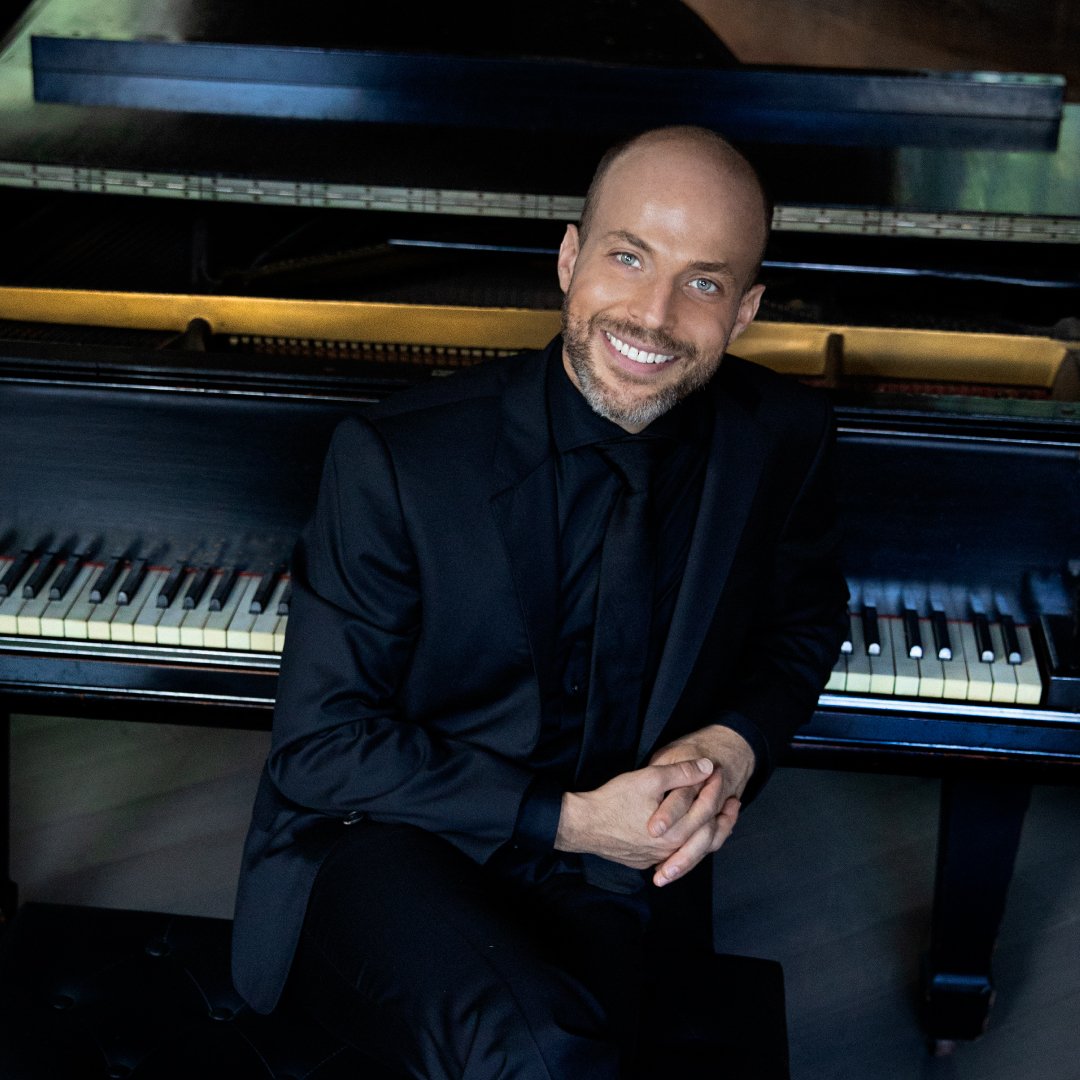
OPENING NIGHT CLASSICAL CONCERT: EARTH
Sunday, August 11 - 7:30 p.m.
Tower Theatre - Bend, OR
IVES (arr. Schuman) - Variations on ‘America’
GERSHWIN - Rhapsody in Blue
Orion Weiss, piano
BEETHOVEN - Symphony No. 6, ‘Pastoral’


CLASSICAL CONCERT II: WATER
Sunday, August 18 - 3 p.m.
Tower Theatre - Bend, OR
J. STRAUSS II - The Blue Danube
DEBUSSY (orch. Büsser) - The Sunken Cathedral
HANDEL (arr. Harty) - Water Music Suite
SCHUMANN - Symphony No. 3, ‘Rhenish’


CLASSICAL CONCERT III: FIRE
Wednesday, August 21 - 7:30 p.m.
Sunriver Resort Great Hall - Sunriver, OR
BEETHOVEN - Overture from The Creatures of Prometheus
HAYDN - Symphony No. 59, ‘Fire’
FALLA - Nights in the Gardens of Spain
Joyce Yang, piano
FALLA - ‘Ritual Fire Dance’ from El amor brujo

SEASON FINALE CLASSICAL CONCERT: AIR
Friday, August 23 - 7:30 p.m.
Sunriver Resort Great Hall - Sunriver, OR
AARON JAY KERNIS - Musica Celestis
MICHAEL TORKE - Sky
Tessa Lark, violin
MOZART - Symphony No. 41, ‘Jupiter’


Repertoire for the complete season is available on our Upcoming Events page.
For more information or to purchase tickets, please visit sunrivermusic.org.
READ MORE:
The Bend Bulletin: ‘Sunriver Music Festival announces 2024 Summer Concert Series’


Sunriver Music Festival announces 2023 season, Brett Mitchell's second as Artistic Director & Conductor
SUNRIVER, Ore. — The Sunriver Music Festival has announced its 2023 summer season, which marks Brett Mitchell’s second as the organization’s Artistic Director & Conductor.
Running from August 4 through 17, the Festival’s 46th season will feature four classical concerts, a pops concert, and a family concert, all under the baton of Mr. Mitchell, as well as a solo piano recital.
The classical season will consist of the following four programs:
CLASSICAL CONCERT I - August 5, 2023
MOZART - Regina coeli | Ave verum corpus
feat. Central Oregon Mastersingers
MOZART - Symphony No. 38, “Prague”
STRAUSS - Suite from Le Bourgeois Gentilhomme
CLASSICAL CONCERT II - August 11, 2023
MILHAUD - La création du monde
BRUCH - Violin Concerto No. 1
William Hagen, violin
BRAHMS - Symphony No. 3
CLASSICAL CONCERT III - August 14, 2023
COPLAND - Three Latin American Sketches
BARBER - Knoxville: Summer of 1915
Kathryn Mueller, soprano
MAHLER (arr. Lee) - Symphony No. 4
Kathryn Mueller, soprano
CLASSICAL CONCERT IV - August 17, 2023
LIGETI - Concert Românesc
HAYDN - Symphony No. 104, “London”
BEETHOVEN - Piano Concerto No. 5, “Emperor”
Andrew von Oeyen, piano
Repertoire for the complete season is available on our Upcoming Events page.
For more information or to purchase tickets, please visit sunrivermusic.org.

Preview: Sunriver Music Festival returns with new conductor, adds Bend venue
Brett Mitchell poses in the Sunriver Resort Great Hall, one of two venues for the 2022 Sunriver Music Festival. (Photo by Tambi Lane)
BEND, Ore. — The Bulletin has published a preview of the Sunriver Music Festival’s 2022 season, featuring an interview with Brett Mitchell as he enters his first season as Artistic Director & Conductor:
The Sunriver Music Festival returns for its 45th season this week. Given that long and storied history, incoming conductor Brett Mitchell humbly sees himself as one part of a, well, classic classical music series.
“I’m obviously thrilled to be coming on as the artistic director and conductor of the Sunriver Music Festival,” he told GO! Friday. “But I really view my job as — I’m kind of a temporary custodian of a permanent position. This position and this festival predate me, and assuming I do it right, it will postdate me as well.”
The festival opens for its 45th season — and the first of the three Mitchell is signed on for — on Wednesday, bringing live classical music performed by the professional Sunriver Festival Orchestra for concerts over three nights at the new Caldera High School in southeast Bend, as well as SRMF’s longtime home in Sunriver, the Sunriver Resort Great Hall.
Bend audiences will see Classical Concert I (Wednesday, Aug. 10), the Pops Concert (Aug. 12) and the closing night performance, Concert III (Aug. 21). Sunriver will see Classical Concerts II and III (Aug. 15 and 18) along with Cliburn International Piano Competition bronze medalist Dmytro Choni’s solo concert (Aug. 16) and the family-friendly Discover the Symphony Concert (Aug. 17). See “More information” for a more detailed breakdown, along with ticketing info.
Mitchell is excited for the entire season, but one of the highlights for him will occur right out of the gate on Wednesday, when Concert I, in lieu of guest soloists, features pieces that will highlight the Festival Orchestra’s innate talent, some of whom have served long tenures themselves.
“Part of the legacy of the festival is that, even though the artistic director will change from time to time, as it is right now, the musicians are the ones that are making the sound, and they are the constant,” Mitchell said. “They are the constant year in year out, and so this second piece by (Alberto) Ginastera, this wonderful South American composer … instead of being a concerto for a solo instrument and orchestra, this piece is in, like, a dozen little movements. And each one of those dozen little movements is like a tiny concerto for one of the members of the orchestra. So there’s a little flute concerto movement, and a little oboe concerto movement, and it’s a great way for us to be able to feature our musicians as soloists.
“That, for me, was really important to do on the first program, to try to throw back as much focus as I can to the musicians. Some of them have been here for decades,” he added. “I think it’s going to be a really nice way for us to start our official relationship.”
Other things he’s looking forward to are the Pops Concert, which will feature a lot of recognizable music from film, as well as jazz arrangements of George Gershwin and Duke Ellington, to name but two. That concert also features bass-baritone Timothy Jones, a friend of Mitchell’s, who will also be heard during Classical Concert IV on Aug. 21 in Bend.
Mitchell replaces longtime conductor George Hanson, who last led the Festival Orchestra in 2019. Prior to COVID rearing its ugly head, the 2020 festival would have celebrated Hanson’s 10th and final year in Sunriver, a program that would have also celebrated composer Ludwig van Beethoven’s 250th birthday.
The enduring festival returned last season, albeit with a slightly downsized orchestra and outdoor performances led by Mitchell and fellow finalist Kelly Kuo, who gave public auditions, as it were, live and in person.
“It was just such a weird time, you know,” Mitchell recalled. “Presenting outdoor concerts is a whole different venture than presenting concerts at the Tower Theatre in Bend or at the Great Hall at the resort here in Sunriver.” Problems with weather and smoke factored in last year.
The prospect of having a new conductor in his inaugural season, along with a full orchestra and a return to indoor venues, one of them new, makes this year special for Meagan Iverson, executive director of SRMF.
Last summer, “we really kept the focus on the music. We didn’t have any of the extras,” Iverson said. “I’m grateful that I have been here through the years prior to COVID, so I do know the flow of things and also how we have just been very creative over the last 2½ years.”
To read the complete article, please click here.

Preview: Sunriver Music Festival summer series presents dynamic duo
SUNRIVER, Ore. — Sunriver Scene has published a front-page preview of the Sunriver Music Festival’s 2022 season, featuring an interview with Brett Mitchell as he enters his first season as Artistic Director & Conductor and an extensive exploration of his long collaboration with bass-baritone Timothy Jones, who will appear on three of the 2022 Festival’s six concerts:
Brett Mitchell met Timothy Jones 20 years ago, working together at the Pittsburgh New Music Ensemble. They performed a few pieces there together during that first summer (the world premiere of “A Lyric’s Tale” by Maurice Wright and “Eight Songs for a Mad King” by Peter Maxwell Davies) and ever since have continued to work together symbiotically on stage and in life as close friends. They have similar work ethics and passion for what they do.
“Making music is such an intense process that musicians often become instant friends when working together. That said, when the music-making is over, those friendships often fade. But once in a great while, you meet and make music with a kindred spirit who becomes a deeply important part of your life, and that’s who Jones is to me,” said Mitchell. “We’ve been making music and sharing laughter together now for 20 years, and I’m thrilled that our audiences in Sunriver and Bend will get to experience his exquisite artistry this summer.”
To read the complete article, please click here.

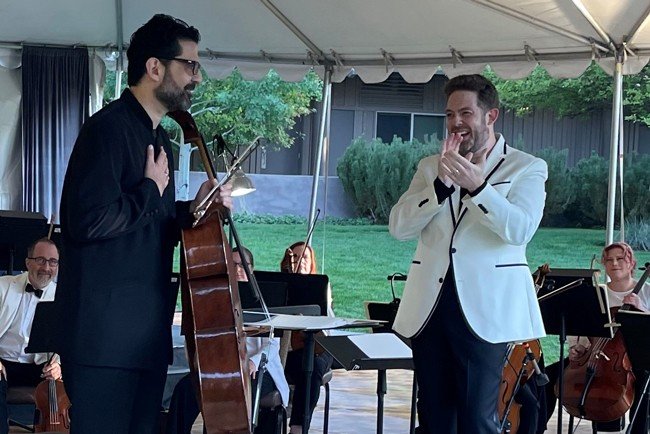
Interview: 'Sunriver Music Fest Has A New Face For 2022'
Brett Mitchell applauds cello soloist Amit Peled after his performance of Saint-Saëns’s Cello Concerto at the Sunriver Music Festival in August 2021.
BEND, Ore. — Source Weekly has published an interview with Brett Mitchell—subtitled ‘PNW native takes baton for 45th concert season’—about his upcoming first season as Artistic Director & Conductor of the Sunriver Music Festival, running August 8-21, 2022:
The Sunriver Music Festival, an annual series of chamber orchestra concerts, welcomes a new artistic director this season, as well as the addition of a brand-new venue. Seattle native Brett Mitchell has a vibrant program lined up for events at Bend's new Caldera High School as well as Sunriver's Great Hall, kicking off with a free movie night outdoors at the resort's Besson Commons on Aug. 8. The Source Weekly spoke with Mitchell this week about the 2022 season and his vision for the future of the festival.
Source Weekly: Welcome to the Sunriver Music Festival. Will this be your first time in Central Oregon?
Brett Mitchell: Surprisingly, yes. It's remarkable because growing up, my family spent a good part of every summer in Grants Pass visiting my grandparents, but we didn't get over to the east side of the Cascades – and it's just stunning. I was here for a week last summer to play for the selection committee.
SW: It looks like this season's lineup has a few "warhorses"–Beethoven's Eroica symphony, Brahms' Violin Concerto and Mendelssohn's 4th–with some interesting diversions in between, like pop and jazz on Aug. 12 and a "piano-centric evening" on Aug. 15.
BM: Yes, it's such a nice program. For the piano-centric concert, we'll feature one or two of the medalists from this year's Cliburn competition (the 16th annual Van Cliburn International Piano Competition, taking place in Fort Worth, Texas, this June). We know it will be a Mozart piano concerto of some kind, because one of the requirements for the Cliburn competition is to perform a Mozart concerto.
For the closing concert, there's this wonderful song cycle by British composer Gerald Finzi, based on songs from five different Shakespeare plays, called "Let us Garlands Bring," sung by my longtime associate and one of my very best friends, bass-baritone Timothy Jones. Before Jones sings, we'll play a five-part instrumental cycle, David Diamond's "Music for Shakespeare's Romeo and Juliet." It's a really nice kind of Shakespearean first half. The second half will be the Italian Symphony by Mendelssohn, a composer who like everyone else in the 19th Century was also a well-known Shakespeare lover. I think it'll be a nice way to end the season.
SW: I see the pops concert includes "symphonic jazz," which some people would describe as involving a lot of improvisation, while others might think of a more big-band sound. Which will it be?
BM: For the pops performance, the first half is all about film scores, which is a deep love of mine. The first piece is from the Bond franchise which turns 60 this year, a medley of themes from the film series. Next is the love theme from The Godfather movie, which turns 50 this year; then after we meander through some other things, we finish the first half with some John Williams works, closing with one from the movie "E.T." which celebrates its 40th anniversary this year. So, kind of a forward timeline of film scores.
For the second half, when we're talking about symphonic jazz, yes, that can mean a lot of different things for different people. I was originally a jazz pianist – I paid for my undergraduate degree at Western Washington University playing in a jazz trio. I conceived of it here as dating back to the ragtime era, so we'll start with some Scott Joplin arrangements. Then when you think about jazzers who crossed over into the symphonic space, I always think of Duke Ellington, so there will be arrangements by Morton Gould of a couple of Ellington tunes. We'll close with selections from George Gershwin's "Porgy and Bess" score, featuring our bass-baritone Jones.
SW: Will there be any pre-concert talks?
BM: There may or may not be a pre-concert talk, but there will certainly be a decent amount of talking from the podium. It's something I love doing. I like to inspire our audiences by showing them what lights me on fire about a piece. I think the days of walking onstage, conducting, taking and bow and walking off are gone. Audiences want to see the personalities behind the music.
SW: What would you say is your overall hope for this, your first season with the Sunriver festival?
BM: For the last few years, the festival has been very different, largely because of COVID, so the aim this summer is really to reconnect with our community. I hope we're going to have new folks with us who will become permanent fans. I also hope I can connect with the audience on a personal level. I don't walk in with a cape flowing behind me, turn my back to the audience and start in without a word. I'm more of a kind of real person. I don't stand on ceremony – I'm just Brett, and I hope that kind of relatability will help our audiences feel entirely welcome.
To read the complete interview, please click here.

Sunriver Music Festival announces 2022 season, Brett Mitchell's first as Artistic Director & Conductor
Brett Mitchell introduces the Sunriver Music Festival’s 2022 summer season, his first as the organization’s Artistic Director & Conductor.
SUNRIVER, Ore. — The Sunriver Music Festival has announced its 2022 summer season, which marks Brett Mitchell’s first as the organization’s Artistic Director & Conductor.
Running from August 8 through 21, the Festival’s 45th season will feature four classical concerts, a pops concert, and a family concert, all under the baton of Mr. Mitchell, as well as a solo piano recital and a movie night.
The classical season will consist of the following four programs:

CLASSICAL CONCERT I - August 10, 2022
DAVIES - Ojai Festival Overture
GINASTERA - Variaciones concertantes
BEETHOVEN - Symphony No. 3, “Eroica”
CLASSICAL CONCERT II - August 15, 2022
WALKER - Lyric for Strings
MOZART - Piano Concerto TBD
Featuring 2022 Van Cliburn Competition medalist
SCHUBERT - Symphony No. 5
CLASSICAL CONCERT III - August 18, 2022
JESSIE MONTGOMERY - Banner
HAYDN - Symphony No. 94, “Surprise”
BRAHMS - Violin Concerto
William Hagen, violin
CLASSICAL CONCERT IV - August 21, 2022
DIAMOND - Music for Shakespeare’s Romeo and Juliet
FINZI - Let Us Garlands Bring
Timothy Jones, bass-baritone
MENDELSSOHN - Symphony No. 4, “Italian”
Repertoire for the complete season is available on our Upcoming Events page.
KTVZ News Channel 21 has also published an article previewing the season.
For more information or to purchase tickets, please visit sunrivermusic.org.