
Review: ‘Alec Baldwin Brings Lincoln’s Legacy to Pasadena Symphony’s Season Finale’
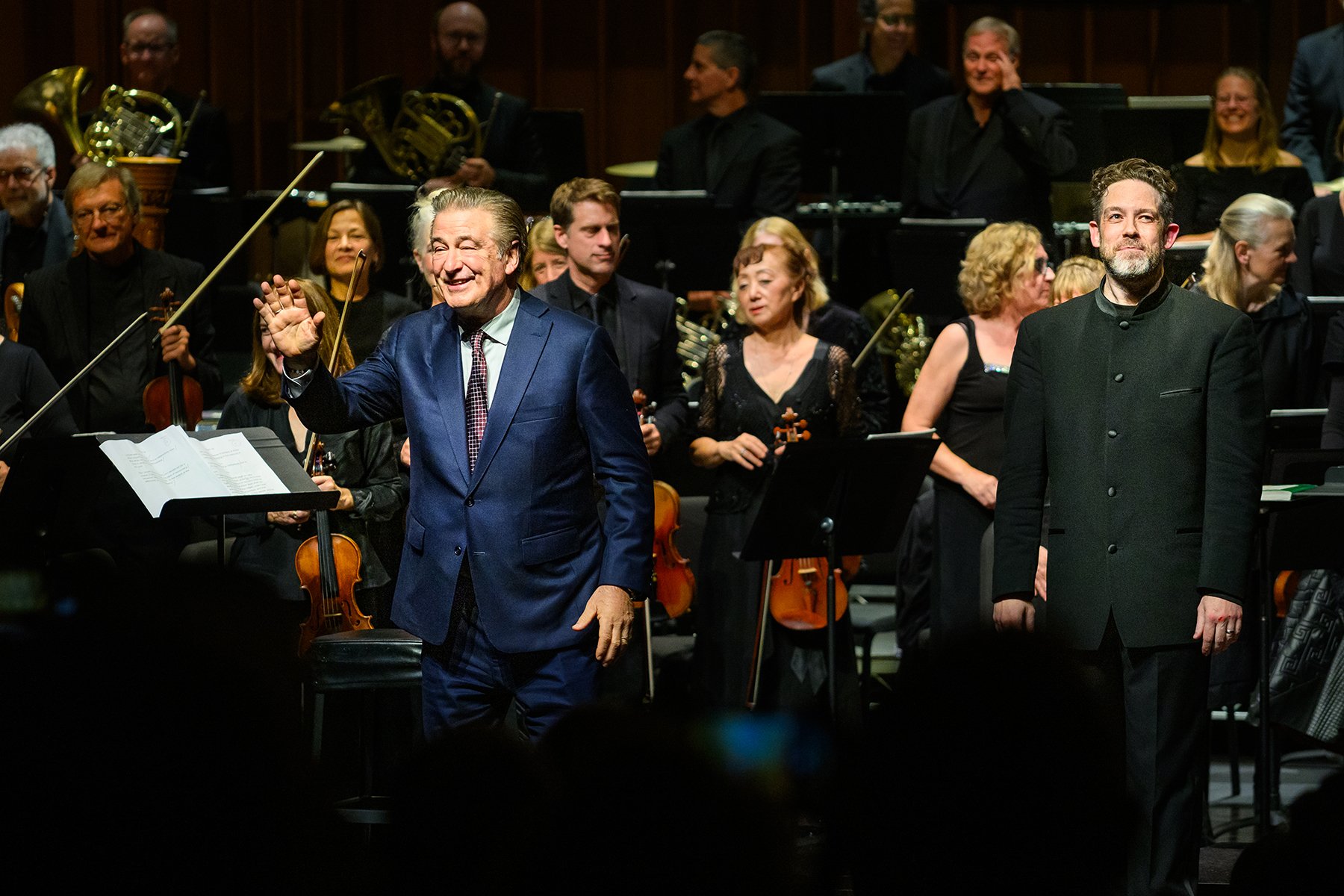
Narrator Alec Baldwin, Music Director Brett Mitchell, and the Pasadena Symphony at the Ambassador Auditorium. (Photo by Jamie Pham)
PASADENA — Local News Pasadena has published a review of the Pasadena Symphony’s 2025-26 season finale, Brett Mitchell’s second as Music Director:
The Pasadena Symphony closed its season at Ambassador Auditorium with a program titled America at 250, celebrating the nation’s upcoming 250th anniversary. The evening combined American compositions with reflections on democracy, immigration, and national identity, culminating in a moving performance of Aaron Copland’s Lincoln Portrait narrated by actor Alec Baldwin.
As is tradition, the symphony hosted its pre-concert “Insights” discussion an hour before the performance. Conductor Brett Mitchell, KUSC radio host Brian Lauritzen, and pianist Terrence Wilson provided historical background and musical context that enriched the audience’s experience throughout the evening.
The concert opened with John Williams’ Liberty Fanfare, composed in 1986 to commemorate the centennial of the Statue of Liberty. Mitchell noted that Williams had previously written the highly successful Olympic Fanfare and Theme for the 1984 Los Angeles Olympics, making him a natural choice for another national celebration.
“The dude knows how to write a fanfare,” Mitchell quipped. “It’s a humdinger.”
The piece immediately set a celebratory tone, filling the hall with the bold, unmistakably American sound that has made Williams one of the nation’s most recognizable composers.
Gershwin’s American Sound
A substantial portion of the pre-concert discussion focused on George Gershwin’s Concerto in F for Piano and Orchestra, the evening’s longest work and a centerpiece of the program. The concerto, composed in 1925, was performed by Grammy-winning, Juilliard-trained pianist Terrence Wilson alongside the Pasadena Symphony.
Lauritzen, Mitchell, and Wilson enthusiastically explored Gershwin’s innovative use of harmony. They described tonic chords as musical “home” and dominant chords as creating a sense of movement or being “away.” Gershwin’s playful manipulation of those relationships became one of the hallmarks of his style, shaped in part by the rich cultural influences surrounding him as the son of Russian-Jewish immigrants.
Mitchell demonstrated these harmonic tensions at the piano, bringing the discussion to life for audience members.
Because conductor Walter Damrosch of the New York Symphony Orchestra was so captivated by Gershwin’s Rhapsody in Blue, he commissioned the composer to create a larger, more ambitious work. The result was the three-movement Concerto in F.
The first movement, Allegro, opens with energetic orchestral rhythms before yielding to a blues-infused piano solo. Mitchell shared his own struggles as a young musician learning to authentically “swing,” underscoring the unique challenge of blending classical precision with jazz sensibility. Wilson, however, made the style sound effortless.
The second movement, Adagio, offered a more reflective atmosphere, highlighted by expressive solos from the woodwinds and brass, including a memorable muted trumpet passage.
The finale, Allegro agitato, was described by Gershwin himself as an “orgy of rhythms.” Wilson and the orchestra delivered a dazzling performance that brought the audience to its feet.
Gershwin’s enduring legacy rests largely on his pioneering fusion of classical music and jazz. As Mitchell observed, “Gershwin wanted to put jazz into classical music and classical music into jazz.” The uniquely American sound he created helped define the Roaring Twenties and continues to resonate today.
Aaron Copland and the American Landscape
The second half of the program featured two works by Aaron Copland, another son of Jewish immigrants whose music became synonymous with the American experience.
Mitchell explained that Copland initially gained recognition for more dissonant, rhythmically complex compositions influenced by modernism and jazz. In later works, however, he embraced a more open and accessible style that listeners came to associate with the American landscape.
One of the finest examples is Appalachian Spring, written for choreographer Martha Graham. Although Copland originally called the work Ballet for Martha, Graham later suggested the title that audiences know today, inspired by a line from a poem by Hart Crane.
When the piece premiered in 1945, audiences remarked that they could almost see the hills and smell the air of Appalachia. Through spacious harmonies and folk-inspired melodies, Copland created a musical portrait of optimism, community, and possibility.
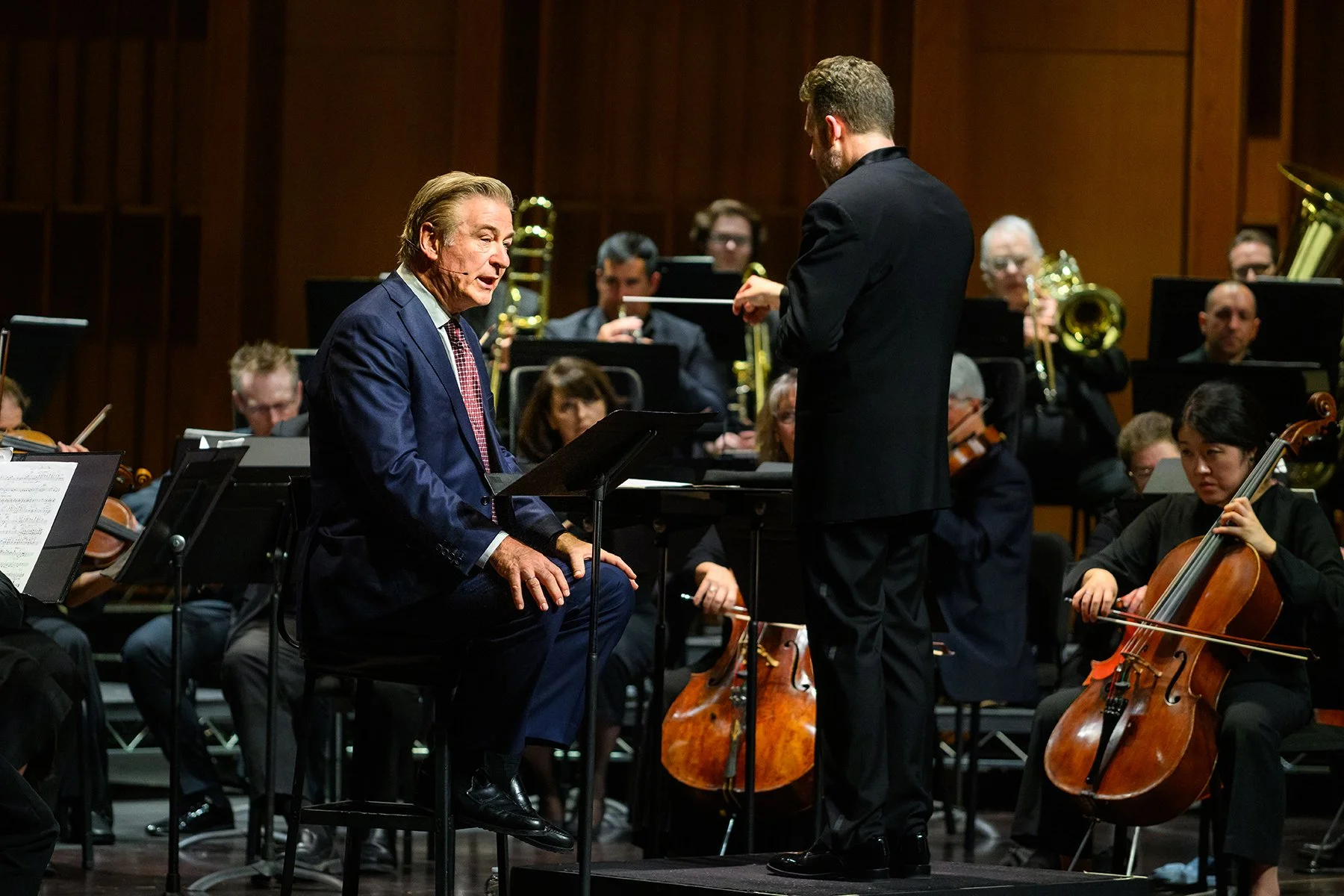
Alec Baldwin narrates Copland’s Lincoln Portrait with the Pasadena Symphony and Music Director Brett Mitchell. (Photo by Jamie Pham)
Lincoln’s Words for Then—and Now
The evening concluded with Copland’s Lincoln Portrait, commissioned in 1942 as America entered World War II. Conductor André Kostelanetz envisioned the work as a patriotic statement that would remind audiences of the nation’s democratic ideals during a time of global crisis.
For this performance, Mitchell invited actor Alec Baldwin to serve as narrator.
After a musical introduction incorporating the folk tunes “Camptown Races” and “Springfield Mountain,” Baldwin delivered Lincoln’s words.
“Fellow citizens, we cannot escape history,” he began in his characteristically booming, resonant baritone. “We of this Congress and this administration will be remembered despite ourselves.”
The audience sat transfixed as Baldwin delivered passages drawn from Lincoln’s speeches and writings, including excerpts addressing slavery, democracy, equality, and civic responsibility. Written during the darkest years of the Civil War, Lincoln’s words felt strikingly relevant today.
Perhaps most powerful was hearing these reflections from December 1862, when the war’s outcome remained uncertain, and the nation appeared irreparably divided. Lincoln offered neither easy optimism nor false reassurance. Instead, he called on Americans to meet their responsibilities with courage and conviction.
More than 160 years later, his message still resonates.
Throughout the hall, audience members wiped away tears as Baldwin’s narration merged seamlessly with Copland’s soaring score. The work became more than a historical tribute. It felt like a reminder that democracy has endured moments of profound division and that its survival has always depended on ordinary citizens’ willingness to uphold its ideals.
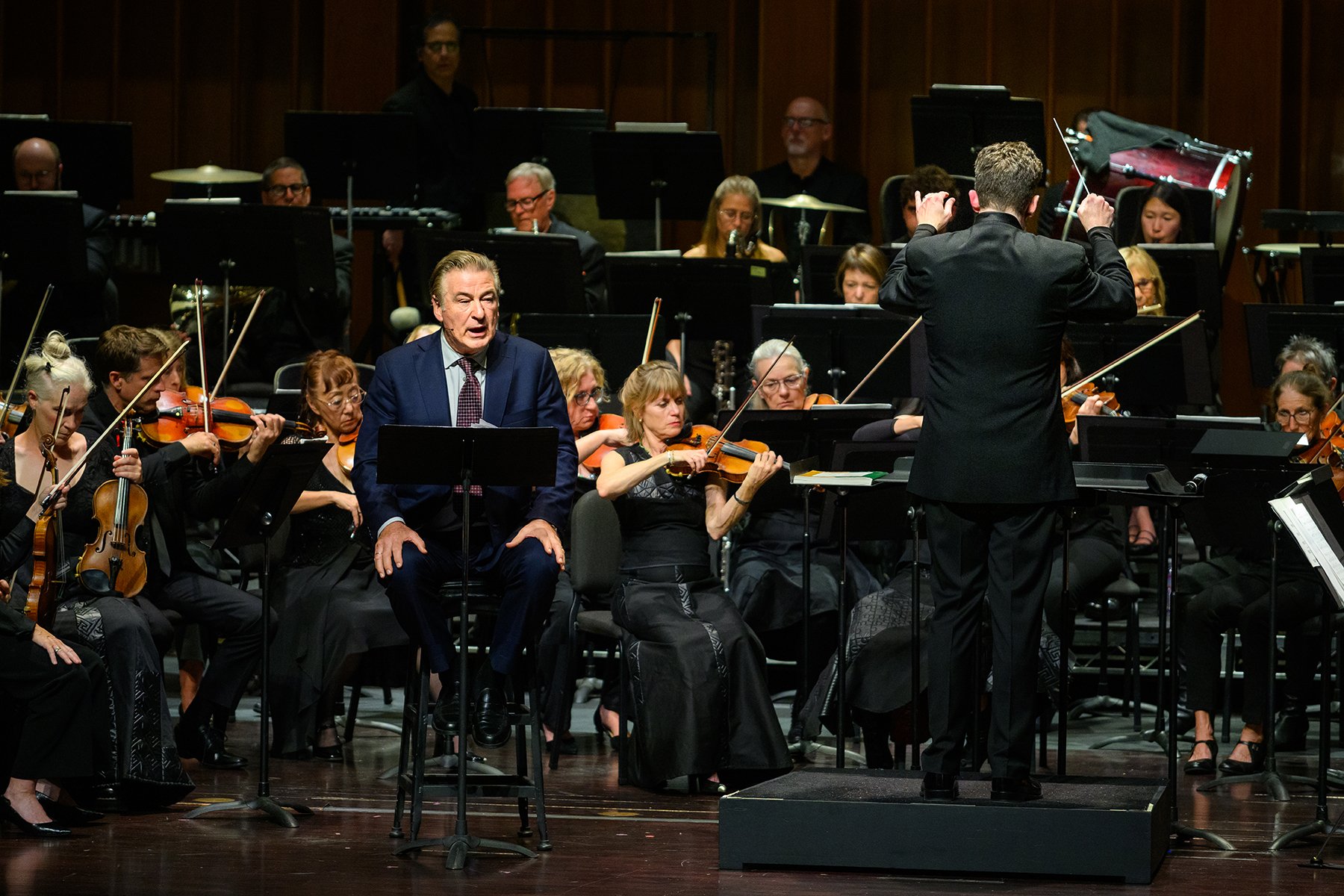
Alec Baldwin narrated the words of President Lincoln as set to music by Aaron Copland on the Pasadena Symphony’s 2025-26 season finale under Music Director Brett Mitchell. (Photo by Jamie Pham)
A Message of Hope
The evening showcased the work of some of America’s greatest artists: Lincoln, whose words continue to inspire; Copland and Gershwin, who helped define an American musical identity; and the performers who brought their visions to life.
Under Brett Mitchell’s leadership, with outstanding performances by Terrence Wilson, Alec Baldwin, and the Pasadena Symphony, America at 250 became a meditation on the nation’s history, its struggles, and its possibilities.
At a time when many Americans question the strength of the institutions that bind us together, hearing Lincoln’s voice once again, through Baldwin’s compelling narration and Copland’s majestic score, offered something increasingly rare: reassurance that the nation has faced great tests before and emerged stronger because citizens chose hope over despair.
For one evening in Pasadena, that message felt both timely and deeply moving.
To read the complete review, please click here.