

NEWS
Preview: "Seven Conductors. One Baton."
Art & Society magazine (Peoria, Ill.) has published a preview of the Peoria Symphony Orchestra's 2009-10 season, during which Brett Mitchell will be the last of seven guest conductors vying to become that orchestra's next music director. To read this article, please click here.
Brett Mitchell: ‘New Music: It’s not just for your Classical Series’

Brett Mitchell has penned a column for online magazine NewMusicBox about the viability of incorporating more contemporary repertoire into orchestras' educational, family, and Pops programming.
As a staff conductor at a major American symphony orchestra, I’m called upon to conduct a wide variety of concerts, not only on our classical series, but also on our education, family, community outreach, and pops series. Programming for concerts outside an orchestra’s classical series typically consists of a mixture of the tried-and-true (i.e., the instantly recognizable) and easily digestible pops arrangements. I’ve been trying a somewhat different approach over the past several seasons with the Houston Symphony—and with great success, I’m happy to say: On every program I conduct, I try to incorporate at least one contemporary American orchestral work.
As a new-music lover, finding ways to introduce audiences to great new orchestral works has always been important to me. I became a conductor because I love to share music with people, and sharing contemporary music in particular has always been at the top of my list of artistic priorities. I have a degree in composition, and I conducted a new music ensemble for five seasons, so incorporating new music into any concert I lead—no matter the genre or venue—is not only important to me, but is an organic, integral part of who I am as an artist.
It may seem that incorporating new works into an orchestra’s concert season might be accomplished most logically through inclusion on its classical series. I propose, however, that the classical series is but one of many in which new music might find a viable, sustainable home. In some cases, it may actually be easier to include contemporary works outside the typical classical concert. Oftentimes, traditional classical audiences may view contemporary works as something to be “gotten through” on the way to the evening’s main course; uninitiated audiences tend to have fewer preconceived notions of what music their orchestra should (and should not) play, and are generally more open-minded and receptive to a broader swath of music.
In my experience, I’ve found that there are three keys to the successful incorporation of new music on pops programs: 1) accessibility of the work itself; 2) a solid rationale for the work’s inclusion on the program; and 3) an effective, concise verbal introduction of the work to the audience.
“Accessibility” has come to be a dirty word in some circles, so let me first define what I do not mean when using this word: mindless, one-dimensional works that are nothing more than ear candy. That said, denying the influence that 20th-century pop music has had on many of today’s composers is counterproductive, especially when an audience is coming to see one of those very acts on the second half of a pops program. The contemporary music I have found to be most successful on such concerts is by composers who take the best attributes of pop music (e.g., rhythmic regularity, simpler harmonic language, and sometimes even a melody or two) and skillfully, artfully incorporate them into their music. Whether one categorizes these composers as neoclassical, neo-romantic, post-minimalist, or something else is secondary to finding music that works well—both musically and programmatically—on a particular program.
A guest artist on the second half of a pops program presents an ideal opportunity to program a new work. With a little imagination, ingenuity, and background research on the artist, one can almost always find a programmatic link between that artist and a contemporary orchestral work. When the Houston Symphony presented Peter Cetera (former lead singer of the band Chicago) in January 2009, the orchestra and I presented an orchestral first half before Cetera and his band performed after intermission. Knowing that Cetera had been a founding member of a band named after one of America’s great big cities, I thought it would be interesting to present different aspects of big-city life on the first half. I wanted to find a contemporary work that captured the bustle, sounds, electric excitement, and fast-paced nature of a city like Chicago, and I found exactly that in a piece by Kevin Puts called Network. This work is around six minutes long and is of the post-minimalist school, which has several advantages: it lives in relatively simple harmonies and has just a handful of ideas that audiences can easily remember while listening through the piece. Before playing the piece, I explained to the audience a bit about the composer, the work, and our reasons for including it on the program; I pointed out what to listen for as we went through it, describing big-city scenes and how that related to the work they were about to hear. We found it to be a perfect complement to the rest of our first half, and, having the right context, the audience enjoyed it immensely.
Even on programs without a guest artist, opportunities may present themselves through an extra-musical theme you’re exploring. Our New Year’s Eve concerts in Houston typically consist of classical/”light classical” fare on the first half, followed by a more pops-oriented second half. On our New Year’s Eve concert in 2007 (my first with the orchestra), I decided to focus on the concept of time and how that relates to New Year’s celebrations. We performed the overture to Rossini’s La cenerentola (Cinderella), a movement from Haydn’s “Clock” Symphony, and selections from Tchaikovsky’s The Nutcracker. I needed a fourth piece to complete our first half, and found it in a work for string orchestra by Michael Torke called December. As with much of Torke’s music, the work is post-minimalist and quite tonal, and thus quite accessible. The great thing about including this work on the program, however, was that it fit in perfectly with my “time” theme for the first half. Torke provides program notes for his work, and I shared a portion of these with our audience from the stage before we played the piece. These notes are wonderfully descriptive, and explain the narrative of the work and what Torke was envisioning as he composed it. Every audience loves going behind the scenes, and getting a composer’s perspective on his work before hearing it lets an audience feel that they’ve got the inside scoop.
A conductor really can help enormously in regard to a work’s accessibility simply by priming the audience well; even a “tough” work can be rendered more accessible by a few well-chosen, articulate words of introduction. An example from my work that I often cite comes not from a pops program but a series of education concerts I led several seasons ago. This program was all about composers who came to America, one of whom was Arnold Schoenberg. Schoenberg is not an easy “sell” to any audience, but finding a way to relate your audience to a composer and his methods can work wonders for an audience’s reaction to a piece. After introducing Schoenberg the man, I briefly introduced the concept of his twelve-tone method by relating it to the similar “unrepeatability” of Sudoku. As most of the young people already knew, in Sudoku, you cannot repeat a number within a given box, row, or column; I then explained that, in Schoenberg’s music, you cannot repeat a note until you have used the other eleven. They then understood (to some degree, at least) why there was less regularity to Schoenberg’s melodies than to those of Dvorák, whose music we had played earlier on the program. Again, with the right context and good explanation, even children can listen to and enjoy something as complex as Schoenberg with new ears.
A quick word to those concerned that composers might be “insulted” by having their works included on something other than a strictly classical program. No composer I’ve ever personally known has ever expressed any feeling of being “relegated” to a pops or educational program. The composers I know create their works out of a genuine desire to communicate, and having one’s music heard by thousands of people over the course of a weekend—whatever the venue—is an opportunity I can’t imagine many composers turning down.
There are myriad reasons to program new works outside the traditional classical series. For one thing, orchestras love the chance to sink their teeth into “real” music on concerts that are typically less engaging and less artistically rewarding for them. I must say, though, that I never program contemporary works on pops programs with the aim of converting our audiences to new music devotees. Will audiences go out and buy a 10-CD retrospective of John Adams’s work after hearing Short Ride in a Fast Machine at a pops concert? Probably not, but that doesn’t mean that they haven’t heard something new, something that they might have genuinely enjoyed, something that might stick with them.
For me, sharing new music with any audience demands finding a piece in which you believe, which works organically with the rest of your program, and which you are willing and able to “sell” to your audience. A well-programmed, well-introduced, well-performed piece of contemporary music can have an impact on any audience like nothing else.
To read the complete column, please click here.
Brett Mitchell named finalist for Peoria Symphony music directorship
Brett Mitchell has been named one of seven finalists to become the next music director of the Peoria Symphony Orchestra. Mr. Mitchell will lead a subscription concert with the orchestra in April 2010 featuring music of Torke, Prokofiev, and Beethoven. For more information, please click here.
Preview: "Houston Symphony ready to dive into concert"
The Houston Chronicle has published a preview of the Houston Symphony's upcoming performance of George Fenton's score for The Blue Planet, led by Brett Mitchell, which will be synchronized with a screening of the film at Jones Hall. To read this article, please click here.
Review: "Music fit for a king, and a world, gone mad"
Incident Light has published a review of Brett Mitchell's recent guest appearance with the SOLI Chamber Ensemble, conducting and co-directing a production of Peter Maxwell Davies's Eight Songs for a Mad King. "It was repellent. It was horrific. It was ugly. And it was utterly riveting... Conductor and co-director Brett Mitchell led the proceedings with skill and conviction." To read the complete review, please click here.
BREAKING: Brett Mitchell to step in at tonight's Houston Symphony concert
HOUSTON — Brett Mitchell will step in to conduct this evening's Houston Symphony subscription concert; guest conductor Thomas Dausgaard has withdrawn due to illness. Mitchell will lead the following unchanged program.
NIELSEN - Prelude to Act II from Saul and David
JOHN ADAMS - Violin Concerto
Leila Josefowicz, violin
BRAHMS - Symphony No. 1
This program marks Mitchell’s second subscription appearances this season following his all-Shostakovich performances in November 2008.
Preview: "Baroque composers battle at Houston Symphony"
The Houston Chronicle has published a preview of the Houston Symphony's upcoming "Bach vs. Vivaldi" Festival, during which Brett Mitchell will conducting a family program with the orchestra. To read this article, please click here.
Review: "Symphony shines on Russian sojourn"
The Houston Chronicle has published a review of Brett Mitchell's recent appearance on the Houston Symphony's classical subscription series. "Mitchell...opened the concert capably leading three short pieces by Shostakovich. He caught the playful novelty of Tahiti Trot. Mitchell also led two excerpts from...The Gadfly: the warmly lyrical 'Romance' and the exuberant 'Folk Festival', allowing the musicians to revel in its racing rhythms and brilliant orchestral colors." To read the complete review, please click here.
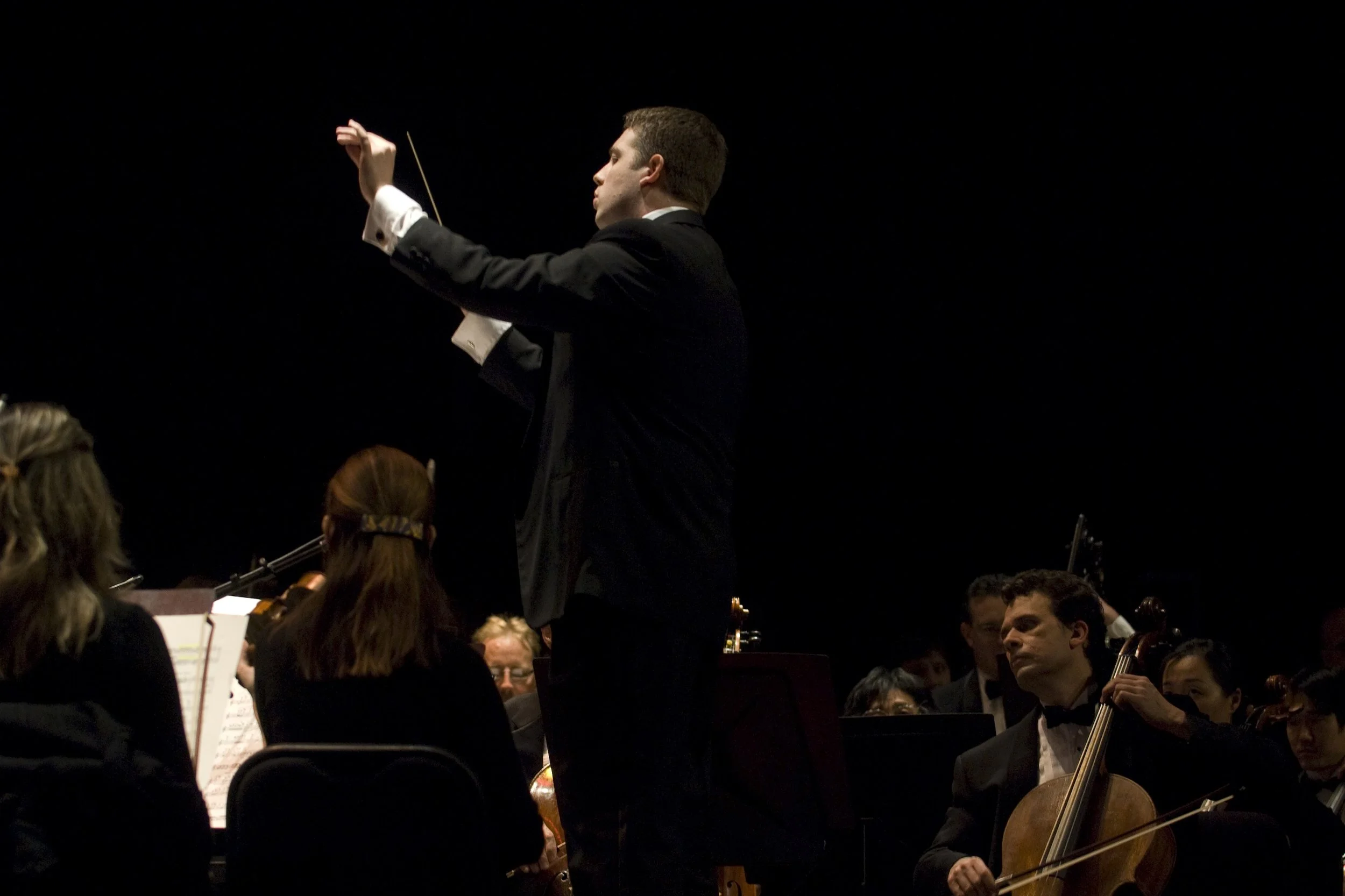
Brett Mitchell promoted to Assistant Conductor of the Houston Symphony
Brett Mitchell leads the Houston Symphony at Miller Outdoor Theatre. (Photo by Jeff Fitlow)
HOUSTON — Having served as American Conducting Fellow of the Houston Symphony for the 2007-08 season, Brett Mitchell has been promoted to Assistant Conductor, effective immediately.
Review: "A Ticklish Affair for HSO’s Opening Night"
The People's Critic has published a review of the Houston Symphony's opening night concert at its summer home at the Mitchell Pavilion, a family-friendly program led by Brett Mitchell. "The casually dressed young conductor, Brett Mitchell, was well-chosen to address the younger members of the audience, as he had an infectious enthusiasm and evident joy while explaining the humorous, 'fun' side of the classical selections on the program." To read the complete review, please click here.
"Conductor Brett Mitchell learns from the feedback"
The Houston Chronicle has published a story about Brett Mitchell and his new position as American Conducting Fellow of the Houston Symphony. The article also previews of several of his upcoming performances with the orchestra, and details his upcoming month in Europe with Kurt Masur, with whom he will study as a recipient of the inaugural American Friends of the Mendelssohn Foundation scholarship. To read this article, please click here.
Review: "The pacing of the piece was magical"
Chuck Klaus of syracuse.com has published a review of a performance of Kevin Puts's Einstein on Mercer Street at the Skaneatles Festival: "Brett Mitchell conducted, and the pacing of the piece was magical." To read the complete review, please click here.
Brett Mitchell named American Conducting Fellow of the Houston Symphony
HOUSTON — Brett Mitchell has been named American Conducting Fellow of the Houston Symphony, beginning September 2007.
This fellowship, spearheaded by the American Symphony Orchestra League, "assists in the development of exceptional conductors in the early stages of their careers, seeking to improve their qualifications to become music directors of American orchestras."
Preview: "Noted composer Kevin Puts to visit School of Music"
"Northern Today" has published a preview of composer Kevin Puts's upcoming multi-concert residency at the Northern Illinois University School of Music, a project spearheaded by Brett Mitchell. For more information, please click here.
"NIU Philharmonic invited to perform concert at Illinois Music Educators Association convention"
Northern Illinois University has issued a press release detailing the NIU Philharmonic's upcoming performance at the Illinois Music Educators Association convention, their first at the conference in over a decade. For more information, please click here.
Frankfurter Allgemeine Zeitung follows Brett Mitchell throughout Solti Competition
The Frankfurter Allegemine Zeitung has published a story following Brett Mitchell's progress in the various rounds of the third Georg Solti Conducting Competition, taking place now in Frankfurt, Germany. To read this story, please click here.
Review: "PNME stresses music over theater with premiere of Stock's 'Hostage'"
The Pittsburgh Post-Gazette has published a review of the Pittsburgh New Music Ensemble's most recent subscription performance, including the world-premiere performance of founder David Stock's "Hostage," which Brett Mitchell led "impeccably." To read the complete review, please click here.
Preview: "NIU Philharmonic to perform Mahler's beloved first symphony"
"Northern Today" has published a preview of the Northern Illinois University Philharmonic's upcoming performance of Mahler's Symphony No. 1, which will be the Philharmonic's first performance of a Mahler symphony in a dozen years. To read this preview, please click here.

Brett Mitchell named Assistant Conductor of the Orchestre National de France
PARIS — The Orchestre National de France and its music director Kurt Masur have announced that Brett Mitchell has been appointed the ensemble’s newest Assistant Conductor.
Mr, Mitchell will continue in his position as Director of Orchestras, Opera Music Director, and Professor of Conducting at Northern Illinois University while commuting between Chicago and Paris to fulfill both these appointments.
More from the Daily Chronicle:
NIU School of Music professor of conducting will help lead Orchestre National de France
Brett Mitchell, a first-year assistant professor of conducting in the Northern Illinois University School of Music, this year will experience Paris in June.
And August. And December. And maybe May.
Mitchell has been selected as the assistant conductor of the Orchestre National de France. He will make at least half a dozen trips a year to Paris to assist and cover for Maestro Kurt Masur in a role that eventually could expand to conducting the orchestra during educational and outreach performances.
The Seattle native learned of his success immediately after his audition, which took place in the Théâtre des Champs-Élysées. The concert hall was the site of the world premiere of Stravinsky’s “The Rite of Spring,” a work so avant-garde it caused riots in the audience.
“I was thrilled, obviously, and stunned. You get so used to rejection after a while — you’re ready for it, you’re prepared for it — I just remember when I heard my name,” Mitchell said. “The orchestra is just phenomenal, not only in their technical prowess, but they play with so much heart. They are never hesitant to dig in, and I love it.”
His opportunities in Paris, where he will meet, observe and work alongside some of the world’s greatest conductors, will benefit his students in DeKalb as well as audiences for Philharmonic and Opera Workshop performances.
“Spending so much time with these great musicians can’t help but affect my work here,” he said. “How could it not influence what I do?”
Mitchell’s road to Paris began in New York by way of Austin, where he earned his master’s and doctoral degrees at The University of Texas.
Masur, who conducted the New York Philharmonic during the 1990s, returned in 2004 to lead a master-class for young conductors. Five of the 100 applicants — Mitchell included — made the cut.
Review: "Ensemble season finale a feast for eyes, ears"
The Pittsburgh Tribune-Review has published a review of the Pittsburgh New Music Ensemble's season finale. " Mitchell began the program with an immensely appealing performance of Kamran Ince's 'Hammer music'…that went way beyond technical assurance to create a vibrant world in sound." To read the complete review, please click here.