

NEWS
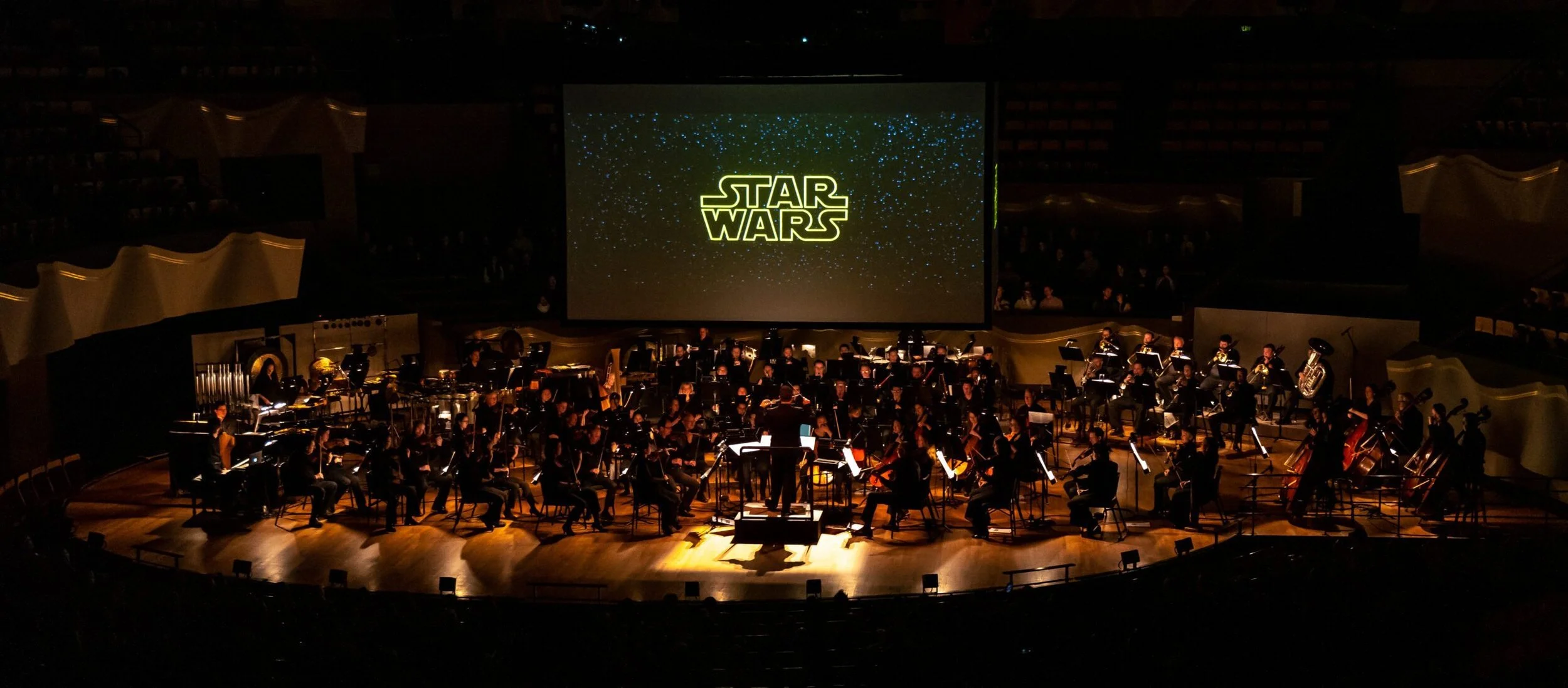
Review: "The Colorado Symphony takes Denver on intergalactic ‘Star Wars’ musical journey"
Brett Mitchell leads the Colorado Symphony in John Williams’s score for ‘Return of the Jedi’ at Boettcher Concert Hall in Denver on Friday, Feb. 28. (Photo by Colin McKinley)
DENVER — Live for Live Music has published a review of Brett Mitchell’s performance last night of John Williams’s score for Return of the Jedi with the Colorado Symphony:
The Colorado Symphony took Denver’s Boettcher Concert Hall through an intergalactic space journey on Friday night with a live performance of the 1983 sci-fi blockbuster, Star Wars: Return of the Jedi.
The performance saw a live, 360-degree play-through of the sixth episode of the Star Wars saga by the 80-symphonic piece. While John Williams was the original composer to the film’s iconic soundtrack, Friday night’s second-only performance of the Jedi battle was conducted by Brett Mitchell, who’s innovative, eclectic, and respectable leadership of the symphony glided music and film fans in attendance through the galaxy. As 7 p.m. came around, the theater lights dimmed as the percussion section led fans into the classic 20th Century Fox cinematic opening to begin the two-and-a-half hours of Luke Skywalker completing his destiny of defeating his father Darth Vader on the Death Star to bring balance to the galaxy.
Solo, Chewbacca, R2-D2, and C-3PO landed on the forest moon of Endor to meet a tribe of always-lovable Ewoks. The opening “second set” banter gave way to Mitchell’s storytelling of the symphony’s remarkable musicianship applied to learn the film’s score in just four days in stating, “We’re gonna blow up the second Death Star, and may the Force be with you.”
The symphony rose to a climactic musical force as Skywalker battled Darth Vader while the Rebel fleet successfully destroyed the Death Star, allowing the Empire to fall back into balance. The six-minute ending credits were completed with a grand musical peak to send fans off into the night’s symphonic galactic journey, while also making for a wonderful reminder that The Force is always with us.
After a kickoff on Thursday and a second performance last night, the Colorado Symphony completes its symphonic Jedi training with a final matinee performance on Saturday at 2 p.m.
To read the complete review, please click here.
Scroll down for a full gallery from Friday’s performance, courtesy of photographer Colin McKinley.


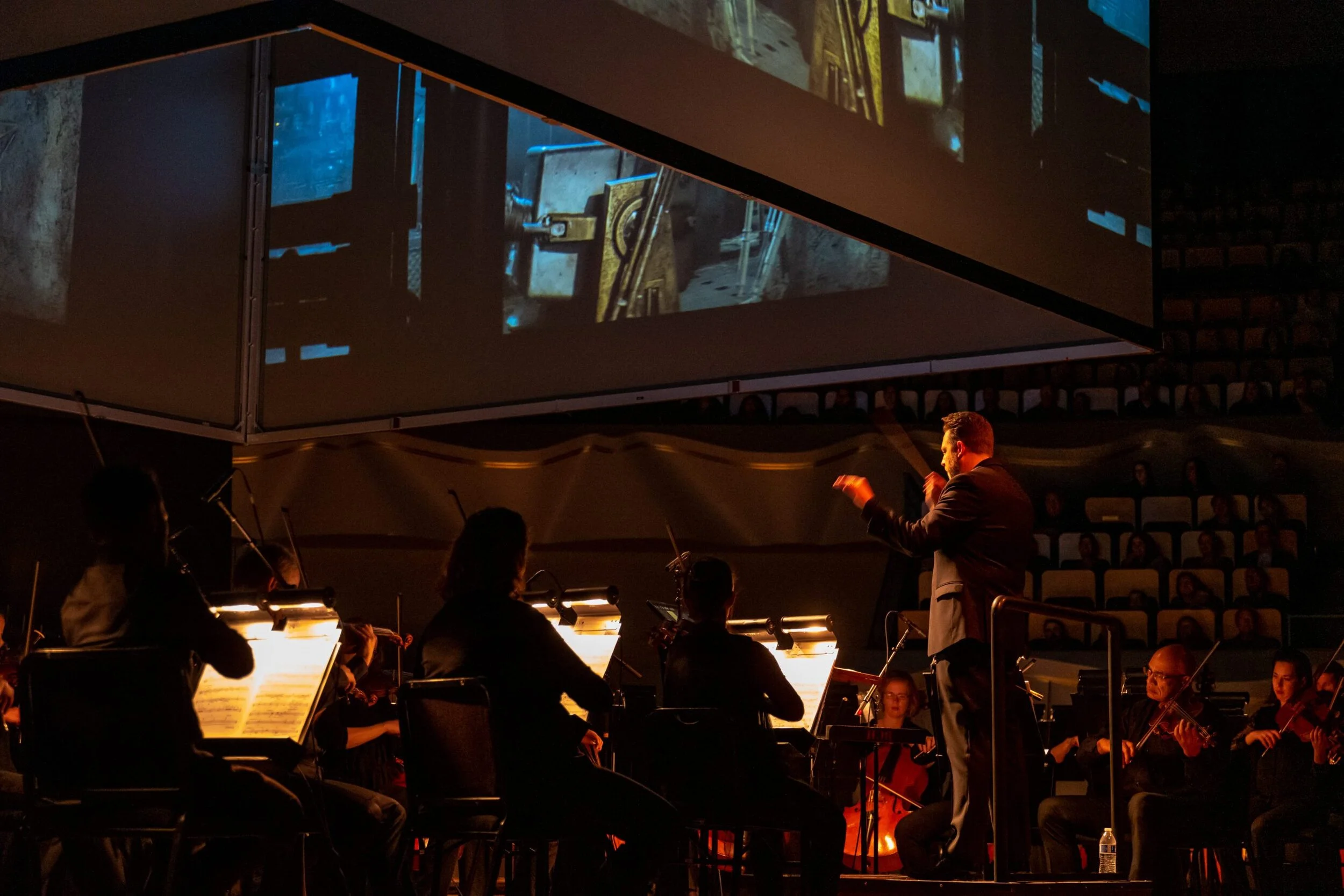


Review: Impressive San Francisco Symphony debuts by conductor and soloist

Brett Mitchell collaborated with violinist Blake Pouliot on his San Francisco Symphony debut at Davis Symphony Hall.
The Rehearsal Studio (San Francisco) has published a review of Brett Mitchell’s performance last night with the San Francisco Symphony:
As previously announced, the two “serious” concerts being performed by the San Francisco Symphony (SFS) as part of the Summer with the Symphony events at Davies Symphony Hall are both introducing new conductors and new soloists. At the first of those two concerts last night, the conductor was Brett Mitchell, currently Music Director of the Colorado Symphony. His soloist was the young Canadian violinist Blake Pouliot….
Mitchell framed the Mendelssohn [Violin] concerto with two selections by Hector Berlioz, both enjoying the same level of general familiarity as the concerto. The second half of the program consisted entirely of the Opus 14 “Symphonie fantastique” (fantastical symphony), while the “overture” for the program was the “Marche hongroise” (Hungarian march) from the Opus 24 “légende dramatique” (dramatic legend), La damnation de Faust (the damnation of Faust). Opus 14 was given a solid interpretation, accounting for the many expressive techniques that Berlioz conjured up to plumb the depths of a deranged (possibly through drugs) mind. What was important was that Mitchell never overplayed his hand, giving free rein to the rhetoric while keeping the vast instrumental resources strictly under control in the service of that rhetoric.
The real surprise came with the “overture.” In the overall plan of Opus 24, this almost serves as “incidental music” between the vocal selections that unfold the Faust narrative. However, Berlioz’ treatment of orchestral resources was never “incidental.” In this case the principal theme unfolds above a polyphony of different textures emerging from the different sections of the orchestra. (The last time I heard this music was when the San Francisco Opera presented a staged version of Opus 24; and, sadly, all of that polyphony got lost in the orchestra pit.) Mitchell clearly knew how many details were in play in this score, and he knew how to make every one of them stand out in its contribution to the intricacies of the entirety.
Mitchell is definitely a conductor to watch; and hopefully he will return to Davies during the “primary portion” of a coming season.
To read the complete review, please click here.
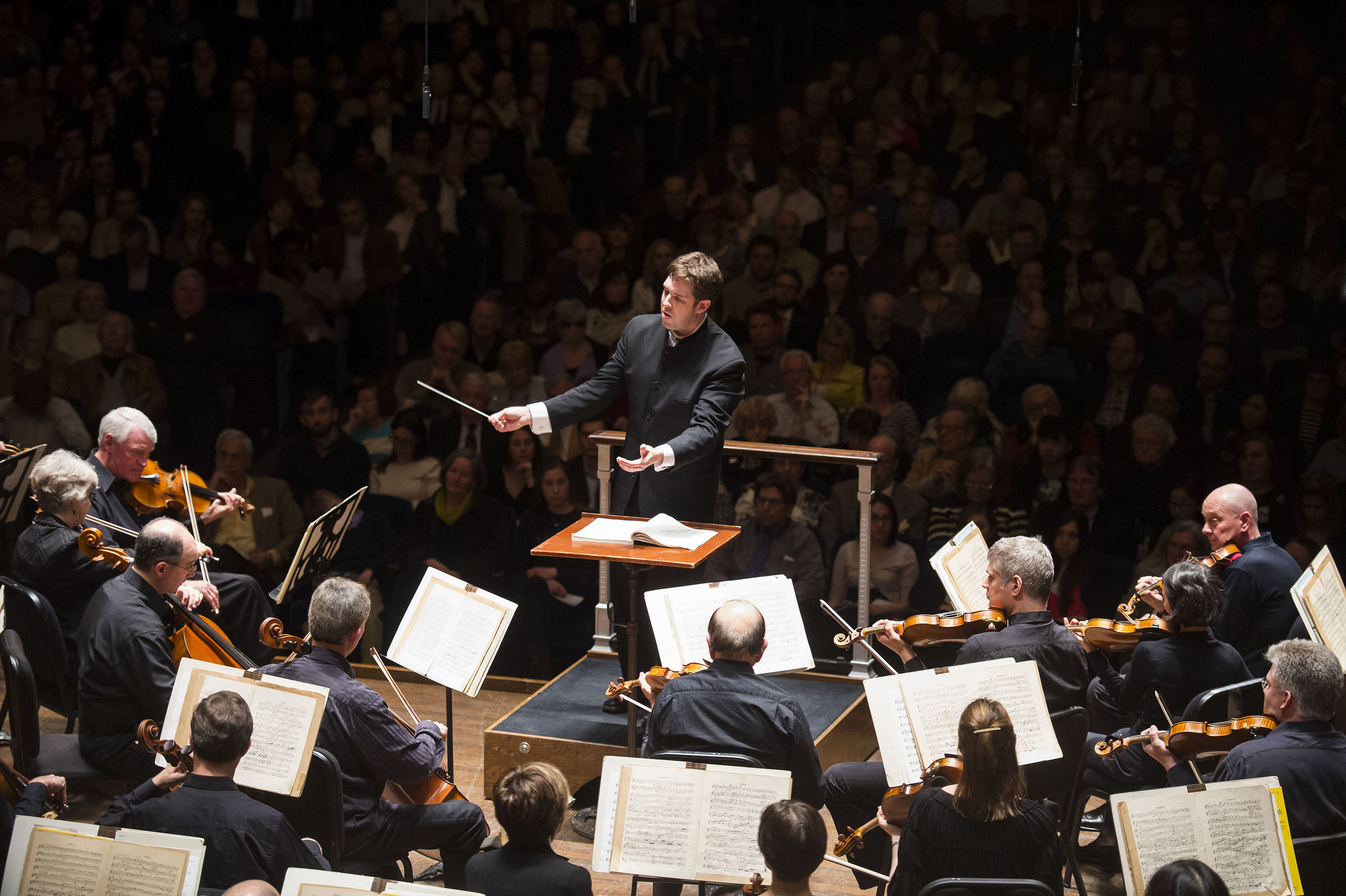
Review: Cleveland Orchestra bids adieu to season with enchanting ‘An American in Paris’

Brett Mitchell conducts The Cleveland Orchestra at Severance Hall. (Photo by Roger Mastroianni)
CLEVELAND — The Plain Dealer has published a review of Brett Mitchell’s performances this weekend with The Cleveland Orchestra:
It’s got Gershwin. It’s got dancing. It’s got Mitchell. On a Cleveland Orchestra season finale, one couldn’t ask for anything more.
No weighty symphonies or concertos on this occasion. Instead, Thursday night at Severance Hall, the orchestra wrapped the year with a film: the award-winning 1951 classic “An American in Paris”….
Make no mistake: this was no walk in the park for the Cleveland Orchestra. For the audience, “An American in Paris” may have been a pleasant way to end a season, but for the orchestra and conductor, Colorado Symphony director (and former Cleveland associate conductor) Brett Mitchell, Thursday’s project entailed two solid hours of vigilant hard work lining up brisk music with the lips of singers and the feet of dancers in lavish tap and ballet numbers….
Nice. Wonderful. Marvelous. These players and their colleagues exemplified every one of the Gershwin brothers’ favorite adjectives. They again made it great to be a music-lover in Cleveland.
To read the complete review, please click here.

Reviews: Orquesta Sinfónica del Principado de Asturias
Brett Mitchell leads Tchaikovsky’s Fifth Symphony with the Orquesta Sinfónica del Principado de Asturias on Thursday, May 2.
OVIEDO — Several media outlets have published reviews of Brett Mitchell’s Spanish debut with the Orquesta Sinfónica del Principado de Asturias:
El Comercio called the May 2 performance in Gijón “a concert full of energy and emotional abundance.”
Cuca Alonso in La Nueva España lauded the May 2 performance of Tchaikovsky’s Fifth Symphony in Gijón as “the highlight of the evening.”
Andrea Torres in La Nueva España praised the May 3 performance of Tchaikovsky’s Fifth Symphony in Oviedo as “full of nuances and a majestic sonority.”
Jonathan Mallada in La Nueva España hailed the May 3 performance of Tchaikovsky’s Fifth Symphony in Oviedo: “Mitchell knew how to maximize the sonic power of the orchestra, and showed good handling of tempi and dynamics with great taste for a phrasing always in favor of the musical discourse.”

Review: 'Mitchell, River Oaks Chamber Orchestra rove widely, from Mozart to Kilar'
Brett Mitchell leads the River Oaks Chamber Orchestra in Houston at St. John the Divine on Saturday, February 23.
HOUSTON — The Texas Classical Review has published a review of Brett Mitchell’s performance on Saturday, February 23 with the River Oaks Chamber Orchestra:
The program ranged from Wojciech Kilar’s Orawa, a string-ensemble piece, to Ethel Smyth’s Overture to The Wreckers, which is typically full-orchestra fare. Mozart’s Symphony No. 35 and others works came in between.
Led by conductor Brett Mitchell, music director of the Colorado Symphony, the orchestra moved adroitly among styles and sounds, capturing The Wreckers’ heft as readily as the Haffner’s airiness and zip.
For The Wreckers…right from the dynamic opening theme, the orchestra brought the overture heft and boldness. Besides spurring the orchestra to play so vigorously, Mitchell guided it confidently through the overture’s mood changes. When a waltz suddenly interrupted the agitation, Mitchell and the orchestra gave it a lustiness that may have harkened back to the opera’s setting in a British village; when the music took a clangorous, aggressive turn, the orchestra dug into it fiercely…
The orchestra played [Orawa] with incisiveness and momentum as Mitchell steered it through Kilar’s meter changes and sudden changes of tone, including a pounding theme that breaks out at one point. The players unleashed bursts of virtuosity in the whirlwind filigree that propelled the music to its climax.
The orchestra had dubbed the program “Ticket to Ride,” casting it as a musical tour of nations. The linchpin was a new work inspired by trains: Jim Stephenson’s ROCOmotive, whose title plays off the River Oaks Chamber Orchestra’s initials… Mitchell and the orchestra revealed the music’s color and charm. The musicians raced through the first and fourth movements with breeziness and clarity. But they also brought a cozy intimacy to the second movement and a jaunty cheerfulness to the third, which included nimble solos for oboe and flute…
Mitchell also directed the orchestra to relish Mozart’s energy and exuberance in the Haffner without allowing the church’s reverberation to muddy the textures. The strings’ nimbleness and precision played a key role, and Mitchell had the winds ringing out brightly without overdoing it.
To read the complete review, please click here.

Review: 'The Dallas Symphony and its chorus excite audiences with Carl Orff's popular Carmina Burana'
Brett Mitchell leads the Dallas Symphony Orchestra, Dallas Symphony Chorus, Children’s Chorus of Greater Dallas, and a roster of soloists at Meyerson Symphony Center. (Photo by Paul Feakes)
DALLAS — TheaterJones has published a review of Brett Mitchell’s recent performances with the Dallas Symphony Orchestra:
Carl Orff’s scenic cantata [Carmina Burana] is a true crowd-pleaser…and the Dallas Symphony Orchestra and Chorus, in collaboration with the Children’s Chorus of Greater Dallas, proved last night to be up to the task.
For opening night of the production, the Meyerson Symphony Center was nearly full. Conductor Brett Mitchell offers them a solid interpretation, filled with forward energy and thoughtful sensitivity….
Kudos for the evening definitely go to the choruses. The DSO choir carries a heavy burden with this piece, but they deliver expertly balanced passages with full lines and near-perfect diction. Director Joshua Habermann has nicely prepared the large group for Mitchell’s expressive and nuanced interpretations….
As appetizers to the main event, the DSO also performed Christopher Theofanidis’ Rainbow Body and Elgar’s Cockaigne Overture, Op. 40. Together, the two pieces filled roughly 30 minutes with a unique mixture of sound and story-telling. Theofanidis, a Dallas native, starts his piece with a Gregorian-like chant inspired by poetry written around the same time as Carmina Burana. The piece goes smoothly through movements that are bright and pastoral to dark and mysterious. Elgar’s Op. 40 is adventurous and provincial, with a lovely accompaniment from Bradley Hunter Welch on organ that gives the piece a full and resounding finish.
These were great teasers to the main course, but what most in attendance came out to see was certainly the Orff, and understandably so. The DSO delivers this well-known favorite with artful precision. It’s difficult not to enjoy such an energetic cantata, especially when everyone around you is so thoroughly engaged.
To read the complete review, please click here.

Review: 'NZSO makes a play for populism'
With the New Zealand Symphony Orchestra, Brett Mitchell presented an Italian program featuring violinist Angelo Xiang Yu and a Bernstein at 100 celebration featuring vocalist Morgan James.
AUCKLAND — The New Zealand Herald has posted a review of Brett Mitchell's two recent programs with the New Zealand Symphony Orchestra:
In two Auckland concerts this month, the New Zealand Symphony Orchestra made a palpable play for populism.
Bernstein at 100...[featured] Lenny on the light side, with most of the music coming from his Broadway shows. Denver-based maestro Brett Mitchell proved to be a lively host in his spoken introductions and drove the mighty music machine that is the NZSO with elan.
It was a shame the musical voyage to sunny Italy didn't encourage sufficient punters out into Auckland's squally weather, meaning that they missed what the programme booklet promised to be a magnificent account of Vivaldi's The Four Seasons. In fact, it was delightful, re-affirming the perennial pleasures of this piece with its dazzling succession of fires, storms, pastoral contentment and domestic bliss, all rendered in music. All this was nicely caught by a smaller band of players together with soloist Angelo Xiang Yu.
After interval, the big guns came out. Mitchell took the orchestra for a thrilling ride through Berlioz's Roman Carnival, its bold, idiosyncratic harmonies and scoring emphasising why this composer remains a key figure in 19th century music.
The evening ended by Mitchell presenting Respighi's Pines of Rome as an unashamed musical spectacular. All we needed to do was relax and be dazzled, without worrying too much about what lay behind it. The ultimate reward was one of the grandest sunrises ever, splendidly assisted by a contingent from the Wellington Brass Band.
To read the complete review, please click here.

Review: 'Making a familiar piece sound fresh to jaded ears'
Brett Mitchell led an Italian-themed program with the New Zealand Symphony Orchestra at Auckland Town Hall on May 19.
AUCKLAND — Scoop has published a review of Brett Mitchell's Italian-themed program with the New Zealand Symphony Orchestra, presented at Auckland Town Hall on Saturday, May 19:
Vivaldi’s The Four Seasons, which I haven’t heard live in over a decade, was every bit as enjoyable. Conductor Brett Mitchell did what I think is essential on these occasions, which is to try to make a familiar piece sound fresh to jaded ears.
Mitchell’s approach was to strip the orchestra right back, and it paid dividends. Everything was sharp and crisp, and the dynamics shifted precisely from level to level in the period manner, rather than being finally gradated. The soloist, young Chinese virtuoso Angelo Xiang Yu, also eschewed the traditional approach, producing instead a thrilling range of tones and timbres, from the sweetly soft to the frankly jagged.
After the interval came Berlioz’s Roman Carnival Overture, continuing the (very loose) Italian theme. Again, this was very well conducted, Mitchell’s unobtrusive style allowing the music to flow up out of the orchestra, as it were. It’s not a piece I knew at all, but I thoroughly enjoyed it, and thought the central cor anglais melody was beautifully played.
To read the complete review, please click here.

Review: 'Bernstein at 100 by the New Zealand Symphony Orchestra'
Brett Mitchell led the New Zealand Symphony Orchestra's centennial celebration of Leonard Bernstein.
WELLINGTON — Stuff has published a review of Brett Mitchell's 'Bernstein At 100' concert with the New Zealand Symphony Orchestra, presented at the Michael Fowler Centre in Wellington on Friday, May 11:
What a fabulous concert this was.
A wonderful subject, superb programming, scintillating playing, marvellous singing and absolutely first rate conducting by Brett Mitchell.
Leonard Bernstein was a larger than life personality of incredible talent, whose composing life was spread across serious concert music and the world of musical theatre. His musical style made more conservative music lovers uncomfortable, his conducting was incandescent, his personality both complex and immensely communicative.
All of Bernstein's intensely individual story was brought to life in this marvellously involving concert under the baton of one of America's up and coming conductors.
Yes, there was the predictable - a lengthy, and very welcome, selection from West Side Story - but there was also a rare, and equally welcome, performance of the symphonic suite from his only film music - On The Waterfront. And also, not heard too often, was music from On The Town and some titillating pieces from Candide.
The orchestral playing was marvellous; both free and dazzlingly precise at the same time. One could have been in New York.
To read the complete review, please click here.

Review: 'Bernstein at 100' with the New Zealand Symphony Orchestra
WELLINGTON — Regional News has published a review of Brett Mitchell's 'Bernstein at 100' concert with the New Zealand Symphony Orchestra, presented at the Michael Fowler Center in Wellington on Friday, May 11:
Bernstein was known for being a truly ‘American’ composer, bringing together multiple styles and bridging the gap between classical and popular music. We were very ably guided through a great programme by American conductor Brett Mitchell who, like Bernstein, was trained in the United States. Maestro Mitchell enjoyed the experience as much as, if not more than, many in the audience and seemingly danced and almost jived his way through a variety of classics from Bernstein’s more popular work.
To read the complete review, please click here.

Review: 'NZSO: Bernstein at 100'
Brett Mitchell led the New Zealand Symphony Orchestra in 'Bernstein At 100' at the Michael Fowler Centre in Wellington on Friday, May 11.
WELLINGTON — DMS Review Blog has published a review of Brett Mitchell's 'Bernstein At 100' concert with the New Zealand Symphony Orchestra, presented at the Michael Fowler Centre in Wellington on Friday, May 11:
[Conductor Brett Mitchell's] florid, sinuous, enthusiastic style was quite dramatic and supremely confident.
The NZSO played marvellously and did Leonard Bernstein justice. His lyrical melodies were so beautifully played: ‘Dream With Me’ from Peter Pan, ‘Tonight’ and ‘Somewhere’ (the encore) from West Side Story were magic. His syncopated, jazzy numbers were full of energy and vitality – exciting, angry, dramatic, thrilling. The percussionists, the brass section, the clarinet section, the double basses (especially with the Mambo!) had a ball!
To read the complete review, please click here.

Review: 'Vivaldi triumphs in the NZSO’s Italian celebration'
Brett Mitchell led the New Zealand Symphony Orchestra in an Italian-themed program at the Michael Fowler Centre in Wellington on Saturday, May 12.
WELLINGTON — Middle C has published a review of Brett Mitchell's Italian-themed program with the New Zealand Symphony Orchestra, presented at the Michael Fowler Centre in Wellington on Saturday, May 12:
What a boringly predictable world it would be if everything in it turned out as one anticipated! I sat pondering this earth-shattering truism during the interval of Saturday evening’s NZSO concert in the wake of the most inspiring and life-enhancing performance of Antonio Vivaldi’s “The Four Seasons” I’ve heard since...the 1970s. Just as that performance blew away the cobwebs and reinvented the work for its time, so did Angelo Xiang Yu’s absolutely riveting playing of the solo violin part and the NZSO players’ galvanic response do much the same for me on this occasion.
I listened to the thistledown-like opening, and straightaway pricked up my ears at its wind-blown, spontaneous-sounding quality, replete with inflections of phrasing and dynamics that suggested the musicians seemed to really “care” about the music.
Both Angelo Xiang Yu and conductor Brett Mitchell readily encouraged the playing’s “pictorial” effects suggested by the music’s different episodes. The playing and its “engagement factor” simply went from strength to strength throughout each of the remaining concerti....
The spectacular opening of Respighi’s Pini di Roma (Pines of Rome), had plenty of impact, conductor Brett Mitchell keeping the music’s pulses steady, thus allowing the players space in which to generate plenty of weight of tone, and flood the ambiences with that barely-contained sense of excitement suggested by the opening Pines of the Villa Borghese. As the tempi quickened, everything came together in a great torrent of sound, as overwhelming in its insistence as tantalising in its sudden disappearance, leaving a vast, resonating space of darkness and mystery. Conductor and players here enabled those spaces to be filled with properly subterranean sounds of breath-taking quality, as if the earth itself was softly resonating with its own music...
For this performance the NZSO enjoyed the sterling services of a number of players from the Wellington Brass Band, whose body of tone with that of the full orchestra’s at the piece’s climax had an almost apocalyptic effect. As he’d done throughout, Brett Mitchell controlled both momentums and dynamics with great tactical and musical skill, holding the legions in check until they actually swung into view in the mind’s eye, and came among us, amid scenes of incredible splendour and awe. Respighi actually wanted the ground beneath his army’s feet to tremble with the excitement of it all, and conductor and players triumphantly achieved that impression over the piece’s last few tumultuous bars.
To read the complete review, please click here.

Review: 'Spectacular centenary concert for Leonard Bernstein from the NZSO'
Brett Mitchell led the New Zealand Symphony Orchestra's centennial celebration of Leonard Bernstein.
WELLINGTON — Middle C has published a review of Brett Mitchell's 'Bernstein At 100' concert with the New Zealand Symphony Orchestra, presented at the Michael Fowler Centre in Wellington on Friday, May 11:
American conductor Brett Mitchell who I’d heard in a lively, Broadway-style interview on Upbeat at midday, entered and immediately launched into a startling performance of Dance of the Great Lover, the first of the three dances from On the Town which rather astonished me for the super-raunchy, trumpet-attacks from nowhere, then throaty trombones, cutting clarinets. There was nothing symphonically genteel about it and Mitchell exclaimed at its end, “the NZSO can swing!” I have sometimes dismissed remarks from conductors tackling this genre of American music, that the orchestra has a great feeling for its brazen energy, the rhythms and attack, as if the entire band had served its musical apprenticeship on Broadway. Here such praise seemed totally justified.
The Symphonic Dances from West Side Story is a more standard concert work that captures the vitality, violence, anger and occasional calm lyricism (‘Somewhere’ and the Finale) of the score and the orchestra’s playing exhibited all those characteristics with tremendous energy and unflagging precision. Finger-clicking, a shrill whistle... Nowhere more vividly than in the riotous ‘Mambo’ where the only missing element was the dancers.
To read the complete review, please click here.
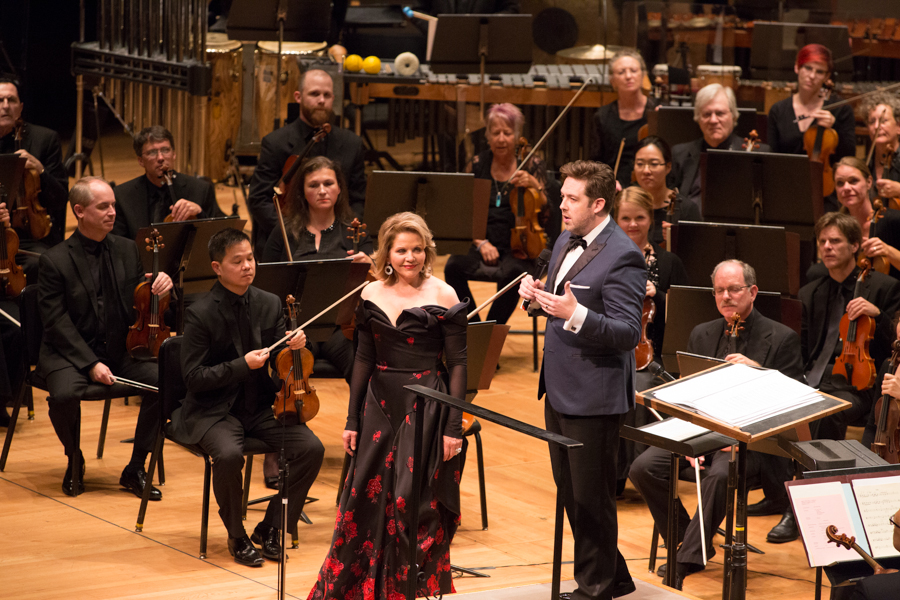
Brett Mitchell's appointment as Music Director of Colorado Symphony featured in "The Year in Denver Arts and Culture"
Brett Mitchell and the Colorado Symphony welcomed soprano Renée Fleming for his inaugural concert as Music Director at Boettcher Concert Hall on September 9, 2017. (Photo by Brandon Marshall)
DENVER — The Denver Business Journal features Brett Mitchell's appointment as Music Director of the Colorado Symphony in its 2017 year-in-review, "The Year in Denver Arts and Culture":
This was a year of fresh starts and breakthroughs on the local culture front... A look back at some cultural highlights of 2017:
The symphony gets a refresh. Brett Mitchell, new CSO conductor, bows with a season-opener concert featuring opera superstar Renée Fleming. In an interview with the Denver Business Journal, Mitchell said, “It takes years to figure out where a new music director is taking an orchestra,” Mitchell said. “The things you will notice right away are the programming… look at kinds of repertoire I like to program, you’ll see more of that contemporary American voice.” Overall, the down-to-earth maestro said, “my goal is to give the audience reason to come to the concert. Because I’ve got Spotify like everybody else. I could listen in my living room, with my glass of wine, with my wife, and not put pants on…”
To read the complete article, please click here. (Subscription required.)

Brett Mitchell's performances with The Cleveland Orchestra featured in "2017 Classical Music Year in Review"
Brett Mitchell led The Cleveland Orchestra in four performances of ‘West Side Story’ at Severance Hall in June 2017. (Photo by Roger Mastroianni)
CLEVELAND — The Plain Dealer has included Brett Mitchell's performances of West Side Story with The Cleveland Orchestra among the highlights of its "2017 Classical Music Year in Review":
It had been a while since this fan had seen "West Side Story" or attended the complete score by Leonard Bernstein. But my love for both the film and the music came rushing back in June when the Cleveland Orchestra and then-associate conductor Brett Mitchell concluded their 2016-17 Severance Hall season with a stellar live performance of the work. If ever there were any doubts about orchestras accompanying films, that night laid them all to rest for good.
To read the complete article, please click here.

Review: "Romanticism, grandeur mark symphony concert"
Brett Mitchell was the guest conductor for the San Antonio Symphony classical concert Friday night at the Tobin Center for the Performing Arts. (Photo by Jeff Nelson)
SAN ANTONIO — The San Antonio Express-News has published a review of Brett Mitchell's debut with the San Antonio Symphony:
Elegant 19th-century European Romanticism was answered by 20th-century American heroics during the San Antonio Symphony’s classical series concert Friday night.
Two talented guest artists, a pianist and a conductor, made sure the program of Franz Liszt and Aaron Copland was both varied and compatible....
[Pianist Scott] Cuellar and guest conductor Brett Mitchell, of the Colorado Symphony, collaborated for a luxuriant exploration of the concerto rather than a flashy, flamboyant one....
The concert concluded with Copland’s Symphony No. 3, known for its use of the composer’s “Fanfare for the Common Man.” Most of the work was characterized by pastoral scenery punctuated by surges of orchestral power.
Mitchell conjured a sense of spaciousness, especially in the third movement. The fanfare, introduced by flutes in the fourth movement, unfolded with spine-tingling grandeur. It seemingly spoke of a nation poised for an unbridled future of progress and prosperity, which the United States was when the piece premiered in 1946.
The concert opened with Liszt’s “Les Préludes,” one of music history’s original symphonic poems. Mitchell added drama with slower tempos than is usually heard. The relaxed pace was especially effective for the love theme in the middle before the work’s initial soaring theme returned with brassy glory at the end.
To read the complete review, please click here.
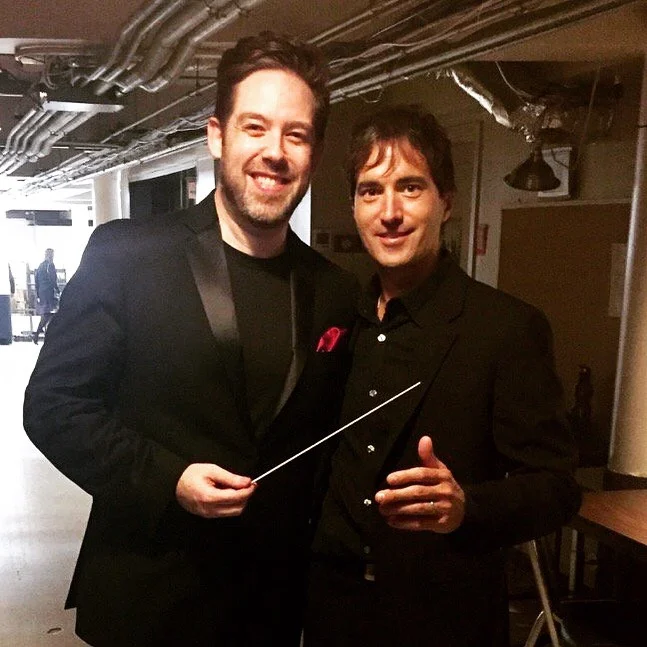
Mason Bates on Brett Mitchell
Brett Mitchell and composer Mason Bates backstage at Boettcher Concert Hall after Mitchell’s inaugural subscription performances as Music Director of the Colorado Symphony.
Composer Mason Bates has written a reflection on his recent experience collaborating with Brett Mitchell on his opening concerts as Music Director of the Colorado Symphony:
Maestro Brett Mitchell opened the Colorado Symphony’s subscription series with characteristic panache, pairing Beethoven with my The B-Sides and a fanfare by Kevin Puts. Launching his music directorship with a mix of new and old shows demonstrates the vivid programming of this dynamo. Mitchell rose to prominence at the Cleveland Orchestra, where he jumped in for last-minute appearances to much acclaim, and he always has his ear to the ground, listening for compelling American voices. But I’d never seen him conduct until last month.
Mitchell knows how to iron-out the myriad subtleties of an intricate piece like The B-Sides while staying focused on the larger arc. In the two acoustic movements “Aerosol Melody Hanalei” and “Temescal Noir,” for example, he stayed focused on the long-lined melodies while bringing out lots of nuances in the constantly-shifting metrical bed. In the electro-acoustic “Broom of the System,” I’ve come to expect that orchestras will need a few run-throughs before acclimating to the mercurial rhythms of the “future clock.” But Colorado played it near perfectly on its first run-through. It’s a fine orchestra with a mature and confident young maestro at its helm, and the crowd and vibe in the hall is hip.
To read the complete post, please click here.
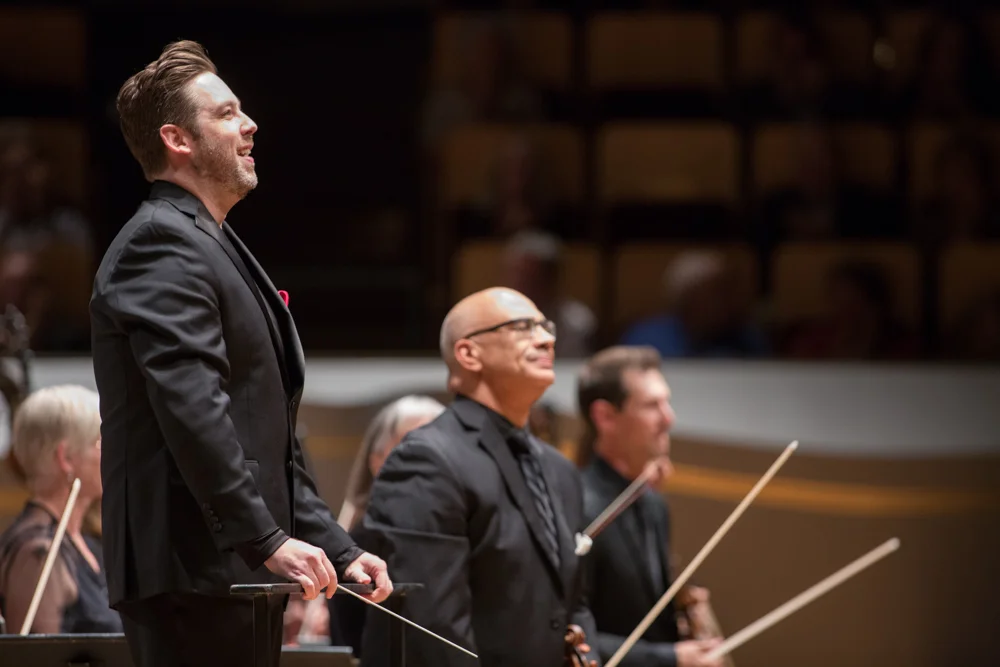
Review: "A New Beginning at the Colorado Symphony"
Brett Mitchell's inaugural subscription concerts as Music Director of the Colorado Symphony featured music by Kevin Puts, Mason Bates, and Beethoven. (Photo by Brandon Marshall)
DENVER — Jeffrey Nytch has published a review of Brett Mitchell's inaugural subscription concerts as Music Director of the Colorado Symphony:
If you glanced at the opening program of the Colorado Symphony’s 2017-18 season, playing this weekend in Denver, you might be tempted to make the assumption that the orchestra was replicating that all-too-familiar pattern of feeling it needed to balance a first half of all-contemporary repertoire with a trusty war-horse – in this case, Beethoven’s Fifth Symphony. Given the frequency with which such programming is done you might be forgiven for your assumption, but in this case you’d be incorrect.
This program, pairing Beethoven’s Fifth with a first half of works by Kevin Puts and Mason Bates, presents a coherent package. Puts and Bates complemented the Beethoven – just as Beethoven retroactively complemented Puts and Bates. This wasn’t cynical programming; this was thoughtful programming that gave every piece on the docket an equal role in service to the whole.
The vision behind this was that of the Colorado Symphony’s new Music Director, Brett Mitchell, and it’s a vision that plays out over the course of the entire season. In concert after concert we see not just a mix of canonical standards with lesser-known classics (or a refreshing number of new works), but a pairing of old and new that illuminates both. Such is certainly the case in this opening concert, where the vibrance of Kevin Puts’ Millennium Canons foreshadows the brass fanfares of the Beethoven finale, and where the pulsing rhythms of Mason Bates’ The B-Sides set us up for the insistent drive of that famous 4-note motive that not only opens the Fifth but spins its way through the entire symphony like a 19th-century version of a techno beat.
So often orchestral programming is done in a paint-by-numbers fashion: overture, concerto, intermission, canonical symphony or tone poem. The corollary to this is that the more adventuresome the first half, the less adventuresome the second half must be. (It goes without saying that in this tired – and tiresome – way of programming the adventuresome piece cannot go after the intermission, at the risk that the audience will leave after they’ve had their fill of ear candy on the first half.) And while I have no doubt that there is a certain segment of the audience that has come to expect this pattern for their concerts, and will rail against anything that confounds it, it’s absolute death to attracting anybody new to the symphony experience, and here’s why:
Anything that is done by rote cannot help but come off as such. And who wants to spend a precious evening out, pay $75 for a ticket, get a sitter, drive into town, pay for parking and all the rest, just to experience rote??

Brett Mitchell with composer Mason Bates after performing The B-Sides with the Colorado Symphony.
And though Boettcher Concert Hall was, as it usually is, only partly full Friday night, to blame the less-than-stunning attendance on the unorthodox programming would be another misplaced assumption. For the most adventuresome of the pieces – the Bates – received a standing ovation. A senior citizen to my right beamed, grabbed my husband by the arm and exclaimed, “Well now that was something different, wasn’t it?” The senior to my left was one of the first to leap to her feet, clapping enthusiastically and saying to her companion, “I thought that was fun, didn’t you?” And at intermission I took careful note of the audience, especially the older more “traditional”-looking patrons: everyone was buzzing about the first half. The fact that someone was willing to open their tenure with an entire half of new American music had gotten everyone’s attention – and the response was favorable.
It was one more bit of proof that it really is time we retire that tired chestnut about senior citizens not accepting anything but the most standard of standard repertoire. It really is time we start respecting our audience more than that. The fresh, the new, the inventive: these are the qualities most folks are seeking from their live music experiences. Why do so many orchestras still insist on depriving audiences of them?
Of course, it’s too early to tell whether or not Maestro Mitchell’s diverse programming will start filling more seats. The more I study the complex dynamics of audiences and why they make the choices they do, the more mysterious it seems. And as I’ve been saying in this forum and others for more than a decade, there are many more factors in determining consumption of classical music than just the repertoire (in fact, in some respects it’s among the least important of factors). But this is the right approach: thoughtful programming that is designed to make connections, to help us see old repertoire in a new light, and new repertoire in the context of what has come before. It’s artistic leadership that inspires risk-taking and adventure – something that the young audiences that orchestras crave regularly seek in practically all their endeavors.
To read the complete review, please click here.
Review: Debut with the Grant Park Orchestra
CHICAGO — Chicago on the Aisle has published a review of Brett Mitchell's debut with the Grant Park Orchestra:

Brett Mitchell leads the Grant Park Orchestra on Wednesday, July 19 at the Pritzker Pavilion in downtown Chicago.
Americana and Romanticism, as well as a thoughtful view of America’s shadowed past, were on display at the Jay Pritzker Pavilion on July 19 when Brett Mitchell led the Grant Park Orchestra in works by Kenji Bunch and Copland as well as Saint-Saëns’ Violin Concerto No. 3 with soloist Angelo Xiang Yu....
The final work on the program was the suite Copland pulled from his 1947 score for the film “The Red Pony” (based on a Steinbeck novella). While audiences might not be familiar with this piece, it was still known territory: Copland used all his beloved tricks, and it was the perfect treat for a breezy summer evening in the middle of America....
As Copland was the defining master of Americana in program music, you didn’t need to have seen the movie to conjure up clear images. We all awoke, yawning and stretching, as the opening movement, “Morning on the Ranch,” illustrated twittering birds, drops of dew, and the lengthening lines of the western landscape at sunrise. Mitchell succeeded in evoking a sense of wonder, in part thanks to the delicate lacing of harp chords and the woodwinds’ lonesome call. It was impossible not to think of rhythmic motifs and harmonic language from Copland’s ballet “Billy the Kid.”
The least predictably Copland-like movement is the third, called “Dream March and Circus Music.” The dream section is dissonant and halting, as if a puppet were dancing. Some passages are strictly tonal, but with the orchestra divided into two keys at once. Mitchell was not afraid to unleash some wild weirdness in the circus section, which features an unsettling calliope tune and an onslaught of piano chords with tambourine accents galumphing up and down to simulate creepy laughter.
“The Red Pony” Suite is not without angst – in “Grandfather’s Story,” movement five, the brass melody marching over strident string patterns tells a tale of peril – but this is Copland’s world, not to mention that of 1940s Hollywood, so you know everything will turn out fine. In fact, the last movement is called “Happy Ending,” bringing back the grand chords and angular melody from the opening. Mitchell and the Grant Park Orchestra made us believe, if only for half an hour, that Copland’s Technicolor soundscape was reality and the American Happy Ending was possible.
Review: Debut with the Grant Park Orchestra
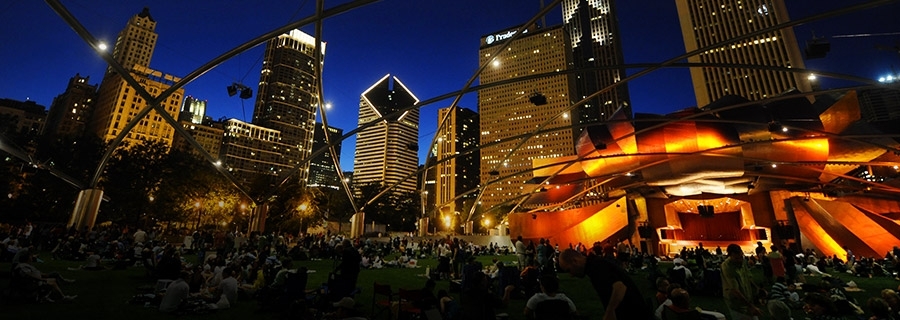
Brett Mitchell led the Grant Park Orchestra on Wednesday, July 19 at the Pritzker Pavilion in downtown Chicago.
CHICAGO — The Chicago Tribune has published a review of Brett Mitchell's recent debut with the Grant Park Orchestra:
Mitchell, who may be remembered from two years of orchestral and operatic work at Northern Illinois University, was to be thanked for reviving the suite from Aaron Copland’s 1948 film score “The Red Pony.” It’s not top-drawer Copland, though the film was improved by it, and the six movements extracted are rambunctious and heartwarming by turns, making for fitting outdoor listening.... Copland’s homespun tenderness shone through, and its successfully calculated naiveté came across.
Mitchell’s allegiance to American composition presumably shows as associate conductor of the Cleveland Orchestra and will carry over to his music directorship of the Colorado Symphony, which begins this fall.