

NEWS

Cover Story: ‘New Beginnings: Pasadena Symphony launches 97th season’
PASADENA — Pasadena Weekly has published an extensive interview and profile of Brett Mitchell as he continues in his first season as Music Director of the Pasadena Symphony:
New Pasadena Symphony Music Director Brett Mitchell is fully aware that many people are exposed to classical music through cartoons or film. Whether it’s Bugs Bunny’s “Rabbit of Seville” or “What’s Opera Doc?” or “The Emperor’s Theme,” the songs resonate still.
That’s what drew him in as well.
“The first orchestra music I ever heard was the music that was coming through our TV set speakers,” he said. “When we got to see a movie, it was the music coming out of the speaker. It really was a gateway to classical music.”
“When I grew up in 1979, I grew up with ‘Star Wars,’ ‘Superman.’ I got my undergrad in composition because I wanted to write film music. I moved to conducting because I have the utmost respect for musicians. They were a formative part of my childhood. The opportunity to make music with them is truly a genuine treat.”
Mitchell continues his debut season with a program comprising four works with distinctive and colorful themes that play off Southern California’s adjacency to the Pacific Ocean and the tech industry.
The “Rhapsody in Blue” performances are scheduled for 2 p.m. and 8 p.m. Saturday, Nov. 16. Mitchell opens the program with Mason Bates’ computer motherboard-inspired “Sea-Blue Circuitry,” an all-acoustic work.
“The grooves of ‘Sea-Blue Circuitry’ hiccup from measure to measure as rapidly as data quietly flashing on the silicon innards of a computer, yet the piece is entirely unplugged. It explores ways of recreating the precision of electronica through the instruments alone.”
For the next piece, featured guest pianist Stewart Goodyear joins Mitchell and the orchestra to interpret George Gershwin’s iconic “Rhapsody in Blue,” as part of the 2024 global celebration of the work’s centenary.
Mitchell is thrilled in his position. He said he feels it was made for him — but he doesn’t take it for granted.
“Any job is great,” he said. “We’re all happy to have any job in 2024. In addition to having the utmost respect for the orchestra, we hit it off right away. We had great chemistry. I equate it to dating: it takes the right guy and the right girl. The lack of chemistry is not indicative of the orchestra.”
He also has served as artistic director and conductor of Oregon’s Sunriver Music Festival since August 2022.
From 2017 to 2021, Mitchell served as music director of the Colorado Symphony in Denver; he previously served as music director designate during the 2016-17 season.
During his five-season tenure, he is credited with deepening the orchestra’s engagement with its audience via in-depth demonstrations from both the podium and the piano.
He also expanded the orchestra’s commitment to contemporary American repertoire — with a particular focus on the music of Mason Bates, Missy Mazzoli, and Kevin Puts — through world premieres, recording projects, and commissions.
In addition, Mitchell spearheaded collaborations with local partners as Colorado Ballet, Denver Young Artists Orchestra, and El Sistema Colorado.
From 2013 to 2017, Mitchell served on the conducting staff of The Cleveland Orchestra. He joined the orchestra as assistant conductor in 2013, and was promoted to associate conductor in 2015, becoming the first person to hold that title in over three decades and only the fifth in the orchestra’s 100-year history. In these roles, he led the orchestra in several dozen concerts each season at Severance Hall, Blossom Music Center, and on tour.
From 2007 to 2011, Mitchell led over 100 performances as Assistant Conductor of the Houston Symphony. He also held Assistant Conductor posts with the Orchestre National de France, where he worked under Kurt Masur from 2006 to 2009, and the Castleton Festival, where he worked under Lorin Maazel in 2009 and 2010.
In 2015, Mitchell completed a highly successful five-year appointment as music director of the Saginaw Bay Symphony Orchestra, where an increased focus on locally relevant programming and community collaborations resulted in record attendance throughout his tenure.
In addition to his work with professional orchestras, Mitchell is also well known for his affinity for working with and mentoring young musicians aspiring to be professional orchestral players.
His tenure as music director of the Cleveland Orchestra Youth Orchestra from 2013 to 2017 was highly praised and included a four-city tour of China in June 2015, marking the orchestra’s second international tour and its first to Asia. Mitchell is regularly invited to work with the talented young musicians at this country’s high-level training programs, such as the Cleveland Institute of Music, the National Repertory Orchestra, Texas Music Festival, Sarasota Music Festival and Interlochen Center for the Arts. He has also served on the faculties of the schools of music at Northern Illinois University (2005-07), the University of Houston (2012-13) and the University of Denver (2019). During the 2022-23 academic year, Mitchell will again serve as adjunct professor of music at the University of Denver, acting as interim director of orchestras and professor of conducting.
Born in Seattle in 1979, Mitchell earned degrees in conducting from the University of Texas at Austin and composition from Western Washington University, which selected him as its Young Alumnus of the Year in 2014. He also studied with Leonard Slatkin at the National Conducting Institut and was selected by Kurt Masur as a recipient of the inaugural American Friends of the Mendelssohn Foundation Scholarship in 2008. Mitchell was also one of five recipients of the League of American Orchestras’ American Conducting Fellowship from 2007 to 2010.
To read the complete story, please click here, or read the full digital edition here.

Brett Mitchell Appointed Music Director of the Pasadena Symphony
Pasadena Symphony Appoints Brett Mitchell Music Director
Highly Acclaimed Conductor Assumes Post on April 1, 2024
PASADENA – Pasadena Symphony Board President Kimberly Winick today announced that the Board of Directors has appointed Brett Mitchell Music Director. Mitchell begins his five-year tenure with Pasadena Symphony on April 1, 2024. His first performance as Music Director will be the orchestra’s season-opening concert on October 26, 2024 (2024/25 season details to be announced).
Winick states, “Brett Mitchell emerged from our competitive music director search as our all-around favorite, and I am delighted to welcome him as our new artistic leader. His energy and talent will engage, sustain, and help to broaden our musical community.”
Pasadena Symphony CEO Andrew Brown adds, “We are excited Brett Mitchell is joining the orchestra at this significant time in the orchestra’s history, with our centennial just four years away. Brett is a tremendous talent. With his deeply creative programming, broad vision, collaborative spirit, and innate ability to keep classical music fresh and inspire musicians and audiences alike, he is the right person to lead the orchestra into its second century.”
Mitchell says, “I'm deeply honored and absolutely thrilled to be joining the Pasadena Symphony as its next Music Director. From the first moment we made music together in March 2022, it was very clear that there was a special connection between the musicians and me, and that same chemistry has since extended beyond the stage to our friends in the audience and throughout our community. I couldn't be more excited for the musical journey that lies ahead for our entire community as we embark together on this next chapter of the Pasadena Symphony's story.”
Orchestra’s Sixth Music Director in Nearly a Century
Mitchell is the sixth conductor to serve as Music Director of the Pasadena Symphony since the orchestra was founded in 1928. He succeeds distinguished Music Directors Reginald Bland (1928- 1936); Dr. Richard Lert (1936-1968); Daniel Lewis (1971-1982); Jorge Mester (1984-2010); and David Lockington (2013-2022). Pasadena Symphony, which has garnered considerable critical and public acclaim throughout its history, is a “virtuoso orchestra” lauded for “zesty, swaggering performances” (Los Angeles Times) and celebrated for its “superb tonal clarity and rich instrumental brilliance” (Pasadena Star News).
In addition to overseeing all artistic aspects of the Pasadena Symphony, Mitchell will collaborate on the orchestra’s highly regarded community and education programs, including the Pasadena Youth Symphony Orchestras, which encompass eleven award-winning ensembles serving students of all musical abilities in grades 5-12.
Mitchell, who has been on Pasadena Symphony’s radar for several years, was previously named an Artistic Partner for the orchestra’s 2021-22 season. Based on the strength of that initial appearance, he was invited to return as an Artistic Partner during the orchestra's 2023-24 season, leading its well-received opening concerts last fall.
Coming Full Circle
Mitchell – who was born in 1979, raised in Seattle, Washington, and now resides in Denver, Colorado with his family, where they plan to remain – vividly recalls the music from the Star Wars and Superman films having a tremendous impact on him as a child. “The first time I heard an orchestra was in a movie theater on a film soundtrack,” he explains, inspiring him to earn a degree in music composition from Western Washington University. “I wanted to be a film composer but ended up writing orchestral works that, in a twist of fate, I started conducting, which I discovered was my true passion.” That led to him earning both Master’s and Doctorate degrees in conducting from the University of Texas at Austin.
He continues, “In many ways, joining the Pasadena Symphony as Music Director is really coming full circle for me. So many of our musicians are these iconic studio players whose work I’ve known and loved for decades. To now be able to work with them and experience their artistry in person is a thrill beyond words.”
Additional Coverage
Colorado Boulevard (3/22): Brett Mitchell Is New Pasadena Symphony Music Director
Slippedisc (3/24): Pasadena Picks an American Music Director
Pizzicato (3/24): Pasadena Symphony appoints Brett Mitchell as Music Director
OperaWire (3/25): Pasadena Symphony Names Sixth Music Director in its History
Hey SoCal (3/25): Pasadena Symphony announces Brett Mitchell as new music director
Musical America (3/26): Pasadena Symphony Taps Music Director(subscription required)
Broadway World (3/27): Pasadena Symphony Appoints Brett Mitchell Music Director
Pasadena Now (3/27): Pasadena Symphony Names Brett Mitchell as Its Next Music Director
The Violin Channel (3/28): California's Pasadena Symphony Appoints New Music Director
Los Angeles Times (3/30): Easter music, alt art fair and the best L.A. culture in the week ahead
Symphony (4/1): Brett Mitchell Named Music Director at Pasadena Symphony
Local News Pasadena (4/4): Brett Mitchell is Listening
Pasadena Weekly (4/11): Major Music Changes: Pasadena Symphony appoints Brett Mitchell as new music director

Brett Mitchell will lead his first concerts as Music Director of the Pasadena Symphony on October 26, 2024, at the orchestra’s home of the Ambassador Auditorium, often referred to as the “Carnegie Hall of the West.”

Review: A "winning performance" with the Fort Worth Symphony Orchestra
Violin soloist Karen Gomyo performs with guest conductor Brett Mitchell and the Fort Worth Symphony in concert at the Will Rogers Auditorium on Friday, Oct. 30, 2020, in Fort Worth. (Photo: Smiley N. Pool)
FORT WORTH — The Dallas Morning News has published a review (subscription required) of Brett Mitchell’s debut last night with the Fort Worth Symphony Orchestra:
Friday night’s concert was led by Brett Mitchell, a Seattle native trained in conducting at the University of Texas at Austin and currently music director of the Colorado Symphony. With 445 tickets sold, audience members were widely spaced in the 2,800-seat auditorium. A maximum of 35 musicians was well spaced onstage, with curtains raised to reveal the brick back wall…
String and percussion players were masked, causing no problems in Bernstein’s Serenade for solo violin, strings, harp and percussion. Strings projected better than I recalled from the Sept. 18 concert…
Gomyo and Mitchell collaborated on a winning performance, alert to the mix of textures, moods and even styles. (Stravinsky is a recurrent influence.) Gomyo dashed off virtuoso skitters, double-stops and high harmonics with panache, supplying unforced ardor elsewhere.
To read the complete review, please click here (subscription required).

Guest conductor Brett Mitchell speaks to the audience before the Fort Worth Symphony concert at the Will Rogers Auditorium on Friday, Oct. 30, 2020, in Fort Worth. (Photo: Smiley N. Pool)

Preview: River Oaks Chamber Orchestra travels across Europe with ‘Ticket to Ride’
Brett Mitchell will lead the River Oaks Chamber Orchestra at St. John the Divine in Houston on Saturday, February 23.
HOUSTON — The Houston Chronicle has published an extensive preview of Brett Mitchell’s upcoming debut with the River Oaks Chamber Orchestra.
“I wasn’t born in Texas, but I got here as fast as I could,” says Brett Mitchell, quoting a favorite bumper sticker of his. “That’s kind of like me. Any excuse to come back to Texas is great.”
Originally from Seattle, the music director of the Colorado Symphony received his master’s and doctoral degrees at the University of Texas at Austin and later worked as the assistant conductor of the Houston Symphony from 2007 to 2011.
On Saturday, Mitchell will return to Houston to make his debut with another local ensemble, leading the River Oaks Chamber Orchestra in “Ticket to Ride” at the Church of St. John the Divine.
The concert will take its audience on a train trip across Europe in a program featuring Ethel Smyth’s “The Wreckers,” Wojciech Kilar’s “Orawa,” Saint-Saëns’ Cello Concerto No. 1, Mozart’s Symphony No. 35 (also called the “Haffner” Symphony) and a new commission by composer Jim Stephenson titled “ROCOmotive…”
In a way, the programming was devised through a back-and-forth “dance” between Mitchell and artistic director Alecia Lawyer, whose father collects miniature trains — a fitting theme that ties into ROCO’s overall season, “Games People Play.”
One of Lawyer’s suggestions was the overture of Smyth’s three-act opera, which was re-scored by composer Mark Buller to fit the smaller orchestra. Highlighting works by women has long been a part of the ensemble’s mission, and it’s an initiative that Mitchell fully supports, saying, “It’s about damn time that we start having more female composers on our series.” …
Although Smyth’s opera debuted over a century ago, it presents a challenge for Mitchell, much like Stephenson’s new commission. Fortunately, he enjoys the challenge and finds inspiration in working on world premieres. In fact, it’s why he became a conductor in the first place, he says, rather than following the paths of a pianist or a composer.
“I came to realize that I didn’t really feel like I personally had anything compelling that I needed to say through my own music,” he says. “What I really love doing is finding other composers that I feel like do have something to say and giving those works a voice, breathing life into them for the first time.” …
“Instead of being a creative artist, I consider what we do in orchestras being a re-creative artist,” he continues. “Priority number one for me always, the person that I am working the hardest for, it’s not the orchestra. It’s not the audience. It’s not even me. It’s the composer. Without the composer, none of us have jobs. I take my obligation to that incredibly seriously, and it’s so incredibly rewarding when you get to bring something to life like this.”
To read the complete preview, please click here.

Feature: "Colorado Symphony's new music director is ready to rock"

Seattle-born Brett Mitchell, the new 38-year-old music director for the Colorado Symphony, was raised on grunge before discovering his love for all things symphonic—and we do mean all things. (Photo by Peter Lockley)
DENVER — Denver Metro Media has published a feature about Brett Mitchell on the eve of his first performances as Music Director of the Colorado Symphony:
Brett Mitchell remembers the day he discovered the genius of Ludwig van Beethoven.
It was 1994 while watching the biopic Immortal Beloved with his mother. As actor Gary Oldman pantomimed one of the great piano sonatas, 15-year-old Mitchell grew puzzled, then aghast.
“Mom, they stole this melody from Billy Joel. How are they getting away with this?” the high school freshman whispered in quiet desperation.
Within a few hours, the truth had sunk in.
It was Joel who had nicked the tune from Beethoven, not the other way around. The 20th-century piano man had some years earlier transformed the German composer’s exquisite “Sonata Pathétique” into a lamenting tribute to 1950s doo-wop in a 1983 hit song called “This Night.”
Like countless devotees before him, the newly enlightened Mitchell would soon scour the life work of Beethoven, whose tortured life, he discovered, was in frequent contrast to the sheer beauty of the composer’s wide-ranging work.
“Beethoven kind of stands for this great moral searching,” Mitchell explained. “Now, he’s a huge part of my life, every bit as much as Kurt Cobain was 25 years ago.”
Today, the 38-year-old Seattle-born musical director for the Colorado Symphony still stands at the intersection of classical and pop, as well as its varied crossroads at video games, movies, rock and roll, and who knows what else....
Like his recent CSO predecessors, the new Generation-X conductor is determined to bring “longhair” music to everyone—yes, including those with hipster beards. The millennial ticket-buying generation will soon constitute half the nation’s workforce and half of its expendable income.
“Millennials tend to not be so insistent about putting things into boxes,” Mitchell said, noting the symphony’s ongoing genre surfing. “Classical music doesn’t actually mean anything. That’s kind of a nonsense term we use to cover a lot of stuff. The opposite of classical, whatever the hell that means, is pops, whatever the hell that means.”
This year, it means not only upcoming homages to Beethoven and George Gershwin and collaborations with classical vocalist Renée Fleming and cellist Yo-Yo Ma, but also tributes to Ella Fitzgerald and Prince, a concert with eclectic banjoist Bela Fleck, live accompaniment to a screening of Tim Burton’s The Nightmare Before Christmas, and a special performance dedicated to the music of video games.
Tell Tchaikovsky the news, but break it to him gently.
Born in Seattle in 1979, Mitchell came of age when new wave was already old and his city of birth was delivering a newer child called grunge. [Remember the dollar bill dangling in front of the swimming infant on the cover of Nirvana’s Nevermind?]
“I heard a very tortured soul who was trying to work through things in a very public way,” Mitchell said of Nirvana’s Kurt Cobain. “When I started listening to Beethoven, honestly, I heard the exact same thing.”
Although rooted in the Baby-Boom rock of his parents and the 90s rock that permeated his hometown, Mitchell somehow found his calling in symphonic music, first in the movie soundtracks of John Williams, which would act as his bridge from pop to classical and set him off on his quest.
Before landing in the Mile High City, Mitchell held conducting positions with symphonies in Saginaw, Michigan, Cleveland and Houston, having studied conducting at the University of Texas in Austin. He held an assistant-conductor post with the Orchestre National de France and had a litany of guest shots across the United States and Europe prior to settling down in Denver this year.
Although Mitchell has yet to hit 40, that is not so unusual for a conductor, he says. Keep in mind, when the legendary Leonard Bernstein took the reins at the New York Philharmonic in 1958, he was only a couple years older than Mitchell is now. Even so, Mitchell sees his relative youth as a benefit.
“I’m sure that doesn’t hurt in terms of reaching out to younger audience members,” he said. “But what really helps is the fact that I’ve been evangelizing for classical music in a way that I hope makes it relatable to anybody and everybody.”
Mitchell points out that even someone as revered as Bernstein was no stick in the mud when it came to music. The conductor-composer was a sort of ambassador between classical and other genres and in 1967 hosted CBS’s Inside Pop: The Rock Revolution, in which Bernstein introduced the “establishment” to the likes of Brian Wilson, Roger McGuinn and Janis Ian.
“[Bernstein] would listen to The Beatles’ Revolver with his kids. The only discrimination was the quality of music they would listen to,” Mitchell said. “We approach it very much the same way in our house and I think Lenny was really a light that led the way for a lot of the rest of us.”
To read the complete article, please click here.
"Colorado Symphony Orchestra announce new music director"
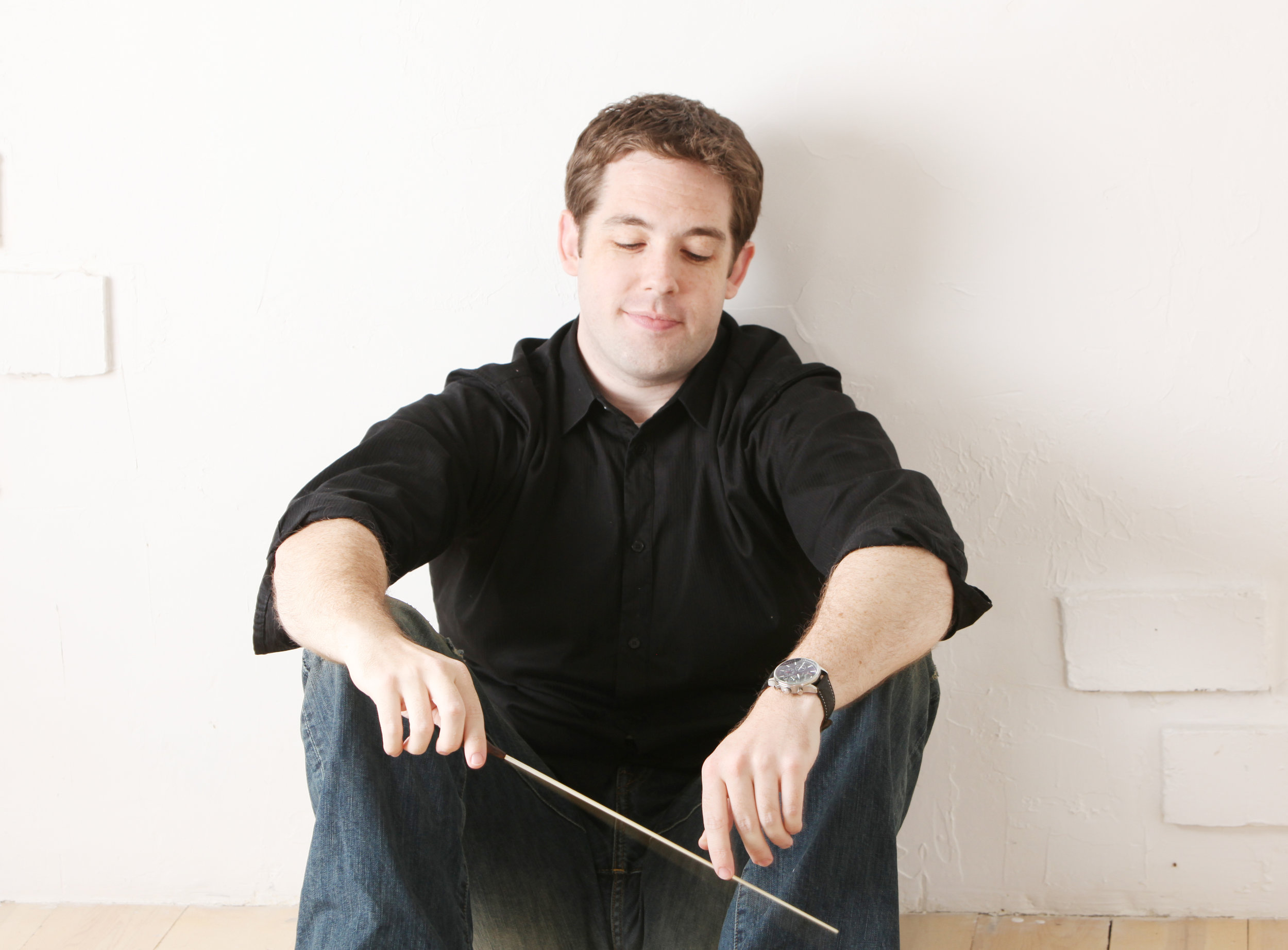
(Photo by Gregg Barckholtz)
The Violin Channel has published an article about Brett Mitchell's appointment as Music Director of the Colorado Symphony:
The Colorado Symphony Orchestra has today announced the appointment of 37 year old American conductor, Brett Mitchell as their new Music Director – effective from the commencement of the 2017/18 season.
A graduate of the University of Texas and the Western Washington University, Brett currently serves as Associate Conductor of the Cleveland Orchestra and as Music Director of the Cleveland Orchestra Youth Orchestra.
“Mitchell was unanimously selected by musicians and artistic leadership alike — a rare occurrence in the orchestra world when making such a momentous change …” Chief Artistic Officer, Anthony Pierce has said.
“Brett’s skill, character, and creativity won us all over, and he’s completely on board with our mission for innovative artistry and financial success …” he has said.
“From the first downbeat of our first rehearsal together, it was clear that the Colorado Symphony and I had that special chemistry vital to any great artistic partnership,” Mitchell has said.
He will replace conductor, Andrew Litton – who has served the position since 2012.
To read the complete article, please click here.
Debut with The Cleveland Orchestra
AUSTIN — Brett Mitchell will make his debut with The Cleveland Orchestra this Saturday, March 1, leading a sold-out concert on tour at the Long Center in Austin. This marks Mr. Mitchell's first appearance on the podium in Austin since attending The University of Texas from 2001 to 2005.
The Composer is Dead!
In a family concert based on the Lemony Snicket book with music by Nathaniel Stookey, an inspector interrogates the instruments of the orchestra to find out who killed the composer. Brett Mitchell conducts the Cleveland Orchestra with Giancarlo Guerrero as narrator. SOLD OUT!
For more information, please click here.
Preview: "Symphony candidate sees youth as a plus"

Brett Mitchell, a candidate for the position of music director at the Peoria Symphony Orchestra, leads the orchestra on April 24 at the Civic Center Theater.
The Journal Star (Peoria) has published a profile of Brett Mitchell in advance of his upcoming concert with the Peoria Symphony Orchestra:
Brett Mitchell, the next candidate in the Peoria Symphony Orchestra's music director search, said that a young face at the podium can be a plus.
"If you look at the list of candidates that the Peoria Symphony has brought this season, it's very clear that they are interested in reaching out to the next generation of concertgoers," said Mitchell of Houston, who leads the orchestra in a performance of Beethoven, Prokofiev and the music of contemporary composer Michael Torke on Saturday.
"We're all, relatively speaking, young. I think that's a great way to bring in young audiences. It seems like a superficial thing, but it's not and I'll tell you why. I go home on Monday night, if I can, and I watch 'House' just like everybody else. I'm excited about the last season of 'Lost' just like everybody else. I listen to top 40 radio just like everybody else. I think there is something really important - the relatability of the person on the podium."
Yet Mitchell, 30, is not just an "average Joe" who just happens to have a passion for classical music. Few rising conductors can impress the likes of conductor Kurt Masur, whom Mitchell can claim as a personal mentor and supporter. Connections to Masur led to three years of shuttling back and forth over the Atlantic while serving as assistant conductor for the French National Orchestra. And besides that world-class orchestra, Mitchell has led several other top-notch organizations: the London Philharmonic, the Philadelphia Orchestra and the Houston Symphony Orchestra, where he now serves as assistant conductor.
Nevertheless, Mitchell, who grew up in Seattle, hardly projects the image of a rarified know-it-all. His parents listened to not just classical but a variety of music, and he owes his fascination with orchestral sound to John Williams via movies like "Star Wars," "Superman," "E.T." and "Indiana Jones." In fact, for a time Mitchell wanted to be a film composer and studied composition at Western Washington University while taking lessons on his primary instrument, the piano, on which he is basically self-taught after having a few formal lessons when he was 6. (Mitchell broke out on his own because his piano teacher insisted that the young boy learn scales instead of songs.)
When he considered graduate school in music, however, Mitchell switched to conducting - partly because he decided he wasn't a young John Williams in the making. Also, he discovered he preferred collaborating with others.
"Playing the piano is a very solitary endeavor," Mitchell said. "You spend hours and hours alone in a practice room. The culmination of all that practice is that you go on stage alone again. Composition is a very solitary endeavor. You spend hours and hours alone writing your music. Once it's written, it's written. But with conducting - yes, I spend hours and hours alone studying these scores. But the end result is so different. The end result is that I get to work with 60, 80, 100 of my colleagues on these pieces. Then we get to perform them for one or two or three or five or 10,000 people. I'm such a people person. That just speaks to me and makes so much sense to me for who I am as an artist."
Not to mention the added benefit of spending a great deal of time with scores by Beethoven or Prokofiev - composers of genius. What job can be better than that?
After receiving a master's and doctoral degrees in orchestral conducting from the University of Texas at Austin, Mitchell went on to a varied career. Thanks to Kurt Masur, Mitchell received the inaugural Felix Mendelssohn Bartholdy Scholarship, which meant one-on-one study with Masur and helping the great conductor with concerts in Europe and America. He currently serves as assistant conductor/American conducting fellow of the Houston Symphony Orchestra.
Mitchell said that orchestras can broaden their audiences by being good representatives of their respective cities and regions. Programs, he said, should not be interchangeable: What is played in Chicago should be different from what is played in Dallas, because Chicago and Dallas are different places. For instance, the Peoria Symphony Orchestra might consider playing more music from local and regional composers as well as standards like Aaron Copland's homage to Abraham Lincoln.
"The Peoria Symphony Orchestra's programming should absolutely be reflective of Peoria and Illinois," Mitchell said. "Because otherwise we just become a symphony orchestra that just happens to be in Peoria. That is a huge mistake."
Beyond that, Mitchell would like to see collaborations with other dance, theater and other arts groups - projects he has tried to cultivate in his time with the Houston Symphony.
Mitchell, who also is in the running for the position of music director at Michigan State's Saginaw Bay Symphony Orchestra, said he's ready for a new stage in his career.
"I've had great music director experiences with my own orchestras - but they've been smaller orchestras," Mitchell said. "They've been largely academic orchestras, in a university setting, or a youth orchestra. I've had great professional orchestra experience, including with some of the greatest orchestras in the world. I've conducted the London Philharmonic. I've conducted the Philadelphia Orchestra. I work with the Houston Symphony. These are really sensational orchestras. I feel like the time is right for me to synthesize those two things - that great music director experience that I have and that great professional experience that I have. And become music director of one of the nation's really, truly great regional orchestras."
Austin Chronicle: "Two UT School of Music doctoral candidates chosen to learn conducting from Maestro Kurt Masur
The Austin Chronicle has published an article about Brett Mitchell and fellow University of Texas conducting student Adam Boyles, two of only seven young conductors personally selected by Maestro Kurt Masur to participate in his first annual conducting seminar at the Manhattan School of Music earlier this month. To read the complete article, please click here.