

NEWS

Feature: ‘Falling in love with music: A conversation with Sunriver Music Festival artistic director and conductor Brett Mitchell’
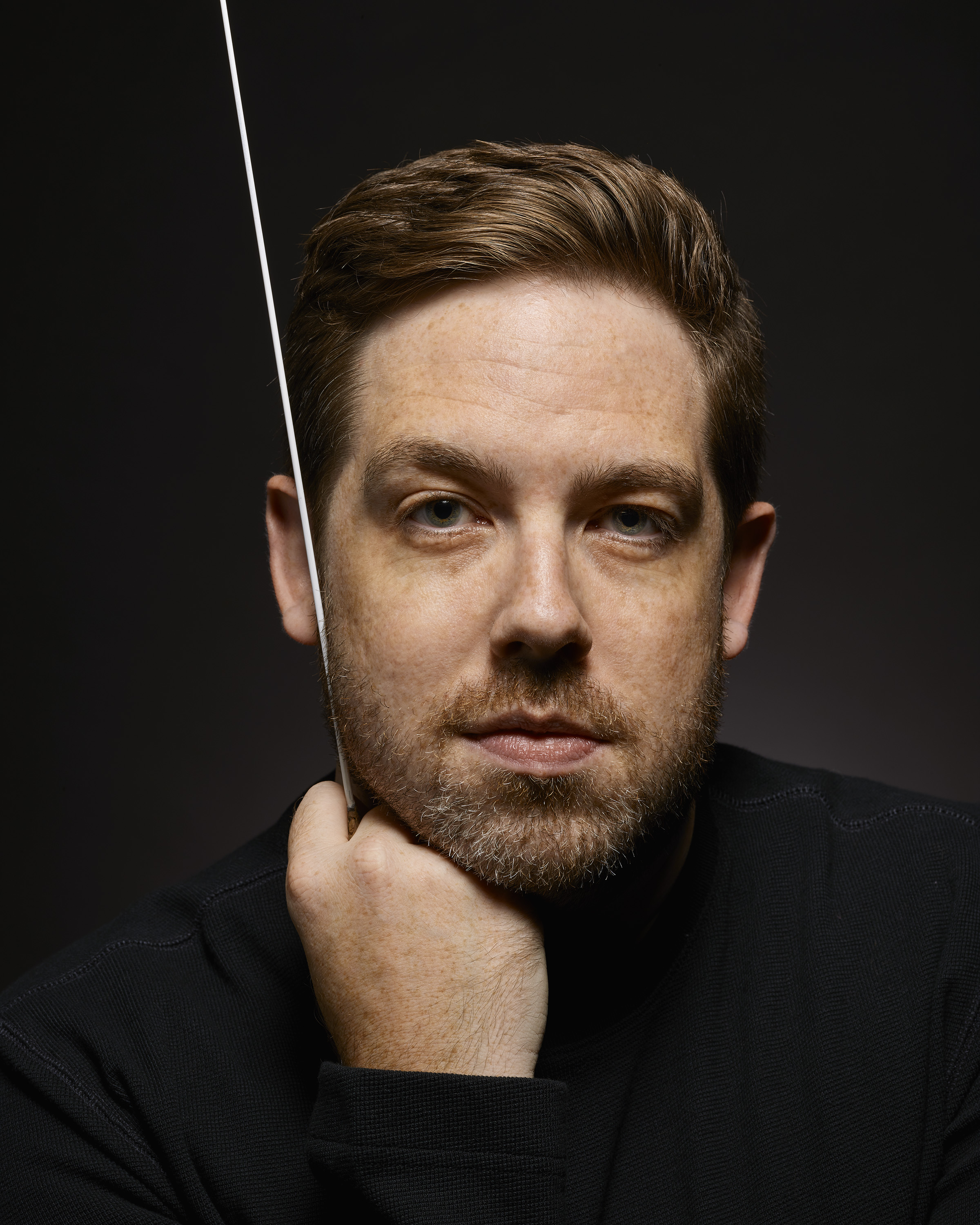
Photo by Roger Mastroianni
BEND, Ore. — Oregon ArtsWatch has published an extensive feature about the Sunriver Music Festival and its Artistic Director & Conductor, Brett Mitchell. The article features a substantial interview with Mr. Mitchell, who is about to begin his fourth season at the helm of the nearly-50-year-old festival in Central Oregon.
Falling in love with music:
A conversation with Sunriver Music Festival artistic director and conductor Brett Mitchell
Mitchell, now in his fourth season with the Central Oregon summer festival, discusses how his background as a composer informs his approach to conducting, why performing in Sunriver feels like coming home, and the immersive future of classical concerts.
Preparing to interview Brett Mitchell — conductor and artistic director of the Sunriver Music Festival, which starts August 2 and runs through the 13th — a few big questions came to mind. First: what is it that a conductor does, exactly? Beyond the time-keeping arm-waving and expressive emoting we all associate with the job, that is. Second: what goes into planning a seven-concert music festival in a resort town? It’s just the right length to be really difficult, in the sense that planning a single concert is hard but manageable, whereas planning a big long festival (like Chamber Music Northwest or the Oregon Bach Festival, say) is a lot more work by volume but also comes with a certain amount of wiggle room in terms of the longer arc.
Turns out, Mitchell had answers to all of these questions and a lot more…
Born in Seattle, studied with Leonard Slatkin, worked with Kurt Masur and Lorin Maazel, did The Lenny Thing and conducted the New York Philharmonic as a last-minute replacement (read those reviews right here). Basically your standard superstar conductor success story. He now lives in Colorado, where he ran the Colorado Symphony in Denver for five years, and currently leads the Pasadena Symphony. Since 2022 he’s been head honcho of the Sunriver Music Festival.
So much for the conducting credentials. During the pandemic he brushed up his piano chops, started having kids, and renewed his youthful interest in composing–an interest he’d mostly left behind when he had to choose career paths in grad school. Five years later and his YouTube channel has dozens of videos: Bartók, Chopin, Glass; massive amounts of film music (he was all dressed up to record Jaws when we spoke earlier this month); and a few samples of his own original work.
Mitchell’s original music was mostly written (or arranged) for his children, and a few pieces were sung by his wife Angela. Here’s “Love You Forever” (written for the first baby, Will):
And here’s Mitchell’s “Nocturne”:
And here he is playing Billy Joel’s “Nocturne”:
And here’s some Star Wars:
And here he is conducting Petrushka in 2016:
Got it? Good, then let’s go.
The following interview has been lightly edited and condensed for clarity and flow.
Oregon ArtWatch: Let’s start with your a-ha moment. What switched the light on for you as a musician?
Brett Mitchell: Thank you for leading with such a fun question. I do have an a-ha moment. I have a few of them as you would imagine, but there’s one that I always point to. I was born in 1979, and I was a little, little kid in the early ‘80s. It was just me and my mom at that point, and my mom was getting ready for work one morning and this song came on the radio, and for whatever reason it just grabbed me. I went into my mom’s bathroom where she was getting ready, and I said, “Mom, what is this song?”
And she told me what the song was. And I said, “do we have a record of this song?” And she said, “We do.” And I said, “Okay, here’s what I want to do. I want to take our record of this song and my little Fisher Price record player that you bought me for Christmas, and I want to take it to Janet’s house” (I used to stay with a caretaker named Janet) “and I want to play the song for Janet.” And my mom said, “well, you know, sweetheart, this was a number one song for a long time. I’m sure Janet knows the song.” I said, “yeah, mom, but I really want to play it for her.” And she said, “OK, well, how about this? Let’s take our record. Janet has a record player, we’ll play it on hers.” And I said, “No, mom, I want to take our record and my record player.” And rather than arguing with a three-year-old, which as a parent of a three-year-old right now I can tell you is not a winning proposition, we grabbed the record and the record player and we went to Janet’s house. And my mom said, “okay, sweetheart, I’ll see you tonight.” And I said, “where are you going?” And she said, “well, I have to go to work.” And I said, “no, mom, I want us all to sit here and listen to it.” And so we all sat there in this living room and listened to Barry Manilow’s “Mandy.”
Mitchell: Of all things, that is not where you thought this story was going! For whatever reason, that song really grabbed me. I mean, to the point where I have up on my wall the silver record signed by Mr. Manilow himself. It’s funny because I tell that anecdote a lot, and it’s cute, and it always gets a good laugh, but what it really illustrates is: It’s the exact same thing that I do today, which is find music that I love and then share it with as many people as I can. If that’s two people in a living room in Seattle, great. If it’s 20,000 people at some outdoor venue at a summer festival, great. It doesn’t matter to me.
Certainly it’s a long leap from “I heard a pop song from the ‘70s” to “I want to conduct the New York Philharmonic.” But at the same time, music is music. Falling in love with music is falling in love with music. There’s a lot of different ways that you can fall in love with music, and a lot of different avenues that that love can channel itself through. But for me, that was the moment that I was like, “okay, this is obviously something very special.”
I also remember from right around that same time, we had a piano at our house later but we didn’t have a piano when I was first growing up. But my mom’s aunt and uncle did in Roseburg, Oregon, and we would go visit them, and I remember being around that piano for the first time, and I remember playing the very highest notes on the piano. I was, again, about three or four years old. And because of the “tinkle, tinkle, tinkle,” I thought, “oh, Three Little Pigs, that’s fun.” And then I went down to the low end and I kind of rumbled down there and I thought, “oh, Big Bad Wolf.” So something about the storytelling potential of music got to me really early.
I grew up in Seattle and when I was at those really peak formative years of middle school that’s when grunge hit. Go back and look at my middle school yearbook from the early 1990s every one of us is in flannels. I really didn’t get to Beethoven until a few years later in high school, but the really nice thing about viewing music the way I’ve always viewed music is that I heard Nirvana and now I’m hearing Beethoven and they don’t sound super different to me. What it sounds like in both of these particular cases is a guy going through some really challenging times, really challenging things, and trying to work it out through his art, through his music. And by doing that, the rest of us that have had those experiences feel less alone, because somebody else is giving voice to the things that we’re experiencing. The crux of music, the whole purpose of music is communication. And composers in particular are only trying to communicate. They’re only trying to feel, to get us to feel what it is that they are feeling at that moment.
That’s the infinite power of music: it doesn’t really matter. Duke Ellington said there’s only two kinds of music, good music and bad music. That’s it. It doesn’t matter whether you call it symphonic or jazz or pop or emo or ska or whatever. Good music is good music. And that’s all we’re looking for.
OAW: Could you describe the nuts and bolts of what a conductor and artistic director does? We all know that it’s more than the arm waving, but what really goes into the work?
Mitchell: Well, the first thing I would say is that there’s the conducting part of the job, and then there’s the music directing part of the job, or the artistic directing part of the job. My title with Sunriver is “artistic director and conductor,” which implies two different things, and in fact it is two different things. As artistic director or music director, depending upon the organization, you’re in charge of the artistic direction of the organization. That means that I decide what the repertoire is that we’re going to play, what the music is that we’re going to play every season. I decide who the soloists are going to be, who are we going to bring in for some of the concertos that we do, the solo pieces with orchestra. I handle a decent amount of the administrative things that go along with any position.
As for the conducting part of things, what I’m essentially there to do is to help all of these highly trained professional musicians–who are looking in any given rehearsal or performance only at their part–to help them understand how their part fits in with everybody else’s part. You see the first flutist is looking at music that says “Flute 1,” and it has all of the music for the first flute. Same for the second flutist, same for the first oboist, the clarinetist, the bassoons, the horns, the violins, they’re all just looking at their own music. They don’t know what the horn player has in that bar because it’s not provided for them. I mean, if everybody had all of the music all of the time, the music would have to stop every 10 seconds so everyone could turn the page, right? It doesn’t really work like that.
So I have the great luxury of not having to learn how to physically, technically execute all of that music. I have to be able to look at the score, which is the document that I have that has everybody’s parts in it. It’s got the first flute and the second flute and the oboes and the clarinets and the bassoons. And so I’m able to see the context. I’m able to see what the musicians don’t see. Musicians are such good colleagues that we tend to always have our ears open, and when we find somebody else that we’re doing something with we try to mimic them. You’ve got a whole note in this bar, but the person sitting over there has a half note, and you think “if they’re exiting at this moment then I should probably be doing that as well.” And the answer is “no you don’t”–but where does that answer come from if you don’t have somebody at the center of it all that’s aware of the hierarchy at any given moment?
If you think about any pop song, there’s the melody that’s sung by the lead singer, but there’s also the drum track, the bass track, the keys track, the guitars track. All of that has to get blended together in a recording session. That’s the job of the engineer and the producer. I am the engineer and the producer when it comes to the orchestra.
I am what I would also call the arbiter of taste. If the score says “loud,” well, what what does “loud” mean? Does a “loud” in Mozart mean the same thing as a “loud” in Tchaikovsky? If it doesn’t, how are they different? Why are they different? So my job is to decide how loud is loud, how soft is soft, how fast is fast, how slow is slow, how long is long, how short is short, and to make sure that everybody is operating under the same rubric. If we’ve got 50 people on stage performing a Beethoven symphony, we might have 50 different opinions of how Beethoven should go. My job is to say, “for this performance, for the sake of intelligibility to the audience, everybody can’t just do what they want. We all have to be at the same place at the same time in the same way.” And I’m the guy that makes sure that all of those things happen. That’s a very high level look at what I do.
OAW: So then how would you characterize your own specific approach to conducting? What makes you different from any other conductor?
Mitchell: Part of what makes me different from any other conductor is that I’m me. We are all who we are as individuals, and you can’t separate who you are as a person from who you are as an artist. It’s a very physical thing that I do; I also contend with my body. We are all trapped in our own bodies. And even if I wanted to look like another conductor, even if I wanted to make a gesture like another conductor, I can mimic it but that’s his body or her body and it’s gonna look and feel more natural to them than it will to me.
So that’s part of the path of learning conducting: absorbing all of these other influences and then saying, “okay, but I’m my own person and I’m in my own body and this is what I have to work with.” So some of the individuality comes purely by you being an individual, and there’s nothing that we can do about that.
I would say that one of my defining characteristics as a conductor really stems from my background as a composer. My undergraduate degree is in composition from Western Washington University up in Bellingham. And when I started, I did not set out to become a conductor. That was not even on the radar. I started conducting by conducting my own music.
My high school band director commissioned me to write a piece the summer between my sophomore and junior years. And then we got to junior year, I had written the piece, and she said, “well, why don’t you just conduct it?” And I said, “because I don’t know how to conduct.” And she said, “yeah, but you know the most important thing about conducting this piece, which is you know this piece.”
And that’s what you really need. If you think about a word like “authority”–to have authority up on the podium, what does that really mean? Authority does not come from standing up on a box. I really think about the root of the word: If I want to have authority on the podium when I’m working on this piece, that means I have to know this piece so well that I could have authored it. That is what being an authority is. You know the thing so well that you may as well have written it yourself.
And listen, I’m a pianist and I am guilty of this when I am a pianist–as many musicians are–of ignoring markings that exist in the music, because I don’t want to do that at that exact moment. Well, okay, fine, but it’s not really about “want to.” The “want to” has to be serving the composer, because if the composer didn’t write this piece then we don’t have anything to do. The musicians don’t, I don’t, nobody does. So if we’re not there trying to serve the composer’s vision, then what are we there trying to do? What that means for me is that I take composers very seriously. And I take composers at their word. Now that doesn’t mean that I’m a slave to the score, that I don’t bring any imagination or thought. I understand that composers want us to use our imagination within what they have laid out for us. But I’m never casual about if. If a composer says that something should be done at, you know, half note equals 104, that’s the tempo the composer wants. Maybe I’ll be 96, maybe I’ll be 100, maybe I’ll be 108, maybe I’ll be 112. But I’m certainly not going to be 72. And I’m certainly not going to be 138.
And so I think part of what defines my approach is a real respect for and reverence for the composer and taking composers seriously and taking composers at their word.
Shakespeare had a great, very short line, which was “speak the speech.” You know what I mean? Just say it, just say the words. David Mamet, a great playwright and director, had a book about acting. He said, “you have to stop with the funny voices.” He said, “if the speech is good, nothing that you put on top of it will make it better. And if the speech is bad, nothing you put on top of it will make it better.” So, what that tells you is, the speech is the speech. The score is the score. You have to trust that the words in the play are going to connect with the people who hear them. And you have to trust that the notes at the concert are going to connect with the people who hear them. But the only way that you can make sure that the composer’s intention is being met is by doing what the composer asks you to do, even if it sometimes feels wrong, even if it sometimes feels awkward, even if you don’t quite understand why. I think presuming that we know better than the composer is a slippery slope and dangerous territory, and I don’t think I’ve ever gone against a composer’s wishes and felt like, “yeah, I showed him.”
That’s not the job. That’s really not the job. This is not a creative art, what I do. It is a re-creative art. I am taking music that is in printed form in these scores and with my colleagues trying to bring that music to life. But I’m not inventing the music. The players aren’t inventing the music. That’s already been done for us. So maybe that sets me apart from some of my colleagues.
OAW: What led you to then focus on conducting, rather than focusing on composing or playing piano?
Mitchell: My undergrad, as I mentioned, is in composition. I’ve always played the piano. And then I started conducting 30 years ago this fall, in October of ‘95. And it was just a practical thing. It was just my teacher saying, “hey, you should conduct this thing.” Not, “I’m gonna write this piece and finagle my way onto the podium.” That wasn’t the thought at all.
Mitchell: When I got to college, I started writing bigger and bigger pieces, and the bigger the piece you write, the more likely you are to need a conductor. So I started conducting more of my music in college. And then my colleagues in the composition program, my fellow composers, would say to me, “look at that, Brett conducts. Hey, you want to conduct my new piece?” And I’d be like, “yeah, sure, why not?” So I would conduct my friends’ music. And it became clear that I had a natural affinity for helping to shepherd what was going on.
And I knew as I was approaching the end of my undergrad that I was going to have to pick something. If you’re going to go to grad school, you’ve got to major in something. You have to get a master’s in something. You can’t get a master’s in everything.
I think my natural talents are part of what I have to offer: leadership ability. And you really need that as a conductor in a way that as a pianist you do not, and as a composer you do not. It’s also true that being a pianist, you spend hours and hours alone practicing, and you often go on stage alone. As a composer, you spend hours and hours alone writing, and then often you just give the music to other people and you’re not even part of the fun.
And as a conductor, certainly I spend hours and hours alone studying, but the penultimate result is that I get together with my colleagues in the orchestra, and we get to work for a few days on this music that I’ve been studying, and then we get to perform for an audience. I love working with other people, and I love performing for an audience, and given the musical spheres that I was in, it made sense to become a conductor.
And so that was really what I exclusively focused on from the time I was about 22 until I was–well, let’s see, I was 40 when the pandemic started. And when the pandemic started, I was stuck at home, as was everybody. And I was so kind of unmoored, because I couldn’t make music. Conductors, we need an orchestra. Orchestras just shut down because you, I mean, think about what an orchestra is. It’s a bunch of people blowing into their instruments. This is not what we wanted to do during COVID times.
I’ve always had a very clear mission statement, which is to share music I love with as many people as possible. And I was complaining to my wife a few months into the pandemic about how I wasn’t able to make music. And she said, “what does your mission statement say?” And I said, “to make music I love for as many people as possible.” And she said, “and where in there does it say anything about an orchestra? Where does it say anything about an audience? Where does it say anything about conducting?” And I was like, “you’re just constantly right.” She was, she was exactly right.
And so while I had played some piano over the intervening 20 years or so, I really got my chops back up once the pandemic started. I started arranging things. I started arranging film scores, scenes for piano, because that was a thing that I was able to do that nobody else was doing. I have conducted a lot of movies live to picture, so I had access to these scores. I have a composition degree, so I’m able to look at a big orchestral score and reduce that for piano. I am a pianist, so I can play those things on the piano. I understand how it works to try and line music up with picture.
Editing the audio, editing the video–that was a whole new thing. That was a challenging thing. But like many, many, many, many people, I figured out how to do that. As with, you know, virtually everything on the planet, COVID forced a readjustment of priorities. Now I find myself conducting all the time again, thank goodness. But I also do have a good following on YouTube, and I want to keep that going. Not because it makes me so much money, but because the people who are on there, who enjoy what I do on there, really enjoy what I do on there. I appreciate that a lot, and I enjoy doing it as well. I’m going to go record a video right after this interview, for Jaws‘ 50th anniversary.
Mitchell: I’m always suspicious of people who say, you know, “I knew from the time I was eight years old that I wanted to be a conductor.” When you’re eight years old, you don’t you don’t really understand what’s going on up there. You see somebody that’s the center of attention and standing on a box and waving their arms and apparently all-powerful. But that is about 1% the truth of what actually goes on up there. I think it’s much healthier if you sort of backdoor your way into it the way I did.
OAW: Could you talk about your composing life, what you’ve been working on and sharing on YouTube these last few years?
Mitchell: Almost everything that I’m composing now is actually not composing, it’s arranging. I would say that the composing that I’ve done over the past few years, with a couple of exceptions, has really been for our kids. We have an almost three-and-a-half-year old boy–a week from today he’d want me to tell you–who just started preschool last week, who’s very excited about that. And a little girl who just turned one back in April. When they were coming into the world, I thought “well dear God, I’m a musician. I’m a composer, I’m a pianist, I can’t not do something for them.”
So I repurposed a lullaby that I wrote back when I was either 15 or 16 and I called it “Will’s Lullaby.” I’ve actually never written it down anywhere; it exists on the YouTube channel, but I’ve never written it down anywhere.
And because my wife is a soprano, we also wanted to do a song for Will. And I had written a song maybe 20 years before for a colleague of mine who had a baby, and that was “Love You Forever.” And I said, “I want to make it a little bigger and a little more expansive.” And so I sort of rearranged that when Will was born.
Will was born Christmas Eve of 2021. Rose was born in April of ‘24, and her little lullaby was from another piece that I had written back in the year 2000 called “Four Miniatures for Solo Piano.” It was just the second movement of that. Again, I expanded it, changed it around a little bit. But I needed to find a new text, because I had run out of old music to repurpose.
We knew we were going to name her Rose. I’m Brett William, so our son is Will. My wife is Angela Rose, so we knew her name was gonna be Rose once we found out it was a girl. So I went looking around for rose poems and found a great poem by Robert Frost called “The Rose Family.”
Mitchell: I’ll tell you the really interesting thing about all four of those. My wife and I just did a recital together here in Denver last month, and we played all four of those things. I played “Will’s Lullaby,” we sang “Love You Forever,” then I did “Rose’s Lullaby,” and then we did “Rose Family.” And “Will’s Lullaby” was written, as I said, when I was 15 or 16, and “Rose’s Lullaby” was written when I was like 20 and towards the end of my composition degree. And one of our neighbors who came to the recital, a big music fan, she said, “I have to tell you, I really liked ‘Will’s Lullaby’ a lot. I think I liked that more than ‘Rose’s Lullaby.’” And I was like, “that’s very interesting because what you’re saying is that the music of the essentially relatively untrained 15-year-old was more palatable than the music of the trained 20-year-old.”
And I completely understand that. I really do. I totally understand where that’s coming from. When you’re in the middle of getting a composition degree, you want to be taken seriously, you want to explore all the different ways you can create music and sound worlds you can make. When I was writing “Will’s Lullaby” when I was 15, I was just writing a pretty tune, because that was all I was interested in doing then. And as it turns out, people are mostly interested in the pretty tune. I found that really interesting, and I didn’t take offense to it at all.
So most of the composing that I do is really in the guise of arranging for the YouTube channel. But then I’ll also write little things here and there, usually as gifts for people. Leonard Bernstein used to write little pieces for people that he called “anniversaries.” And it was either for an anniversary or a birthday, just little teeny tiny gifts. And then I think after Lenny died, they were all published together in three different sets or something like that. But it was never intended to be that. It was just intended to be, “hey, I love you.” Some people like to cook for other people. I like to write music for other people. It’s no different. It’s a love language coming from me.
OAW: Let’s talk about Sunriver Music Festival. How did you get the job in the first place, and what’s it like putting together a music festival?
Mitchell: I got a phone call, or maybe an email, at the beginning of a pandemic about this festival that was looking for an artistic director and would I be interested in applying. I think somebody may have recommended me for it. And I said, “sure, why not?” And ended up coming out during the summer of 2021. I was one of two candidates that they brought in to lead half of the festival. I led half the festival that year and they offered me the position and I took it. So this will be my fourth season.
The thing about a summer festival is we spend so much of our year working with the same people week in, week out. So there’s something really nice for musicians about going on the road for a couple of weeks, going to a really beautiful place like Sunriver–that’s certainly part of why we’re able to attract the caliber of musicians that we’re able to attract is, because we have a festival in a beautiful place–and to come together and to make a whole bunch of music in a relatively short period of time.
I’m always listening to the audience and what the audience is saying they want to hear, because that’s important. I’m listening to the board, I’m listening to the musicians. What do they want to hear? What do they want to play?
And then I’m really balancing that with the simple truth, the practical reality of how these festivals work. I’ll give you an example. If we have a show on Sunday night, the way that the rehearsal schedule usually works for it is we rehearse Saturday morning, Saturday night, Sunday morning, show on Sunday night. So we start at 10 a.m. on Saturday morning and 36 hours later, 10 p.m., we’re done with the program and we’ve done three rehearsals and the show. That is a tall order for anybody.
Part of what that means, and this aligns nicely with the summer festival, is that the programming has to be a little bit more conservative. You can’t just go totally crazy with these people who don’t play together for most of the year. So part of it is just getting our sea legs in terms of how we listen to each other. But then also being realistic about how much time we have to put this program together. And so I have to be very cognizant of all of those things.
So on our first program this year, there’s a couple of pieces that the orchestra could play, you know, blindfolded backwards in their sleep upside down. The selections from Carmen, I mean dear God, we have all played Carmen thousands of times in our career. No problem. The Ravel Piano Concerto, professional musicians play that all the time and we love it. And then there are a couple of pieces that are slightly more off the beaten path, but nothing that’s gonna cause the musicians any challenges. The Fauré, Pelléas et Mélisande, is one of the most beautiful pieces on the planet. And then the opening fanfare is a piece that doesn’t get played a lot. It’s also not terribly long, but it’s a great way to show off the brass section.
I’m trying to take all of the constituencies that we’re trying to serve. I’m trying to serve the audience. I’m trying to serve the musicians. I’m trying to serve the board for whom I work. I’m trying to serve myself because I have to believe in what we’re doing up there. Making sure that all of those different constituencies are being served and that we’ve got real variety over the course of the season. That’s the other thing that I think is really, really crucial.
That opening program is all French music. The next classical program is a classically oriented program: There’s Mozart, which is pure classical music; there is Tchaikovsky doing his Mozart impersonation; there is Stravinsky doing his Mozart impersonation; and there is Bill Bolcom doing his Mozart impersonation. So all of these pieces go together in a not haphazard way–they go together in a very intentional way to make sure that what you just heard is a little different from what you’re about to hear, but somehow related. That the concert you heard a few days ago is different from what you’re hearing tonight. I mean, how much more different can you get from an all-French program than the way we close with Haydn, Mozart, and Beethoven? The height of what we would call the Viennese school, Viennese classicism. And then in the middle of all of that, you’ve got this beautiful trip to Leipzig with Robert Schumann, and Mendelssohn with our concertmaster, and then a couple pieces by Bach.
And we haven’t even touched the family show, we haven’t talked about the pops show. So there’s all sorts of music that occurs over the course of the season with the intent of serving all of us so that we’ve got this great variety as we’re working our way through each of these seasons.
OAW: Having grown up in Seattle and now working all over the place and living in Colorado, does coming back to Bend feel like coming home?
Mitchell: Oh, 100 percent, totally. And it’s not just because I grew up in Seattle. I spent all my summers in Oregon. My mom is from Roseburg. By the time I was growing up, my grandparents had moved about an hour down I-5 to Grants Pass. So Grants Pass is where I used to spend my summers. I mean, if you were to look at my knees today, the vast majority of those scars I got in Grants Pass, falling off dirt bikes.
So I have been coming to Oregon my whole life. My mom’s entire side of the family is from Oregon. It was one of the things that I told the search committee, that it would be wonderful to feel like I’m back home for some time every summer. When I was a kid, my grandparents and I came over to Bend once, in the mid ‘80s. We came into Bend and I was like, “wow, this makes Grants Pass look like the big city.” And then I didn’t go back to Bend until 2021, when I auditioned. And I was like, “what happened?” Now it’s the big metropolis in Central Oregon. So it’s nice to have that lifelong perspective of what Bend was, which I remember so clearly from being a kid, and to see it now and to spend a good portion of my summer every year there.
Yes, it more than feels like coming home. It’s very special to me.
OAW: Our standard last question–what would you ask Brett Mitchell?
Mitchell: Oh my God. You know, very seldom do I get asked a question I’ve never been asked before. I guess I would ask myself, “where do you see the art form going?” The art form has changed a lot even in the course of my career. I’ve been doing this almost 30 years, and I got my doctoral degree 20 years ago, which means that was when I “finished” my training–we’re always training. When I was going to grad school, there was no such thing as, “what if we did the score for Empire Strikes Back live while we showed the movie?” It literally didn’t exist. The technology didn’t exist. They couldn’t have done that back then, even if they had wanted to. I was in academia, so it probably would have been looked down upon anyway. I’m glad to hear that that’s kind of going away, that looking down the nose kind of thing.
What does it look like 30 years from now? I mean, 30 years from now, I’ll be 75, almost 76, just wrapping it up-ish, hopefully. And what does it look like? I mean, I think that the more we can kind of hew to Duke Ellington’s “there are only two kinds of music,” the more successful we will be. I think if we say “dead white European males from the 19th century and everyone else need not apply,” that’s when the field gets in real trouble. Because I have conducted, I believe, over a thousand concerts now in my life. And at those thousands of concerts that I have performed for tens of thousands, if not hundreds of thousands of people, never once have I seen a dead white European male, ever. Never happened. I’m not saying that they don’t have things to say to us, because they do, and they’re universal messages. But they shouldn’t be heard at the expense of people who have things to say today.
And the more we can successfully look at music as a continuum. Classical music is not a thing that happened. It’s a thing that is happening. It is a genre all its own, and a genre that is doing its level best, I do believe, to break down barriers, to break down walls, both in terms of who’s on stage and who’s in the audience and whose music we’re performing. So I think that the future of music is very bright for organizations that embrace the reality of who we are and when we are and where we are. We are not a museum. We are not there to encase works and to put them on a pedestal and to look at them and say, “oh golly, isn’t that lovely?”
That’s not what composers are trying to do. Composers are trying to communicate with immediacy. This is part of the challenge of doing something like Beethoven 5. Imagine how paradigm-shattering and mind-blowing it would have been to hear that piece for the first time. And yet that piece is now over 200 years old, and we’ve all heard it many times. So how do you recapture that immediacy? Beethoven wants to grab you. So how do we grab the audience?
The thing about music that’s really well known is it loses its power. It loses its impact. And I’ll give you two perfect examples from the world of film. The first is the shower scene from Psycho. The second is anytime you hear the shark theme from Jaws. Back in 1960, when Psycho came out and Janet Leigh was getting hacked to death in the shower, and Bernard Herrmann has those screeching strings–that must have been truly terrifying in the theater. If you think about Jaws and those two notes, how terrifying. I mean, John Williams won the Oscar for that score. And I have done Psycho in performance, and I have done Jaws in performance. And you get to those scenes, and people laugh. Not because it’s funny, but because it’s like, “oh, right, there’s the wee, wee, wee,” or “there’s the doom, doom, doom, doom, doom.” So it loses its power.
Mitchell: Beethoven 5 loses its power with overexposure. This is why we try not to repeat ourselves too much, so that when the time does come for immediacy, it can really land.
I think the ability to take an audience on a journey that really is a clear conversation, so that the way you hear the first piece impacts the way you hear the second piece and the way you heard those first two pieces impacts the way you heard you hear the third piece. We have all sorts of visual possibilities now. I don’t see anything wrong with incorporating visual elements in concerts. We have eyes as well as ears, and there’s nothing wrong with trying to engage more than one sense at a time.
I think the organizations that are the nimblest, that are willing to zig and zag, rather than, “we are an ocean liner, we are classical music, this is the direction we are headed.” It’s like, “yes, but it’s an iceberg, don’t you see the iceberg?” You’ve got to be able to, you know, take the schooner this way.
So what do concerts look like in 30 years? Gosh, I don’t know. Immersive, I think. I think all of the senses will be engaged somehow.
I don’t believe for one second–maybe eight years ago, I would have believed this–but after COVID, I don’t believe for one second that people are only going to stay at home and listen to music. I have seen it myself. As we all got back into the concert hall, people wanted to be in the hall. People needed to be in the hall. People need the communal experience. And particularly today, where we’ve got so many blips and bings and pings and alerts and dings–for all of us to come together, shut up, shut off the devices, and let the composer or composers take us on the journey that they’re trying to take us on.
For anybody that’s ever been to a concert, it’s one thing to have a big loud end to a concert and then everybody leaps to their feet and screams. That’s wonderful, that’s lovely and it’s a nice thing to have happen. But I will tell you that I never ever feel more connected to an audience than I do when we end a piece quietly and we all hold the quiet. Now, I’m holding the quiet. I’m the one that’s not moving, and nobody’s going to clap until I move, and I know that. But I literally just got goosebumps, because you can feel 2,000 people wrapping you in that silence. And then when we release it and we can all exhale–that’s never going to go away.
So it’s like the Mark Twain quote, right? “Reports of my death have been greatly exaggerated.” Reports of classical music’s death have been greatly exaggerated. There’s a great Time Magazine article that goes around all the time about, “oh man, the audiences are getting older and look at all that white hair in the audiences and what are we ever gonna do?” And then you look at the date and it’s 1954. It’s like we have been saying classical music is dying since classical music was born. It’s not going anywhere. We just need to be constantly flexible and imaginative in terms of how we are presenting this music that we love to other people so that they might have an opportunity to love it too.

Cover Story: ‘New Beginnings: Pasadena Symphony launches 97th season’
PASADENA — Pasadena Weekly has published an extensive interview and profile of Brett Mitchell as he continues in his first season as Music Director of the Pasadena Symphony:
New Pasadena Symphony Music Director Brett Mitchell is fully aware that many people are exposed to classical music through cartoons or film. Whether it’s Bugs Bunny’s “Rabbit of Seville” or “What’s Opera Doc?” or “The Emperor’s Theme,” the songs resonate still.
That’s what drew him in as well.
“The first orchestra music I ever heard was the music that was coming through our TV set speakers,” he said. “When we got to see a movie, it was the music coming out of the speaker. It really was a gateway to classical music.”
“When I grew up in 1979, I grew up with ‘Star Wars,’ ‘Superman.’ I got my undergrad in composition because I wanted to write film music. I moved to conducting because I have the utmost respect for musicians. They were a formative part of my childhood. The opportunity to make music with them is truly a genuine treat.”
Mitchell continues his debut season with a program comprising four works with distinctive and colorful themes that play off Southern California’s adjacency to the Pacific Ocean and the tech industry.
The “Rhapsody in Blue” performances are scheduled for 2 p.m. and 8 p.m. Saturday, Nov. 16. Mitchell opens the program with Mason Bates’ computer motherboard-inspired “Sea-Blue Circuitry,” an all-acoustic work.
“The grooves of ‘Sea-Blue Circuitry’ hiccup from measure to measure as rapidly as data quietly flashing on the silicon innards of a computer, yet the piece is entirely unplugged. It explores ways of recreating the precision of electronica through the instruments alone.”
For the next piece, featured guest pianist Stewart Goodyear joins Mitchell and the orchestra to interpret George Gershwin’s iconic “Rhapsody in Blue,” as part of the 2024 global celebration of the work’s centenary.
Mitchell is thrilled in his position. He said he feels it was made for him — but he doesn’t take it for granted.
“Any job is great,” he said. “We’re all happy to have any job in 2024. In addition to having the utmost respect for the orchestra, we hit it off right away. We had great chemistry. I equate it to dating: it takes the right guy and the right girl. The lack of chemistry is not indicative of the orchestra.”
He also has served as artistic director and conductor of Oregon’s Sunriver Music Festival since August 2022.
From 2017 to 2021, Mitchell served as music director of the Colorado Symphony in Denver; he previously served as music director designate during the 2016-17 season.
During his five-season tenure, he is credited with deepening the orchestra’s engagement with its audience via in-depth demonstrations from both the podium and the piano.
He also expanded the orchestra’s commitment to contemporary American repertoire — with a particular focus on the music of Mason Bates, Missy Mazzoli, and Kevin Puts — through world premieres, recording projects, and commissions.
In addition, Mitchell spearheaded collaborations with local partners as Colorado Ballet, Denver Young Artists Orchestra, and El Sistema Colorado.
From 2013 to 2017, Mitchell served on the conducting staff of The Cleveland Orchestra. He joined the orchestra as assistant conductor in 2013, and was promoted to associate conductor in 2015, becoming the first person to hold that title in over three decades and only the fifth in the orchestra’s 100-year history. In these roles, he led the orchestra in several dozen concerts each season at Severance Hall, Blossom Music Center, and on tour.
From 2007 to 2011, Mitchell led over 100 performances as Assistant Conductor of the Houston Symphony. He also held Assistant Conductor posts with the Orchestre National de France, where he worked under Kurt Masur from 2006 to 2009, and the Castleton Festival, where he worked under Lorin Maazel in 2009 and 2010.
In 2015, Mitchell completed a highly successful five-year appointment as music director of the Saginaw Bay Symphony Orchestra, where an increased focus on locally relevant programming and community collaborations resulted in record attendance throughout his tenure.
In addition to his work with professional orchestras, Mitchell is also well known for his affinity for working with and mentoring young musicians aspiring to be professional orchestral players.
His tenure as music director of the Cleveland Orchestra Youth Orchestra from 2013 to 2017 was highly praised and included a four-city tour of China in June 2015, marking the orchestra’s second international tour and its first to Asia. Mitchell is regularly invited to work with the talented young musicians at this country’s high-level training programs, such as the Cleveland Institute of Music, the National Repertory Orchestra, Texas Music Festival, Sarasota Music Festival and Interlochen Center for the Arts. He has also served on the faculties of the schools of music at Northern Illinois University (2005-07), the University of Houston (2012-13) and the University of Denver (2019). During the 2022-23 academic year, Mitchell will again serve as adjunct professor of music at the University of Denver, acting as interim director of orchestras and professor of conducting.
Born in Seattle in 1979, Mitchell earned degrees in conducting from the University of Texas at Austin and composition from Western Washington University, which selected him as its Young Alumnus of the Year in 2014. He also studied with Leonard Slatkin at the National Conducting Institut and was selected by Kurt Masur as a recipient of the inaugural American Friends of the Mendelssohn Foundation Scholarship in 2008. Mitchell was also one of five recipients of the League of American Orchestras’ American Conducting Fellowship from 2007 to 2010.
To read the complete story, please click here, or read the full digital edition here.

Preview: ‘Mahler’s “Titan” Launches New Era for Pasadena Symphony Under Baton of Brett Mitchell’
PASADENA — Pasadena Now has published a preview of Brett Mitchell’s upcoming inaugural concerts as Music Director of the Pasadena Symphony:
Incoming Music Director Brett Mitchell lays out his vision of orchestral music accessible to all
The Pasadena Symphony will open its 2024-25 season on October 26 at Ambassador Auditorium with a landmark performance of Gustav Mahler’s First Symphony, marking the debut of new Music Director Brett Mitchell. The ambitious program signals Mitchell’s vision to broaden the orchestra’s appeal while honoring classical traditions.
“My fundamental philosophy of symphonic music is that it really is for everybody,” Mitchell said in a recent interview. “My ultimate idea is that there shouldn’t be any kind of music you couldn’t hear by coming to the Pasadena Symphony.”
The 45-year-old Mitchell was appointed to lead the Pasadena Symphony as it approaches its centennial.
He plans to shape the orchestra’s sound and repertoire through diverse programming that balances classical masterpieces with contemporary works.
The choice of Mahler’s First Symphony, nicknamed “Titan,” for Mitchell’s inaugural concert holds deep personal significance.
“I was 16 years old when I first heard this music,” Mitchell recalled. “It is not too much to say that moment changed my life.”
Mitchell’s journey to classical music was unconventional. Growing up in Seattle during the 1990s, he was immersed in the grunge scene before discovering Beethoven.
In fact, this background informs his current approach to programming: “very diverse, very inclusive” in terms of the composers and styles that are represented.
“If all we’re doing is programming one kind of music, we may only attract one kind of audience,” Mitchell explained. “Whereas if we have music by, let’s say, an African-American woman on a particular program, it becomes much easier for people to feel welcome in the hall.”
Mitchell’s background in composition — he holds an undergraduate degree in the field — influences his support for contemporary composers, especially those from underrepresented communities.
He sees classical music as a continuum, aiming to create “conversations across the centuries” in his programming.
Beyond programming, Mitchell emphasized community engagement as his key priority. He aims to make the orchestra more accessible through educational outreach, particularly to young people.
“It is more incumbent upon nonprofits and arts organizations like ours to step in,” he said, by way of referring to declining arts education funding in schools.
Mitchell brings significant experience in youth education having worked with the Cleveland Orchestra Youth Orchestra. He plans to be involved with the Pasadena Youth Symphony Orchestra and to visit schools, working directly with young musicians.
To attract new audiences, Mitchell plans, in part, to incorporate technology and innovative performance formats.
“We have to do that in the 21st century,” he said. “There are so many options now for entertainment.”
He hinted this could include adding visual elements to some performances.
Mitchell’s long-term vision is for the Pasadena Symphony to become “a nexus for all of the arts in Pasadena,” potentially incorporating dance, visual art, and even popular music into performances. He sees this artistic growth as interconnected with audience engagement and financial stability.
The conductor credits two principal mentors for shaping his approach: Kurt Masur and Lorin Maazel, both former music directors of the New York Philharmonic.
“I can’t even imagine my career without the influence of both of those men,” Mitchell said.
The October 26 concerts will take place at 2 p.m. and 8 p.m. at Ambassador Auditorium. In addition to Mahler’s First Symphony, the program will feature New Beginnings by local composer Peter Boyer of Altadena and International Tchaikovsky Competition winner Akiko Suwanai performing Erich Wolfgang Korngold’s Violin Concerto.
“My goodness, a new era has arrived!” Mitchell said of the upcoming season.
To read the complete preview, please click here.

World premiere video: Brett Mitchell and the Colorado Symphony explore Wagner’s ‘Ring’
Brett Mitchell introduces the Colorado Symphony’s latest Virtual Music Hour: ‘The Ring without Words.’
DENVER — From May 22 to 24, as part of its ongoing Virtual Music Hour series, the Colorado Symphony will present never-before-seen video of its April 2018 performances of The Ring without Words, a selection of orchestral highlights from Richard Wagner’s Ring cycle as arranged by Lorin Maazel. Music Director Brett Mitchell explains how the project came to Denver:
“In my late twenties, I was very fortunate to be mentored by the great conductor Lorin Maazel. One of the many pieces we delved into during our time together was his arrangement of orchestral highlights from Richard Wagner’s Ring cycle, which Maazel affectionately titled The Ring without Words. When I accepted my position at the Colorado Symphony, I knew right away that I wanted to bring this incredible masterpiece to our audience, not just because of the greatness of Wagner’s music, but also because of my personal relationship with Maazel. When I reached out to Maestro’s widow to let her know we’d be doing this piece, I was stunned and incredibly moved when, a few weeks later, I received from her one of Maestro’s last batons with which to conduct the weekend’s performances. For so many reasons, it remains one of the most meaningful programs I’ve ever led, and one I’ll certainly carry with me for the rest of my life.”
Before presenting a complete performance of the piece, Mr. Mitchell and the orchestra shared with the audience various leitmotifs, compositional techniques, and plot points from Wagner's score:

Preview: 'The Ring without Words' with the CIM Orchestra
CLEVELAND — Cleveland Scene has published a brief preview of Brett Mitchell's upcoming performance with the Cleveland Institute of Music Orchestra:
Former Cleveland Orchestra associate conductor Brett Mitchell will return to town to lead the CIM Orchestra in the late Lorin Maazel’s The Ring Without Words, a compact, user-friendly, no-singers-in-sight version of Richard Wagner’s cycle of four operas based on old Norse Legends. The free concert takes place on Wednesday, March 28 at 8:00 pm in Kulas Hall at the Cleveland Institute of Music. Can’t make it to the performance? It’ll be broadcast live over WCLV, 104.9 FM.
To read the complete preview, please click here.
Feature: "Colorado Symphony Looks Up — and Sees More Challenges"
Colorado Symphony Music Director Designate Brett Mitchell (Photo by Roger Mastroianni)
The Colorado Symphony finally posted a budget surplus for the first time in its history. It’s back from the brink of death, with a growing multi-million-dollar endowment and a raft of new and returning corporate sponsors. It’s got a peppy new music director designate....
Now the musical directorship will transfer to the present associate conductor of the Cleveland Orchestra, 37-year-old Brett Mitchell, who takes up the position formally on July 1, 2017. Is Mitchell the kind of committed, charismatic leader the symphony needs?
[CEO Jerome] Kern is a staunch supporter, of course. “When you look at a guy like Brett Mitchell, who’s committed to spending no less than 25 weeks a year in Denver, to move here with his wife, well, we haven’t had that since Marin Alsop,” he says.
“It’s not my first rodeo,” says Mitchell, who’s currently braving Denver’s insane housing market. In a short span of years, the conductor has accumulated a significant amount of experience, ranging from opera to leading the Cleveland Orchestra’s Youth Orchestra. He’s excited about the challenge ahead, praises the musicians (“They’ve been doing their part in this place for so long that it’s a labor of love”) and looks forward to conducting the full range of concert offerings.
“Hey,” the Seattle native says, “I am not the guy who did nothing but listen to Mozart growing up.” He confesses to playing a little alto sax à la David Sanborn – “Hey, it was the '80s!” – but he didn’t really feel the impulse to conduct until his freshman year in college.
“At first I thought I would be a band teacher,” he says. “Mr. Holland’s Opus.” Once he determined his career path, he studied extensively with such prominent conductors as Alsop, Kurt Masur and Lorin Maazel. However, he doesn’t disdain the popular fare.
“I think that, having been a staff conductor, I’ve played just about every kind of music there is for orchestra, and I love it all,” Mitchell continues. “I want to do the pop shows and the movies. My interest is to appear on every series, not just the masterworks. Those works need to be performed with the enthusiasm they deserve because they mean something. I mean, John Williams [composer of Star Wars et al.] was my intro to orchestra. That’s a gateway. Developing a broad footprint, having enormous diversity and variety — those are gateways.
“With an audience, you need to develop relatability," he goes on. "If you are doing the same thing over and over again, people can shut you out. The way that we have it is not as a museum, but as part of a continuum. How do you make music that opens ears in a new way that doesn’t make it intimidating? We want to be responsive, not reactive. We’re not dumbing down anything at all. The presentation is managed differently, and there’s more salesmanship to it. We’re just trying to have fun and share these extraordinary experiences.”
To read the complete article, please click here.
"Cleveland O Associate Conductor to Colorado"

Musical America Worldwide has published an article about Brett Mitchell's appointment as Music Director of the Colorado Symphony:
Succeeding Andrew Litton as music director of the Colorado Symphony will be Brett Mitchell, associate conductor of the Cleveland Orchestra and music director of its youth orchestra. He serves as designate in Colorado's current season and starts in earnest next July....
Mitchell, 37, has guest conducted widely and apprenticed under Kurt Masur at the Orchestre National de France, as assistant conductor, and Lorin Maazel at the Castelton Festival.
To read the complete article (subscription required), please click here.
Brett Mitchell on Lorin Maazel in the Plain Dealer
Brett Mitchell released a statement to the Cleveland Plain Dealer upon the passing of Lorin Maazel, with whom Mitchell studied and worked at the Castleton Festival: "Audiences and orchestras know Maestro Maazel's on-podium demeanor as demanding, exacting, and precise, but my personal experiences with him revealed a man of great passion, wit, intelligence, and generosity." To read the complete article, please click here.
Lorin Maazel appoints Brett Mitchell assistant conductor of the 2010 Castelton Festival
After participating in last summer's inaugural Castleton Festival as an apprentice conductor, Brett Mitchell has been personally invited by Lorin Maazel to return to the 2010 Festival as assistant conductor and coach. Mr. Mitchell will prepare a new production of Puccini's Trittico (Il Tabarro, Gianni Schicchi, and Suor Angelica), and will share a concert program with Maestro Maazel during the Festival. For more information or to purchase tickets for these events, please click the "SCHEDULE" link above.