

NEWS
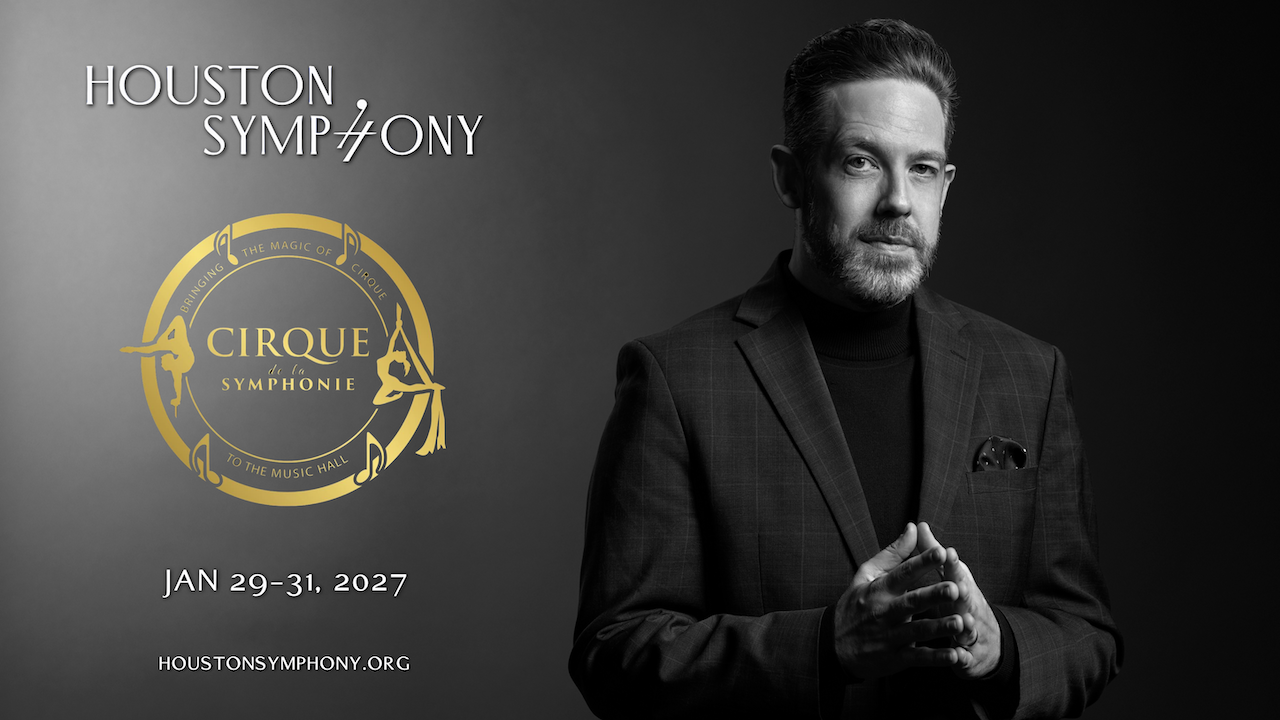
Brett Mitchell to Lead Five Performances with the Houston Symphony in January 2027
HOUSTON — The Houston Symphony has announced that Brett Mitchell will return in January 2027 to lead the orchestra in five performances with Cirque de la Symphonie at Jones Hall.
Mr. Mitchell and the orchestra will present three pops performances with the troupe:
Friday, January 29 at 7:30 p.m.
Saturday, January 30 at 7:30 p.m.
Sunday, January 31 at 2 p.m.
They will also present two family concerts:
Saturday, January 30 at 10 a.m.
Saturday, January 30 at 11:30 a.m.
Mr. Mitchell has been leading the Houston Symphony for almost 20 years since joining the orchestra as Assistant Conductor in the 2007-08 season. Since then, he has led more than 150 concerts with the ensemble, including upcoming performances of Nicholas Hooper’s score for Harry Potter and the Order of the Phoenix in June 2026.
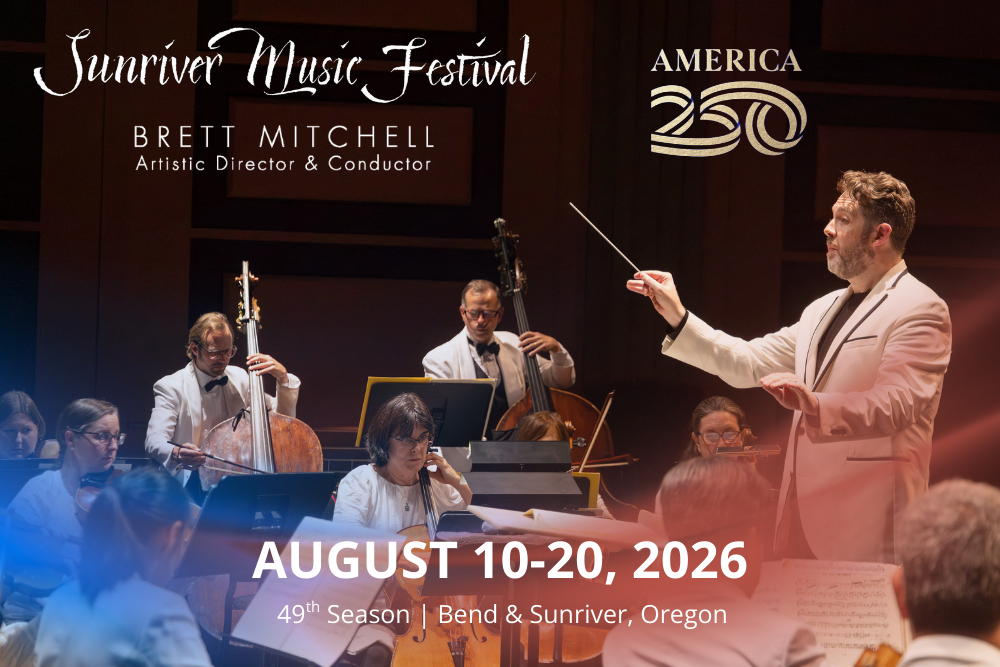
Sunriver Music Festival announces 2026 season, Brett Mitchell’s fifth as Artistic Director & Conductor
SUNRIVER, Ore. — The Sunriver Music Festival has announced details of its 2026 summer season, Brett Mitchell’s fifth as Artistic Director & Conductor:
As America celebrates 250 years in 2026, we honor one of its greatest gifts to the world: music. The 49th season programming, curated by Artistic Director & Conductor Brett Mitchell, will feature world-class orchestra musicians and acclaimed soloists performing eclectic works by American composers — Aaron Copland, Samuel Barber, William Grant Still, Joan Tower, Kevin Puts, Edgar Meyer and John Williams — alongside favorites by Beethoven, Bach, Mozart, Haydn, Schumann, and Mendelssohn and more.
The Summer Festival opens August 10 at Sunriver Resort’s historic Great Hall and closes August 20 at the iconic Tower Theatre in downtown Bend. Four classical concerts, a pops concert and a family concert will be presented. Featured artists include pianist Michelle Cann, violinists William Hagen and Tessa Lark, bass-baritone Timothy Jones, and the Central Oregon Mastersingers.
The classical season will consist of the following four programs:
Wed, Aug 12 | Sunriver Resort Great Hall - Sunriver, OR
AMERICA MEETS SCOTLAND
STILL - Darker America
BARBER - Violin Concerto
William Hagen, violin
MENDELSSOHN - Symphony No. 3, ‘Scottish’
Mon, Aug 10 | Sunriver Resort Great Hall - Sunriver, OR
BEETHOVEN, HAYDN, AND MADE IN AMERICA
JOAN TOWER - Made in America
BEETHOVEN - Piano Concerto No. 4
Michelle Cann, piano
HAYDN - Symphony No. 101, ‘Clock’
Thu, Aug 20 | Tower Theatre - Bend, OR
APPALACHIA AND SPRING
COPLAND - Suite from Appalachian Spring
EDGAR MEYER - Violin Concerto
Tessa Lark, violin
R. SCHUMANN - Symphony No. 1, ‘Spring’
Tue, Aug 18 | Tower Theatre - Bend, OR
THE GENIUS OF MUSIC
KEVIN PUTS - Einstein on Mercer Street
Timothy Jones, bass-baritone
J.S. BACH - Brandenburg Concerto No. 3
MOZART - Symphony No. 39
See our Upcoming Events page for complete repertoire, and visit sunrivermusic.org to learn more. Click here to read a preview in The Source.
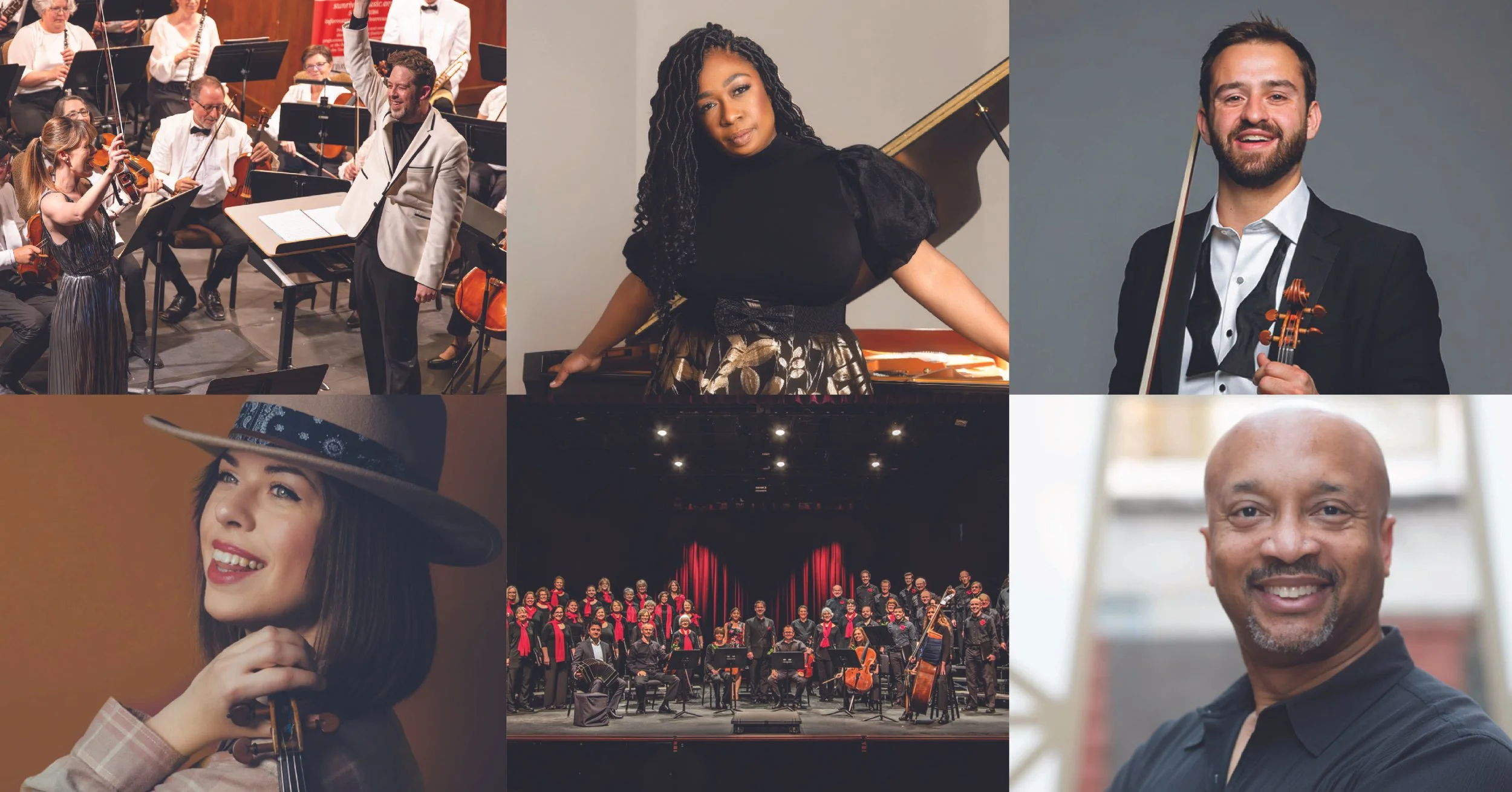
Artistic Director & Conductor Brett Mitchell will welcome pianist Michelle Cann, violinists William Hagen and Tessa Lark, bass-baritone Timothy Jones, and the Central Oregon Mastersingers as featured artists during the 2026 Sunriver Music Festival.

Feature: ‘Simply a Composer’s Advocate’
Photo by Roger Mastroianni
The American technical formal apparel company Coregami has announced Brett Mitchell as a brand ambassador, and journalist Owen Clarke has marked the new partnership with a 2,000-word feature article about the multifaceted conductor, composer, and pianist.
Simply a Composer’s Advocate
In a profession often defined by tradition and the worship of past masters, conductor and Coregami ambassador Brett Mitchell has a strict rule: never copy the giants.
“I would rather be a first-rate Brett Mitchell than a second-rate Leonard Bernstein,” he told me. “I want everything that I do, for better or worse, to come genuinely from me. That's the only way it'll be new.”
Born and raised in Seattle, Washington, Mitchell was the oldest of three boys. No one else in his family was a musician, and he wasn’t introduced to classical music until high school. As a kid, he was surrounded by the pop artists of his parents’ generation, like the Beatles, Simon and Garfunkel, Billy Joel, and Elton John. As he grew into his teens, in the early 1990s, his influences changed. “There was no way to escape grunge in Seattle at that time,” he joked. “If you go look at my 8th grade yearbook, our jazz band photo, we’re all in flannels and ripped jeans,” he said. “Nirvana, Pearl Jam, Soundgarden, those bands were huge for me back then.”
As he entered high school, however, he became more interested in classical music. In particular, he loved the soundtracks of popular films at the time, movies like Superman, Indiana Jones, E.T., and Star Wars—all scored by John Williams. “I wouldn’t have had a career if it weren’t for falling in love with John’s music,” Mitchell said.
Mitchell knew he loved music, but he wasn’t sure how he wanted to approach it. For a time he thought he might want to be a pianist, or perhaps a film composer. So he started writing bigger and bigger pieces, and his high school band director eventually said, “Why don’t you conduct this piece that you wrote?”
And in October of 1995, exactly thirty years ago, a 16-year-old Mitchell conducted his first piece of music. “Was I terrified? Yes, absolutely,” he said, laughing. “But it was that night in October ‘95 that I really decided, ‘Okay, I think this is the direction I want to go in life.’” After high school, he earned an undergraduate degree in music composition from Western Washington University, and then a master’s and doctorate in orchestral conducting from the University of Texas. By age 26, Mitchell was teaching at Northern Illinois University, and later that same year, he landed his first professional job as an assistant conductor for Orchestre National de France in Paris. From there, he was off to the races.
(Readers can read Mitchell’s full biography on his website. Currently, he is the music director of the Pasadena Symphony, and the artistic director and conductor for Oregon’s Sunriver Music Festival. Just two weeks ago, he was named piano company Steinway & Sons' newest Steinway Artist.)
But Mitchell wasn’t inclined to dwell on his lengthy (and admittedly prestigious) resume, reminiscing on where he’s conducted or directed. “I’ve been doing this for 30 years now,” he told me, early on in our interview. “And when you get to this point, every interview is the same interview.”
Instead, we focused on the philosophy and lifestyle that shape the man behind the baton.

Photo by Roger Mastroianni
Life Above 7,000 Feet
Mitchell has been married to his wife, Angela, for a little over ten years, and together they have two children, a 20-month-old girl, Rose, and a boy, Will, who turns four on Christmas Eve. His family has lived in the foothills outside Denver, Colorado since 2017, when he was named music director of the Colorado Symphony. “We love living here, because we love the outdoors,” he said.
The family’s home is at 7,300 feet, and backs up to the Bear Creek Highlands. “It's like 880 acres of open green space,” he said. “There are a dozen miles of trails right outside our back door, and it’s sunny 300 days a year, which is a big change, for me, from Seattle.” When the trails are clear, Mitchell and his family are hiking, but when it snows, they strap on snowshoes and hit the trails anyway. “Even in the winter, maybe you get a snowstorm and it dumps a foot of snow on you,” he said, “but the next day is almost invariably a bluebird day, crystal clear, bright blue sky, and we’re out there.”
Beyond the accessibility to pristine nature, there are other advantages, as a performer and conductor, to living in Colorado, Mitchell said. Chiefly, rehearsing at high elevation is a great way to build strong lungs. Mitchell recalled conducting his first concert in Colorado, in 2016. He noticed some oxygen tanks backstage at the concert hall. “I was like, ‘Oh, that’s funny,’” he remarked. “But then I was conducting, I think it was a Tchaikovsky symphony, one that ends big and loud and fast, with lots of energy, and at the end I was really, really winded.” The oxygen tanks weren’t just a gimmick. Players who come to Colorado, he said, will often come a day or two early to acclimate to the elevation.
“There is a reason we train our Olympic teams in Colorado,” he added. “Working out up here, when I go down to sea level, I feel like Superman.”
This passion for an active lifestyle is also what drew Mitchell to Coregami. “Conductors always look for the most comfortable thing possible to rehearse in, attire that breathes, that lets us move the way we want to move. Then we get to the concert hall and we have to put on, well, the most restrictive clothing imaginable!” He laughed. “Coregami figured out a way to rectify that problem.”

Brett Mitchell leads the Colorado Symphony at Boettcher Concert Hall. Photo by Brandon Marshall
More Than Waving a Stick
As a conductor, Mitchell sees his job as multi-faceted, with responsibilities that go far beyond the music. The books on the shelves in his studio, where he sat when we conducted our interview, reflect this. “There are at least as many books on sports psychology and coaching as there are on conducting,” he said. “I’m looking at Phil Jackson, Eleven Rings. Pat Summitt, Sum It Up. Robert Greene, The 48 Laws of Power. I'm looking at John Wooden, at David Brooks, at books about Kobe [Bryant].”
Why so many books about athletics? Mitchell is blunt. “Coaches of professional athletes have the most insight in terms of how to deal with what I deal with as a conductor, which is elite talent,” Mitchell said. “These people are the best in the world at what they do, and they know it. Your job is to make them better, which isn’t easy. So yes, my role is diplomat. It's politician. It's counselor. It's psychologist.”
In fact, Mitchell said his job is “as much about understanding people as it is about understanding music,” if not more, and that it’s not about taking charge and making unilateral decisions, but about organically building a consensus. “While I certainly bring my ideas to the podium, I am not the sole proprietor of good ideas,” he admitted. He added that to the layman, a conductor may seem like a shotcaller. That’s not how it is. “You probably think of this guy standing up there on a box, waving a stick in your face saying, ‘My way or the highway!’ Nothing could be further from the truth,” he said.
Mitchell likened his role to being an “arbiter of taste.” He has the final say, of course, but his voice should be the mouthpiece through which the orchestra speaks. “I try to be as open as I possibly can,” he said. “That give and take is what I love about conducting.”
When I asked Mitchell about some of the quotes or books that have inspired his philosophies on conducting, he was quick to name one by Austrian-born American composer Erich Leinsdorf: The Composer’s Advocate. “This book is great,” Mitchell admitted, “but honestly the title of the book was more revealing to me than anything inside it, because it cuts to the heart of what our job is as conductors. We're advocating on behalf of the composer.”
Mitchell is also fond of a line from the Pulitzer Prize-winning musical Sunday in the Park with George, by Stephen Sondheim, about the work of French painter Georges Seurat. “The line comes at the end of Act II, toward the very end of the show,” Mitchell explained. “Seurat’s in a creative rut, he doesn't know what to do. He doesn't know how to get to the next place. And his muse [Dot] tells him, ‘Anything you do, let it come from you. Then it will be new. Give us more to see.’”
Mitchell loves the quote so much he had it engraved on a piece of wood and mounted on the wall in his studio. This quote was the genesis for what he told me at the beginning of this piece, and it’s a personal mantra for Mitchell, a reminder that, whatever subconscious influences he may absorb as he goes about his life, he needs to be his own artist, for better or worse. As much as Williams, Bernstein, Sondheim, Tchaikovsky, or any other great composer from days gone by may have inspired him, he’s careful never to fall into the trap of emulating their work.
“I want to give audiences something new,” he said.

Brett Mitchell leads the New York Philharmonic at David Geffen Hall. Photo by Brandon Patoc
We’re Here to Show the World What Can Be
Much of Mitchell’s work today involves mentoring young people. He served as music director for the Cleveland Orchestra Youth Orchestra for four years, and has taught at a number of programs for budding musicians. But in an era of generative artificial intelligence—when youth are encouraged to use generative AI for everything from writing essays to creating imagery—he admits that there’s a lot of pressure for youth to mimic. Convincing kids to “let everything you do come from you” isn’t always easy.
Mitchell says that if he had anything to say to the young artists of today, growing up in an era of AI, it’s to not get discouraged. “AI will never be able to stumble upon happy accidents the way humans do,” he said. “AI is trained on the past. It’s trained to take the past, and distill into what it thinks is best for the present. But the most interesting, beautiful things are often those that arrive by accident.” Mitchell often plays jazz in his free time, and remarked on the popular joke that “there are no wrong notes in jazz,” because, “if you hit a note that you didn't mean to hit, all you have to do is take that little mistake and then do it again. Do it again and make it a feature, not a bug. This is something only a human brain can do.”
Another piece of advice Mitchell has for budding orchestral players is to remember that synchronization isn’t the goal. “In orchestras, there’s an emphasis placed on playing together,” he said. “If there's a chord on the downbeat, we all play that chord on the downbeat together. But we have to remember, the end goal is not to play with each other. The end goal is to play for each other.”
He gave an example. “If it's the oboe solo, that may mean the violins need to tone it down, and play more transparently. It’s not just about being in the same place at the same time. It's understanding when it's your turn and when it's somebody else's turn. You have to ask yourself, ‘Am I doing everything that I can to support my colleague?’”
This, Mitchell said, is part of what makes playing, conducting, and listening to orchestral music so special. It’s a collaborative effort, it’s many individuals coming together to craft something beautiful. “Anything that you’re gonna accomplish in your life, if it is worthwhile, you will accomplish it with other people,” Mitchell said.
This is, in part, why he isn’t worried about the future of the arts. Developments in technology like artificial intelligence will take some jobs. That’s only natural. “When’s the last time you saw an elevator operator?” Mitchell joked. But he doesn’t see it ever having a fatal impact on the arts, simply because by nature, AI is retrospective.
“We can't write symphonies with robots. We can't paint pictures with robots,” he said. “Or we can, but the symphonies AI writes, the paintings AI creates, these are just a conglomeration of everything that already has been, they aren’t a lens into things that could be.”
He paused. “We have to remember, that's what artists are here for. We’re here to show the world what could be.”

Brett Mitchell leads The Cleveland Orchestra at Blossom Music Center. Photo by Roger Mastroianni

Sunriver Music Festival announces 2025 season, Brett Mitchell’s fourth as Artistic Director & Conductor
SUNRIVER, Ore. — The Sunriver Music Festival has announced details of its 2025 summer season, Brett Mitchell’s fourth as Artistic Director & Conductor and the organization’s 48th:
The Summer Festival opens August 2 at the iconic Tower Theatre in downtown Bend and closes August 13 at Sunriver Resort’s historic Great Hall. Four classical concerts, one pops concert, a brilliant solo piano recital and a Family Concert will be presented. Featured artists include pianist Stewart Goodyear, cellist Mark Kosower, and Festival concertmaster Yi Zhao.
The classical season will consist of the following four programs:
THE CLASSICAL TRADITION
WILLIAM BOLCOM - Commedia for (Almost) 18th-Century Orchestra
TCHAIKOVSKY - Variations on a Rococo Theme
Mark Kosower, cello
MOZART - Overture to The Marriage of Figaro
STRAVINSKY - Danses Concertantes
A FRENCH SOIRÉE
DUKAS - Fanfare from La Péri
RAVEL - Piano Concerto in G Major
Stewart Goodyear, piano
FAURÉ - Suite from Pelléas et Mélisande
BIZET - Selections from Carmen
VIENNA WAITS FOR YOU
HAYDN - Symphony No. 96, ‘Miracle’
MOZART - Piano Concerto TBD
2025 Van Cliburn International Piano Competition medalist
BEETHOVEN - Symphony No. 5
THE LEIPZIG CONNECTION
SCHUMANN - Manfred Overture
MENDELSSOHN - Violin Concerto
Yi Zhao, violin
BACH (arr. Styles) - Toccata and Fugue in D minor
BACH - Orchestral Suite No. 3 in D Major
For complete repertoire, see our Upcoming Events page, and visit sunrivermusic.org to learn more.


Feature: ‘Brett Mitchell Is Listening’
PASADENA — Local News Pasadena has published a feature about Brett Mitchell following his appointment as Music Director of the Pasadena Symphony. Mr. Mitchell spoke extensively with veteran journalist Victoria Thomas for this piece, excerpted here in part:
Smells like teen spirit
[Mitchell] describes his new role [as Music Director of the Pasadena Symphony] this way: “My job is to serve the music, the musicians, and the community.”
A Seattle native who grew up down the street from Kurt Cobain and now a resident of Denver, Colorado, Mitchell grew up loving grunge as well as John Williams’ iconic “Star Wars” and “Superman” scores. He cites Barry Manilow as a musical guilty pleasure “…because Manilow is a consummate entertainer and showman. He genuinely connects with everyone in the audience. It’s real, and the people know it’s real, and my passion is to do the same with classical music as well as other genres,” Desi Arnaz-Copacabana ruffles optional. He recounts an evening in 2018 in Denver’s spectacular open-air Red Rocks amphitheater where he shared the stage with Yo-Yo Ma, saying, “He held those 9,000 people rapt. They were as attentive and silent 90 minutes into the program as they were 90 seconds in. Don’t ever underestimate the power of music.”
“The great thing about the Pasadena Symphony is that we’re working with the world’s A-grade, first-call studio musicians who can play everything and anything. They’re professional chameleons, so a specific focus of mine is to showcase the breadth of the team,” says Mitchell.
“This is one of the key differences between pop and classical performance. Pop music is the domain of an individual persona. Billy Joel always sounds like Billy Joel and people love the brand. But classical players need to be at ease in many different costumes. Debussy should not sound like Beethoven.”
On the subject of ego, he makes the distinction between hubris and authority. “Yes, it absolutely takes confidence to take the podium and lead. Without ego, we’d never get off the couch, much less get from the couch to the podium. But if a person’s surety arises from some innate sense of superiority or entitlement or ‘deserving to be here,’ there will be problems. In my case, I feel confident because I know I’ve done the work and that I continue to do it with passion and fervor. I am always gobbling up information, and I learn as much or maybe even more than I teach. Doing the work in this sense begins with respect for the audience, as well as the virtuosity of the musicians, and consists essentially of listening – active listening – seeing how the artists and the audience respond to certain things.”

So Wolfie, Ludvig Van and Antonio V. walk into a bar…
As he moves into position to lead the 2024-2025 season, Mitchell recounts receiving invaluable advice from none other than Ara Guzelimian, current Artistic Director of the Ojai Music Festival and former Dean and Provost of The Julliard School, who previously served as Artistic Advisor and Senior Director for Carnegie Hall.
“On the subject of programming and how to build a compelling program that will bring the folks to the hall, Ara told me to picture three pieces of music as entities sidling up to a bar. Would the three have anything to say to each other? If the pieces are too similar, there isn’t much excitement, although you’d have something very harmonious. If the pieces are radically different, that can be interesting, but it might be difficult to find common ground.” For the approaching season, Mitchell promises a “varied diet” of music, pulling from a broad spectrum and a broadening palette.
In addition to overseeing all artistic aspects of the Pasadena Symphony, Mitchell will collaborate on the orchestra’s highly regarded community and education programs, including the Pasadena Youth Symphony Orchestras, which encompass eleven award-winning ensembles serving students of all musical abilities in grades 5-12.
On the subject of relating to kids, he says, “I grew up listening to the pop music of my parents’ generation, then I listened to Nirvana and Pearl Jam, and then I listened to Beethoven. That’s when I began to understand what music actually is. It’s all emotion. In listening to Beethoven, I felt that the artist was someone having a hard time with something. As an artist, he was able to articulate it without words, and hearing that makes the rest of us feel less alone.”

Brett Mitchell will lead the majority of his concerts as Music Director of the Pasadena Symphony at the orchestra’s home of the Ambassador Auditorium, often referred to as the “Carnegie Hall of the West.”
Orchestrating a Graceful Future
Andrew Brown accepted the role of Chief Executive Officer of the Pasadena Symphony and POPS. He manages the Pasadena Symphony, the Pasadena POPS, under the direction of Principal Pops Conductor Michael Feinstein, and the Pasadena Youth Symphony Orchestras (PYSO), serving over 800 students in the San Gabriel Valley.
We spoke with Brown this week, who commented, “After a few years without a music director, we are honored and delighted to welcome Brett as our partner in building out our ensemble. His resume is superb, but beyond that, he’s both creative and pragmatic, and he brings planning, leadership, and organizational intelligence to the role in addition to his impeccable musical credentials.”
Brown says that Mitchell’s arrival brings with it a new sense of opportunity, as well as challenge. “We’ve relied for so long on the subscription model, but all of that was disrupted by the pandemic. There’s no denying the fact that thanks to digital technology, we can all enjoy incredible music while sitting at home in our pajamas, and of course, people got comfortable doing that for a few years of COVID-19. But now we’re inviting people to come back out into the world for an immersive musical experience, even if it’s only a couple of times a year. In the presence of live performance before a live audience, there’s a momentum, those goosebumps that you really can’t replicate any other way.”
To read the complete feature, ‘Brett Mitchell Is Listening,’ please click here.

Sunriver Music Festival announces 2024 season, ‘Classical Elements,’ Brett Mitchell’s third as Artistic Director & Conductor
“One of my favorite things about Central Oregon is the power of nature that we’re able to witness all year round, so I’m particularly thrilled to share with you an entire season filled with pieces inspired by the four classical elements: earth, water, fire, and air. Composers for centuries have been inspired by the enormity and grandeur of nature, and I know you’ll be just as inspired when you hear their extraordinary music.” Brett Mitchell, Artistic Director & Conductor
SUNRIVER, Ore. — The Sunriver Music Festival has announced its 2024 summer season, ‘Classical Elements,’ which marks Brett Mitchell’s third as the organization’s Artistic Director & Conductor.
The Festival’s 47th season opens Sunday, August 11 at the iconic Tower Theatre in downtown Bend, and closes Friday, August 23 at Sunriver Resort’s historic Great Hall. Four classical concerts, one pops concert, a solo violin recital, and a family-friendly ‘Discover the Symphony’ concert will be presented.
The classical season will consist of the following four programs, all under the direction of Artistic Director & Conductor Brett Mitchell:
OPENING NIGHT CLASSICAL CONCERT: EARTH
Sunday, August 11 - 7:30 p.m.
Tower Theatre - Bend, OR
IVES (arr. Schuman) - Variations on ‘America’
GERSHWIN - Rhapsody in Blue
Orion Weiss, piano
BEETHOVEN - Symphony No. 6, ‘Pastoral’


CLASSICAL CONCERT II: WATER
Sunday, August 18 - 3 p.m.
Tower Theatre - Bend, OR
J. STRAUSS II - The Blue Danube
DEBUSSY (orch. Büsser) - The Sunken Cathedral
HANDEL (arr. Harty) - Water Music Suite
SCHUMANN - Symphony No. 3, ‘Rhenish’


CLASSICAL CONCERT III: FIRE
Wednesday, August 21 - 7:30 p.m.
Sunriver Resort Great Hall - Sunriver, OR
BEETHOVEN - Overture from The Creatures of Prometheus
HAYDN - Symphony No. 59, ‘Fire’
FALLA - Nights in the Gardens of Spain
Joyce Yang, piano
FALLA - ‘Ritual Fire Dance’ from El amor brujo

SEASON FINALE CLASSICAL CONCERT: AIR
Friday, August 23 - 7:30 p.m.
Sunriver Resort Great Hall - Sunriver, OR
AARON JAY KERNIS - Musica Celestis
MICHAEL TORKE - Sky
Tessa Lark, violin
MOZART - Symphony No. 41, ‘Jupiter’


Repertoire for the complete season is available on our Upcoming Events page.
For more information or to purchase tickets, please visit sunrivermusic.org.
READ MORE:
The Bend Bulletin: ‘Sunriver Music Festival announces 2024 Summer Concert Series’


Sunriver Music Festival announces 2023 season, Brett Mitchell's second as Artistic Director & Conductor
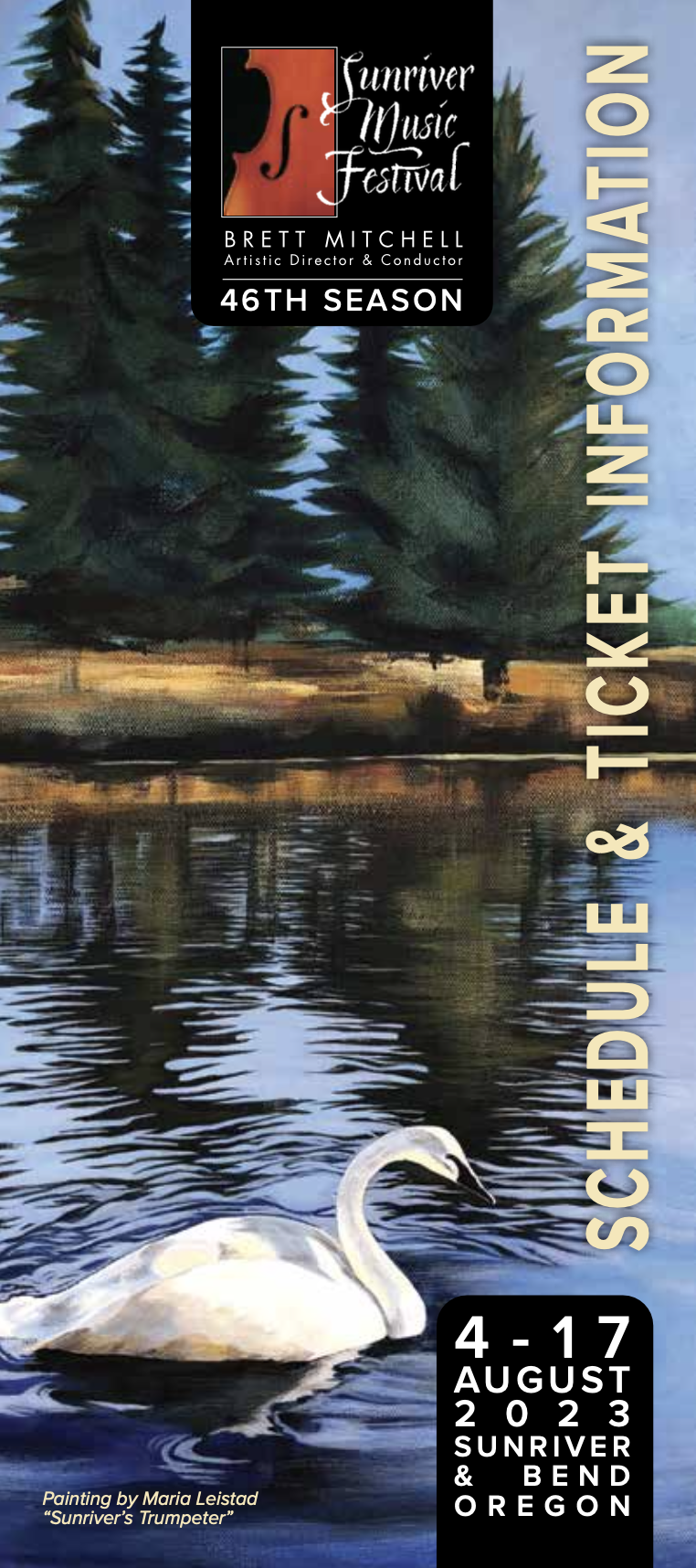
SUNRIVER, Ore. — The Sunriver Music Festival has announced its 2023 summer season, which marks Brett Mitchell’s second as the organization’s Artistic Director & Conductor.
Running from August 4 through 17, the Festival’s 46th season will feature four classical concerts, a pops concert, and a family concert, all under the baton of Mr. Mitchell, as well as a solo piano recital.
The classical season will consist of the following four programs:
CLASSICAL CONCERT I - August 5, 2023
MOZART - Regina coeli | Ave verum corpus
feat. Central Oregon Mastersingers
MOZART - Symphony No. 38, “Prague”
STRAUSS - Suite from Le Bourgeois Gentilhomme
CLASSICAL CONCERT II - August 11, 2023
MILHAUD - La création du monde
BRUCH - Violin Concerto No. 1
William Hagen, violin
BRAHMS - Symphony No. 3
CLASSICAL CONCERT III - August 14, 2023
COPLAND - Three Latin American Sketches
BARBER - Knoxville: Summer of 1915
Kathryn Mueller, soprano
MAHLER (arr. Lee) - Symphony No. 4
Kathryn Mueller, soprano
CLASSICAL CONCERT IV - August 17, 2023
LIGETI - Concert Românesc
HAYDN - Symphony No. 104, “London”
BEETHOVEN - Piano Concerto No. 5, “Emperor”
Andrew von Oeyen, piano
Repertoire for the complete season is available on our Upcoming Events page.
For more information or to purchase tickets, please visit sunrivermusic.org.
Brett Mitchell named Interim Director of Orchestras at University of Denver
Brett Mitchell will serve as Interim Director of Orchestras and Professor of Conducting at the University of Denver’s Lamont School of Music during the 2022-23 academic year.
DENVER — The University of Denver has announced that Brett Mitchell will return to the Lamont School of Music during the 2022-23 academic year as Interim Director of Orchestras and Professor of Conducting while its Director of Orchestras—Lawrence Golan—is on sabbatical. From the official press release:
Brett Mitchell will return to conduct the Lamont Symphony Orchestra on Wednesday, November 16 at 7:30 p.m. in Gates Concert Hall. This will be his second engagement with the group, having previously led the LSO in Fall 2019.
On the first half of the program is the Violin Concerto in A minor, Op. 82, by Alexander Glazunov. Lamont faculty member Igor Pikayzen is the soloist. After intermission, Mitchell conducts Dvořák's Symphony No. 6.
"I couldn't be more thrilled to be returning to work with the talented students at the Lamont School of Music," said Mitchell. "After our first collaboration together in October 2019, I was eager for the opportunity to make music again with these promising young musicians, and I'm particularly thrilled to be leading works by two Romantic masters—Antonín Dvořák and Alexander Glazunov—with the Lamont Symphony Orchestra this Fall."
In addition to his appearance with the Lamont Symphony Orchestra in November, Mr. Mitchell will also teach additional courses to select advanced conducting students in Fall 2022 and Spring 2023.

Sunriver Music Festival announces 2022 season, Brett Mitchell's first as Artistic Director & Conductor
Brett Mitchell introduces the Sunriver Music Festival’s 2022 summer season, his first as the organization’s Artistic Director & Conductor.
SUNRIVER, Ore. — The Sunriver Music Festival has announced its 2022 summer season, which marks Brett Mitchell’s first as the organization’s Artistic Director & Conductor.
Running from August 8 through 21, the Festival’s 45th season will feature four classical concerts, a pops concert, and a family concert, all under the baton of Mr. Mitchell, as well as a solo piano recital and a movie night.
The classical season will consist of the following four programs:

CLASSICAL CONCERT I - August 10, 2022
DAVIES - Ojai Festival Overture
GINASTERA - Variaciones concertantes
BEETHOVEN - Symphony No. 3, “Eroica”
CLASSICAL CONCERT II - August 15, 2022
WALKER - Lyric for Strings
MOZART - Piano Concerto TBD
Featuring 2022 Van Cliburn Competition medalist
SCHUBERT - Symphony No. 5
CLASSICAL CONCERT III - August 18, 2022
JESSIE MONTGOMERY - Banner
HAYDN - Symphony No. 94, “Surprise”
BRAHMS - Violin Concerto
William Hagen, violin
CLASSICAL CONCERT IV - August 21, 2022
DIAMOND - Music for Shakespeare’s Romeo and Juliet
FINZI - Let Us Garlands Bring
Timothy Jones, bass-baritone
MENDELSSOHN - Symphony No. 4, “Italian”
Repertoire for the complete season is available on our Upcoming Events page.
KTVZ News Channel 21 has also published an article previewing the season.
For more information or to purchase tickets, please visit sunrivermusic.org.

Brett Mitchell conducts ‘Return of the Jedi’ with the Houston Symphony
Published January 30, 2022 Updated March 4, 2022
HOUSTON — The Houston Symphony has announced that Brett Mitchell will return to lead four performances of John Williams’s Oscar-nominated score for Star Wars: Episode VI - Return of the Jedi at Jones Hall in March 2022. The complete schedule is as follows:
Friday, March 4 at 8 p.m.
Saturday, March 5 at 2:30 p.m. & 8 p.m.
Sunday, March 6 at 2:30 p.m.
Mr. Mitchell has led over 100 performances with the Houston Symphony, principally in his former role as Assistant Conductor from 2007 to 2011.
For more information about these performances and to purchase tickets, please click here.
Read several preview articles by clicking on the following links:
The Katy News: “Houston Symphony Screens Star Wars: Return Of The Jedi With Orchestra Performing John Williams’ Iconic Score Live”
Culture Map: “Houston Symphony blasts off with special Return of the Jedi screening and performance”
Houston Chronicle: “Houston Symphony goes out of this world” (subscription required)
To watch Mr. Mitchell’s in-depth exploration of the music of Return of the Jedi, watch the video below, or click here to view it on YouTube.

Brett Mitchell named Artistic Director and Conductor of Sunriver Music Festival
Brett Mitchell has been named Artistic Director and Conductor of Oregon’s Sunriver Music Festival, beginning a three-year term in August 2022. (Photo by Jeff Nelson)
SUNRIVER, Ore. — The Sunriver Music Festival has announced that Brett Mitchell will serve as its next Artistic Director and Conductor, beginning a three-year term in August 2022.
In this role, Mr. Mitchell will lead the Festival Orchestra each summer in four classical concerts, a family program, and a pops concert.
The Festival was founded in 1978, and Mr. Mitchell is the fourth Artistic Director and Conductor in the organization’s 44-year history.
From the official press release:
“We don’t name orchestras after conductors. We name them after communities,“ explains Maestro Mitchell. “That’s because festivals reflect their communities. I am thrilled that I will be able to make a contribution to this festival that has been a part of the Central Oregon community for 44 years.”
Mitchell has accepted a 3-year contract with Sunriver Music Festival which includes a commitment for quarterly visits to the region for ongoing connection with the community and the Festival’s thriving music education programs.
Mr. Mitchell previously led the Orchestra in two programs on August 21 and 23 during the Festival’s 2021 season:
COPLAND - Music for Movies
MOZART - Piano Concerto No. 20 in D Minor
Daniel Hsu, piano
STRAVINSKY - Suite from Pulcinella
JESSIE MONTGOMERY - Starburst
SAINT-SAËNS - Cello Concerto No. 1 in A Minor
Amit Peled, cello
BEETHOVEN - Symphony No. 7 in A Major
On August 18, Mr. Mitchell also played an evening of John Williams’s chamber music from the piano with musicians from the Festival, including music from Fiddler on the Roof, The Terminal, Memoirs of a Geisha, Lincoln, and Schindler’s List.
The official press release points to the importance of the feedback about these performances from the Festival’s musicians and audiences when selecting Mr. Mitchell as their next Artistic Director:
The Festival’s Board of Trustees received hundreds of helpful evaluations submitted by patrons and musicians. Here's just a sampling:
"Brett Mitchell is a high-level conductor with very good conducting technique, rehearsal technique, big personality, very good. Keeping interest and energy levels high are Maestro Mitchell's strongest qualities as a conductor, and he has many more."
"Brett Mitchell is an effective musical leader. His conducting was very clear and did not get in the way of our ability to concentrate. Players were led by someone who understands what conducting is about and who therefore makes our task easier. He is extremely musical, gives excellent cues, is great with the audience and has a very polished approach."
For more information on Mr. Mitchell’s appointment, please view the press release on the Sunriver Music Festival’s website.
KTVZ News Channel 21 (NBC’s affiliate in Bend) has published a piece about Mr. Mitchell’s appointment: “Patrons, musicians help select Mitchell as new maestro for Sunriver Music Festival.”
Dates for Mr. Mitchell’s inaugural season as Artistic Director and Conductor in August 2022 will be announced in Fall 2021.
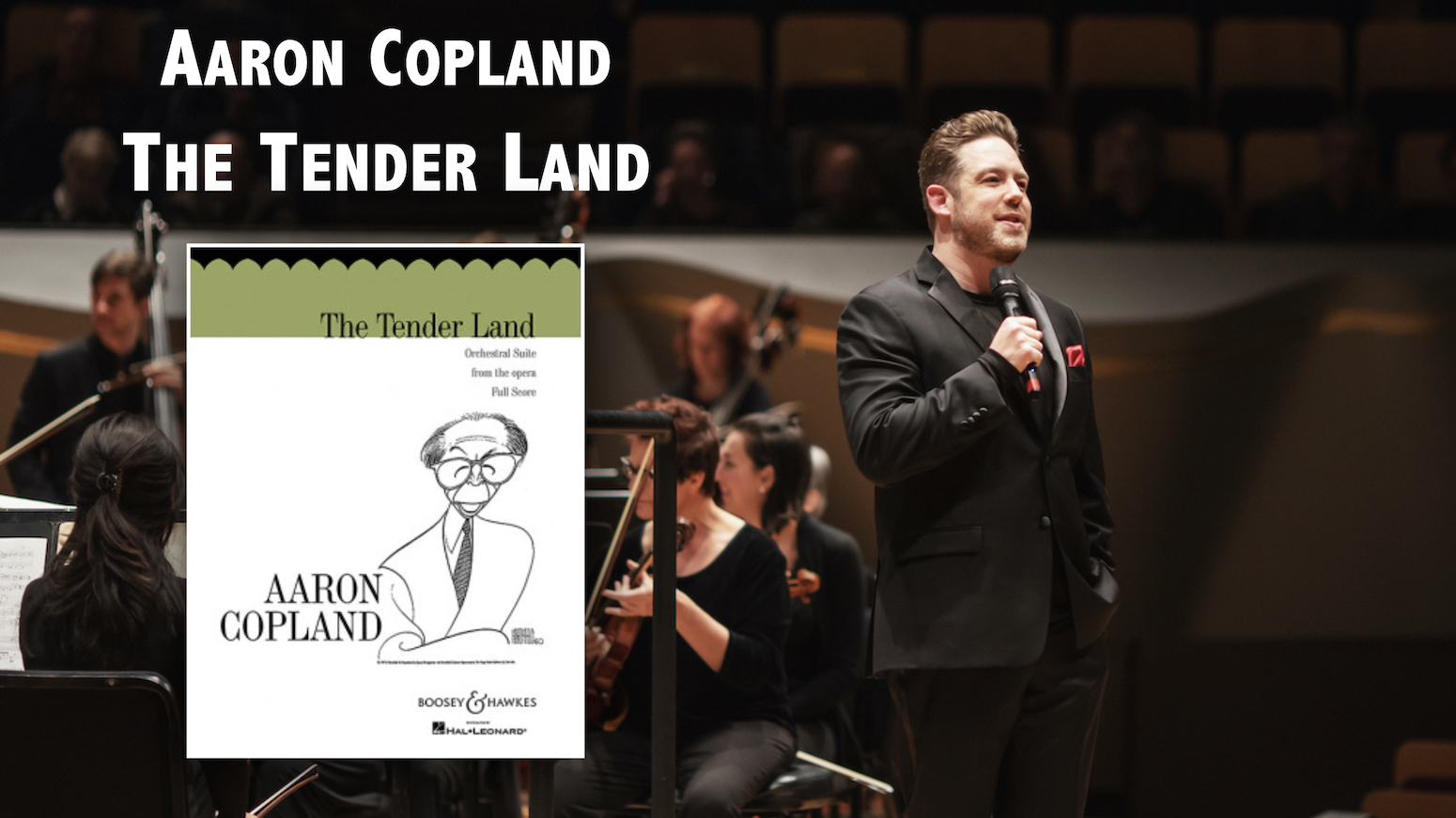
Video: Brett Mitchell explores Copland’s ‘The Tender Land’
DENVER — Brett Mitchell has released a new video exploring Aaron Copland’s Suite from The Tender Land.
Presented live at Boettcher Concert Hall in April 2018 as part of a program entitled The American Voice, Mr. Mitchell leads the Colorado Symphony in demonstrations exploring what makes the 1954 opera sound so distinctly American.
All three movements of the Suite are explored:
I. Introduction and Love Music
II. Party Scene
III. Finale: The Promise of Living
Watch the complete demonstration above, or learn more on YouTube, Facebook, and Twitter.

Brett Mitchell marks milestone anniversary of conducting debut with multimedia release
Brett Mitchell with the combined bands at Lynnwood High School after his conducting debut on October 12, 1995.
LYNNWOOD, Wash. - Brett Mitchell made his conducting debut 25 years ago today on October 12, 1995.
As a 16-year-old junior at Lynnwood High School in a northern suburb of Seattle, Mr. Mitchell created and then conducted the premiere performance of an arrangement of Bruce Healey’s music from Fantasmic!, a nighttime show at Disneyland and Walt Disney World that premiered in 1992.
Watch Lesley Moffat, Director of Bands and Orchestra at Lynnwood High School from 1992 to 2002, introduce Mr. Mitchell’s debut:
The Performance
For the first time ever, to commemorate this anniversary, Mr. Mitchell is releasing complete footage of his debut:
Capturing the Moment
Mitchell’s writer’s notebook from 1995-96
The journal entry describing Mitchell’s conducting debut
Mr. Mitchell captured the experience of his debut several days later in his writer’s notebook:
As all three bands set up together, I waited backstage. After a while, I had to go sit down on the stairs because my knees were shaking so badly! Then Mrs. Moffat introduced me: “Never in 8 years of teaching have I asked a student to conduct, but because your students have done their jobs and Brett is so capable, I’m very proud to turn the baton over to our own arranger, Brett Mitchell.”
When I walked onstage, everybody—even the band—was clapping. WOW! Then I went over to the left side of the podium, just like we rehearsed, and stood there until everybody (the band) was watching. Then I stepped up onto the podium, lifted my arms, and gave the pickup. Everything after that (not to give a cliché) was a blur… I gave the last note and held my arms up. As soon as my arms went down, the whole audience started applauding. I motioned for the band to stand up, and when I turned around to bow, the whole audience was standing!! A standing ovation! Man. Mrs. Moffat was crying and came to give me a hug… I won’t ever forget that.
Interview with Lesley Moffat (2020)
Nearly 30 years after becoming her student in 7th grade band, Mr. Mitchell recently sat down for a Zoom conversation with Mrs. Moffat, who was his band director at both Alderwood Middle School (1991-92) and Lynnwood High School (1993-97). In the conversation below, they discuss Mr. Mitchell’s 1995 conducting debut, Mrs. Moffat’s three-plus decades as an educator, and what music education looks like in times of COVID.
Brett Mitchell interviews Lesley Moffat, his middle and high school band director in the 1990s.
Meeting Bruce Healey
Bruce Healey and Brett Mitchell in Hollywood, CA (Sep 2019)
Nearly 25 years after arranging Fantasmic!, Mr. Mitchell met composer Bruce Healey—now retired from Disney—while in Southern California for his debut with the Los Angeles Philharmonic at the Hollywood Bowl in September 2019.
A manuscript folio of Fantasmic! autographed by composer Bruce Healey

Video: Brett Mitchell explores Mahler 9 with the Colorado Symphony
Brett Mitchell and a virtual ensemble of Colorado Symphony musicians explore Mahler's Ninth Symphony.
DENVER — The Colorado Symphony and Music Director Brett Mitchell have released a new video exploring Gustav Mahler’s Ninth Symphony.
Mr. Mitchell and the orchestra were to have performed the work in May 2020, but those performances were canceled due to the COVID-19 outbreak.
Instead, Mr. Mitchell explores the work from the piano at home, and is joined virtually by members of the Colorado Symphony for demonstrations of three orchestral excerpts from Mahler’s final masterpiece.
Mr. Mitchell is also joined by his wife, soprano Angela Mitchell, for demonstrations from Mahler’s Kindertotenlieder and the hymn Abide With Me.
The video originally premiered on Wednesday, September 9 on both YouTube and Facebook, and may now be viewed on both platforms on demand.

Gustav Mahler (1909)

Audio: Brett Mitchell on Billy Joel and Beethoven
Beethoven’s Pathétique Sonata forms the chorus of Billy Joel’s “This Night”. (Graphic: Classic FM)
DENVER — Brett Mitchell has shared a reminiscence about Billy Joel and Beethoven with Colorado Public Radio as part of CPR Classical’s Beethoven 250 series:
When Brett Mitchell, Music Director of the Colorado Symphony, was a teenager, he watched the 1990s Beethoven biopic “Immortal Beloved” in the living room of his home in Seattle.
“And I asked my mother, ‘Why are they playing a Billy Joel song in the middle of a Beethoven movie?’” Mitchell recalls.
He was a Billy Joel fan as a teenager. He still is, he says.
That Beethoven “tune” in the movie was the Pathétique Sonata. To Mitchell, it sounded just like Joel’s song “This Night”. In fact, Joel credits “L.v. Beethoven” as co-writer of the song on his 1983 album An Innocent Man.
Read Why Beethoven Is Credited In This Billy Joel Song From ‘An Innocent Man’ at CPR Classical, and hear Mr. Mitchell’s full reminiscence below:

World premiere video: Brett Mitchell and the Colorado Symphony explore Wagner’s ‘Ring’
Brett Mitchell introduces the Colorado Symphony’s latest Virtual Music Hour: ‘The Ring without Words.’
DENVER — From May 22 to 24, as part of its ongoing Virtual Music Hour series, the Colorado Symphony will present never-before-seen video of its April 2018 performances of The Ring without Words, a selection of orchestral highlights from Richard Wagner’s Ring cycle as arranged by Lorin Maazel. Music Director Brett Mitchell explains how the project came to Denver:
“In my late twenties, I was very fortunate to be mentored by the great conductor Lorin Maazel. One of the many pieces we delved into during our time together was his arrangement of orchestral highlights from Richard Wagner’s Ring cycle, which Maazel affectionately titled The Ring without Words. When I accepted my position at the Colorado Symphony, I knew right away that I wanted to bring this incredible masterpiece to our audience, not just because of the greatness of Wagner’s music, but also because of my personal relationship with Maazel. When I reached out to Maestro’s widow to let her know we’d be doing this piece, I was stunned and incredibly moved when, a few weeks later, I received from her one of Maestro’s last batons with which to conduct the weekend’s performances. For so many reasons, it remains one of the most meaningful programs I’ve ever led, and one I’ll certainly carry with me for the rest of my life.”
Before presenting a complete performance of the piece, Mr. Mitchell and the orchestra shared with the audience various leitmotifs, compositional techniques, and plot points from Wagner's score:

Audio: A Little Help From My Friends: The Colorado Symphony Can Thank The Beatles For Its Conductor
Brett Mitchell at the piano in the CPR Classical Performance Studio.
DENVER — Colorado Public Radio Classical has produced an audio story featuring Brett Mitchell discussing some of his earliest experiences with classical music, exploring works by the Beatles, Antonio Vivaldi, Bernard Herrmann, Samuel Barber, and Felix Mendelssohn:
Do you remember the first time you heard classical music? Brett Mitchell, Music Director of the Colorado Symphony, thinks for him, it may have been the Beatles! Yes, the Beatles.
Classical music is an important part of movies, television, and concealed in the DNA of some of the modern popular music we know and love.
“There are all sorts of ways to get yourself into the world of classical music and it doesn’t necessarily have to be that you’re listening to Mozart from the time you’re in the womb,” said Mitchell. “I came to classical music quite late but what I didn’t know was that even in listening to this great pop music from the 60’s, I was getting a great dose of classical music.”
Listen as Brett Mitchell explains why the Beatles’ “Eleanor Rigby” has hints of Vivaldi. Paul McCartney’s then girlfriend can take some credit for that. Mitchell also teases out the classical influence on Bernard Herrmann’s score to Alfred Hitchcock’s “Psycho” and more.
To listen to the complete story, please click here.

Feature: 'Brett Mitchell on Sharing His Passion for New Music with Broad Audiences'
Photo by Jeff Nelson
Brett Mitchell is the featured guest in the latest issue of The Muse in Music, an online interview series about new music hosted by composer Daniel Perttu. Over the course of the interview, Mr. Mitchell discussed his passion for working with living composers, how he brings contemporary music to the Denver audience as Music Director of the Colorado Symphony, and how he serves as an advocate for new music.
On his passion for working with living composers:
I became a conductor of contemporary music because I was a composer before I was a conductor. Actually, my undergraduate degree is in composition, and I started conducting out of necessity because I was writing pieces for larger forces…. It was really my fellow student composers who said, “I've written a bigger piece; now maybe I'll have Brett conduct it,” so I really started by conducting contemporary music, brand-new, fresh world premieres. This was what I did at the beginning of my conducting career, and it wasn't really until I was twenty when I first conducted something that hadn't literally just come out of the printer. I guess I conducted other small things in high school, but it was the Mozart Oboe Concerto that was the first big piece that I ever conducted that wasn't by a living composer. I say all of that to point out that for me, the baseline where I started was conducting contemporary music. It didn't really have anything to do at that point with delving into the past and interpreting the works of these great masters. That certainly came in time, but that's not how I got started in my career….
The joy of bringing music to life for me is to do the composer's music justice. I am really there first and foremost, in my opinion, to serve one person, and that's the composer, and then certainly the orchestra, and then I serve the audience. But, it's really all about the composer because if the composer hadn’t written any of these notes, none of us would have anything to do with our lives. So that's really why I love it as much as I do, and, ultimately, why I do it.
On how he brings contemporary music to the Denver audience:
For me, presenting new music is all about the context in which one presents it. I mean context is key. So, I'll give you a perfect example of my very first subscription concerts, where I saw this back in September 2017. I knew that I wanted to do Beethoven Five on that program because that was the first full symphony that I ever conducted. And then I thought, how do I work some contemporary American music into this program, so that from the very outset I am setting this audience up to know when they come visit us in the concert hall what they're going to get. Yes, of course they will hear the greatest classical masterpieces, but they will also hear music that's being written by our friends and our neighbors, our compatriots, because I think that while those great classic pieces from centuries ago stick around for obvious reasons, and they have, in many ways, universal things to say, composers writing today are writing specifically for today’s audience. In that first contact point that I had with our subscription audience, I wanted to set that expectation up. So, I looked at Beethoven Five, and I thought, what are the two things that make Beethoven Five tick? And one of them, for me, is the journey from darkness into light, starting with the C minor and ending with that glorious celebratory C major. So I thought, what would be a kind of contemporary American corollary to that idea of trial. I'm very good friends with Kevin Puts, and have been, for -- God, it's almost twenty years now, which is terrifying. Kevin has a wonderful piece called Millennium Canons that I've done quite frequently. We opened our concert with this great celebratory fanfare, which is a perfect way to open a concert, and a perfect way, as far as I'm concerned, to start a music directorship. It also shows the audience, because of the kind of language that Kevin uses as he writes, that just because you may not know a name or two of these living composers, I promise, I'm never going to throw anything your way that's going to make you wish that you had stayed home with a glass of wine tonight.
So that was item one. Item two in the Beethoven that makes it tick is that kind of insistent rhythmic drive. Of course, that applies mostly to the first movement, but I was thinking of what contemporary American case might be a good corollary to that. The first thing I think of when I think of contemporary American music even more than John Adams is Mason Bates, because of the amount of electronica that he includes in his pieces. We did a piece that he wrote called The B-Sides for Orchestra and Electronica. We had Mason come out and play the electronica part. So, the audience had some interaction with him, and I came out and I played Millennium Canons with the orchestra and Kevin’s piece. I welcomed the audience and introduced Mason; Mason came out; and we chatted for two or three minutes on stage before we played the piece. So again, as I say, context is key, and I think putting the audience in as direct contact as possible with these composers, seeing that these are real people writing music today, it's not some abstract thing. It works best when you approach it from multiple angles: explaining to the audience that yes, we're playing contemporary music, explaining why are we playing contemporary music, and why did these pieces go together….
So, there has to be some kind of link, and you have to be willing and able to share that link with your audience, so I do an awful lot of speaking from the podium to our audience, and almost always it's to prepare them for the contemporary piece that we're about to hear. I try to give a little bit of context, a little bit of background, a little bit of history in the programmatic piece, what is it actually about. I find it's much more helpful for the audience to hear things like that before a contemporary piece, more than even, you know, an old programmatic work like the Symphonie fantastique or whatever. I mean, not that there's not plenty to talk about with Symphonie fantastique, but it's such a known quantity, I mean it’s now 190 years old.
But that's not the case with contemporary music. So, it's really about letting the audience in and making sure that you're programming intelligently, that you're finding those links, that if they were all to sidle up next to each other at a bar, they'd have something to talk about. And then sharing that with the audience. Honestly, I think that conductors aren’t always good at that. We tend to be good at programming, because that's what we do for a living; we come up with these great programs that have all these great links and intricate interrelationships. We go to all that trouble, but then many of us don't even bother to talk to the audience. We came up with this great idea and then we say, no, we're just going to play these three pieces and not tell them why you would play those pieces together. And I think that's more than half the battle right there.
On how he serves as an advocate for new music:
When you have the priorities that I have, which are: how do you show an audience that the music of Beethoven and the music of Bates are not so different, that it's all part of a continuum, those are the kinds of programs that I enjoy conducting the most. When I'm able to do contemporary music on programs, I always feel like those are the kind of healthiest and most intriguing programs that we do…. I suppose it would be easy to throw your hands up after a while, and it would certainly be easier on my time management if I didn't bother programming contemporary music all the time, and just kept programming Beethoven and Brahms symphonies and all, but I didn't get into conducting because I wanted to conduct Brahms symphonies, I got into conducting because I was conducting contemporary music. I didn't even think of it as contemporary music. I mean, it was just music.
To read the complete interview, please click here.

Video: Brett Mitchell discusses John Williams’s score for ‘Return of the Jedi’
Brett Mitchell and host Karla Walker in the Colorado Public Radio studios. (Photo by Hart Van Denburg/CPR)
DENVER — Before leading the Colorado Symphony in Star Wars: Return of the Jedi later this week (Feb. 27-29, more info here), Brett Mitchell sat down with host Karla Walker in the Colorado Public Radio Performance Studio to explore some of the highlights of John Williams's iconic soundtrack.
After reviewing themes from A New Hope (original breakdown here) and The Empire Strikes Back (original breakdown here), Mr. Mitchell explores the new themes Mr. Williams created for characters in Return of the Jedi, including Luke and Leia, the Emperor, Jabba the Hutt, and the Ewoks.
Watch the full video and listen to the audio version below, or read the complete story on CPR.org: WATCH: The Iconic Musical Themes Of ‘Return Of The Jedi,’ Explained.
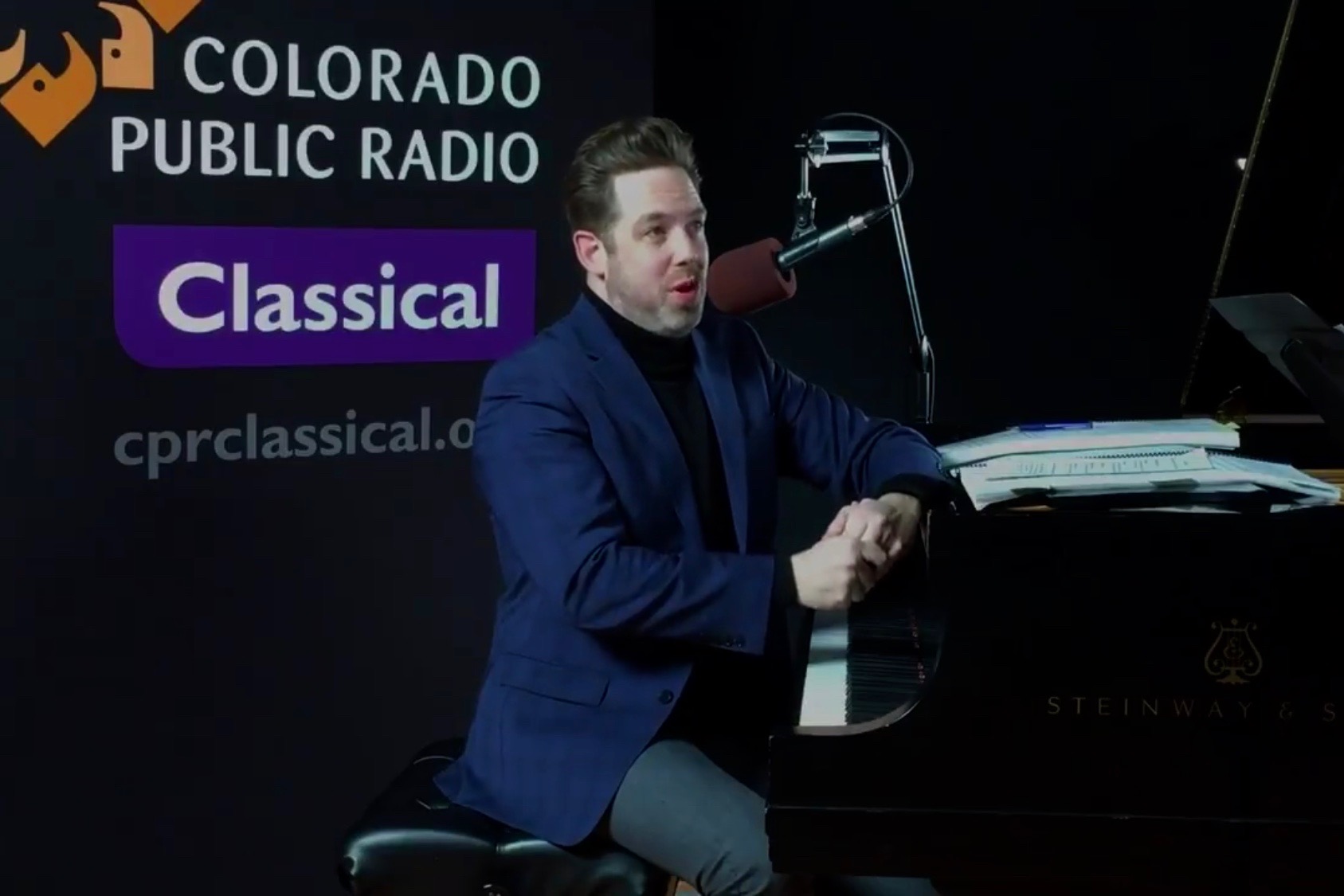
Preview: Brett Mitchell discusses John Williams's score for 'The Empire Strikes Back'
Brett Mitchell at the piano in the Colorado Public Radio studios. (Photo by Hart Van Denburg/CPR)
DENVER — Before leading the Colorado Symphony in Star Wars: The Empire Strikes Back next weekend, Brett Mitchell sat down with host David Rutherford in the Colorado Public Radio Performance Studio to explore some of the highlights of John Williams's iconic soundtrack.
After reviewing themes from Star Wars: A New Hope (watch the breakdown here), Mr. Mitchell explores the new themes Mr. Williams created for characters in The Empire Strikes Back, including Darth Vader, Yoda, and Han and Leia.
Watch the full video here.
This special was also featured on the most recent episode of Star Wars podcast Rebel Force Radio. To hear this segment, please begin at 1:57:07 in the video below.