

NEWS

Brett Mitchell Appointed Music Director of the Pasadena Symphony
Pasadena Symphony Appoints Brett Mitchell Music Director
Highly Acclaimed Conductor Assumes Post on April 1, 2024
PASADENA – Pasadena Symphony Board President Kimberly Winick today announced that the Board of Directors has appointed Brett Mitchell Music Director. Mitchell begins his five-year tenure with Pasadena Symphony on April 1, 2024. His first performance as Music Director will be the orchestra’s season-opening concert on October 26, 2024 (2024/25 season details to be announced).
Winick states, “Brett Mitchell emerged from our competitive music director search as our all-around favorite, and I am delighted to welcome him as our new artistic leader. His energy and talent will engage, sustain, and help to broaden our musical community.”
Pasadena Symphony CEO Andrew Brown adds, “We are excited Brett Mitchell is joining the orchestra at this significant time in the orchestra’s history, with our centennial just four years away. Brett is a tremendous talent. With his deeply creative programming, broad vision, collaborative spirit, and innate ability to keep classical music fresh and inspire musicians and audiences alike, he is the right person to lead the orchestra into its second century.”
Mitchell says, “I'm deeply honored and absolutely thrilled to be joining the Pasadena Symphony as its next Music Director. From the first moment we made music together in March 2022, it was very clear that there was a special connection between the musicians and me, and that same chemistry has since extended beyond the stage to our friends in the audience and throughout our community. I couldn't be more excited for the musical journey that lies ahead for our entire community as we embark together on this next chapter of the Pasadena Symphony's story.”
Orchestra’s Sixth Music Director in Nearly a Century
Mitchell is the sixth conductor to serve as Music Director of the Pasadena Symphony since the orchestra was founded in 1928. He succeeds distinguished Music Directors Reginald Bland (1928- 1936); Dr. Richard Lert (1936-1968); Daniel Lewis (1971-1982); Jorge Mester (1984-2010); and David Lockington (2013-2022). Pasadena Symphony, which has garnered considerable critical and public acclaim throughout its history, is a “virtuoso orchestra” lauded for “zesty, swaggering performances” (Los Angeles Times) and celebrated for its “superb tonal clarity and rich instrumental brilliance” (Pasadena Star News).
In addition to overseeing all artistic aspects of the Pasadena Symphony, Mitchell will collaborate on the orchestra’s highly regarded community and education programs, including the Pasadena Youth Symphony Orchestras, which encompass eleven award-winning ensembles serving students of all musical abilities in grades 5-12.
Mitchell, who has been on Pasadena Symphony’s radar for several years, was previously named an Artistic Partner for the orchestra’s 2021-22 season. Based on the strength of that initial appearance, he was invited to return as an Artistic Partner during the orchestra's 2023-24 season, leading its well-received opening concerts last fall.
Coming Full Circle
Mitchell – who was born in 1979, raised in Seattle, Washington, and now resides in Denver, Colorado with his family, where they plan to remain – vividly recalls the music from the Star Wars and Superman films having a tremendous impact on him as a child. “The first time I heard an orchestra was in a movie theater on a film soundtrack,” he explains, inspiring him to earn a degree in music composition from Western Washington University. “I wanted to be a film composer but ended up writing orchestral works that, in a twist of fate, I started conducting, which I discovered was my true passion.” That led to him earning both Master’s and Doctorate degrees in conducting from the University of Texas at Austin.
He continues, “In many ways, joining the Pasadena Symphony as Music Director is really coming full circle for me. So many of our musicians are these iconic studio players whose work I’ve known and loved for decades. To now be able to work with them and experience their artistry in person is a thrill beyond words.”
Additional Coverage
Colorado Boulevard (3/22): Brett Mitchell Is New Pasadena Symphony Music Director
Slippedisc (3/24): Pasadena Picks an American Music Director
Pizzicato (3/24): Pasadena Symphony appoints Brett Mitchell as Music Director
OperaWire (3/25): Pasadena Symphony Names Sixth Music Director in its History
Hey SoCal (3/25): Pasadena Symphony announces Brett Mitchell as new music director
Musical America (3/26): Pasadena Symphony Taps Music Director(subscription required)
Broadway World (3/27): Pasadena Symphony Appoints Brett Mitchell Music Director
Pasadena Now (3/27): Pasadena Symphony Names Brett Mitchell as Its Next Music Director
The Violin Channel (3/28): California's Pasadena Symphony Appoints New Music Director
Los Angeles Times (3/30): Easter music, alt art fair and the best L.A. culture in the week ahead
Symphony (4/1): Brett Mitchell Named Music Director at Pasadena Symphony
Local News Pasadena (4/4): Brett Mitchell is Listening
Pasadena Weekly (4/11): Major Music Changes: Pasadena Symphony appoints Brett Mitchell as new music director

Brett Mitchell will lead his first concerts as Music Director of the Pasadena Symphony on October 26, 2024, at the orchestra’s home of the Ambassador Auditorium, often referred to as the “Carnegie Hall of the West.”
Interview: 'Sunriver Music Fest Has A New Face For 2022'
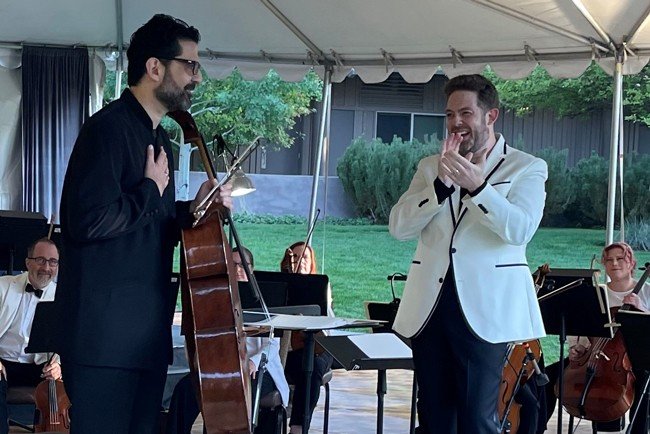
Brett Mitchell applauds cello soloist Amit Peled after his performance of Saint-Saëns’s Cello Concerto at the Sunriver Music Festival in August 2021.
BEND, Ore. — Source Weekly has published an interview with Brett Mitchell—subtitled ‘PNW native takes baton for 45th concert season’—about his upcoming first season as Artistic Director & Conductor of the Sunriver Music Festival, running August 8-21, 2022:
The Sunriver Music Festival, an annual series of chamber orchestra concerts, welcomes a new artistic director this season, as well as the addition of a brand-new venue. Seattle native Brett Mitchell has a vibrant program lined up for events at Bend's new Caldera High School as well as Sunriver's Great Hall, kicking off with a free movie night outdoors at the resort's Besson Commons on Aug. 8. The Source Weekly spoke with Mitchell this week about the 2022 season and his vision for the future of the festival.
Source Weekly: Welcome to the Sunriver Music Festival. Will this be your first time in Central Oregon?
Brett Mitchell: Surprisingly, yes. It's remarkable because growing up, my family spent a good part of every summer in Grants Pass visiting my grandparents, but we didn't get over to the east side of the Cascades – and it's just stunning. I was here for a week last summer to play for the selection committee.
SW: It looks like this season's lineup has a few "warhorses"–Beethoven's Eroica symphony, Brahms' Violin Concerto and Mendelssohn's 4th–with some interesting diversions in between, like pop and jazz on Aug. 12 and a "piano-centric evening" on Aug. 15.
BM: Yes, it's such a nice program. For the piano-centric concert, we'll feature one or two of the medalists from this year's Cliburn competition (the 16th annual Van Cliburn International Piano Competition, taking place in Fort Worth, Texas, this June). We know it will be a Mozart piano concerto of some kind, because one of the requirements for the Cliburn competition is to perform a Mozart concerto.
For the closing concert, there's this wonderful song cycle by British composer Gerald Finzi, based on songs from five different Shakespeare plays, called "Let us Garlands Bring," sung by my longtime associate and one of my very best friends, bass-baritone Timothy Jones. Before Jones sings, we'll play a five-part instrumental cycle, David Diamond's "Music for Shakespeare's Romeo and Juliet." It's a really nice kind of Shakespearean first half. The second half will be the Italian Symphony by Mendelssohn, a composer who like everyone else in the 19th Century was also a well-known Shakespeare lover. I think it'll be a nice way to end the season.
SW: I see the pops concert includes "symphonic jazz," which some people would describe as involving a lot of improvisation, while others might think of a more big-band sound. Which will it be?
BM: For the pops performance, the first half is all about film scores, which is a deep love of mine. The first piece is from the Bond franchise which turns 60 this year, a medley of themes from the film series. Next is the love theme from The Godfather movie, which turns 50 this year; then after we meander through some other things, we finish the first half with some John Williams works, closing with one from the movie "E.T." which celebrates its 40th anniversary this year. So, kind of a forward timeline of film scores.
For the second half, when we're talking about symphonic jazz, yes, that can mean a lot of different things for different people. I was originally a jazz pianist – I paid for my undergraduate degree at Western Washington University playing in a jazz trio. I conceived of it here as dating back to the ragtime era, so we'll start with some Scott Joplin arrangements. Then when you think about jazzers who crossed over into the symphonic space, I always think of Duke Ellington, so there will be arrangements by Morton Gould of a couple of Ellington tunes. We'll close with selections from George Gershwin's "Porgy and Bess" score, featuring our bass-baritone Jones.
SW: Will there be any pre-concert talks?
BM: There may or may not be a pre-concert talk, but there will certainly be a decent amount of talking from the podium. It's something I love doing. I like to inspire our audiences by showing them what lights me on fire about a piece. I think the days of walking onstage, conducting, taking and bow and walking off are gone. Audiences want to see the personalities behind the music.
SW: What would you say is your overall hope for this, your first season with the Sunriver festival?
BM: For the last few years, the festival has been very different, largely because of COVID, so the aim this summer is really to reconnect with our community. I hope we're going to have new folks with us who will become permanent fans. I also hope I can connect with the audience on a personal level. I don't walk in with a cape flowing behind me, turn my back to the audience and start in without a word. I'm more of a kind of real person. I don't stand on ceremony – I'm just Brett, and I hope that kind of relatability will help our audiences feel entirely welcome.
To read the complete interview, please click here.

Feature: "Colorado Symphony’s new music director leads bold drive to grow audience"
DENVER — The Denver Business Journal has published a feature on Brett Mitchell as he prepares to begin his first season as Music Director of the Colorado Symphony:
Brett Mitchell is the new music director of the Colorado Symphony. (Photo by Roger Mastroianni)
Denver’s new Colorado Symphony music director wants you to know he’s a regular guy.
Brett Mitchell, 38, is a sports fan. The Seattle native is eager to root for the Broncos (“unless they’re playing the Seahawks,” he whispers). He and his wife are foodies and hikers. He was excited about Jay-Z’s latest release. He programs concerts with a ear for what his nonmusical family members would like.
The maestro (“I’m just Brett”) is gregarious and optimistic, ready to do whatever needs doing to boost the symphony’s profile and cash flow. His enthusiasm is contagious.
Just a regular guy with a baton.
He served four seasons as associate conductor of the Cleveland Orchestra, a title held by only four previous conductors in the Orchestra’s 100-year history. Here Mitchell succeeds Andrew Litton, who will continue to serve as Colorado Symphony’s principal guest conductor through this season.
The two-decades-younger Mitchell said some of the differences between the two won’t be immediately discernible, but, “I’m my own kind of leader.”
Beneath the regular-guy exterior is a fast-rising young star whose rapid ascent at the world-renowned Cleveland Orchestra was followed by a whirlwind tryout and leap to Denver. Mitchell is also a sometime composer (with a degree in composing from Western Washington University). His wife, Angela Mitchell, is a public radio host/interviewer as well as a classically trained soprano.
Mitchell’s praise for the “fabulous” Colorado orchestra is abundant. He now faces the impossible job description: As music director, he must have artistic excellence combined with marketing and fundraising skills, a reverence for the classics as well as new, experimental works, and a knack forpleasing traditionalists as well as for drawing in younger, more diverse audiences....
“A big leap forward”
[Colorado Symphony CEO and board co-chair Jerry] Kern sees Mitchell’s arrival as “a big leap forward as opposed to inching along and trying to break even.” For the young conductor, “he understands it’s an enormous opportunity to begin to build a major reputation.”
“It takes years to figure out where a new music director is taking an orchestra,” Mitchell said. “The things you will notice right away are the programming... Look at kinds of repertoire I like to program, you’ll see more of that contemporary American voice.”
For his opening weekend, Sept. 15, he has paired Beethoven’s Symphony No. 5 (“who doesn’t like a Beethoven 5?”) with works by two American composers in their early 40s: Kevin Puts (Millennium Canons) and electronica soloist Mason Bates (The B-Sides: Five Pieces for Orchestra).
Mitchell rapturously explains his thinking: the Puts Millennium Canons represents “a triumphant opening to my tenure, and, more important, a perfect analog to the finale of Beethoven 5… it’s all about the rhythmic drive.
“And then, whose music is more about rhythm than anybody? Mason Bates. He lives a double life, composer by day, DJ in San Francisco by night. On The B-Sides, five little pieces for orchestra that incorporate electronica, Mason will do all of that stuff live. Then listen to the rhythmic drive of Beethoven 5 on the second half … what makes Beethoven 5 fly? By the finale, it’s so rhythmically driving, that glorious C major finale is nothing but celebratory. And now you’ve come up with AN EVENING!”
In other words, he said, “My goal is to give the audience reason to come to the concert. Because, I’ve got Spotify like everybody else. I could listen in my living room with my glass of wine, with my wife, and not put pants on…”
It’s all about the experience....
Mitchell finds it remarkable that the Cleveland Orchestra has sustained its status as one of the elite ensembles in world even as the population of Cleveland has declined. “That’s one hell of a testament. In Denver, there is so much growth, as our Realtor keeps telling us— every time I hear that I think we gotta buy a house— but lots of people are coming here. Part of my job is to capitalize on that.”
The couple is living a few steps from the concert hall for now. Mitchell’s four-year contract requires him to live here at least half the year.
While some music directors balk at the idea of chatting up potential sponsors over cocktails, Mitchell is all in.
“As music director,” Mitchell said, “I am the face of the organization and I understand that.” It’s a more immersive role than the European orchestra’s designation of principal conductor. “The whole reason we have to raise money is because of my crazy ideas.”
Just a regular guy with a baton and some crazy ideas.
To read the complete article, please click here (subscription required).
Preview: "Cleveland Orchestra Youth Orchestra: a conversation with composer Roger Briggs"
ClevelandClassical has published the second installment in a three-part series previewing the Cleveland Orchestra Youth Orchestra's upcoming world premiere of Roger Briggs's Fountain of Youth, led by music director Brett Mitchell:
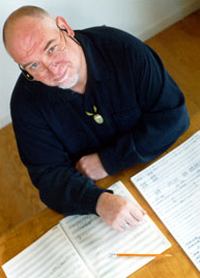
Composer Roger Briggs
Whether you’re a member of a “Big Five” orchestra or not, the prospect of performing a newly-composed work is always exciting. On Friday, November 18 at 8:00 pm at Severance Hall, the Cleveland Orchestra Youth Orchestra (COYO) under the direction of Brett Mitchell will have that opportunity when they present the world premiere of Roger Briggs’ Fountain of Youth, commissioned by COYO. The program will also include Bruckner’s Symphony No. 4 (“Romantic”).
For composer Roger Briggs, the COYO commission was immediately attractive to him for two reasons: first, it provided him with the opportunity to write a new work that would be conducted by a former student. “Brett Mitchell studied composition and conducting with me at Western Washington University. He was a marvelous talent,” Briggs said during a telephone conversation.“I remember playing Billy Joel’s Just the Way You Are on the piano in class one day, and afterwards he politely came up and told me that I had left out a note of a chord, and he sat down and played the chord adding the note.” Briggs recalled. “I told him I didn’t think he was correct, so I immediately went to the score, and he was right!”
Second, it would be his first commission for a large-scale symphonic work from a youth orchestra. “The Cleveland Orchestra Youth Orchestra has the reputation of being one of the finest youth orchestras in the world, so I wrote the piece as though I was writing for a professional orchestra — I knew I didn’t need to write down to them,” the composer said.
To read the complete article, please click here.
Preview: "Cleveland Orchestra Youth Orchestra to premiere Briggs' 'Fountain of Youth'"

From Cleveland Classical:
The first in a series of articles highlighting the world premiere of Roger Briggs’ Fountain of Youth.
The prospect of performing a newly-composed work is always exciting. On Friday, November 18 at 8:00 pm at Severance Hall, the Cleveland Orchestra Youth Orchestra (COYO) under the direction of Brett Mitchell will have that opportunity when they present the world premiere of Roger Briggs’ Fountain of Youth, commissioned by COYO. The program will also include Bruckner’s Symphony No. 4 (“Romantic”).
Premiering Briggs’ eighteen-minute tone poem is especially exciting for Brett Mitchell. “It’s impossible to overestimate the impact Roger Briggs had on me,” the conductor said during a telephone conversation. “If it weren’t for the opportunities he provided me, I wouldn’t be here now.”
Mitchell first met Briggs twenty years ago when pursuing his undergraduate degree in composition at Western Washington University, where Briggs was the head of the department as well as director of orchestras. “Roger was my primary composition teacher,” Mitchell said. “I also studied conducting with him and found my way onto the podium more and more as the years went by.”
Mitchell also credits Briggs for encouraging him to continue embracing his love of jazz. “When Roger talked about harmony, he was just as likely to point to recordings by McCoy Tyner as he was to textbooks by Schoenberg and Persichetti. The breadth of his musical knowledge inspired me to not narrow my focus only to classical music.”
The idea to commission Briggs to write a piece for COYO originated after Mitchell sent out an email announcing that his contract with The Cleveland Orchestra had been extended and he would be promoted to associate conductor. Briggs responded with his congratulations, adding that someday he hoped to be able to write a piece for one of Mitchell’s orchestras. “I thought, why wait for someday?” Mitchell recalled. “It would be so special to have my teacher from when I was in my late teens write a piece for me to play with my 17- and 18-year-olds.”

Before getting into rehearsals, Mitchell told his players about Briggs and his music. He noted that one challenge was teaching the young musicians a new musical language. “At the first rehearsal I emphasized that the opportunity to perform a world premiere is rare, but what was about to happen was even more magical — this would be the first time any group of musicians had ever played these notes. We had to make a few stops along the way to pick up the luggage that fell out of the station wagon, but we did get through the whole piece at that rehearsal.”
How does the conductor prepare to rehearse a piece of music that has never been seen or heard before? He opens the score and looks at the first page for a few seconds, taking it in with a wide-angle lens. Then he repeats that process until he has been through the entire score. “I want to be sure that I have the overall picture of the piece, because my job is to communicate the essence of it to the musicians and to the audience. And if I’m wrapped up in every little detail from bar one to the end, I won’t be able to see the forest for the trees.”
Mitchell gave some specifics about his experience learning the Briggs. “The first page of the score is marked ‘energetic with great precision,’ and I saw a lot of activity all over the page with changing meters — the strings playing here, and the brass and winds playing there. I noticed how that develops, where it gets smaller, and where it gets thicker. Rehearsal number 22 seems to be a climax, and at number 23 there is a shift into a different texture.”
Mitchell is often asked if it is difficult to conduct a world premiere as there is no recording of the piece. But he said the process is no different from preparing to conduct any piece of music for the first time. “Besides, if you only know a piece of music through a recording, then you don’t actually know the piece, you know somebody’s interpretation of that piece.”
Mitchell and the COYO musicians are having a great time learning Fountain of Youth. “The players are really engaged in the process — they’re asking questions and pointing out inconsistencies. I’ve been communicating with Roger and giving him progress reports. It’s going to be wonderful to get his thoughts when he hears it. But he trusts the process and knows that his baby is safe in our hands.”
To read the complete article, please click here.
"Colorado Symphony Orchestra announce new music director"
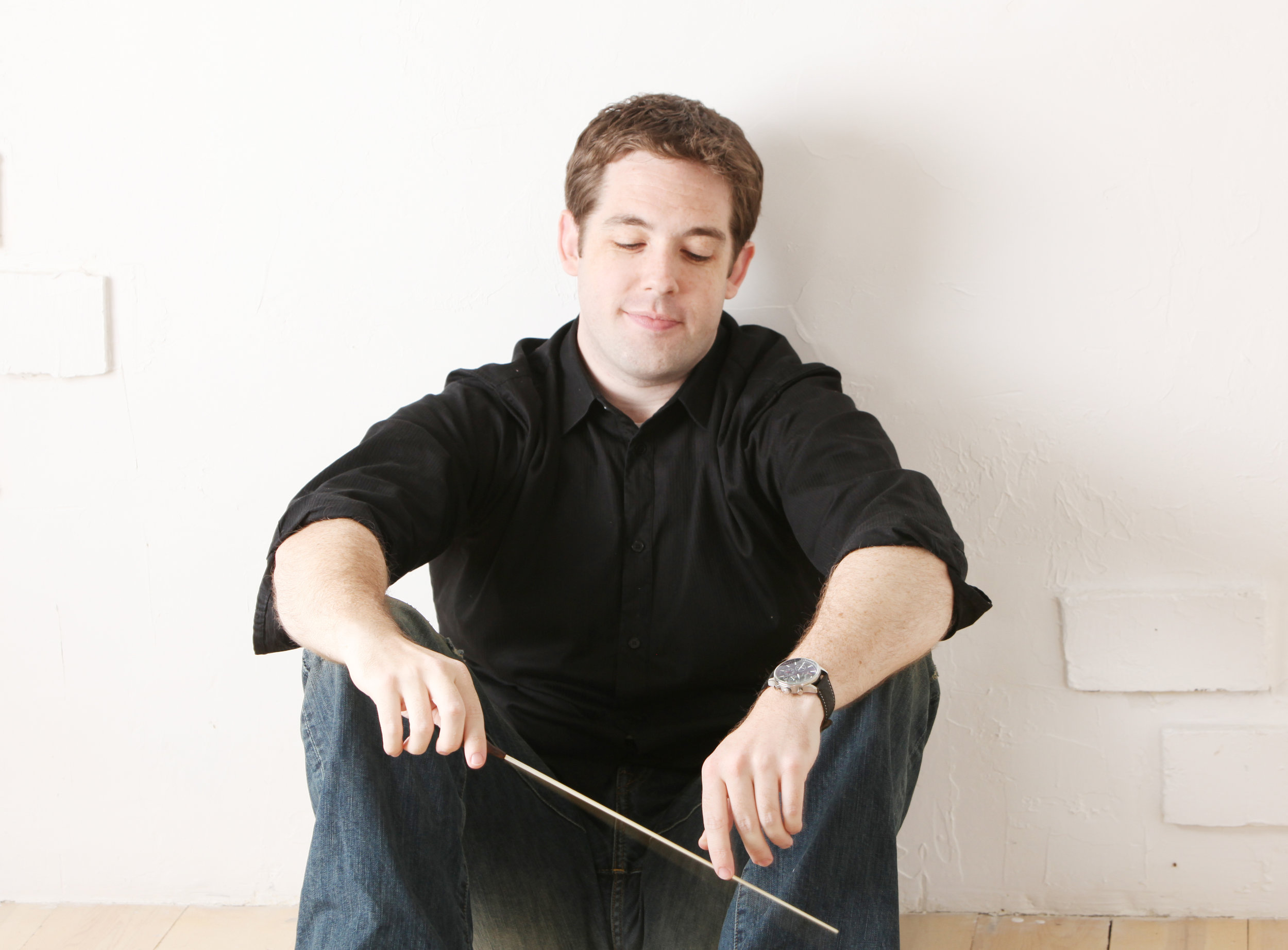
(Photo by Gregg Barckholtz)
The Violin Channel has published an article about Brett Mitchell's appointment as Music Director of the Colorado Symphony:
The Colorado Symphony Orchestra has today announced the appointment of 37 year old American conductor, Brett Mitchell as their new Music Director – effective from the commencement of the 2017/18 season.
A graduate of the University of Texas and the Western Washington University, Brett currently serves as Associate Conductor of the Cleveland Orchestra and as Music Director of the Cleveland Orchestra Youth Orchestra.
“Mitchell was unanimously selected by musicians and artistic leadership alike — a rare occurrence in the orchestra world when making such a momentous change …” Chief Artistic Officer, Anthony Pierce has said.
“Brett’s skill, character, and creativity won us all over, and he’s completely on board with our mission for innovative artistry and financial success …” he has said.
“From the first downbeat of our first rehearsal together, it was clear that the Colorado Symphony and I had that special chemistry vital to any great artistic partnership,” Mitchell has said.
He will replace conductor, Andrew Litton – who has served the position since 2012.
To read the complete article, please click here.
Preview: "Cleveland Orchestra Youth Orchestra announces details of ambitious 2016-17 season"

The Cleveland Orchestra Youth Orchestra announced its 2016-17 season Wednesday. Included in the plans are several contemporary works and first performances of symphonies by Bruckner and Prokofiev. (Photo by Roger Mastroianni)
The Plain Dealer (Cleveland) has published an article previewing the Cleveland Orchestra Youth Orchestra's 2016-17 season, its fourth under music director Brett Mitchell:
Nothing flashy about the number 31, but the 31st season of the Cleveland Orchestra Youth Orchestra is special nonetheless.
During its fourth year under music director Brett Mitchell, associate conductor of the Cleveland Orchestra, the distinguished pre-professional ensemble will take several giant steps forward in the form of a world premiere, two other contemporary works, and first-time performances of symphonies by Bruckner and Prokofiev.
"It's such a wonderful opportunity to keep building on this culture," said Mitchell before the 2016-17 season announcement Wednesday. "Three years isn't time enough to do anything."
They'll be getting a lot done this year, that's for sure. So sophisticated are the three programs COYO has planned, one might even confuse them with those of the main Cleveland Orchestra.
Up first, on Friday, Nov. 18, is a weighty night of two firsts: the group's first Bruckner (Symphony No. 4) and the premiere of "Fountains of Youth," by Roger Briggs, Mitchell's former teacher at Western Washington University.
"To have that lineage is a beautiful, special thing," Mitchell explained. "His [Briggs'] was one of the first modern voices to enter to my ear. I wish I had the words to describe the honor of this, how touched I am."
As for the Bruckner, Mitchell said it was Cleveland Orchestra music director Franz Welser-Möst who gave him the idea, and the nerve. After publicly praising COYO at its season finale this year, Mitchell said the conductor and Bruckner expert gave his blessing to the group taking on the Fourth.
"Once he said that, having that vote of support, that was really what gave us the confidence to move forward," Mitchell said, noting that Bruckner "has always been a foreign language to me. But these are my colleagues now, and we get to take this journey together."
More new territory awaits on the second program, on Sunday, Feb. 19. Then, in addition to Debussy's "Nocturnes" and the Poulenc Gloria with the Cleveland Orchestra Youth Chorus, the group will perform "Sea-Blue Circuitry," a work by American composer Mason Bates.
Think of that as further evidence that when it comes to the music of his homeland today, Mitchell is serious.
"It's a core part of who I am," Mitchell said. "For me, it is never lip service. We are a contemporary American orchestra, and we should be playing contemporary American music."
The final program, on Friday, May 12, takes COYO in both directions simultaneously.
On the one hand, the group will undertake its first Prokofiev Symphony (the widely-beloved Fifth). On the other, another contemporary American work: Joan Tower's "Made in America."
All in a night's work for a group striving every year to do and be more.
"It's a huge, huge season for us," Mitchell said, adding that "this is what we in COYO do now."
To read the complete article, please click here. To read the official news release from The Cleveland Orchestra, please click here.

Western Washington University names Brett Mitchell Young Alumnus of the Year
BELLINGHAM, Wash. — Western Washington University has issued a press release announcing Brett Mitchell's selection as the recipient of the university's 2014 Young Alumnus of the Year award. This award, established in 1980, is the most prestigious honor bestowed on a young alumnus.
Mitchell earned a Bachelor of Music in composition from Western in 2001, and will return to WWU to accept this award and lead their orchestra in Tchaikovsky's Symphony No. 5 on June 2, 2014.
Brett Mitchell followed his love of music around the world and rose to the top. He has become one of the most prominent conductors of our time. He has conducted orchestras in London, Philadelphia, and Dallas. Mitchell serves as the Assistant Conductor of the prestigious Cleveland Orchestra. He is also the Music Director of the Cleveland Orchestra Youth Orchestra.
I love working with people and inspiring the musicians I work with to come together and achieve more than they ever expected. - Brett Mitchell ('01).
Mitchell’s passion for music ignited when he began studying piano with his first grade teacher. Throughout much of his youth, he continued to play piano, saxophone, and percussion. By high school began to compose his own music and to conduct.
Mitchell enrolled at Western in the fall of 1997. He began formal piano, composition and conducting studies.
Mitchell worked with influential professors like Roger Briggs, Margaret Brink, and Jeffrey Gilliam at WWU. He served as the music director of the North Sound Youth Symphony in Bellingham.
The Young Alumnus of the Year Award goes to an alumnus under the age of 40 who achieve personal and professional notoriety. These awards represent the most prestigious honors bestowed by the Western Alumni Association. In 2007, the Western Washington University Alumni Association Board of Directors expanded the recognition. Awards are given to Distinguished Alumni for each college; the Young Alumnus of the Year to acknowledge alumni under the age of 40; and the Legacy Family of the Year Award to honor a family with strong multi-generational affinity for Western.

Brett Mitchell receives Young Alumnus of the Year Award from undergraduate alma mater
Brett Mitchell has been selected to receive the 2014 Young Alumnus of the Year Award from his undergraduate alma mater, Western Washington University, from which he earned a Bachelor of Music in composition in 2001. This award, established in 1980, is the most prestigious honor bestowed on a young alumnus. Mr. Mitchell will return to WWU to accept this award and lead their orchestra in Tchaikovsky's Symphony No. 5 on June 2, 2014. To learn more, please click here.
Preview: "Symphony candidate sees youth as a plus"

Brett Mitchell, a candidate for the position of music director at the Peoria Symphony Orchestra, leads the orchestra on April 24 at the Civic Center Theater.
The Journal Star (Peoria) has published a profile of Brett Mitchell in advance of his upcoming concert with the Peoria Symphony Orchestra:
Brett Mitchell, the next candidate in the Peoria Symphony Orchestra's music director search, said that a young face at the podium can be a plus.
"If you look at the list of candidates that the Peoria Symphony has brought this season, it's very clear that they are interested in reaching out to the next generation of concertgoers," said Mitchell of Houston, who leads the orchestra in a performance of Beethoven, Prokofiev and the music of contemporary composer Michael Torke on Saturday.
"We're all, relatively speaking, young. I think that's a great way to bring in young audiences. It seems like a superficial thing, but it's not and I'll tell you why. I go home on Monday night, if I can, and I watch 'House' just like everybody else. I'm excited about the last season of 'Lost' just like everybody else. I listen to top 40 radio just like everybody else. I think there is something really important - the relatability of the person on the podium."
Yet Mitchell, 30, is not just an "average Joe" who just happens to have a passion for classical music. Few rising conductors can impress the likes of conductor Kurt Masur, whom Mitchell can claim as a personal mentor and supporter. Connections to Masur led to three years of shuttling back and forth over the Atlantic while serving as assistant conductor for the French National Orchestra. And besides that world-class orchestra, Mitchell has led several other top-notch organizations: the London Philharmonic, the Philadelphia Orchestra and the Houston Symphony Orchestra, where he now serves as assistant conductor.
Nevertheless, Mitchell, who grew up in Seattle, hardly projects the image of a rarified know-it-all. His parents listened to not just classical but a variety of music, and he owes his fascination with orchestral sound to John Williams via movies like "Star Wars," "Superman," "E.T." and "Indiana Jones." In fact, for a time Mitchell wanted to be a film composer and studied composition at Western Washington University while taking lessons on his primary instrument, the piano, on which he is basically self-taught after having a few formal lessons when he was 6. (Mitchell broke out on his own because his piano teacher insisted that the young boy learn scales instead of songs.)
When he considered graduate school in music, however, Mitchell switched to conducting - partly because he decided he wasn't a young John Williams in the making. Also, he discovered he preferred collaborating with others.
"Playing the piano is a very solitary endeavor," Mitchell said. "You spend hours and hours alone in a practice room. The culmination of all that practice is that you go on stage alone again. Composition is a very solitary endeavor. You spend hours and hours alone writing your music. Once it's written, it's written. But with conducting - yes, I spend hours and hours alone studying these scores. But the end result is so different. The end result is that I get to work with 60, 80, 100 of my colleagues on these pieces. Then we get to perform them for one or two or three or five or 10,000 people. I'm such a people person. That just speaks to me and makes so much sense to me for who I am as an artist."
Not to mention the added benefit of spending a great deal of time with scores by Beethoven or Prokofiev - composers of genius. What job can be better than that?
After receiving a master's and doctoral degrees in orchestral conducting from the University of Texas at Austin, Mitchell went on to a varied career. Thanks to Kurt Masur, Mitchell received the inaugural Felix Mendelssohn Bartholdy Scholarship, which meant one-on-one study with Masur and helping the great conductor with concerts in Europe and America. He currently serves as assistant conductor/American conducting fellow of the Houston Symphony Orchestra.
Mitchell said that orchestras can broaden their audiences by being good representatives of their respective cities and regions. Programs, he said, should not be interchangeable: What is played in Chicago should be different from what is played in Dallas, because Chicago and Dallas are different places. For instance, the Peoria Symphony Orchestra might consider playing more music from local and regional composers as well as standards like Aaron Copland's homage to Abraham Lincoln.
"The Peoria Symphony Orchestra's programming should absolutely be reflective of Peoria and Illinois," Mitchell said. "Because otherwise we just become a symphony orchestra that just happens to be in Peoria. That is a huge mistake."
Beyond that, Mitchell would like to see collaborations with other dance, theater and other arts groups - projects he has tried to cultivate in his time with the Houston Symphony.
Mitchell, who also is in the running for the position of music director at Michigan State's Saginaw Bay Symphony Orchestra, said he's ready for a new stage in his career.
"I've had great music director experiences with my own orchestras - but they've been smaller orchestras," Mitchell said. "They've been largely academic orchestras, in a university setting, or a youth orchestra. I've had great professional orchestra experience, including with some of the greatest orchestras in the world. I've conducted the London Philharmonic. I've conducted the Philadelphia Orchestra. I work with the Houston Symphony. These are really sensational orchestras. I feel like the time is right for me to synthesize those two things - that great music director experience that I have and that great professional experience that I have. And become music director of one of the nation's really, truly great regional orchestras."