

NEWS
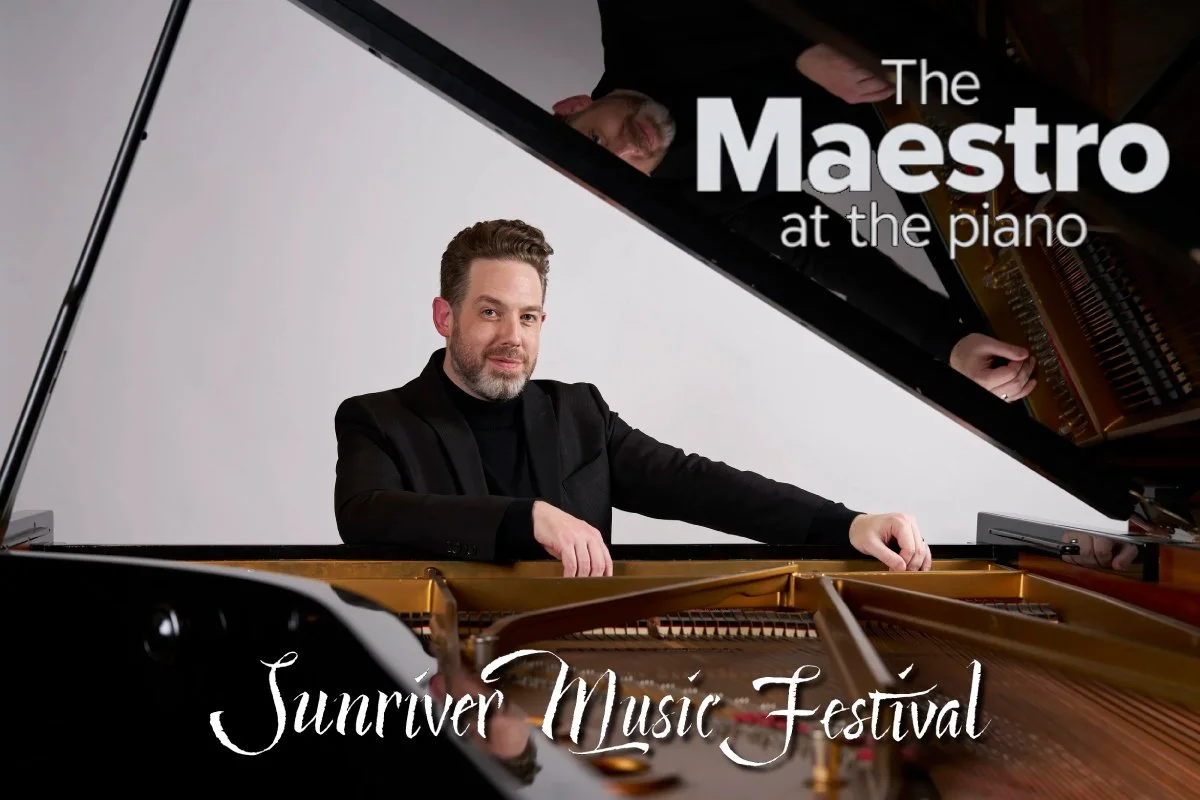
Preview: Sunriver Music Festival — The Maestro at the Piano
BEND, Ore. — The Source has published a preview of Brett Mitchell’s upcoming solo piano recital, presented by the Sunriver Music Festival:
Hailed for the breadth of his work on the podium and at the piano, Maestro Brett Mitchell has carved a unique path in the world of contemporary American classical music. Sunriver Music Festival’s Artistic Director & Conductor will present an exclusive solo piano recital featuring his own arrangements for film in Sunriver on April 11. Visit sunrivermusic.org for tickets to The Maestro at the Piano.
As a conductor, Mitchell currently serves as Music Director of the Pasadena Symphony and Artistic Director & Conductor of Oregon’s Sunriver Music Festival. He previously served as Music Director of the Colorado Symphony, Associate Conductor of The Cleveland Orchestra, and Assistant Conductor of both the Houston Symphony and Orchestre National de France. Working widely as a guest conductor, Mitchell has led the New York Philharmonic at David Geffen Hall, the Los Angeles Philharmonic at the Hollywood Bowl, and principal orchestras spanning the United States and beyond.
As a pianist, Steinway Artist Brett Mitchell has a devoted fanbase of his work at the keyboard. The high standard he has set with artistic and professional achievements makes it most appropriate that Mitchell is formally included on the Steinway Artist roster—a list of the most accomplished and discriminating artists in the world. His exceptionally active YouTube channel @brettmitchellconductor features his original solo piano videos of iconic cues from film history and landmark works from classical, jazz, and pop canons.
“Film music has always been one of my great musical loves. When the pandemic hit in 2020 and we couldn’t present orchestral music, I flexed my arranging chops, taking iconic scores from film music history and arranging them for solo piano. What began as a pandemic diversion has morphed into a continuing passion project that I’m now thrilled to share with more than 15,000 subscribers across my social platforms, and I couldn’t be more pleased as we gear up for Sunriver Music Festival’s “America @ 250” celebrations in August 2026 to share many of these iconic selections with our audience in Central Oregon. The art of film scoring was born during the American century, and I can’t imagine a better way to kick off our celebrations than with an intimate evening featuring some of my favorite music of all time. Please join me on April 11 in Sunriver.” - Artistic Director & Conductor Brett Mitchell
Mark your calendars for April 11 and visit sunrivermusic.org for tickets to Sunriver Music Festival’s exclusive concert The Maestro at the Piano. VIP ticketed guests are welcomed to an intimate post-concert reception offering wine, light fare and unhurried conversation with the maestro in an informal setting.
Click here to read the complete preview, and here to read the official press release from the Sunriver Music Festival.

Feature: ‘Simply a Composer’s Advocate’
Photo by Roger Mastroianni
The American technical formal apparel company Coregami has announced Brett Mitchell as a brand ambassador, and journalist Owen Clarke has marked the new partnership with a 2,000-word feature article about the multifaceted conductor, composer, and pianist.
Simply a Composer’s Advocate
In a profession often defined by tradition and the worship of past masters, conductor and Coregami ambassador Brett Mitchell has a strict rule: never copy the giants.
“I would rather be a first-rate Brett Mitchell than a second-rate Leonard Bernstein,” he told me. “I want everything that I do, for better or worse, to come genuinely from me. That's the only way it'll be new.”
Born and raised in Seattle, Washington, Mitchell was the oldest of three boys. No one else in his family was a musician, and he wasn’t introduced to classical music until high school. As a kid, he was surrounded by the pop artists of his parents’ generation, like the Beatles, Simon and Garfunkel, Billy Joel, and Elton John. As he grew into his teens, in the early 1990s, his influences changed. “There was no way to escape grunge in Seattle at that time,” he joked. “If you go look at my 8th grade yearbook, our jazz band photo, we’re all in flannels and ripped jeans,” he said. “Nirvana, Pearl Jam, Soundgarden, those bands were huge for me back then.”
As he entered high school, however, he became more interested in classical music. In particular, he loved the soundtracks of popular films at the time, movies like Superman, Indiana Jones, E.T., and Star Wars—all scored by John Williams. “I wouldn’t have had a career if it weren’t for falling in love with John’s music,” Mitchell said.
Mitchell knew he loved music, but he wasn’t sure how he wanted to approach it. For a time he thought he might want to be a pianist, or perhaps a film composer. So he started writing bigger and bigger pieces, and his high school band director eventually said, “Why don’t you conduct this piece that you wrote?”
And in October of 1995, exactly thirty years ago, a 16-year-old Mitchell conducted his first piece of music. “Was I terrified? Yes, absolutely,” he said, laughing. “But it was that night in October ‘95 that I really decided, ‘Okay, I think this is the direction I want to go in life.’” After high school, he earned an undergraduate degree in music composition from Western Washington University, and then a master’s and doctorate in orchestral conducting from the University of Texas. By age 26, Mitchell was teaching at Northern Illinois University, and later that same year, he landed his first professional job as an assistant conductor for Orchestre National de France in Paris. From there, he was off to the races.
(Readers can read Mitchell’s full biography on his website. Currently, he is the music director of the Pasadena Symphony, and the artistic director and conductor for Oregon’s Sunriver Music Festival. Just two weeks ago, he was named piano company Steinway & Sons' newest Steinway Artist.)
But Mitchell wasn’t inclined to dwell on his lengthy (and admittedly prestigious) resume, reminiscing on where he’s conducted or directed. “I’ve been doing this for 30 years now,” he told me, early on in our interview. “And when you get to this point, every interview is the same interview.”
Instead, we focused on the philosophy and lifestyle that shape the man behind the baton.

Photo by Roger Mastroianni
Life Above 7,000 Feet
Mitchell has been married to his wife, Angela, for a little over ten years, and together they have two children, a 20-month-old girl, Rose, and a boy, Will, who turns four on Christmas Eve. His family has lived in the foothills outside Denver, Colorado since 2017, when he was named music director of the Colorado Symphony. “We love living here, because we love the outdoors,” he said.
The family’s home is at 7,300 feet, and backs up to the Bear Creek Highlands. “It's like 880 acres of open green space,” he said. “There are a dozen miles of trails right outside our back door, and it’s sunny 300 days a year, which is a big change, for me, from Seattle.” When the trails are clear, Mitchell and his family are hiking, but when it snows, they strap on snowshoes and hit the trails anyway. “Even in the winter, maybe you get a snowstorm and it dumps a foot of snow on you,” he said, “but the next day is almost invariably a bluebird day, crystal clear, bright blue sky, and we’re out there.”
Beyond the accessibility to pristine nature, there are other advantages, as a performer and conductor, to living in Colorado, Mitchell said. Chiefly, rehearsing at high elevation is a great way to build strong lungs. Mitchell recalled conducting his first concert in Colorado, in 2016. He noticed some oxygen tanks backstage at the concert hall. “I was like, ‘Oh, that’s funny,’” he remarked. “But then I was conducting, I think it was a Tchaikovsky symphony, one that ends big and loud and fast, with lots of energy, and at the end I was really, really winded.” The oxygen tanks weren’t just a gimmick. Players who come to Colorado, he said, will often come a day or two early to acclimate to the elevation.
“There is a reason we train our Olympic teams in Colorado,” he added. “Working out up here, when I go down to sea level, I feel like Superman.”
This passion for an active lifestyle is also what drew Mitchell to Coregami. “Conductors always look for the most comfortable thing possible to rehearse in, attire that breathes, that lets us move the way we want to move. Then we get to the concert hall and we have to put on, well, the most restrictive clothing imaginable!” He laughed. “Coregami figured out a way to rectify that problem.”

Brett Mitchell leads the Colorado Symphony at Boettcher Concert Hall. Photo by Brandon Marshall
More Than Waving a Stick
As a conductor, Mitchell sees his job as multi-faceted, with responsibilities that go far beyond the music. The books on the shelves in his studio, where he sat when we conducted our interview, reflect this. “There are at least as many books on sports psychology and coaching as there are on conducting,” he said. “I’m looking at Phil Jackson, Eleven Rings. Pat Summitt, Sum It Up. Robert Greene, The 48 Laws of Power. I'm looking at John Wooden, at David Brooks, at books about Kobe [Bryant].”
Why so many books about athletics? Mitchell is blunt. “Coaches of professional athletes have the most insight in terms of how to deal with what I deal with as a conductor, which is elite talent,” Mitchell said. “These people are the best in the world at what they do, and they know it. Your job is to make them better, which isn’t easy. So yes, my role is diplomat. It's politician. It's counselor. It's psychologist.”
In fact, Mitchell said his job is “as much about understanding people as it is about understanding music,” if not more, and that it’s not about taking charge and making unilateral decisions, but about organically building a consensus. “While I certainly bring my ideas to the podium, I am not the sole proprietor of good ideas,” he admitted. He added that to the layman, a conductor may seem like a shotcaller. That’s not how it is. “You probably think of this guy standing up there on a box, waving a stick in your face saying, ‘My way or the highway!’ Nothing could be further from the truth,” he said.
Mitchell likened his role to being an “arbiter of taste.” He has the final say, of course, but his voice should be the mouthpiece through which the orchestra speaks. “I try to be as open as I possibly can,” he said. “That give and take is what I love about conducting.”
When I asked Mitchell about some of the quotes or books that have inspired his philosophies on conducting, he was quick to name one by Austrian-born American composer Erich Leinsdorf: The Composer’s Advocate. “This book is great,” Mitchell admitted, “but honestly the title of the book was more revealing to me than anything inside it, because it cuts to the heart of what our job is as conductors. We're advocating on behalf of the composer.”
Mitchell is also fond of a line from the Pulitzer Prize-winning musical Sunday in the Park with George, by Stephen Sondheim, about the work of French painter Georges Seurat. “The line comes at the end of Act II, toward the very end of the show,” Mitchell explained. “Seurat’s in a creative rut, he doesn't know what to do. He doesn't know how to get to the next place. And his muse [Dot] tells him, ‘Anything you do, let it come from you. Then it will be new. Give us more to see.’”
Mitchell loves the quote so much he had it engraved on a piece of wood and mounted on the wall in his studio. This quote was the genesis for what he told me at the beginning of this piece, and it’s a personal mantra for Mitchell, a reminder that, whatever subconscious influences he may absorb as he goes about his life, he needs to be his own artist, for better or worse. As much as Williams, Bernstein, Sondheim, Tchaikovsky, or any other great composer from days gone by may have inspired him, he’s careful never to fall into the trap of emulating their work.
“I want to give audiences something new,” he said.

Brett Mitchell leads the New York Philharmonic at David Geffen Hall. Photo by Brandon Patoc
We’re Here to Show the World What Can Be
Much of Mitchell’s work today involves mentoring young people. He served as music director for the Cleveland Orchestra Youth Orchestra for four years, and has taught at a number of programs for budding musicians. But in an era of generative artificial intelligence—when youth are encouraged to use generative AI for everything from writing essays to creating imagery—he admits that there’s a lot of pressure for youth to mimic. Convincing kids to “let everything you do come from you” isn’t always easy.
Mitchell says that if he had anything to say to the young artists of today, growing up in an era of AI, it’s to not get discouraged. “AI will never be able to stumble upon happy accidents the way humans do,” he said. “AI is trained on the past. It’s trained to take the past, and distill into what it thinks is best for the present. But the most interesting, beautiful things are often those that arrive by accident.” Mitchell often plays jazz in his free time, and remarked on the popular joke that “there are no wrong notes in jazz,” because, “if you hit a note that you didn't mean to hit, all you have to do is take that little mistake and then do it again. Do it again and make it a feature, not a bug. This is something only a human brain can do.”
Another piece of advice Mitchell has for budding orchestral players is to remember that synchronization isn’t the goal. “In orchestras, there’s an emphasis placed on playing together,” he said. “If there's a chord on the downbeat, we all play that chord on the downbeat together. But we have to remember, the end goal is not to play with each other. The end goal is to play for each other.”
He gave an example. “If it's the oboe solo, that may mean the violins need to tone it down, and play more transparently. It’s not just about being in the same place at the same time. It's understanding when it's your turn and when it's somebody else's turn. You have to ask yourself, ‘Am I doing everything that I can to support my colleague?’”
This, Mitchell said, is part of what makes playing, conducting, and listening to orchestral music so special. It’s a collaborative effort, it’s many individuals coming together to craft something beautiful. “Anything that you’re gonna accomplish in your life, if it is worthwhile, you will accomplish it with other people,” Mitchell said.
This is, in part, why he isn’t worried about the future of the arts. Developments in technology like artificial intelligence will take some jobs. That’s only natural. “When’s the last time you saw an elevator operator?” Mitchell joked. But he doesn’t see it ever having a fatal impact on the arts, simply because by nature, AI is retrospective.
“We can't write symphonies with robots. We can't paint pictures with robots,” he said. “Or we can, but the symphonies AI writes, the paintings AI creates, these are just a conglomeration of everything that already has been, they aren’t a lens into things that could be.”
He paused. “We have to remember, that's what artists are here for. We’re here to show the world what could be.”

Brett Mitchell leads The Cleveland Orchestra at Blossom Music Center. Photo by Roger Mastroianni

Feature: ‘From Manilow to Mozart, Sunriver maestro Brett Mitchell is an all-around music fan’
Brett Mitchell leads the Sunriver Music Festival Orchestra (Photo by David Young-Wolff)
BEND, Ore. — The Bulletin has published a feature about the Sunriver Music Festival and its Artistic Director & Conductor, Brett Mitchell, who is about to begin his fourth season at the helm of the nearly-50-year-old festival in Central Oregon.
Sunriver Music Festival kicks off Saturday, with four classical concerts, a family concert and the ever-popular, and often sold-out, pops concert over the next week and a half in Bend and Sunriver.
The festival opens at the Tower Theatre with an evening program titled “A French Soiree,” followed by the Pops Concert Sunday night, also in the downtown Bend theater.
Concerts continue apace, through Aug. 11’s Season Finale Classical Concert, “Vienna Waits for You,” with music by Haydn, Mozart and Beethoven, among the many composers who called the Austrian city home.
But if, like Brett Mitchell, conductor and music director of the seasonal classical festival, you’re a Billy Joel fan, you know that the concert’s title is a pulled directly from the lyrics of “Vienna,” the B-Side to Joel’s 1977 single “Just the Way You Are.”
“I really am a subscriber to Duke Ellington’s great aphorism, which is, ‘There’s only two kinds of music. There’s good music, and there’s bad music,'” Mitchell said.
First came rock
Mitchell’s classical bona fides include his service as current music director of the Pasadena Symphony, and previous stints as music director of the Colorado Symphony, associate conductor of The Cleveland Orchestra and assistant conductor of both the Houston Symphony and Orchestre National de France. In May, Mitchell stepped in for conductor Juanjo Mena and made his subscription debut with the New York Philharmonic with less the 24 hours’ notice, receiving wide praise in reviews of his work.
But Mitchell is also a rock and pop aficionado. The array of autographs on the wall of his home studio attests to his wide and varied musical influences and tastes:
“I’m in my studio right now, and I’ve got to my left what I call my autograph wall, and I’ll tell you who’s autographs are on this wall,” Mitchell said. “The autographs are Stephen Sondheim, Leonard Bernstein, John Williams, Billy Joel, Barry Manilow, Paul Simon and Art Garfunkel and Tony Bennett.”
If there are any aesthetes turning a nose up at the very notion of this diverse group sharing space on Mitchell’s wall or playlists, know this: He grew up in a non-musical family, and from a young age, rock and pop were his entry points into what he does professionally now.
We mean very young.
In the early ’80s, when he was 3 years old, he heard a song on the radio and asked his mom, who was getting ready for work, if they had it on vinyl.
“She said, ‘We do have a record of it.'”
Mitchell told his mom he wanted to take said record and his Fisher-Price record player to his caretaker, Janet’s house. His mom said Janet probably already knew the song. But he was determined to do it his was. His mom gave in on the record, but told him Janet has her own record player.
“I said, ‘No mom, I really want to take our record and my record player.’ And rather than argue with a 3-year-old, which is never a winning proposition — which I can attest to because we have a 3-year-old right now — she said, ‘OK.'”
Oh Mandy
When they arrived at Janet’s, the future conductor stopped his mom from leaving to head to work, he insisted the three of them sit together and listen to it.
The record: “Mandy,” Manilow’s 1975 no. 1 song, in which Mandy came and gave without taking. “The thing I have up on my wall — there was a silver record released for ‘Mandy’s’ 40th anniversary like 10 years ago, that Barry signed however many of.
“It’s funny, because people hear, you know, Leonard Bernstein, Stephen Sondheim, John Williams up on my wall with the silver record of ‘Mandy’ by Barry Manilow, and it’s like, ‘Guys, this is what I’m talking about,'” Mitchell said. “I tell that story all the time because it’s a cute story … but here’s what it really is. I found music that I loved, and I wanted to share it with as many people as I could.
“Now, when I was 3, that was for my mom and my caretaker on a living room floor in Seattle,” he added. “Now I get to do it — I opened the Cleveland Orchestra’s Blossom season (that’s the name of its summer performance venue) for 20,000 people a couple of weekends ago. So when you ask do I listen to pop, I do listen to pop. I listen to jazz. I listen to almost everything but classical to be honest with you, because I’m always working on classical music. That’s what I do all the time.
“The last thing I want to do when I’ve finished a day of studying Mozart is go listen to more Mozart. I’d much rather listen to Dave Brubeck and Bill Evans.”
The early ’90s
Knowing he was 3 in the early ’80s and living in the Pacific Northwest, you can probably guess what genre he got into after the smooth rock of Manilow.
“I was born in 1979 in Seattle,” he said. “By the time I got to middle school in 1991, it was Nirvana, it was Pearl Jam, it was Soundgarden.”
Crack open his middle school yearbook to “whatever page you want, every one of us is in flannels and ripped jeans,” he said, laughing.
He’s chiefly a Nirvana guy: “I thought Nirvana was as good as it got.” He even preferred the raucous, Steve Albini-engineered “In Utero” over the polished, Butch Vig-produced breakthrough “Nevermind.”
For him, there’s a common thread among all the songwriters and composers he’s come to love in his work and his free time that ties it all together.
Because of the way Mitchell had always viewed music, when he began exploring classical at age 15, “It didn’t strike me as any different from Nirvana,” he said. “Here’s a guy dealing with some serious things in his life, and has chosen, as part of the way that he’s going to work through these things, he has chosen to share that with the rest of us, to make the rest of us feel less alone. That’s exactly what Kurt Cobain was doing. That’s exactly what Beethoven was doing.”
“To me, it’s all the same,” he said.

Cover Story: ‘New Beginnings: Pasadena Symphony launches 97th season’
PASADENA — Pasadena Weekly has published an extensive interview and profile of Brett Mitchell as he continues in his first season as Music Director of the Pasadena Symphony:
New Pasadena Symphony Music Director Brett Mitchell is fully aware that many people are exposed to classical music through cartoons or film. Whether it’s Bugs Bunny’s “Rabbit of Seville” or “What’s Opera Doc?” or “The Emperor’s Theme,” the songs resonate still.
That’s what drew him in as well.
“The first orchestra music I ever heard was the music that was coming through our TV set speakers,” he said. “When we got to see a movie, it was the music coming out of the speaker. It really was a gateway to classical music.”
“When I grew up in 1979, I grew up with ‘Star Wars,’ ‘Superman.’ I got my undergrad in composition because I wanted to write film music. I moved to conducting because I have the utmost respect for musicians. They were a formative part of my childhood. The opportunity to make music with them is truly a genuine treat.”
Mitchell continues his debut season with a program comprising four works with distinctive and colorful themes that play off Southern California’s adjacency to the Pacific Ocean and the tech industry.
The “Rhapsody in Blue” performances are scheduled for 2 p.m. and 8 p.m. Saturday, Nov. 16. Mitchell opens the program with Mason Bates’ computer motherboard-inspired “Sea-Blue Circuitry,” an all-acoustic work.
“The grooves of ‘Sea-Blue Circuitry’ hiccup from measure to measure as rapidly as data quietly flashing on the silicon innards of a computer, yet the piece is entirely unplugged. It explores ways of recreating the precision of electronica through the instruments alone.”
For the next piece, featured guest pianist Stewart Goodyear joins Mitchell and the orchestra to interpret George Gershwin’s iconic “Rhapsody in Blue,” as part of the 2024 global celebration of the work’s centenary.
Mitchell is thrilled in his position. He said he feels it was made for him — but he doesn’t take it for granted.
“Any job is great,” he said. “We’re all happy to have any job in 2024. In addition to having the utmost respect for the orchestra, we hit it off right away. We had great chemistry. I equate it to dating: it takes the right guy and the right girl. The lack of chemistry is not indicative of the orchestra.”
He also has served as artistic director and conductor of Oregon’s Sunriver Music Festival since August 2022.
From 2017 to 2021, Mitchell served as music director of the Colorado Symphony in Denver; he previously served as music director designate during the 2016-17 season.
During his five-season tenure, he is credited with deepening the orchestra’s engagement with its audience via in-depth demonstrations from both the podium and the piano.
He also expanded the orchestra’s commitment to contemporary American repertoire — with a particular focus on the music of Mason Bates, Missy Mazzoli, and Kevin Puts — through world premieres, recording projects, and commissions.
In addition, Mitchell spearheaded collaborations with local partners as Colorado Ballet, Denver Young Artists Orchestra, and El Sistema Colorado.
From 2013 to 2017, Mitchell served on the conducting staff of The Cleveland Orchestra. He joined the orchestra as assistant conductor in 2013, and was promoted to associate conductor in 2015, becoming the first person to hold that title in over three decades and only the fifth in the orchestra’s 100-year history. In these roles, he led the orchestra in several dozen concerts each season at Severance Hall, Blossom Music Center, and on tour.
From 2007 to 2011, Mitchell led over 100 performances as Assistant Conductor of the Houston Symphony. He also held Assistant Conductor posts with the Orchestre National de France, where he worked under Kurt Masur from 2006 to 2009, and the Castleton Festival, where he worked under Lorin Maazel in 2009 and 2010.
In 2015, Mitchell completed a highly successful five-year appointment as music director of the Saginaw Bay Symphony Orchestra, where an increased focus on locally relevant programming and community collaborations resulted in record attendance throughout his tenure.
In addition to his work with professional orchestras, Mitchell is also well known for his affinity for working with and mentoring young musicians aspiring to be professional orchestral players.
His tenure as music director of the Cleveland Orchestra Youth Orchestra from 2013 to 2017 was highly praised and included a four-city tour of China in June 2015, marking the orchestra’s second international tour and its first to Asia. Mitchell is regularly invited to work with the talented young musicians at this country’s high-level training programs, such as the Cleveland Institute of Music, the National Repertory Orchestra, Texas Music Festival, Sarasota Music Festival and Interlochen Center for the Arts. He has also served on the faculties of the schools of music at Northern Illinois University (2005-07), the University of Houston (2012-13) and the University of Denver (2019). During the 2022-23 academic year, Mitchell will again serve as adjunct professor of music at the University of Denver, acting as interim director of orchestras and professor of conducting.
Born in Seattle in 1979, Mitchell earned degrees in conducting from the University of Texas at Austin and composition from Western Washington University, which selected him as its Young Alumnus of the Year in 2014. He also studied with Leonard Slatkin at the National Conducting Institut and was selected by Kurt Masur as a recipient of the inaugural American Friends of the Mendelssohn Foundation Scholarship in 2008. Mitchell was also one of five recipients of the League of American Orchestras’ American Conducting Fellowship from 2007 to 2010.
To read the complete story, please click here, or read the full digital edition here.

Feature: "Know Your Art: Symphony Conductor Brett Mitchell"
Brett Mitchell at home in Denver in September 2017. (Photo by Jeff Nelson)
DENVER — Denver Life Magazine has published a feature about Brett Mitchell, coinciding with his first season as Music Director of the Colorado Symphony:
If he hadn’t found his calling in music, Brett Mitchell—the 38-year-old Seattle native who assumes command of the Colorado Symphony this fall as the organization’s fourth music director—might have made a decent cult leader in another life. He’s self-assured, charming and prone to expounding on the virtues of classical music with such single-minded fervor that, listening to him, one feels the urge to run out, buy a bassoon or cello and start logging practice hours. He also has a knack for leading large groups of passionate people—a talent that has made him one of the most successful and sought-after young conductors in the country. In his short career, he has served as associate conductor of the Cleveland Orchestra, assistant conductor of the Houston Symphony and assistant conductor of the Orchestre National de France, as well as a handful of other equally impressive titles. Now he’s bringing his considerable ability to Denver, kicking off his four-year tenure with a season featuring a diverse array of performances—from Stravinsky’s “The Rite of Spring” to the score of “Jurassic Park.” We sat down with Mitchell to ask about life on the conductor’s podium.
Did you grow up with classical music? Actually, no. I come from a family of a lot of wonderful people, none of whom are musicians. When I was growing up, we didn’t really have classical music in the house. The only thing we had was an LP of (Vladimir) Horowitz and a cassette with “The Nutcracker Suite” by Tchaikovsky on one side, and “Peter and the Wolf” by Prokofiev on the other. That was it.
So you discovered classical music on your own? Exactly. I was in high school when I started composing and conducting. During my sophomore year, the high school band took a trip to Disneyland, where we saw a nighttime show called “Fantasmic!” At the time, the sheet music for that show hadn’t been released, but my band director, whom I’m still very close with, said she wanted to play some of those songs. She knew I had a good ear, so as we were going through the show, she had me write down the music that I was hearing on a paper towel. Then I bought the CD, and over that summer, between my sophomore and junior years, I transcribed the music and arranged it for my high school band. It was at that point that the band director said, “Why don’t you just conduct it yourself?” I was 16. It was the first performance I ever conducted, October of 1995. I still remember standing backstage, shaking like a leaf.
Then you studied music in college? Correct. I got my composition degree at Western Washington University because I thought I wanted to score films. About halfway through college, I decided I wanted to conduct instead of compose. When you’re a composer, most of what you do is alone. Being a conductor, you get to work with your colleagues in the orchestra, the chorus, and then you get to play for thousands of people. It’s much more social. That’s why I made the switch. The solitary part of being a composer just didn’t do it for me.
What abilities does a conductor need? Communication skills, definitely. Group psychology is an enormous part of it. Leadership, of course. If you looked at my bookshelf at home, most of what you would find would be music books and books on leadership.
What about the people who say, “Classical music is boring—it’s not for me”? Part of the issue is that when people think of classical music, they think of music by—and I mean this with love in my heart—Bach, Mozart, Haydn, Beethoven, Schubert, Schumann. And that music actually takes a little bit more effort to get inside of, because it gets played on classical radio like background music. Now take Mahler, Wagner, Tchaikovsky, Stravinsky—those boys weren’t writing background music. Their music is intended to grab you by the throat. So when people say, “Oh, classical music is boring,” it may just be that their entrée into classical music was not the best. Frankly, Bach and Haydn and Mozart wrote a lot of music that was designed to be background music; it was music for rich people to eat dinner by. But that’s not the kind of thing I’m interested in programming and conducting.
How do you hope to make the Colorado Symphony’s 2017-18 season unique? It’s really important in life—whether you’re on a date or conducting an orchestra—that people be themselves. There’s nothing worse than pretending to be somebody you’re not. So long as I remain genuine and authentic in who I am, I think I’ll bring something new to the table.
What drives you, artistically and professionally? When I was a little boy, during the days I had a caretaker named Janet who looked after me. One morning, my mom was getting ready to take me to Janet’s house, and we were listening to the radio. A song came on that I’d never heard, and it hit me really hard. “Do we have a record of this?” I asked her. This was around 1982. She told me we did, so I said, “I want to play this song for Janet. It’s so pretty.” Rather than argue with a 3-year-old, which is never a winning strategy, my mom drove us to Janet’s house and we sat together, the three of us, grouped around the record player, and listened to Barry Manilow’s “Mandy.” I was as happy as could be. I tell this story a lot because I feel it illustrates exactly what I do today. I find music that I love, and I share it with people. Whether that’s two people in a living room in Seattle in 1982, or 10,000 people at Red Rocks in 2018, it doesn’t matter to me. I do what I do because I feel impelled to share the music I love.
To read the complete article, please click here.

Feature: "Colorado Symphony's new music director is ready to rock"

Seattle-born Brett Mitchell, the new 38-year-old music director for the Colorado Symphony, was raised on grunge before discovering his love for all things symphonic—and we do mean all things. (Photo by Peter Lockley)
DENVER — Denver Metro Media has published a feature about Brett Mitchell on the eve of his first performances as Music Director of the Colorado Symphony:
Brett Mitchell remembers the day he discovered the genius of Ludwig van Beethoven.
It was 1994 while watching the biopic Immortal Beloved with his mother. As actor Gary Oldman pantomimed one of the great piano sonatas, 15-year-old Mitchell grew puzzled, then aghast.
“Mom, they stole this melody from Billy Joel. How are they getting away with this?” the high school freshman whispered in quiet desperation.
Within a few hours, the truth had sunk in.
It was Joel who had nicked the tune from Beethoven, not the other way around. The 20th-century piano man had some years earlier transformed the German composer’s exquisite “Sonata Pathétique” into a lamenting tribute to 1950s doo-wop in a 1983 hit song called “This Night.”
Like countless devotees before him, the newly enlightened Mitchell would soon scour the life work of Beethoven, whose tortured life, he discovered, was in frequent contrast to the sheer beauty of the composer’s wide-ranging work.
“Beethoven kind of stands for this great moral searching,” Mitchell explained. “Now, he’s a huge part of my life, every bit as much as Kurt Cobain was 25 years ago.”
Today, the 38-year-old Seattle-born musical director for the Colorado Symphony still stands at the intersection of classical and pop, as well as its varied crossroads at video games, movies, rock and roll, and who knows what else....
Like his recent CSO predecessors, the new Generation-X conductor is determined to bring “longhair” music to everyone—yes, including those with hipster beards. The millennial ticket-buying generation will soon constitute half the nation’s workforce and half of its expendable income.
“Millennials tend to not be so insistent about putting things into boxes,” Mitchell said, noting the symphony’s ongoing genre surfing. “Classical music doesn’t actually mean anything. That’s kind of a nonsense term we use to cover a lot of stuff. The opposite of classical, whatever the hell that means, is pops, whatever the hell that means.”
This year, it means not only upcoming homages to Beethoven and George Gershwin and collaborations with classical vocalist Renée Fleming and cellist Yo-Yo Ma, but also tributes to Ella Fitzgerald and Prince, a concert with eclectic banjoist Bela Fleck, live accompaniment to a screening of Tim Burton’s The Nightmare Before Christmas, and a special performance dedicated to the music of video games.
Tell Tchaikovsky the news, but break it to him gently.
Born in Seattle in 1979, Mitchell came of age when new wave was already old and his city of birth was delivering a newer child called grunge. [Remember the dollar bill dangling in front of the swimming infant on the cover of Nirvana’s Nevermind?]
“I heard a very tortured soul who was trying to work through things in a very public way,” Mitchell said of Nirvana’s Kurt Cobain. “When I started listening to Beethoven, honestly, I heard the exact same thing.”
Although rooted in the Baby-Boom rock of his parents and the 90s rock that permeated his hometown, Mitchell somehow found his calling in symphonic music, first in the movie soundtracks of John Williams, which would act as his bridge from pop to classical and set him off on his quest.
Before landing in the Mile High City, Mitchell held conducting positions with symphonies in Saginaw, Michigan, Cleveland and Houston, having studied conducting at the University of Texas in Austin. He held an assistant-conductor post with the Orchestre National de France and had a litany of guest shots across the United States and Europe prior to settling down in Denver this year.
Although Mitchell has yet to hit 40, that is not so unusual for a conductor, he says. Keep in mind, when the legendary Leonard Bernstein took the reins at the New York Philharmonic in 1958, he was only a couple years older than Mitchell is now. Even so, Mitchell sees his relative youth as a benefit.
“I’m sure that doesn’t hurt in terms of reaching out to younger audience members,” he said. “But what really helps is the fact that I’ve been evangelizing for classical music in a way that I hope makes it relatable to anybody and everybody.”
Mitchell points out that even someone as revered as Bernstein was no stick in the mud when it came to music. The conductor-composer was a sort of ambassador between classical and other genres and in 1967 hosted CBS’s Inside Pop: The Rock Revolution, in which Bernstein introduced the “establishment” to the likes of Brian Wilson, Roger McGuinn and Janis Ian.
“[Bernstein] would listen to The Beatles’ Revolver with his kids. The only discrimination was the quality of music they would listen to,” Mitchell said. “We approach it very much the same way in our house and I think Lenny was really a light that led the way for a lot of the rest of us.”
To read the complete article, please click here.
"Cleveland O Associate Conductor to Colorado"

Musical America Worldwide has published an article about Brett Mitchell's appointment as Music Director of the Colorado Symphony:
Succeeding Andrew Litton as music director of the Colorado Symphony will be Brett Mitchell, associate conductor of the Cleveland Orchestra and music director of its youth orchestra. He serves as designate in Colorado's current season and starts in earnest next July....
Mitchell, 37, has guest conducted widely and apprenticed under Kurt Masur at the Orchestre National de France, as assistant conductor, and Lorin Maazel at the Castelton Festival.
To read the complete article (subscription required), please click here.
Essay: 'The Masur I Knew'

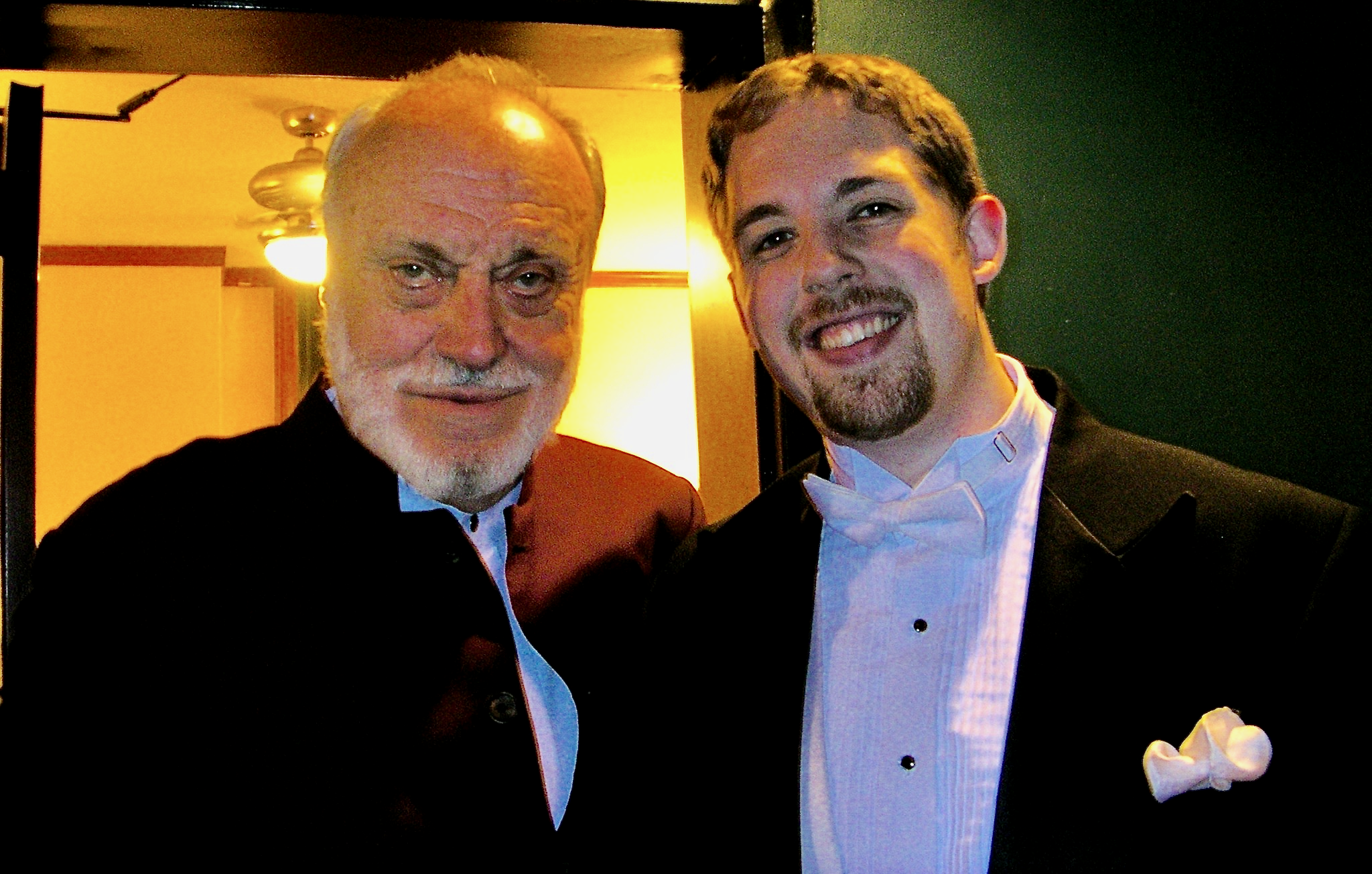
Kurt Masur and Brett Mitchell after performing together at the Manhattan School of Music on March 12, 2004.
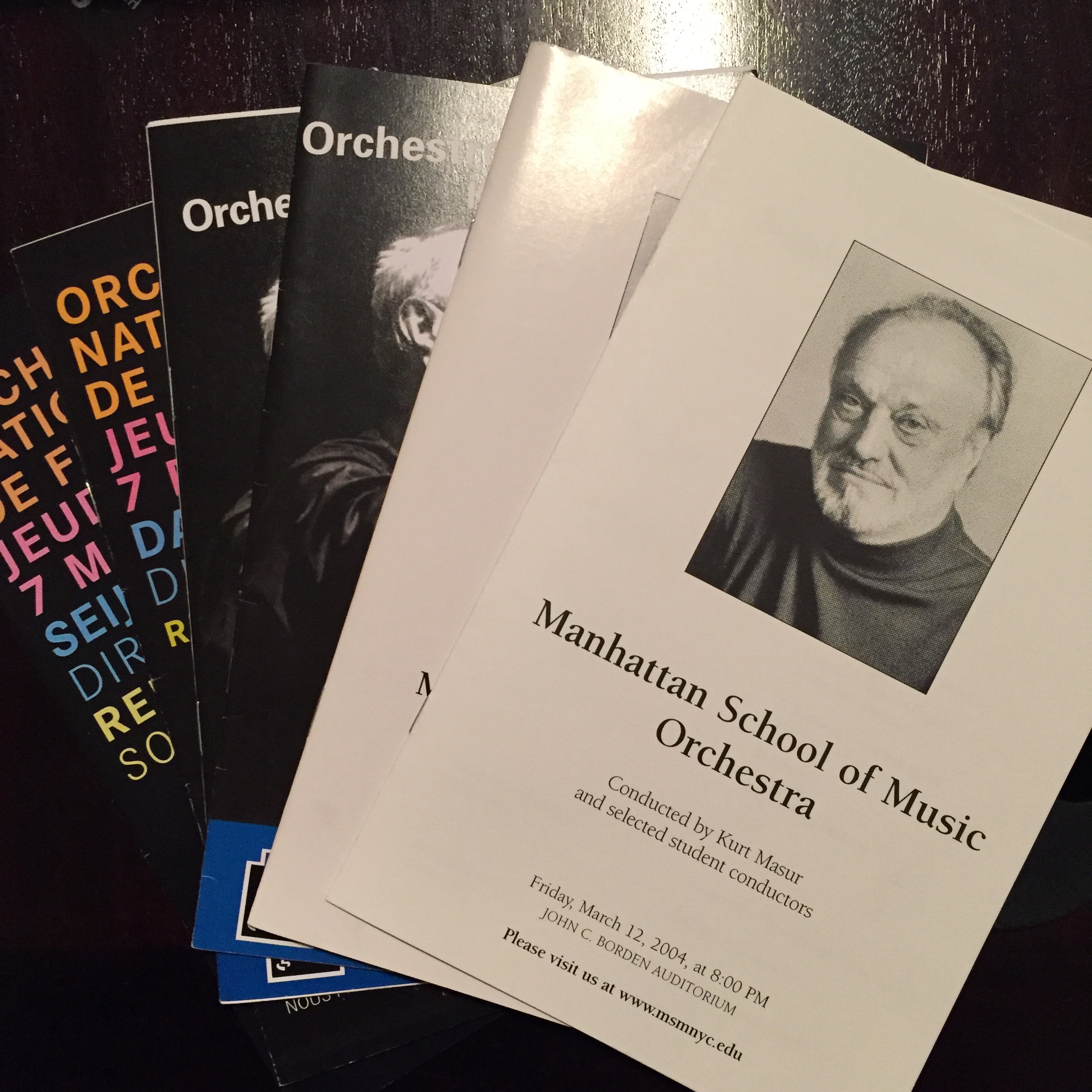
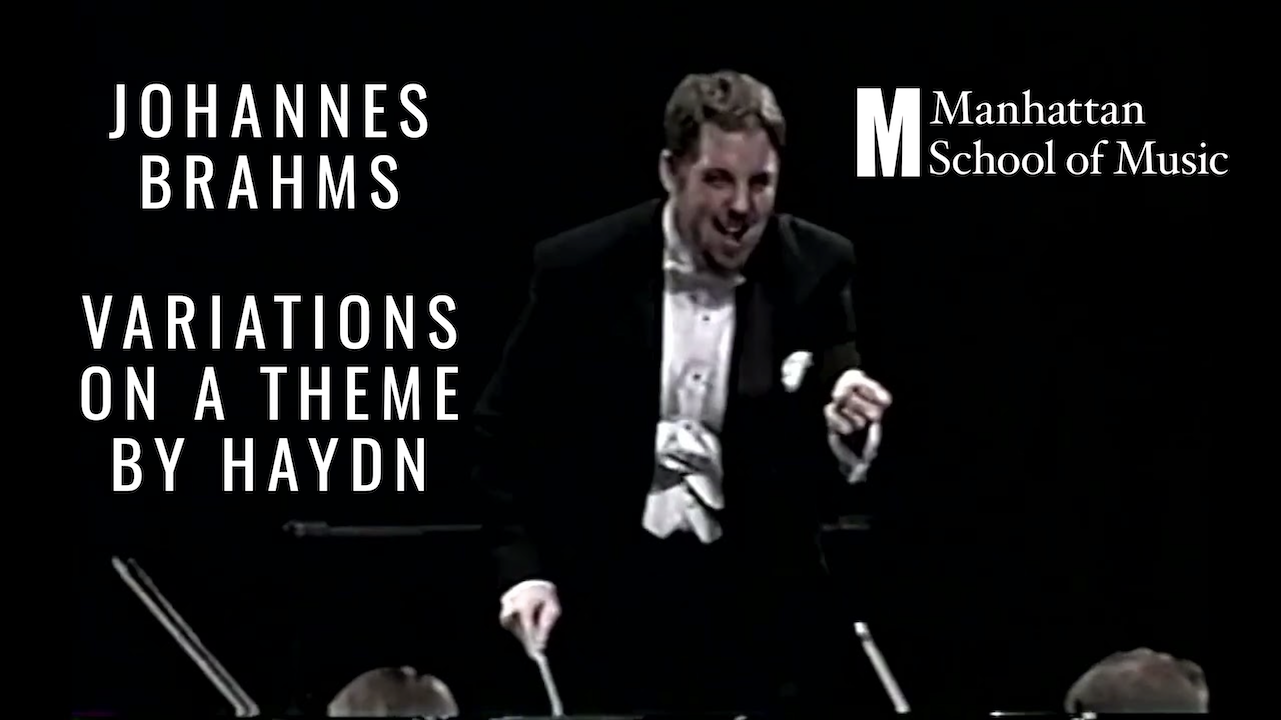
I first met Kurt Masur as a graduate student in March 2004, when I was one of a handful of young conductors he selected to attend his first weeklong conducting seminar at the Manhattan School of Music. During our first encounters, I was enormously intimidated by the recently named Music Director Emeritus of the New York Philharmonic, but by the end of the week, we were sharing the second half of the seminar’s culminating concert (which was also my New York debut). I began with the Haydn Variations (while Maestro peered on from just offstage – no pressure!), and he concluded with Till Eulenspiegel.
Two years later, after another seminar together at the Manhattan School, Maestro invited me to Paris to audition to become one of his assistant conductors at the Orchestre National de France. Not speaking a word of French, I took him up on his offer, and ended up working with him in Paris and on tour for the next three seasons. Among the many extraordinary musical memories from those years, two in particular stand out: a desperately moving War Requiem at the Basilica of St Denis, and his unforgettable 80th-birthday concert at the BBC Proms, played by the combined forces of his two orchestras at that time: the ONF and the London Philharmonic Orchestra.
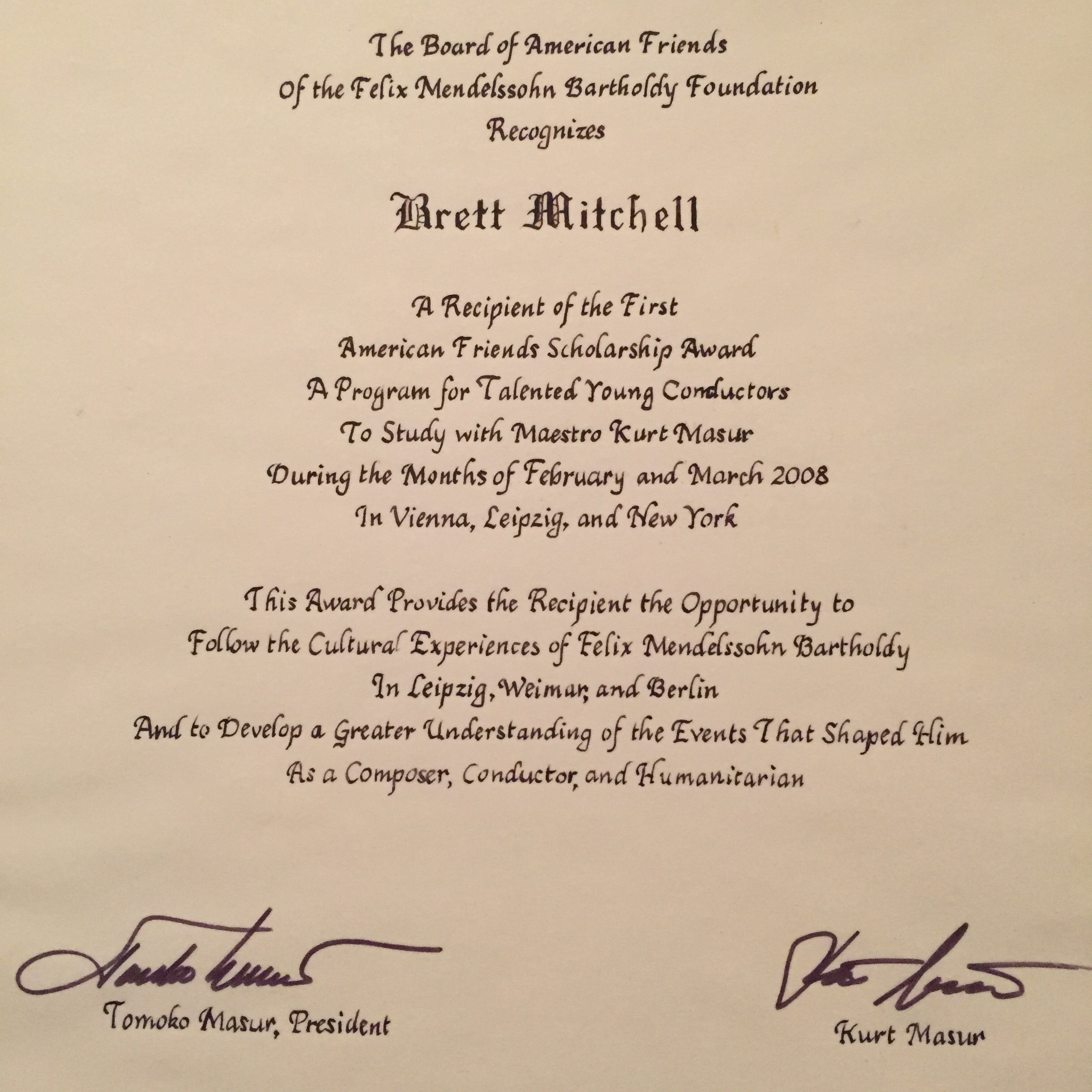
In 2008, Maestro selected me as one of his first two Mendelssohn Scholarship recipients, which allowed me to spend a month learning from him as we traveled from Vienna to Leipzig, from Berlin to New York. (It was during this trip that Maestro posed for the photograph below, which captures perfectly the lighthearted, humorous, even silly man that rarely made a public appearance.) Over the course of that trip, Maestro asked me to lead a rehearsal of the Mendelssohn Violin Concerto with Anne-Sophie Mutter and the Gewandhausorchester, and to accompany an impromptu vocal rehearsal for St. Matthew Passion at the New York Philharmonic. Throughout all these experiences, Maestro helped me grow with both a watchful eye and an open heart. The countless meals and conversations we shared during that month—especially those at his home in Leipzig—will remain dear to me for the rest of my life.

Kurt Masur at Vienna International Airport in February 2008. (Photo by Brett Mitchell)

Kurt Masur and Brett Mitchell at the Musikverein in February 2008.
Over the many years we worked together, Maestro became for me the greatest mentor a young conductor could hope for, offering far more than technical advice and “tricks of the trade.” Nothing illustrates better the musician and human being I came to know than the time I asked him about a certain crescendo he requested of an orchestra: “Maestro, if Mozart wanted a crescendo there, why didn’t he just write one?” Masur replied, “Because if he wrote it down, you’d do it with your head instead of with your heart.” For Maestro, music was never about sharps and flats, dots and dashes; at its core, music was about communicating thoughts, ideas, and feelings. Technique was important, yes, but only insofar as it served the music; everything else was superficial.
When I learned of Maestro’s passing this past Saturday morning, I was stunned. Yes, he was 88 years old, and yes, had struggled with health issues for some time, but I don’t think any of us ever imagined a world without him in it until he left. As we all mourn his loss, my great hope is that the artistry and humanity he shared for almost nine decades will light the way for those of us who strive to continue in his footsteps.
Farewell, dear Maestro, and Godspeed.
Watch Mr. Mitchell’s culminating performances from Maestro Masur’s 2004 and 2006 masterclasses at the Manhattan School of Music.
BRAHMS — Variations on a Theme by Haydn
(March 2004)
MOZART — Finale from Symphony No. 40
(January 2006)


Brett Mitchell named Assistant Conductor of the Orchestre National de France
PARIS — The Orchestre National de France and its music director Kurt Masur have announced that Brett Mitchell has been appointed the ensemble’s newest Assistant Conductor.
Mr, Mitchell will continue in his position as Director of Orchestras, Opera Music Director, and Professor of Conducting at Northern Illinois University while commuting between Chicago and Paris to fulfill both these appointments.
More from the Daily Chronicle:
NIU School of Music professor of conducting will help lead Orchestre National de France
Brett Mitchell, a first-year assistant professor of conducting in the Northern Illinois University School of Music, this year will experience Paris in June.
And August. And December. And maybe May.
Mitchell has been selected as the assistant conductor of the Orchestre National de France. He will make at least half a dozen trips a year to Paris to assist and cover for Maestro Kurt Masur in a role that eventually could expand to conducting the orchestra during educational and outreach performances.
The Seattle native learned of his success immediately after his audition, which took place in the Théâtre des Champs-Élysées. The concert hall was the site of the world premiere of Stravinsky’s “The Rite of Spring,” a work so avant-garde it caused riots in the audience.
“I was thrilled, obviously, and stunned. You get so used to rejection after a while — you’re ready for it, you’re prepared for it — I just remember when I heard my name,” Mitchell said. “The orchestra is just phenomenal, not only in their technical prowess, but they play with so much heart. They are never hesitant to dig in, and I love it.”
His opportunities in Paris, where he will meet, observe and work alongside some of the world’s greatest conductors, will benefit his students in DeKalb as well as audiences for Philharmonic and Opera Workshop performances.
“Spending so much time with these great musicians can’t help but affect my work here,” he said. “How could it not influence what I do?”
Mitchell’s road to Paris began in New York by way of Austin, where he earned his master’s and doctoral degrees at The University of Texas.
Masur, who conducted the New York Philharmonic during the 1990s, returned in 2004 to lead a master-class for young conductors. Five of the 100 applicants — Mitchell included — made the cut.